Hi all,
Another year and Experimental has grown again! We have more equipment and more capabilities. There is much, more you can do in our area. So much more that it’s not possible to give you the details with just a quick in person orientation. This document is an intake package to give you a more thorough overview of the equipment, facilities and possibilities for your projects. I look forward to seeing what you do with them in your coursework!
This document is a work in progress and thank you for your patience if I’ve missed anything or if anything is unclear.
Any questions? Ask me, and I’ll be happy to help!
Have fun, have an awesome term, and make great art!
Nathan (the Experimental technician)
Table of Contents
- Support for Student Personal Computers
- Technician Support
- The Lab
- Recommended Software
- Equipment
- Miscellaneous
Support for Student Personal Computers
Computers nowadays are very capable and have made it possible for students to work on their own computers and laptops. Some students like working on their own devices and that’s great! We are trying to support this as much as possible.
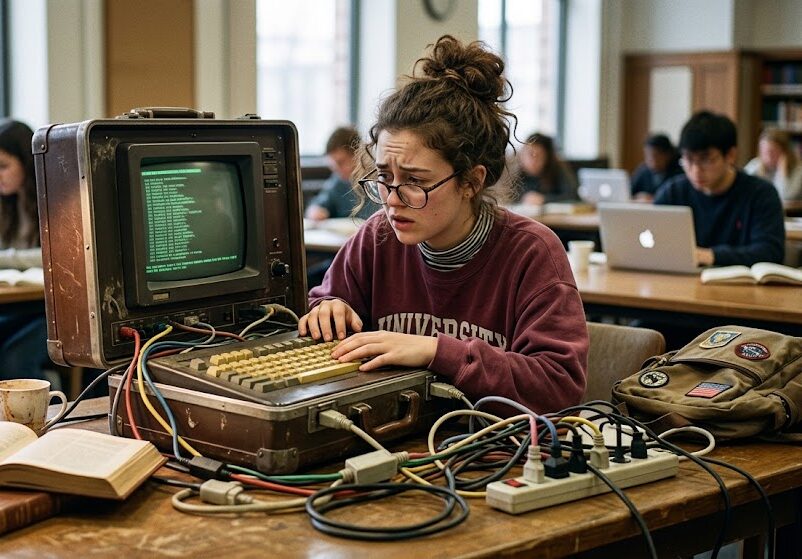
Here are some of the ways we are trying to accommodate student computers:
- Around 8 to 10 large docking screens will be available in the lab for your personal laptops: Simply plug your MacBook or Windows laptop to the USB-C cable, and work away on a larger screen. Some initial permissions set up might be required, but once you’re passed that it works very easily. Most laptops have a “clamshell” mode, where the laptop can be closed and all activity gets moved to the external monitor. Keyboards and mice are provided, and if you prefer, Windows keyboards and mice are also available. Connecting to the monitor also charges your laptop while you work!
- We will be using open source and/or free software. Everything we do in class will be done with software that you can download and install onto your computer for free. The two main apps you will need are DaVinci Resolve and Affinity. (See list of recommended software below.)
- The technician and lab monitors will help you with Screen calibration. We use software called Calibrite Profiler and a screen calibration devices to check your monitor and make sure the colours displayed are accurate and match the lab computers and projector. It’s something every digital artist should know how to do!
Technician Support
What do I do as a technician?
- Provide and manage equipment
- Technical instruction for equipment and software
- Consultations on projects
- Technical support when things go wrong
My Work Hours and Availability
My works hours are
- Monday to Friday: 9:30am – 5:00pm
- Lunch between 12:30 – 1:00
- On Fridays I work online and can be reached by email or Teams
Class time
During class time I am available with priority to students in that class. Outside of class time, I am available to you during open lab times this term (Fall 2026) for any question you may have:
- Mondays: 9:30 – 11:30 / 2:30 – 5:00
- Tuesdays: 11:30 – 5:00
- Wednesdays: 9:30 – 11:30 / 2:30 – 5:00
- Thursdays: 11:30 – 5:00
Best ways to contact and communicate with me
I am available to answer your questions and help you out during work hours, when I’m not helping out during a scheduled class. Usually I’m in my office in Zavitz 317 or in the Experimental Lab in Zavitz 318. Drop by in person and I’ll be happy to answer any questions!
If you have a technical issue or important equipment request, see me sooner than later! Sometimes students wait until the last minute, and I don’t always have enough time to help them out.
If you can’t meet in person, feel free to send me an email anytime: nsaliwon@uoguelph.ca. After 5:00pm I might not be checking email, but if I do see your email and I have time I will try to respond.
My inbox is usually overwhelmed, so if I don’t respond in reasonable time, please email me again. I’m not ignoring you – I have to go through a lot of email every day.
Often I make important announcements on Courselink, so please check Courselink regularly.
The Lab
You are welcome to work in the lab during your class and during open lab time. We have a number of computers for you to work on, but you are also welcome to use your own personal computers too.
Schedule
| Monday | Tuesday | Wednesday | Thursday | Friday | Saturday | Sunday | |
| 8:30am | x1 Class 8:30 – 11:20 | x1 Class 8:30 – 11:20 | Times TBA | Times TBA | Times TBA | ||
| 9:30am | Open Lab time | Open Lab time | |||||
| 10:30am | |||||||
| 11:30am | x2/3 Class 11:30 – 2:20 | Open Lab time 11:30 – 9:30 | x2/3 Class 11:30 – 2:20 | Open Lab time 11:30 – 9:30 | |||
| 12:30pm | |||||||
| 1:30pm | |||||||
| 2:30pm | Open Lab time 2:30 – 9:30 | Open Lab time 2:30 – 9:30 | |||||
| 3:30pm | |||||||
| 4:30pm | |||||||
| 5:00pm | |||||||
| 5:30pm | |||||||
| 6:30pm | |||||||
| 7:30pm | |||||||
| 8:30pm | |||||||
| 9:30pm | Lab closes | Lab closes | Lab closes | Lab closes | Lab closes | Lab closes | Lab closes |
Note: This schedule will change and a final schedule will be posted and sent to you over Courselink.
After Hours Access
The lab will be open after hours during the week and weekends. To access the building you will need to ensure tap access is available. The exact hours will be posted on Courselink and on an information sheet outside the lab.
The lab is are supervised by Lab Monitors. Lab Monitors are fellow students who have been hired to take care of the lab and keep it open for after hours access. Please follow their instructions and show courtesy to them as they work. When the Lab Monitors close the lab for the night, please promptly vacate the lab.
If you encounter any trouble in the lab, please tell a monitor and make me aware right away with an email to my work account explaining the situation: nsaliwon@uoguelph.ca
Rules about food
Food can ruin equipment! So, please keep your chili burritos, coffees, Booster juices, and other messy meals at least 10ft away from the computers. I’ve had to clean food off the computers too many times. GROSS.

But, fear not! We have a food area! By the door to room 318 there is a microwave and mini fridge. Feel free to use them. Just make sure to clean up your mess afterward and please don’t forget to take your Tupperware with mystery casserole in the fridge with you.
Using the Lab space for production
We don’t have much space, so our lab is a teaching area, a computer lab, and a production space! We try to do what we can with our limits. You are welcome to shoot your videos in the lab.
Advance notice for shooting in the lab would be good idea to prevent double booking. If it looks like it will be busy shooting in the lab I will set up a Microsoft Bookings page for it.
The lab has 4 soft box lights you are welcome to use, plus an assortment of backdrops stored up in the loft. We have stands and other gear to help set up backdrops and lights. If you’d like to shoot on a greenscreen for chromakeying, we have you covered! If there’s anything you’d like to do, please let me know and I’ll do my best to set you up.
The Photo Studio
The photo studio in room 320 is run by Richelle Forsey, the Photo Technician (rforsey@uoguelph.ca). When the studio isn’t being used by Photo students, it can be used by Experimental Students with Richelle’s permission. If you would like to use this room for your video or photo shoots, please see her in her office (Zavitz 406) and politely introduce yourself as an “Experimental Student wanting to use the Photo Studio”. She is nice and will help you out. Make sure not to touch the photo area gear and equipment in that room! Use only Experimental equipment in this studio.
Recommended Software
If you’re curious about using your own computer for media production, feel free to try out these software apps! Free versions of this software are available.
In your classes we will mostly use DaVinci Resolve and Affinity.
For Computers
Davinci Resolve
(Video and audio editing, some photo editing, special effects)
https://www.blackmagicdesign.com/products/davinciresolve
Affinity
(Graphic design, photo compositing and editing, book publishing)
https://www.affinity.studio/
Canva user account required
Fusion
(Video special effects):
https://www.blackmagicdesign.com/products/fusion/
Cavalry
(2D Animation and effects)
https://cavalry.studio/en/
Canva user account required
Blender (3D sculpting and animation):
https://www.blender.org/ (Free and open source)
Phocus (Lightroom-like batch photo processing)
https://www.hasselblad.com/phocus/phocus-for-pc-mac/
Calibrite Profiler (Monitor and camera calibration)
https://calibrite.com/software-downloads/
Processing
(Simple yet amazing app for interactive art programming)
https://processing.org
Unreal Engine
(For making video games, but a great 3d video animation software)
https://www.unrealengine.com
Unity
(Like Unreal Engine but much easier to use)
https://unity.com
For Phones and Devices
Blackmagic Camera
A capable iPhone video camera app that records in high quality formats. It allows for a lot of manual control, which most video recorders do not have.
https://www.blackmagicdesign.com/products/blackmagiccamera
Motiv Audio
The software that connects to the microphones we use in class. It can record without a mic attached, using the mic on your phone or tablet.
https://www.shure.com/en-US/products/software/shure_plus_motiv?variant=%20ShurePlus%20MOTIV
Kiri
Awesome 3D photogrammetry app for 3D scans. A free version is available.
https://www.kiriengine.app/
Equipment
Equipment Loans
We have a lot of equipment for you to take out and use! You are welcome to use all our equipment, since the more you use it the more you will learn – and that’s sort of the point of what we’re all doing here…
Level 1 students will have access to intro equipment and with training can access other equipment. Level 2/3 students have access to all equipment.
Try to book equipment ahead of time, and pick it up between 4:00 – 4:30 Mondays – Thursday. Return the next day between 10:00 – 10:30. Items taken on Thursdays are to be returned on Mondays.
Equipment List
Here is a list of some of the equipment we have for you to use. Ask about any of them!
| Equipment | Purpose | Need extra training? |
| Canon 70d DSLR camera | Photography and entry-level video | Covered In class |
| Blackmagic Pocket Cinema Camera | High level video | Yes |
| Tripods | Keeping your photos and videos still | Covered In class |
| Large softbox lights in lab | Lighting videos and photos | Covered In class |
| Portable LED light kit | Lighting outside lab | Yes |
| Bounce kits | Reflects / Filters light | Covered In class |
| Ronin Gyro stabilizer | Smooths out moving camera motion | Yes! |
| Projectors | Project videos on walls etc. | Yes |
| iPads + Apple Pencil | Drawing, audio, animation | Yes |
| iPods | Audio recording | Covered In class |
| MV88 Microphone | Audio recording | Covered In class |
| Boom pole for lights | Lighting from difficult angles | Yes |
| Wireless Mics | Recording audio from a distance | Yes |
| Media Players | Playback of video on TVs and projectors | A little |
| Mac Minis | Video and interactive installations | Yes |
| miniDV Cameras | Old school tape-based video cameras | Yes |
| HDTVs and old SDTVs | Video playback. We have lots of them. | Not really |
| Laser Levels | Installing works in straight lines | A little |
| Calibration cards | Colour accuracy in photo and video | Yes |
| Flash | For lighting in photography | Yes |
| Go Pro | Portable body recorder | Yes |
Crafting equipment
We have various tools for “real” media production, such as working with paper.
Just a quick reminder: These items STAY IN THE LAB!
Button Maker
It uses 2.25” buttons and I have templates for laying out your designs for printing. This requires a tutorial before you use it, to ensure you will be safe using it. 100% fun.
Other tools and thingies
- Rulers: we have plenty of rulers and straight edges for guiding line drawings and cutting.
- Rotary cutters: a safe way to cut paper and cardstock, using a “pizza cutter” like form. It also makes it easy to cut curves.
- Rotary Perforator: a tool to make perforated lines in paper and card stock.
- Cutting Mats: always cut paper and cardstock on a cutting mat. Never directly on a table!
- Scoring Board: a small scoring board to make creases and folding lines in your papers and cardstock
- Bone Knife: not really a bone, but a tool for making scores in paper. Use with ruler or the scoring board.
- Paper: I have various stocks of paper and cardstock that you’re welcome to use and try out.
Printer
The printer is available for use for course-related art printouts. It is not for printing essays or documents as the ink is archival quality and extremely expensive. Quick training is required before using the printer. This printer can print up to 13”x19”.
Before you use the printer make sure to clear it with the technician!
For larger sizes and large runs of printouts, please see Heather Rattray (hrattray@uoguelph.ca) in Zavitz 402.
Miscellaneous
Here are a few parts of our facilities that I don’t usually get time to show students but are pretty cool and worth using.
Animation Studio / Recording Booth
This space is really awesome! Make any kind of stop-motion animation you want! We have a camera installed and stop-motion capture software called Dragonframe. We have two mounted lights for bright exposures. We also have light tables if you’d like to work with backlit/transparent material rather than reflective. It is available while I am at work, and if you’d like to work after hours, you need to pick up a key from me.
It’s quiet, so you can record decent audio. The professional microphones are used in here, so if you want to record a really awesome voice recording, this is the place to do it.
It’s also great for documenting small to medium-sized works!
Scanners
We have a few scanners in the lab. If you plan on scanning wet or dirty materials we have transparent mylar sheets to place on the scanner bed so it does not get dirt or ruined. Wanting to scan with a black background? We have pieces of very low reflectivity black velvet that can be draped upon the scanner. The scanners can scan items up to 12” x 17”.
Microphones
We have a whole set of microphones for different purposes. I never have time to show them all to students, but come by my office to check the others out!
Lenses
Same thing. I have a library of different lenses for different purposes. If you have a look you’re going for or a technical goal, I can set you up with the right lens.
New analogue station
We’re trying to bridge the old and the new with an analogue digitation station. If you have old VHS, Hi8, or miniDV tapes, with footage you want to use, bring them in and I’ll set you up. Audiocassettes and records can be digitized too! The university library has a lot of old analogue tapes in its archive which you can bring into your projects. You can also rip DVDs – just ask me how.
Logic Pro
We used to teach Logic Pro – amazing audio software for audio editing and music making – but sadly we are phasing it out to give priority to software that students can install on their own computers for free. But, I can teach you plenty about it, and it’s still on the lab computers to be used. And it’s fun fun fun...
Printing on the Office Printer
If you are making zines or cheap posters, give me a PDF and I can print it full colour on the laser printer in the office! Sizes can go up to 11×17” – great for full page zines.
Lockers
Outside the lab we have lockers for you to use. Bring your own lock and use the lockers to store your belongings. Ahem, to add to that: non-food belongings please.