I am a second-year studio art major with a minor in media and cinema studies. I have always been interested in the nuances underlying art and the reaction a work can provoke so I planned on attending a University in the arts field but wasn’t sure where.
Guelph’s campus and community is what convinced me to enrol in its studio art program. I want to continue expanding my knowledge of art mediums, especially in the digital landscape, which is what made me take experimental studio.
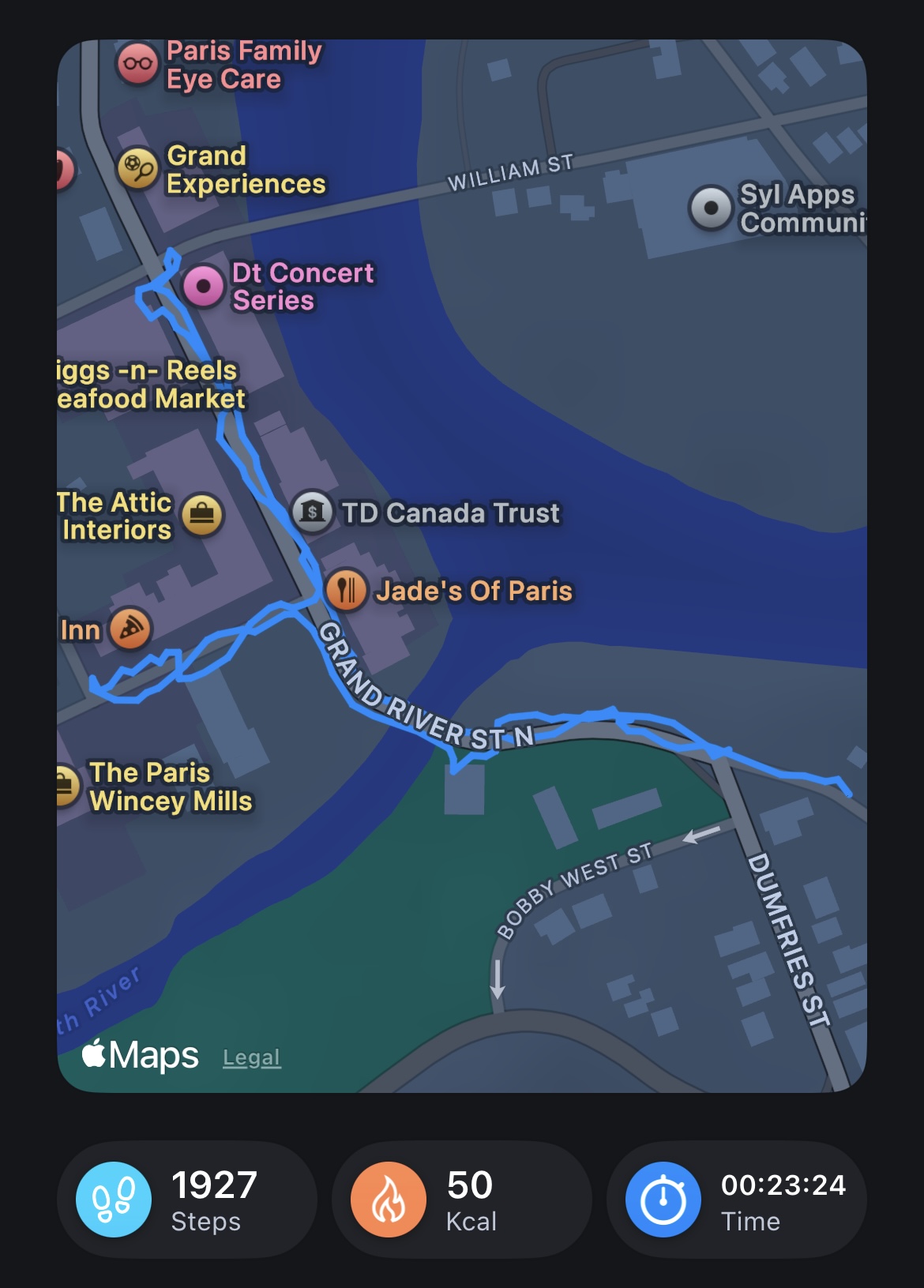
To represent a kilometre, I decided to go on a kilometre walk and document every advertisement that I came across. My original idea was to collect receipts and sew them together to measure out to a kilometre, however, time and material become major restraints.
Consumerism has been a growing interest of mine, certainly due to the landfills most trending items find themselves in. So, building off my previous idea I decided to explore the role and impact of advertising on over consumption within real life.
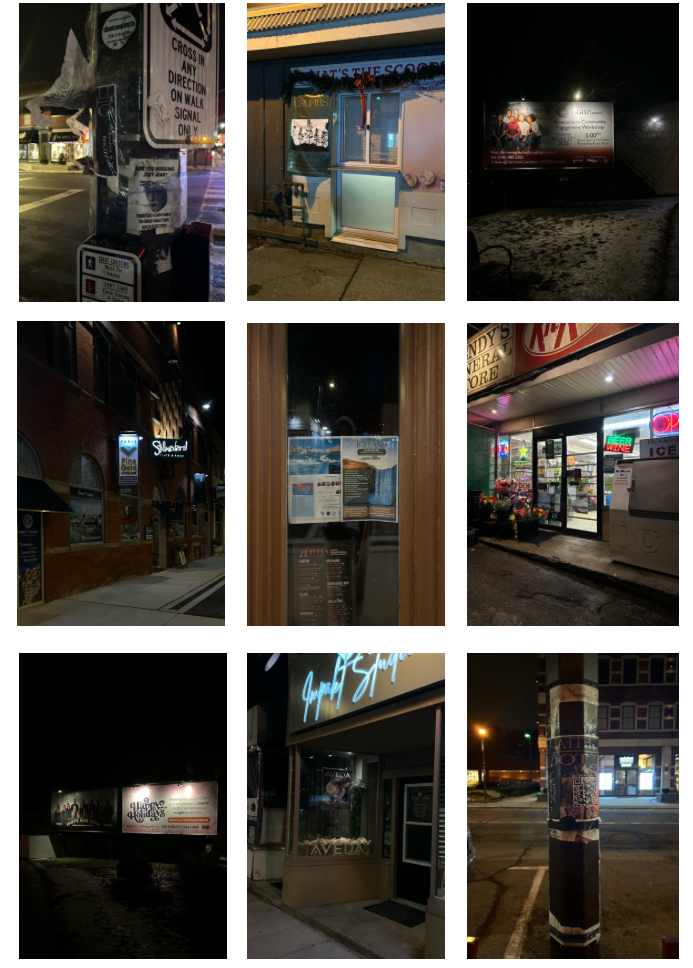
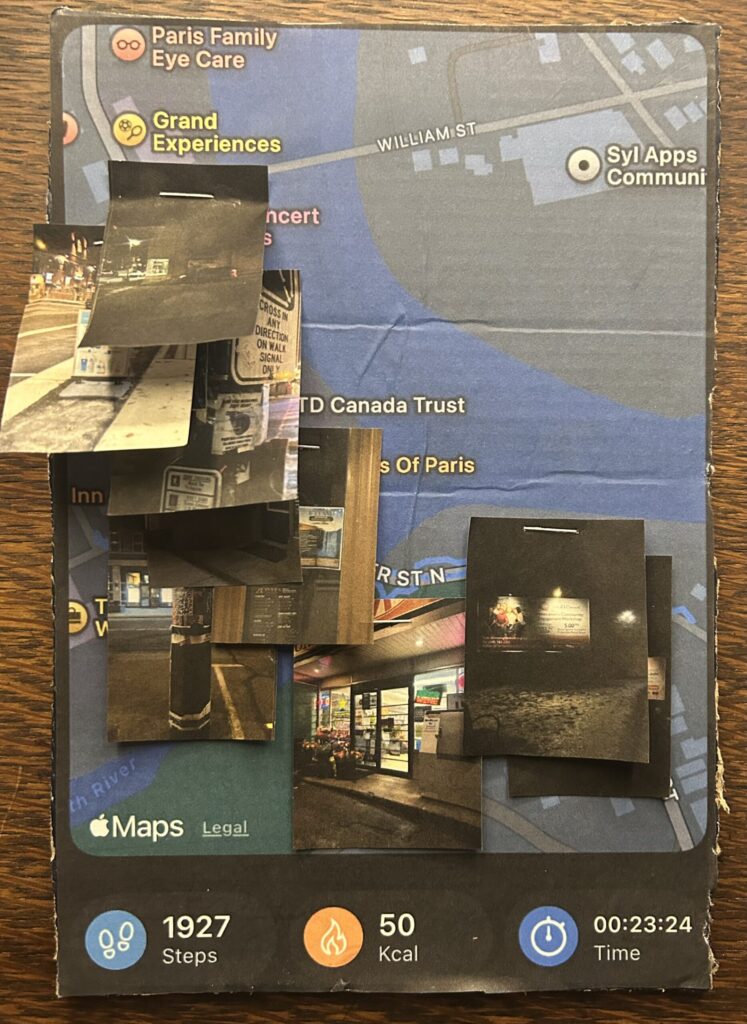
When I think of advertisements my mind immediately resorts to digital marketing (commercials, pop-up ads, sponsorships, etc.) since ads predominate the digital realm. I wanted to challenge myself and see how many I can find in a mere kilometre.
Process/Measuring
I used a pedometer app to measure the precise kilometre I walked and displayed the advertisements posted alongside. I decided to walk through the town I grew up in, it yielded a lot more results than a section of Cambridge & Hamilton I did because more stores were condensed in a smaller area.
Materials & Presentation
I digitally recorded my findings but decided to physically create a document of the walk to give the piece both a digital and physical essence. I used my phone camera, paper, cardboard, glue, and staples to make the work presented on the left. By presenting the physical advertisements, physically despite capturing it all digitally I wanted to juxtapose my predisposed ideas of ads, which are digitally crafted and presented yet seek to sell physical commodities. By doing this I hope to promote discourse regarding the influence, and influx of advertisements, as well as, it’s harmful role in consumerism.
Results/Thoughts
I had a great time documenting and creating this work, I believe the display encapsulates my ideas most accurately and clearly. Nevertheless, if I were to do it again, I would make the presentation look cleaner and test out a variety of areas/walks to compare and contrast the density of advertisements in different areas.
The one-shot
Sealing Envelopes
For our feat, Dani and I chose to repeat the action of licking and sealing envelopes. I think seeing an outdated method of communication utilized at the rate of communication today raises important questions about how we connect through digital technologies. Shooting the videos in a sterile appearing environment helped emphasize the act itself; to do it again I would bring it a step further with attire and align it with the atmosphere. Moreover, I would experiment further with camera angles and different ways of performing the gesture.
the sequence
The Sequence
Dani had creative freedom to produce the edited video. In the future I would approach this project in a manner where we both contributed to each section of the videos to create our best work. I would spend more time story-booking our ideas to make the videos flow better and make them feel complete.
The Loop
Final Thoughts
This was my first time creating video art and I had fun editing and creating the animation, watching the drawings come together into the video was cool to see. I produced the uncut video as well as the animation, I am very proud how the animation turned out; however, the gesture itself is rather boring. Experimenting further could have yielded me more content to pick amongst.
“Sweet Sixteen”
The original idea I brought to the round table was to re-create the frequent sounds I would hear growing up while trying to fall asleep. Attempting to capture the particular sounds I wanted to make apart of my audio was too tricky, and while trying to get a good audio of my dogs barking, I got lost in my old journals I began keeping at 12. My nostalgia led to my current piece, wherein I read aloud journal entries I wrote at 15 while overlaying multiple clips of my friends and I goofing around at 15 from cam corner videos I recorded at the time. I never thought about the relationship between my internal thoughts and my external actions and behaviour, and in creating this complete story of my experience being 15 I have realized my tendency to think in black and white. I wanted it to be hard to listen to both simultaneously to express that quality and for the clips of laughter to act as a distraction to my monologue of sorts since I would hangout with my friends to avoid thinking too much. “Sweet Sixteen” encapsulates gray area and ambivalence which I find myself experiencing more often than not.
Micah Lexier, A Portrait of David, 1994
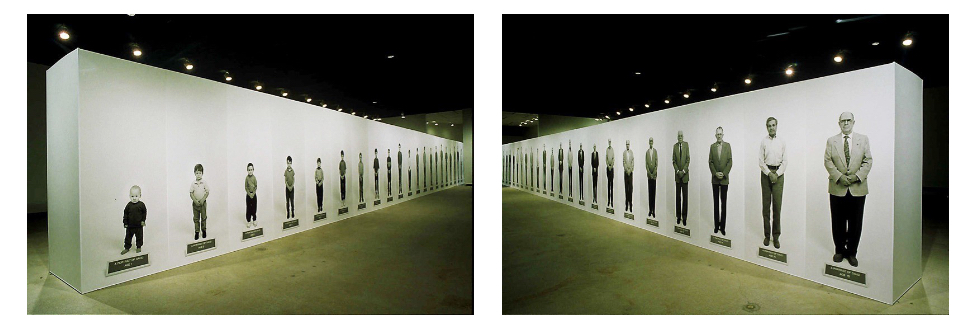
Along with the Perfect Lovers clock piece, Lexier’s collaborative visualization of self intrigued me the most among the pieces we viewed. They made me reflect on the singular moments and years which construct our lives but also how moments merge together to create a unified picture.
Approaching this assignment, I wasn’t sure who I would represent or how and began thinking about my connections with the people in my life. My sister and I were incredibly close growing up but don’t get to see much of each other anymore. One way we remain connected to going to concerts together of our favourite artists, music has always been our primary bonding device, and I thought utilizing that connection for this assignment would not only accurately represent who she is but our relationship to one another.
I often associate past times or people with the music I listened to during them or with them, hearing or seeing those songs years later carries memories along with it. I want to represent that through my conceptual portrait; however, I have two ideas to approach it in particular:
Idea One: burn a cd with 23 songs: each representative of a year of my sister’s life
Idea Two: place my sisters cd collection in order of first purchased to most recently within a cd holder, and have the collection be the piece
Marina Abramovic: The Artist is Present
Grace K
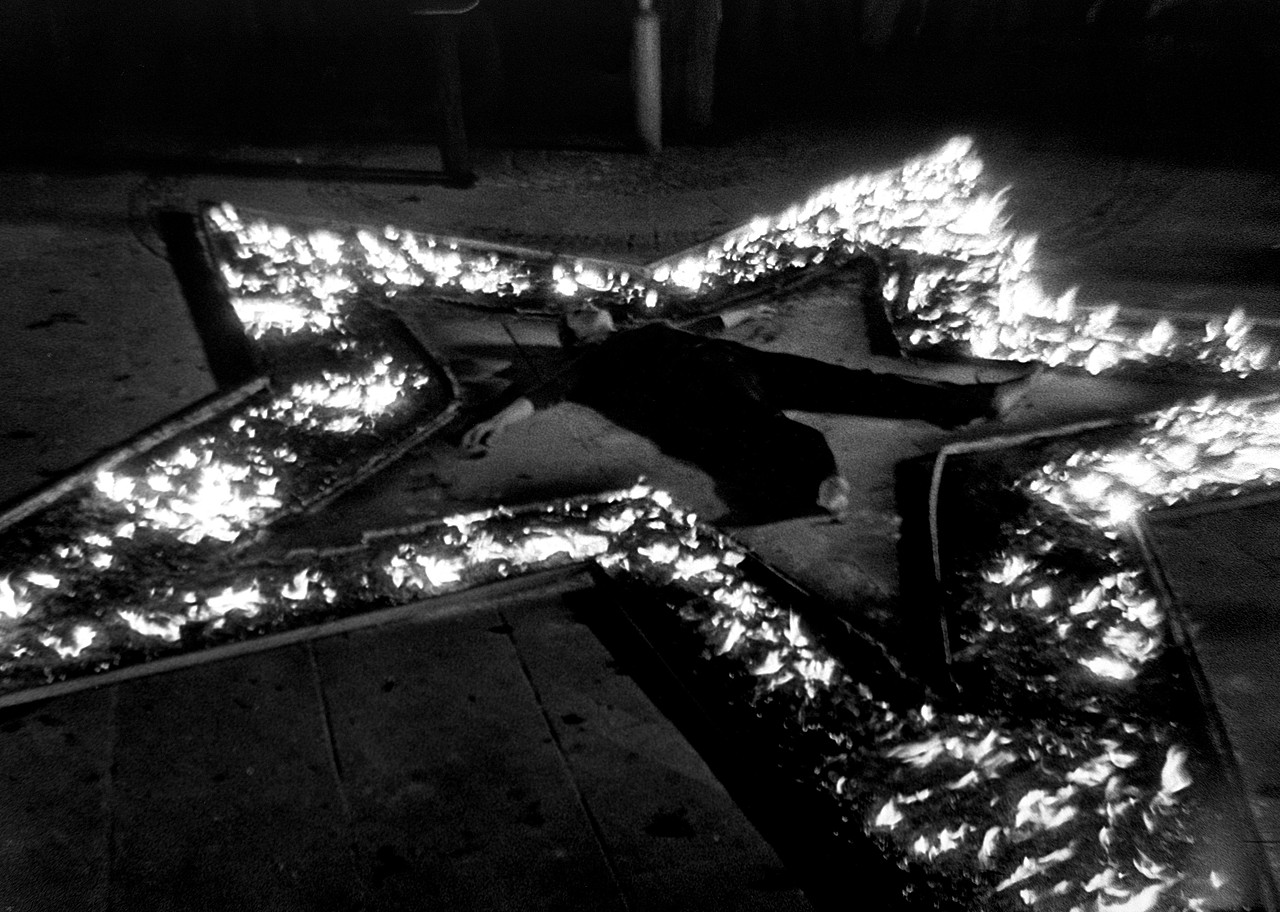
What are some of your first impressions of Marina Abramovic’s performance works, based on the documentary?
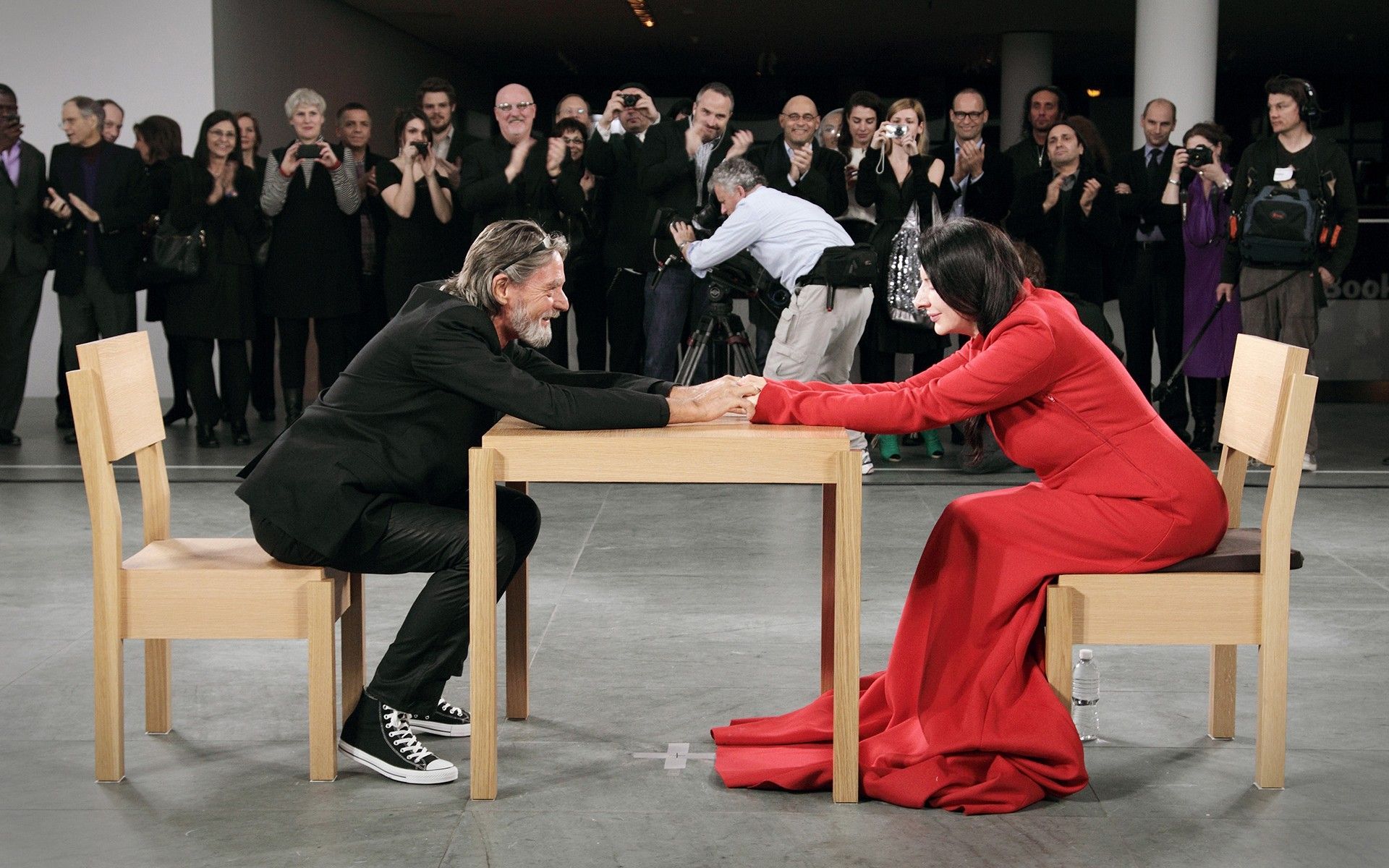
I had seen Abramovic’s performances of The Artist is Present and Rhythm 0 on social media years before watching this documentary, specifically her performances of endurance: sitting in silence with strangers and, in Rhythm 0, allowing them to do whatever they wish to her. They always stayed with me because of their unique and revealing nature of humanity. The documentary allowed me to discover her oeuvre, and despite its violence, I found myself admiring her dedication to her art. Her work walks the line between art and shock value, sometimes stepping to one side or the other. For example, in her work Rhythm 5, she carves a pentagram into herself, a rather grotesque and uncomfortable sight, which I do not believe was a necessity to convey the meaning of the work. Nevertheless, Rhythm 0 was a novel work that showcased people’s capabilities and destructive tendencies, despite likely causing Abramovic more pain than Rhythm 5. I can understand why people would see it as unethical and problematic; however, her work has pioneered performance art, and when presented in the proper context, it can be incredibly moving, inspiring, and almost unbelievable.
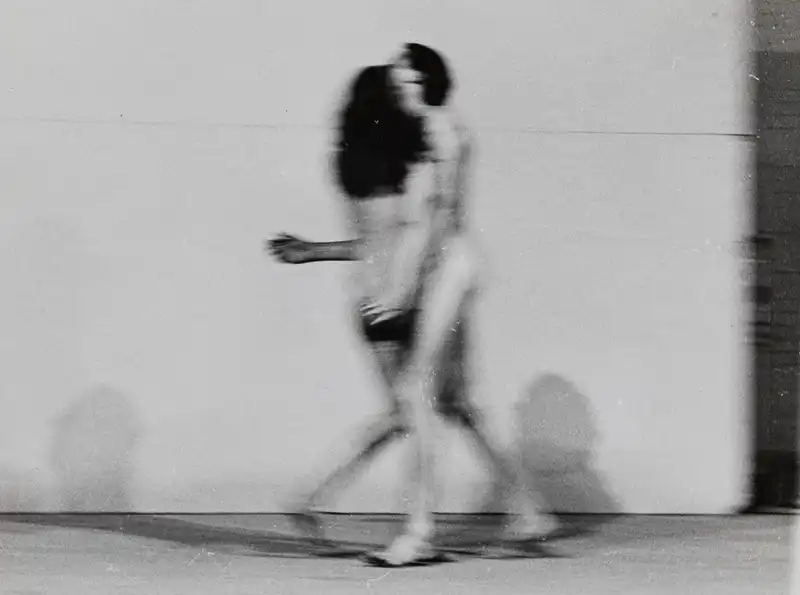
What have you learned about features of performance art based on Abramovic’s work? Consider her quote, “When you perform it is a knife and your blood, when you act it is a fake knife and ketchup.”
Performance art requires as much physical exertion as mental effort; it takes immense confidence, strength, courage, and determination to build a career in performance. Viewing Abramovic’s works changed my perspective on what performance art is and can be. For example, her work with Ulay Relation in Space felt pointless and harmful when I first saw it. However, as I kept watching and learning about the medium and her works, I realized it captures life in a way no painting could. The art is as alive as the audience; everything that occurs may be more real than life itself. The audience and their provoked emotions become a component of the art. It transforms the viewer through a unique experience, exemplified by some of the people who sat across from Abramovic in The Artist is Present. When interviewed afterwards, many told the documentary that it altered their lives, showing that it is distinctly different from conventional art media.
Discuss the ways performance art resists many museum and commercial artworld conventions. How does Abramovic solve/negotiate some of these challenges, and do you find these compromises add to, or undermine the ideas at play in her work?
Public art is generally expected to remain in a single spot, be available for most of the day, and be static, allowing museums to display a variety of work consistently and efficiently. Performance art disobeys all previous conventions of art; it has no monetary value, is limited, requires performers, requires more space, and can be unpredictable. Having an exhibition as a performer would not be possible, since each work requires the performer at all times. To address this, Abramovic’s exhibition at the MOMA included earlier performances of hers that used other performers to execute the works. Seeing the same performance with different performers separates the artist from the art, making the meanings feel more communal but also less of an experience. What is unique about performance art is that an audience is together viewing and thinking about the same work, and being in a gallery setting makes them assume a gallery mindset. The viewer does not put as much thought or attention into works that would otherwise have the whole room’s eyes.
Turning the Gestures of Everyday Life into Art by Zoey Poll
Reading & Response
1. Describe the work discussed in the article and the unique challenges – as well as the unique gifts- that come with attempting to archive personal movements?
2. Discuss one or two examples of movements in the article – what strikes you about them?
3. Describe the habitual movements/unconscious gestures of 3 people you know well. How do individual body parts move, and how does the whole body interact? What about facial expressions and the emotional valence of the movement? How does body type inform the movement? What do these examples of small movements mean and imply?
Katja Heitmann’s project “Motus Mori” (“movement that is dying out”) features ten dancers performing the gestures/movements of hundreds of people in public installations. The unique movements are captured by dancers shadowing the bodily autonomy of volunteers who visit the studio for an hour. Interviews are private and do not guarantee the inclusion of one’s movements within the project. Since the work is analog and ephemeral, the dancer’s muscle memory is essential for retaining it. If something goes wrong with a dancer, it can halt the project’s progress before another dancer can be trained to take over. Relying on dancers to remember hundreds of movements can lead to some movements being forgotten or misinterpreted. It may also make volunteers insecure about how they present themselves when viewing a performance of their movement; however, as the article points out, volunteers often learn about themselves through the installations and regard them as a positive experience. Furthermore, the article notes that Heitmann receives an influx of interview requests from people in hospital or hospice settings, exemplifying the meaning the project can offer to people dealing with loss.
The idea that personal movements can unconsciously influence a dancer’s bodily autonomy, such as when Berkhout woke up in Dora’s movement, in a fetal position with hands clasped between the knees, alarms me. It seems inevitable that overlap will occur between a dancer’s authentic movements and their muscle memory after performing for an extended period, but keeping that boundary in place seems complicated, especially if you are unaware of external movements seeping through. It seems easy to lose yourself in the project when you are one of the only people executing it. A movement which impacted me differently, however, was Tjan’s movement of hiding his thumbs in his palms. He mentioned that he hadn’t realized his intent or reasoning in the moment, but that, through the interview process, he realized he arranges his body so it takes up less space. I had not realized how much of our movements arise from underlying emotions or feelings, and how I was holding myself in similar positions.
I recently moved my room into the basement of my house and differentiated between my family’s footsteps to know who is walking above me, down to the specific dog. I hadn’t thought about the nuances of walking and how it reveals a person’s personal traits. For example, my mother’s pace is fast, and her steps are loud. When performing tasks, she does things quickly and effectively. Moreover, I recently noticed how my sister fidgets with her fingers as I do. It seems to occur in new places or, more generally, in public spaces, as an anxious tic. Her facial expression and composure always match her movements, suggesting nervousness or worry. An unconscious gesture I have become aware of in myself is that I’m extremely expressive with my face and hands. It is something other people have told me before I realized the extent to which I do it, but after thinking about it, I realized it stems from a deep insecurity about my appearance. My voice and body start moving as fast as possible to draw attention away from me, which makes me look weird or jumpy. The body seems to exude the emotions that encompass the mind, reflecting internal feelings or displaying one’s personality through its navigation of life.
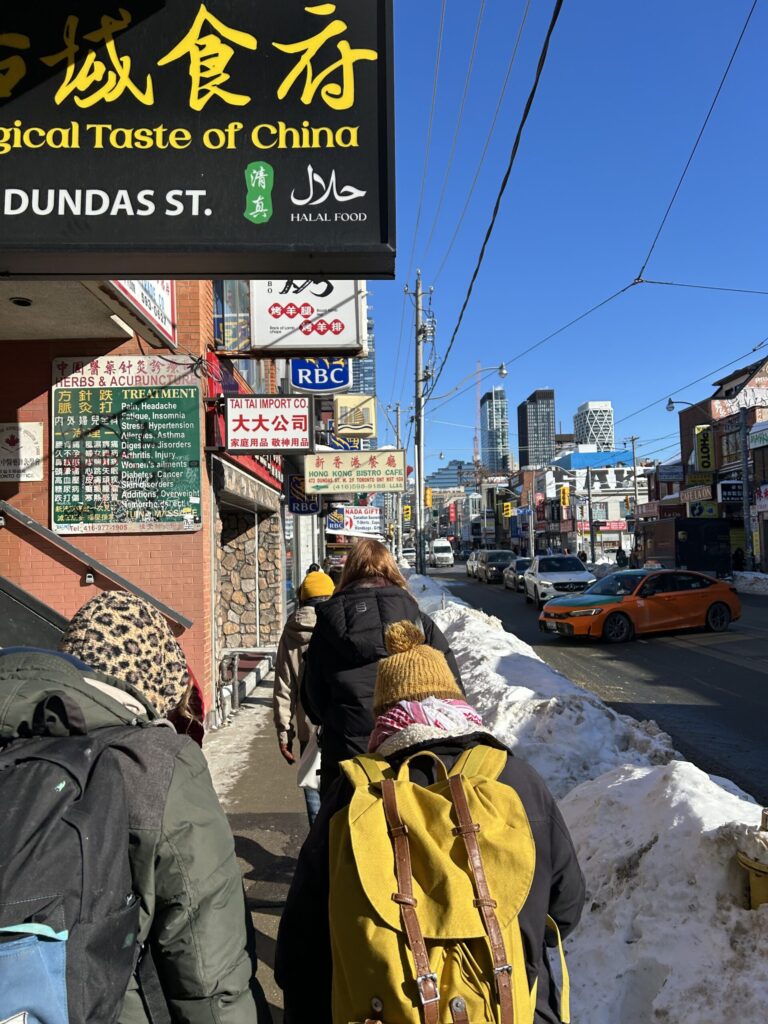
Toronto Galleries
The Power Plant Contemporary Art Gallery
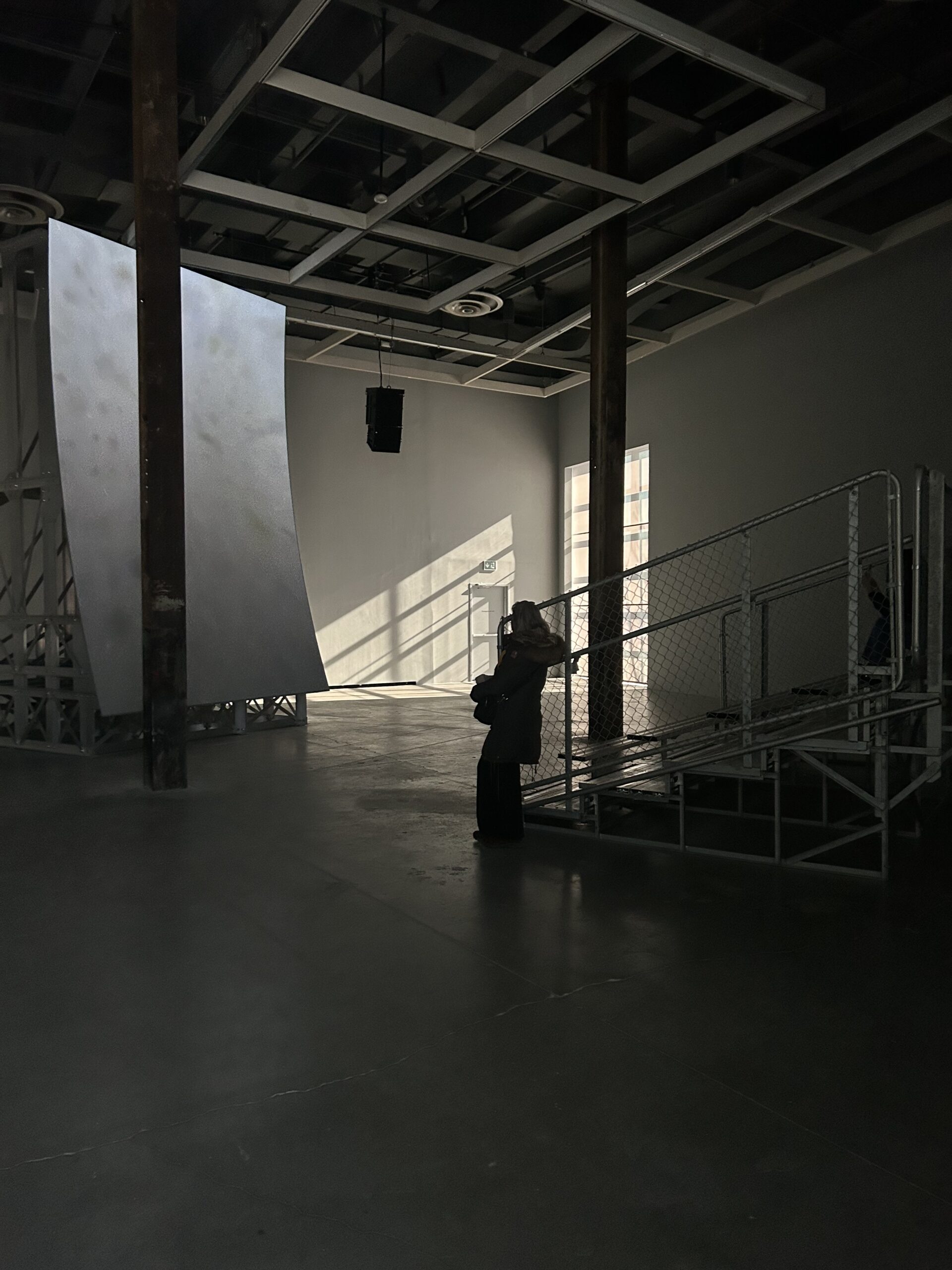
Murderers Bar by Lucy Raven left the biggest impression on me of all the pieces we viewed in Toronto, in which a vertical screen sits opposite a set of bleachers for audiences to watch the release of the Klamath River after the removal of four hydroelectric dams. I was surprised by how many emotions it managed to provoke in me through the various sequences of the river flowing, particularly how the camera’s perspective can influence the interpretation of events and meaning. The play between the aggressive audio and peaceful visuals encapsulated the pressure and institutional tension perfectly, conveyed through an approach I would not typically understand and a form I do not usually enjoy; it made me appreciate the practice more. I do not know why I overlooked it initially. I have a passion for film because I love the combination of audio and video to portray human complexities. Video art does the same thing through diverse techniques. The experience gave me a greater passion for producing video works while teaching me new storytelling techniques.
The Onsite Gallery
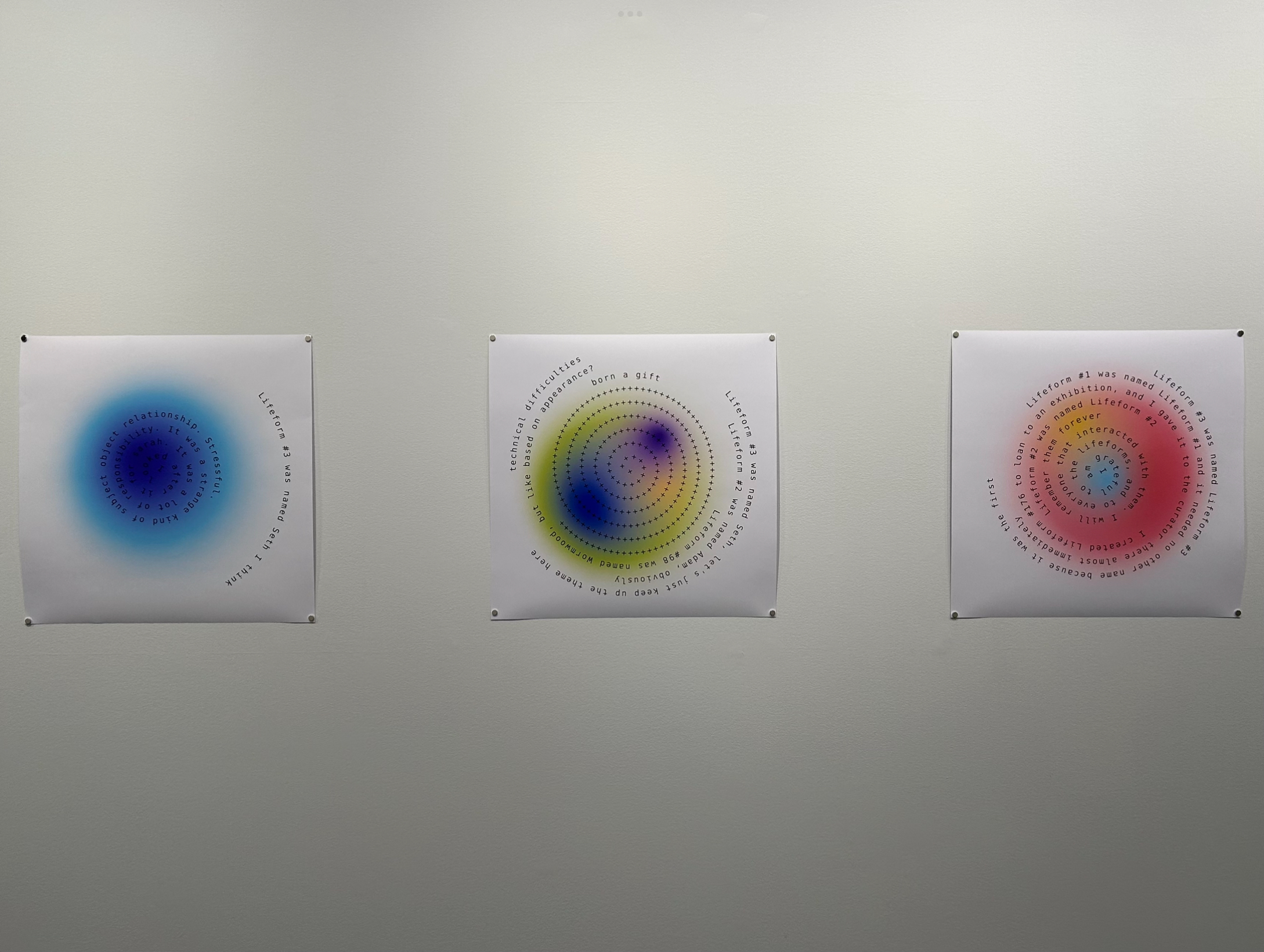
The concept behind Becoming (in the light of the miracle) exhibition at the Onsite Gallery truly caught my attention. With the normalization of AI technology across all electronic media, exploring the influence of technological advancements on culture and society was insightful and informative. Sarah Friend’s series of memory forms transforms NFT identities by representing each with thought-like text, overlaying soft circles of colour. I had almost completely forgotten about NFTs. When they initially rose in popularity, I disregarded them because they seemed useless. Seeing them again in this context made me realize how many digital trends almost disappear after the next popular thing, how many digital creations were left to die. Framing them in a way that nearly humanizes each identity gives their demise new meaning. It was such a unique perspective, seeing them as their own entities rather than creations of man, that it made me reflect on the relationship between man and machine, as well as on how I incorporate digital aspects into the works I produce. I find that visiting exhibitions helps nurture new ideas for creating and expands my interests and pursuits. Additionally, I always leave feeling inspired or motivated to make something of my own that evokes the same emotions as the works I previously viewed.
Pauline Oliveros: Deep Listening
Reflect on your own experiences of listening — to sound, to others, to your environment, or to yourself. How does Oliveros’s idea of deep listening challenge the way you typically give attention? In what ways might listening through your whole body, or approaching sound as a form of play and research, change your understanding of connection, communication, or creativity?
I recently wanted to lay down for a nap, which I often did in my first year on residence, and found that the car engines and motion sounds of people which I hated so much at the time was all I wished to hear. I think I often find myself too overwhelmed or distracted by sounds to give them enough appreciation. Reflecting on Olivero’s idea, I initially thought of how I constantly listen to music when walking or working alone in public. I constantly try to ignore the ambient sounds around me. Similarly to the NYT article we read on gestures, I think I try to avoid making too much noise or speaking to others because i’m scared of saying the wrong thing and therefore, give more attention to providing the best response instead of simply listening. Furthermore, I spend too much time mentally configuring my thoughts and ideas rather than actively sharing and listening to others’ ideas.
Approaching sound as a form of play and research diminishes the fear I feel to speak and allows me to deeply listen. It removes any pre-determined reaction I may have to a certain sound or interaction and encourages me to experience the soundscape around me. I believe deep listening will strengthen my connections and ability to connect with others around me, because it reframes the way I view interacting with others and my environment which much of my creative inspiration tends to stem from.
Leave a Reply
You must be logged in to post a comment.