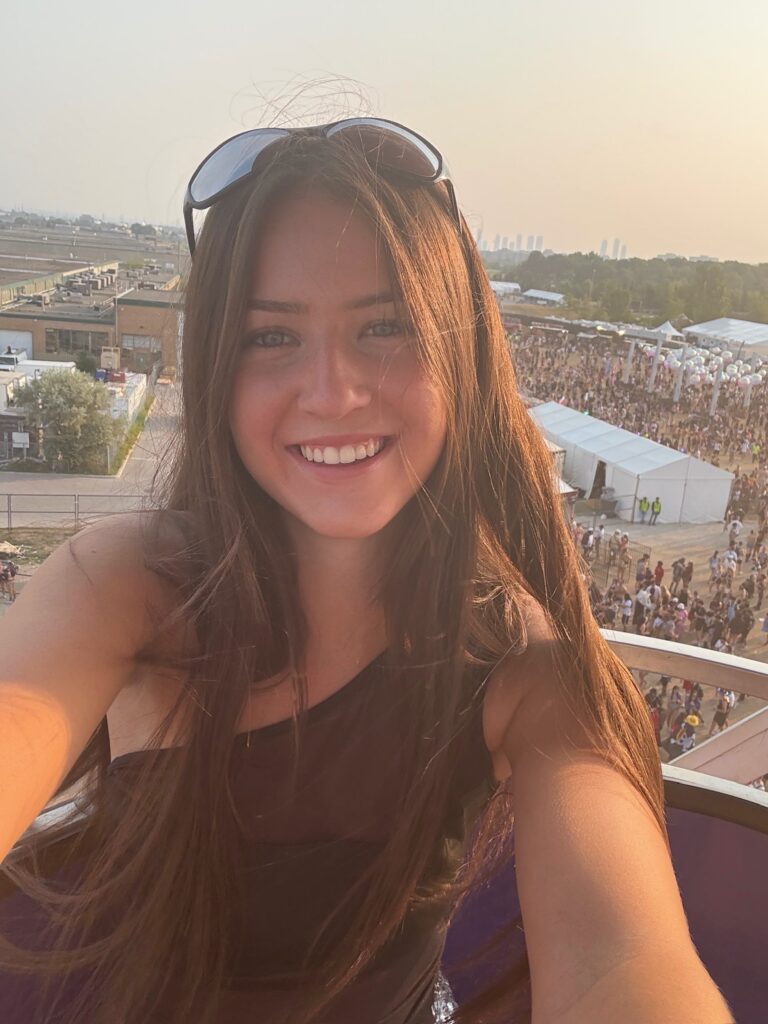
Hi my name is Rylee! I am a student in the batcher of arts health and wellness program at guelph university!
The Artist Is Present – Movie Questions
- What are some of your first impressions of Marina Abramovic’s performance works, based on the documentary? Use an image/example of one or two works to describe aspects you admire, and aspects you might agree are problematic? One aspect I admire is her fearlessness, particularly in Rhythm 5, where she lies inside a burning five-pointed star. The act is visually very powerful. At the same time, some of her work feels deeply problematic, especially performances involving cutting and self-inflicted harm, such as Rhythm 0. While the intent is to expose audience psychology, power, and violence, the escalation into physical injury raises ethical concerns. The line between artistic exploration and self-harm becomes blurred. I believe self harm shouldn’t be normalized as an art form because it’s using the act itself as an art form when realistically it’s a world problem that needs helping. You don’t have to do the act and abuse yourself publicly for it to be moving. That just seems emotionally harming to the artist and audience experiencing somebody go through this real pain. Rather than inviting reflection alone, these moments can risk normalizing or sensationalizing harm in the name of art.
- What have you learned about features of performance art based on Abramovic’s work? Name a few key features according to her examples. Include an image to illustrate. Consider her quote “When you perform it is a knife and your blood, when you act it is a fake. knife and ketchup.” In my opinion this quote clearly shows that a performance uses real materials, real pain, and real consequences. Nothing is staged or pretend. Performance art breaks through the barrier of art not being a reality and only an act or simulation representing something, it is not an act you are in it and feeling the presence of the message being voiced through this art. Performance art involves genuine risk. The outcome is not fully controlled, which creates tension and makes the audience aware that what they are witnessing could go wrong. Viewers are not just observers. Abramović often invites or allows the audience to participate, making them partly responsible for what happens during the performance. so whats going on itsint all planned because nobody can predict what the observers will do. Performance art, as shown through Abramović’s work, collapses the distance between art and life. It demands presence, confronts discomfort, and forces viewers to recognize that what they are seeing is not representation. Its a reality happening in front of them.
- Discuss the ways performance art resists many museum and commercial artworld conventions. How does Abramovic solve/negotiate some of these challenges, and do you find. Do these compromises add to, or undermine the ideas at play in her work? Performance art resists museum and commercial artworld conventions because it is temporary, embodied, and experiential, rather than object-based. It cannot easily be owned, sold, or permanently displayed, and it often involves real risk, unpredictability, and direct audience engagement, which conflicts with the controlled environment of museums. To me, it almost feels like a social experiment, testing both the artist and the audience. Giving people the choice to participate or respond in real time pushes the boundaries of what we usually think art is. In Abramović’s case, she works around these challenges through documentation, re-performance, and working with institutions so the work can continue to exist after the live moment. Even though this reduces some of the raw danger of her earlier performances, I think it adds to the work by making it accessible to more people and by highlighting the tension between lived experience and institutional control.
Make a Kilometer
Meaning: My kilometre represents an ongoing pattern in my life. Avoiding something I need to do because it feels overwhelming. I often feel stressed when I have to focus for long periods of time, especially when I’m studying. Instead of staying with that discomfort, I choose movement. Walking feels productive, but for me it can also become a form of procrastination.To me this kilometre is not just distance. It is time… specifically, time spent avoiding something that feels mentally difficult. The 1km walk becomes a measurement of my psychological resistance.
This kilometre is recreated by representing:
- lost time
- emotional tension
- avoidance disguised as productivity
- a measure of psychological resistance
The distance becomes more than physical space. It becomes a way of measuring how me being overwhelmed affects my behaviour.
measurement of 1 km:
I measured exactly 1 kilometer using my Apple Watch in indoor Walk mode. The walk was continuous and uninterrupted. Although the video does not show the tracking screen at the very beginning, the Apple Watch recording provides a precise digital measurement of the total distance travelled. At the end of the video, I show clear proof of the 1 km and 13 minutes
Conceptual connection: This project connects to Marina Abramović’s work, which often asks the viewer and the artist to remain present with discomfort. Abramović’s performances are about endurance, stillness, and resisting the urge to escape difficult feelings. In my case, the discomfort is not extreme or dramatic, but it is personal and real. I was recently diagnosed with ADHD, and I’ve become more aware of how strongly my body reacts when I’m required to sit still, stay focused, and complete a task that feels overwhelming or mentally demanding. When I’m studying, my discomfort shows up physically with restlessness, tension, irritation, and the constant urge to do something else. What makes studying especially difficult for me is the moment I hit a problem that isn’t easily solvable. When I don’t understand something right away, I feel frozen. It’s like my brain locks up and I become unbearably stuck, and the longer I sit there, the worse it feels. That feeling is awful because I’m still “trying,” but nothing is moving forward. It’s mentally exhausting and it creates pressure, shame, and frustration all at once. I start to associate the desk and the work with being trapped inside that feeling. The kilometre represents my habit of using movement to escape that stuckness. Walking feels like relief because I’m no longer frozen I’m moving, I’m doing something, and my body feels like it has an outlet. It gives me immediate comfort and a sense of control, and it feels productive because it’s healthy and measurable. But even while I’m walking, I’m thinking about what I should be doing instead. I’m mentally rehearsing the work I left behind, feeling behind, and trying to justify the decision to leave my desk. That creates guilt, and the walk stops being purely relaxing, it becomes part of a loop. I feel relief in the moment because I’m moving, but the stress returns as soon as I stop, because the original task is still waiting for me. In that way, the kilometre becomes both a physical distance and a psychological pattern of avoidance disguised as productivity, followed by pressure, guilt, and the need to escape again.
Self-assessment: I would give this project a 9/10 for combining precise measurement with a personal and experiential understanding of distance, and for using video effectively to communicate the emotional experience of time and avoidance. I think the strongest part of my work is the personal connection behind the concept, and how clearly the kilometre represents a real pattern in my life. If I could improve anything, it would be the video execution. After filming the video I came up with additional ideas that could have made the final edit even stronger and more intentional. However, I still feel like the piece successfully communicates the tension between avoidance and productivity, and the emotional cycle behind it.
Feild Trip
During the tour, this was my favorite installation. I love waterfalls, so naturally I was drawn to this piece. When I realized it was actually mechanical and flipping to create the movement, I thought it was really cool. It takes something natural and chaotic like rushing water and turns it into something mechanical and orderly while still capturing that uneven movement. I also loved how everything in the gallery slightly moved, so you had to stand there and watch for a while to notice the smallest changes.
One Feat Three Ways video project Critical Reflection
the everyday act of getting ready and applying makeup as a way to explore the pressure society places on appearance. We wanted to show the contrast between looking beautiful on the outside while feeling chaotic or overwhelmed on the inside. The project explored ideas of rushing versus slowing down, enjoyment versus frustration, and the emotional tension that can exist in something as ordinary as putting on makeup.
The work was structured around two videos. What’s the Rush?, focused on the feeling of being rushed and pressured. It showed the act of applying makeup quickly, reflecting the pressure people feel to look a certain way before going out. The video, Pretty, focused more on reflection and emotion. In this video the makeup is removed, which represents taking away the “mask” that society often expects people to wear.
We also created an animation video inspired by a simple video game style to show the buildup of makeup in a more orderly way. The memory of playing these games and seeing makeup normalized from a young age made me think about how it can blur the lines between whether makeup is a good or bad thing. On one hand, makeup can be used beautifully as a form of self-expression, but on the other hand, many women may feel pressure to wear it in order to fit in with beauty standards. I find this contrast really fascinating, because makeup can be both empowering and restrictive at the same time. This tension is what often creates ongoing social debates about what makeup represents, since it can be both something beautiful and something complicated.
Babcia and Jimbo
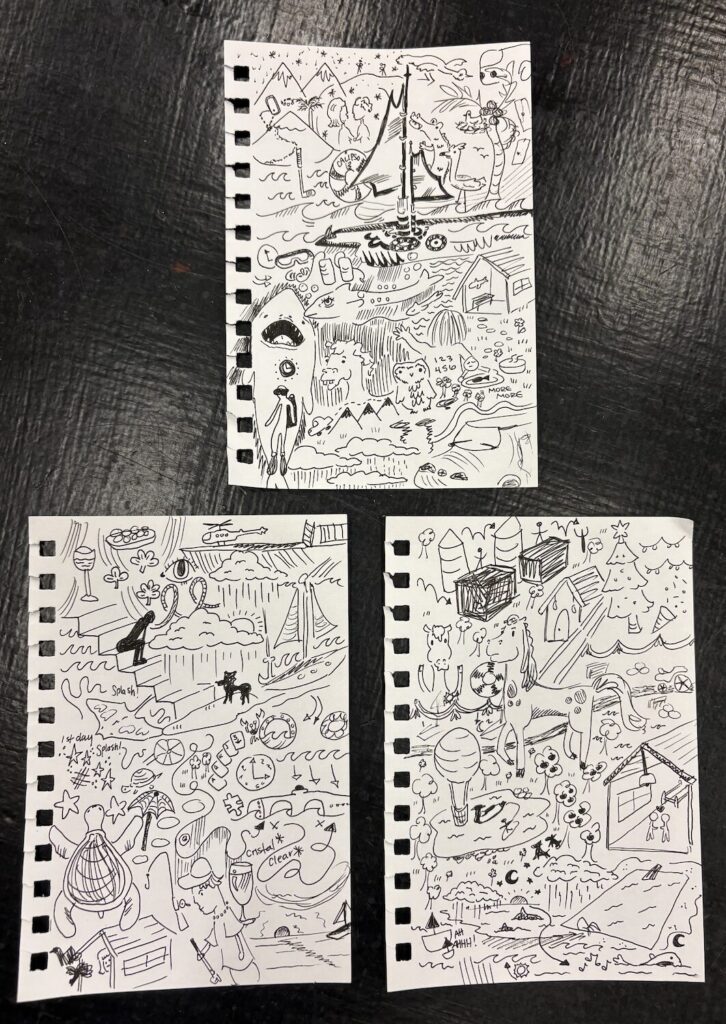
For my conceptual portrait, I chose to represent my grandparents. Something that really defines them is their storytelling. They always have stories to tell, and many of them are exciting or unbelievable. Their stories have always been important to me because I have been hearing them since I was a child, often as bedtime stories before going to sleep. For this project, I called my grandparents and asked them to tell me as many stories as they could think of. While they were talking, I quickly drew images based on what I imagined as they described the events. The drawings are fast and sometimes messy because I was being fed a lot of information and trying to keep up with their stories in real time. My imagination is very vivid when they tell stories, and sometimes it almost feels like I was there experiencing the moment myself. The way they describe things makes the memories feel very real in my mind.This portrait is not about what my grandparents look like, but about their energy, storytelling, and the way their stories live in my imagination. It also represents my relationship with them and the memories we share through their stories.
ZINE
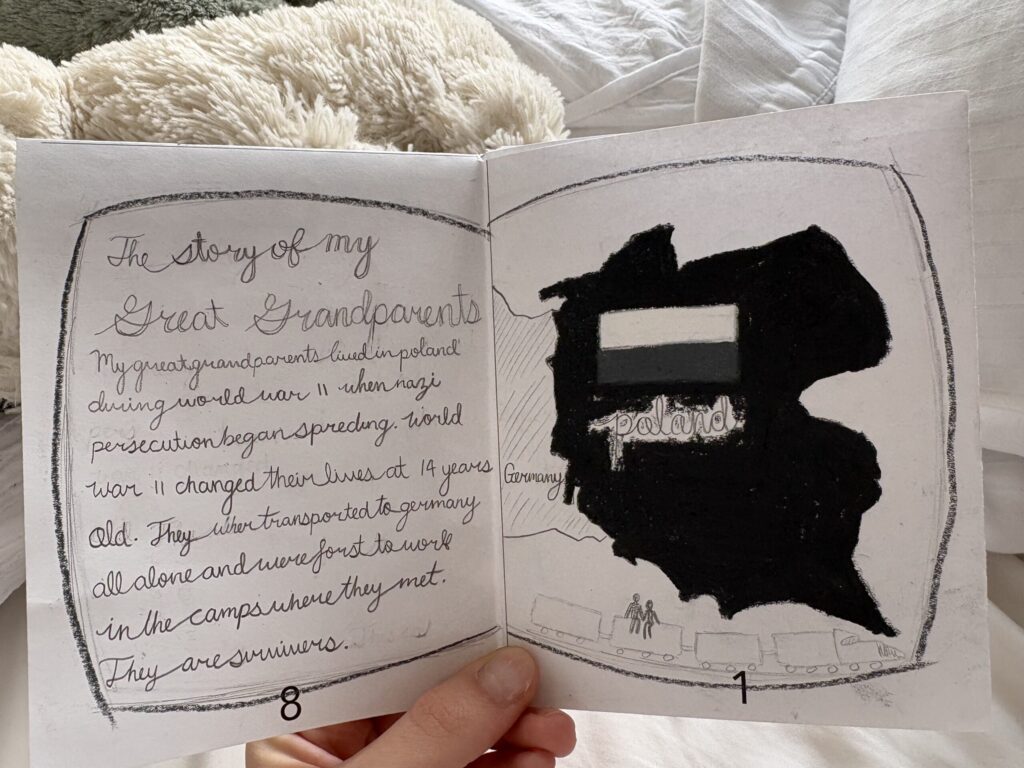
My Polish great-grandparents were still teenagers when World War II changed their lives. My great-grandmother, Babcia, was only about fourteen years old when she was taken from her home in Poland and transported by train to Germany during the war. Like many others during that time, she was forced to leave her family and everything she knew behind.
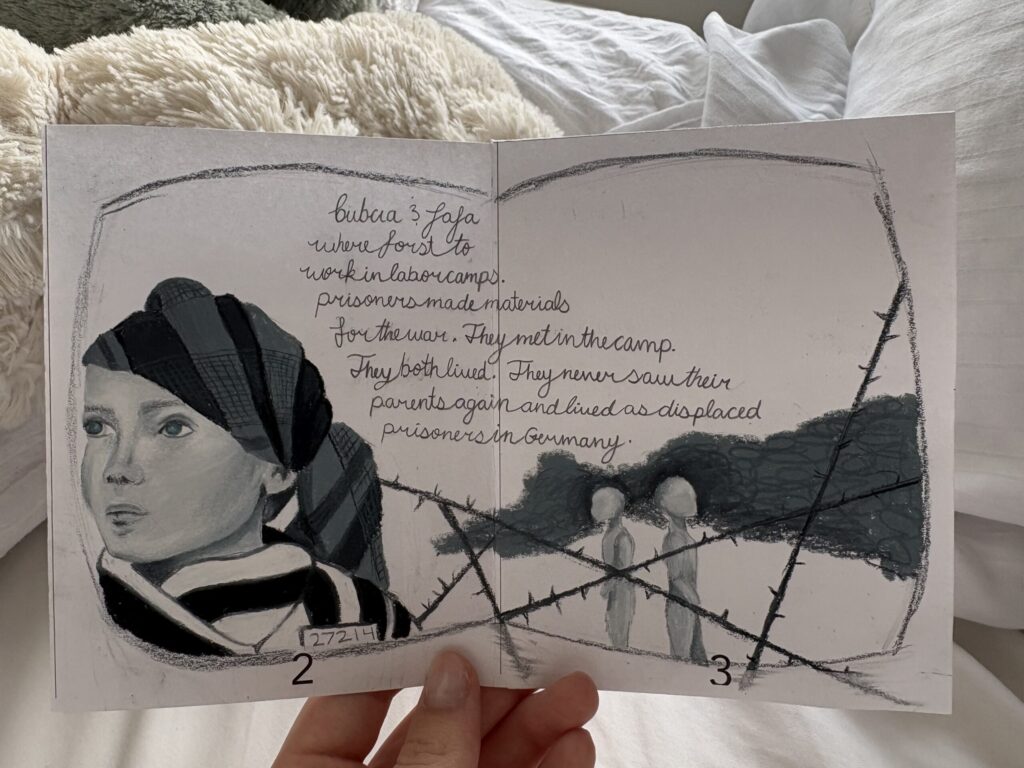
The town in Germany where my great-grandparents were taken during the war was called Vledflecken. She was placed in a work camp where prisoners were required to work long hours producing materials for the German war effort. Life in the camp was extremely difficult and uncertain, and many people were simply trying to survive day by day. It was during this time that Babcia met my great-grandfather, Dziadzia, who had also been taken and forced into labor. Despite the harsh conditions they were living in, they found each other and eventually began building a life together. Both of them survived the war and remained in Germany for some time afterward as displaced prisoners of war.
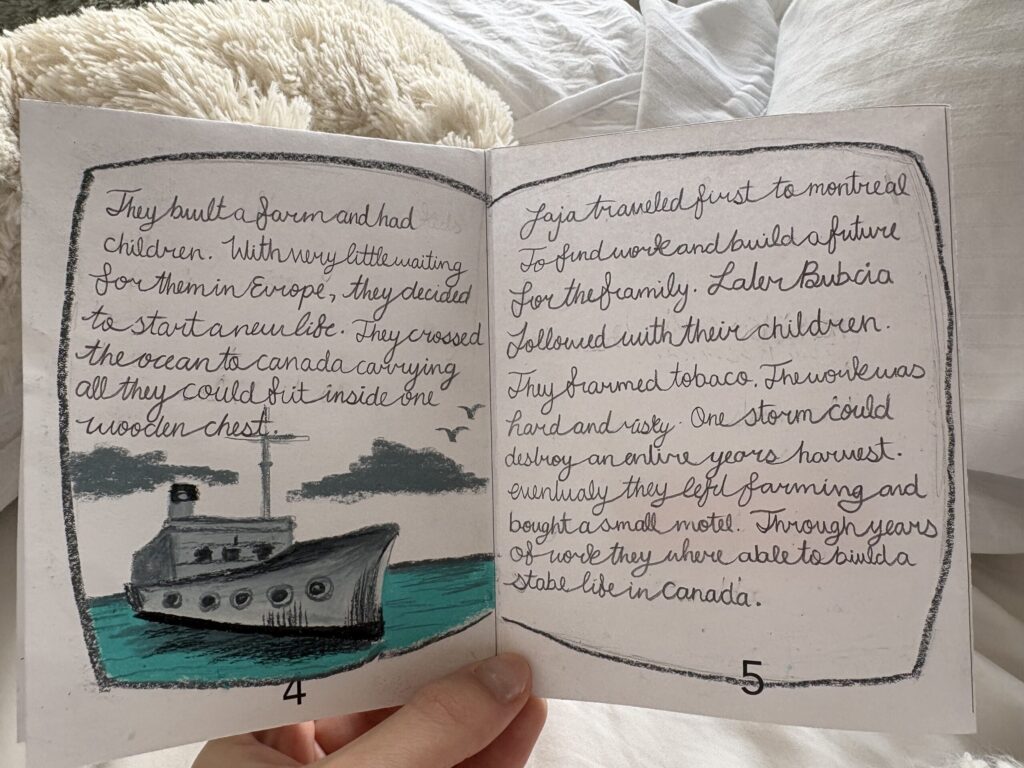
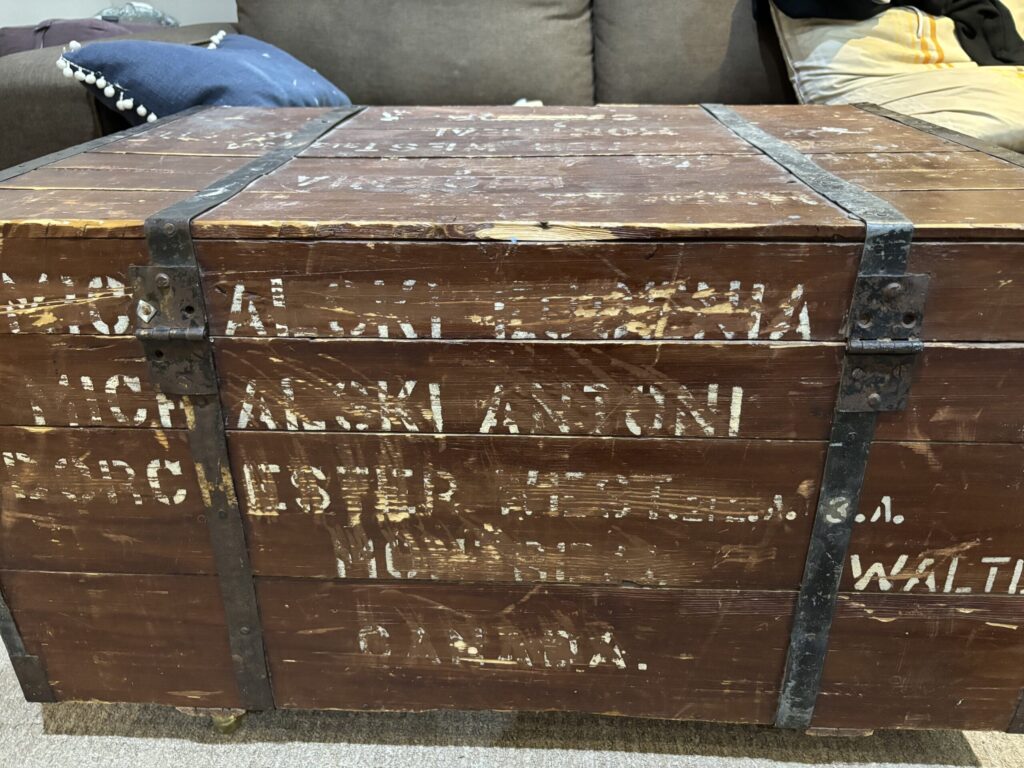
When the war ended, they knew that very little was waiting for them back home. They came from extremely poor backgrounds and hoped to rebuild their lives somewhere new. At first they attempted to immigrate to the United States, but during the medical inspection one of their children appeared ill and the family was denied entry. Instead, they were accepted into Canada. Dziadzia traveled first to Montreal to find work and begin building a life for the family. With him he carried the only major possession they had left: a wooden chest that held all of their belongings. Later Babcia followed with their children. At the time my grandmother had been born in Germany and was only about seven months old when they crossed the ocean by boat to reunite with him in Canada.
After living in Montreal for a short time, the family moved to Ontario to farm tobacco, hoping to build a better future. Farming was extremely difficult and risky work, and storms could destroy an entire year’s harvest. After several challenging seasons, they decided to leave farming behind and start over once again by purchasing a small motel. Through years of hard work and determination, they were eventually able to build a stable life in Canada. However, their struggles did not end when the war was over. The hardships they experienced in the camps were followed by years of rebuilding their lives from almost nothing. Their journey was a continuous effort to create the opportunities and stability that my family has today. I am forever grateful to my great-grandparents, because their courage and resilience are the reason I am here and able to thrive. Their story reminds me never to take the life I have for granted.
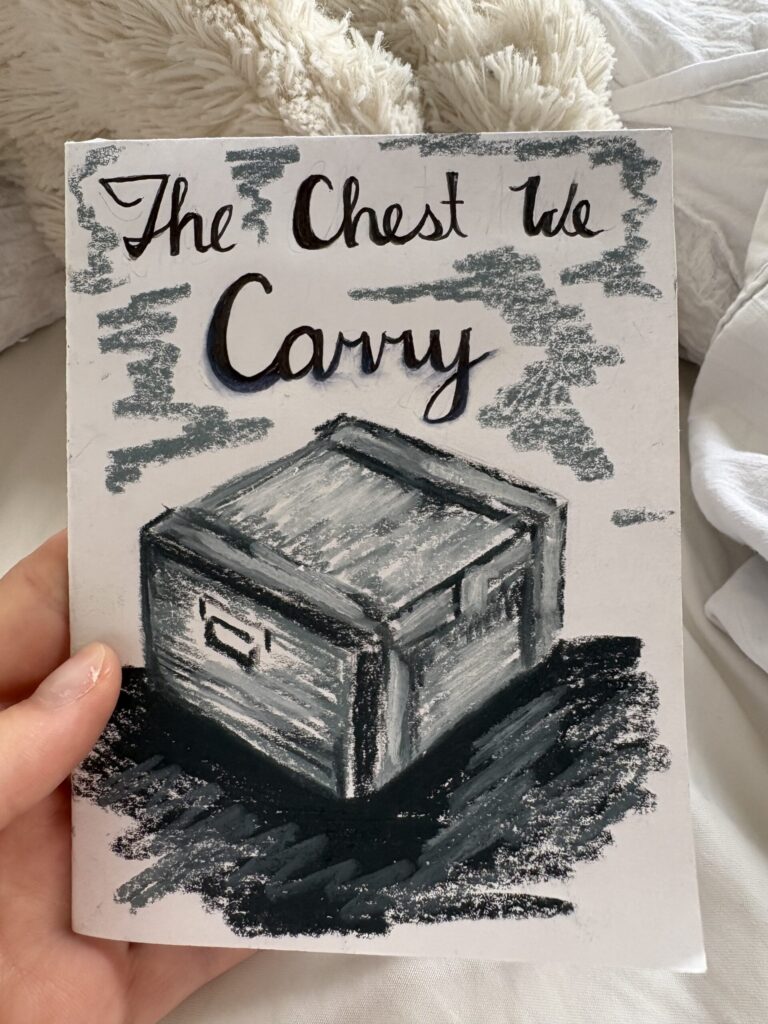
Throughout this entire journey, the wooden chest remained an important part of my family’s story. It originally carried the few belongings my great-grandparents had when they fled Europe and crossed the ocean to Canada. At one point, however, the chest was actually given away when they no longer needed it while rebuilding their lives. A few years later, while attending an auction, they unexpectedly saw the same chest again. They decided to take it back and keep it as a keepsake, believing it was fate that they had found it once more.
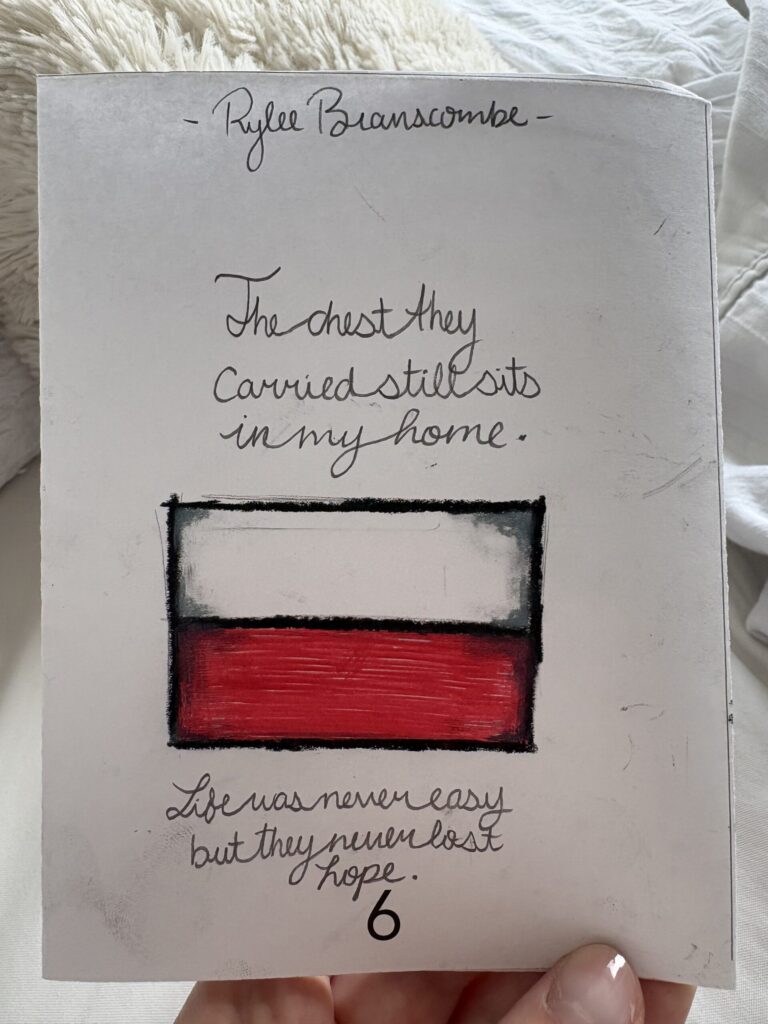
Today that same chest sits in my home and is used as our coffee table. What may appear to be an ordinary piece of furniture holds an extraordinary story. It represents survival, resilience, and the beginning of my family’s life in Canada, reminding us of where our family started and how far we have come.
REFLECTION:
For this project I created a counter archive zine that documents the story of my Polish great-grandparents, who were taken from their home during World War II, forced into work camps, and later immigrated to Canada to rebuild their lives. Their story has mostly been passed down through family conversations rather than through official historical records. Because of this, I wanted to create a small archive that preserves this memory in a tangible form. The central focus of my zine is the wooden chest that my great-grandparents carried with them when they left Europe. Inside that chest were everything they had when they fled their home. Today the chest sits in my home and is used as our coffee table. While it may appear to be an ordinary object, it represents survival, resilience, and the beginning of my family’s life in Canada. It symbolizes where our family started and how far we have come since then. By documenting this object and the story connected to it, my zine highlights how personal belongings and family memories can act as important forms of historical record. Through this process I wanted to show how objects hold deep historical significance. This assignment helped me understand how creative formats like zines can be used to document stories that might otherwise be forgotten, allowing personal histories to become part of a broader understanding of the past. I find it interesting that something as ordinary as a wooden chest has become such a powerful symbol of my family’s history and where our journey began. It felt fitting to transform this piece of paper into a zine that shares such a powerful and meaningful story.
self Grade:
I would grade my work a 9/10 because my zine clearly tells a meaningful family story while connecting to the idea of a counter-archive. It highlights my great-grandparents’ journey and uses the wooden chest as a symbol of survival, resilience, and the beginning of my family’s life in Canada. I feel the story is well organized and visually engaging. I chose a 9 instead of a 10 because there are always small ways the project could be improved, such as adding more visual or historical details, although i was trying to keep it short to fit the book. Overall, I am proud of how the zine preserves and shares an important part of my family’s history.
Leave a Reply
You must be logged in to post a comment.