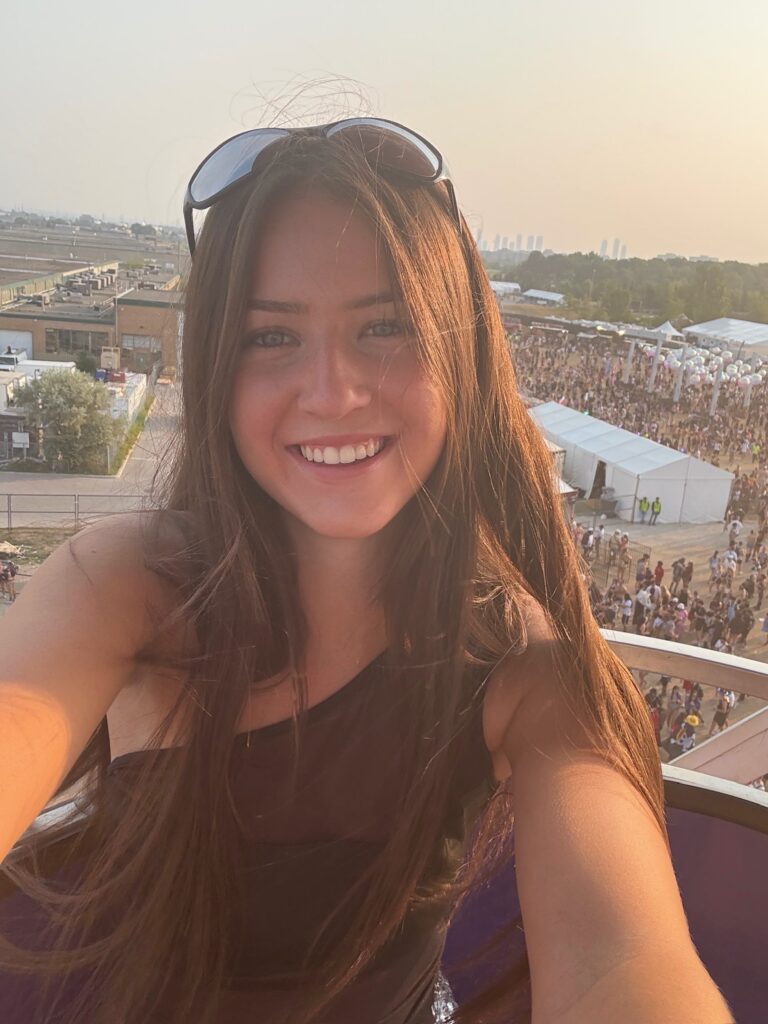
Hi my name is Rylee! I am a student in the batcher of arts health and wellness program at guelph university!
The Artist Is Present – Movie Questions
- What are some of your first impressions of Marina Abramovic’s performance works, based on the documentary? Use an image/example of one or two works to describe aspects you admire, and aspects you might agree are problematic? One aspect I admire is her fearlessness, particularly in Rhythm 5, where she lies inside a burning five-pointed star. The act is visually very powerful. At the same time, some of her work feels deeply problematic, especially performances involving cutting and self-inflicted harm, such as Rhythm 0. While the intent is to expose audience psychology, power, and violence, the escalation into physical injury raises ethical concerns. The line between artistic exploration and self-harm becomes blurred. I believe self harm shouldn’t be normalized as an art form because it’s using the act itself as an art form when realistically it’s a world problem that needs helping. You don’t have to do the act and abuse yourself publicly for it to be moving. That just seems emotionally harming to the artist and audience experiencing somebody go through this real pain. Rather than inviting reflection alone, these moments can risk normalizing or sensationalizing harm in the name of art.
- What have you learned about features of performance art based on Abramovic’s work? Name a few key features according to her examples. Include an image to illustrate. Consider her quote “When you perform it is a knife and your blood, when you act it is a fake. knife and ketchup.” In my opinion this quote clearly shows that a performance uses real materials, real pain, and real consequences. Nothing is staged or pretend. Performance art breaks through the barrier of art not being a reality and only an act or simulation representing something, it is not an act you are in it and feeling the presence of the message being voiced through this art. Performance art involves genuine risk. The outcome is not fully controlled, which creates tension and makes the audience aware that what they are witnessing could go wrong. Viewers are not just observers. Abramović often invites or allows the audience to participate, making them partly responsible for what happens during the performance. so whats going on itsint all planned because nobody can predict what the observers will do. Performance art, as shown through Abramović’s work, collapses the distance between art and life. It demands presence, confronts discomfort, and forces viewers to recognize that what they are seeing is not representation. Its a reality happening in front of them.
- Discuss the ways performance art resists many museum and commercial artworld conventions. How does Abramovic solve/negotiate some of these challenges, and do you find. Do these compromises add to, or undermine the ideas at play in her work? Performance art resists museum and commercial artworld conventions because it is temporary, embodied, and experiential, rather than object-based. It cannot easily be owned, sold, or permanently displayed, and it often involves real risk, unpredictability, and direct audience engagement, which conflicts with the controlled environment of museums. To me, it almost feels like a social experiment, testing both the artist and the audience. Giving people the choice to participate or respond in real time pushes the boundaries of what we usually think art is. In Abramović’s case, she works around these challenges through documentation, re-performance, and working with institutions so the work can continue to exist after the live moment. Even though this reduces some of the raw danger of her earlier performances, I think it adds to the work by making it accessible to more people and by highlighting the tension between lived experience and institutional control.
Make a Kilometer
Meaning: My kilometre represents an ongoing pattern in my life. Avoiding something I need to do because it feels overwhelming. I often feel stressed when I have to focus for long periods of time, especially when I’m studying. Instead of staying with that discomfort, I choose movement. Walking feels productive, but for me it can also become a form of procrastination.To me this kilometre is not just distance. It is time… specifically, time spent avoiding something that feels mentally difficult. The 1km walk becomes a measurement of my psychological resistance.
This kilometre is recreated by representing:
- lost time
- emotional tension
- avoidance disguised as productivity
- a measure of psychological resistance
The distance becomes more than physical space. It becomes a way of measuring how me being overwhelmed affects my behaviour.
measurement of 1 km:
I measured exactly 1 kilometer using my Apple Watch in indoor Walk mode. The walk was continuous and uninterrupted. Although the video does not show the tracking screen at the very beginning, the Apple Watch recording provides a precise digital measurement of the total distance travelled. At the end of the video, I show clear proof of the 1 km and 13 minutes
Conceptual connection: This project connects to Marina Abramović’s work, which often asks the viewer and the artist to remain present with discomfort. Abramović’s performances are about endurance, stillness, and resisting the urge to escape difficult feelings. In my case, the discomfort is not extreme or dramatic, but it is personal and real. I was recently diagnosed with ADHD, and I’ve become more aware of how strongly my body reacts when I’m required to sit still, stay focused, and complete a task that feels overwhelming or mentally demanding. When I’m studying, my discomfort shows up physically with restlessness, tension, irritation, and the constant urge to do something else. What makes studying especially difficult for me is the moment I hit a problem that isn’t easily solvable. When I don’t understand something right away, I feel frozen. It’s like my brain locks up and I become unbearably stuck, and the longer I sit there, the worse it feels. That feeling is awful because I’m still “trying,” but nothing is moving forward. It’s mentally exhausting and it creates pressure, shame, and frustration all at once. I start to associate the desk and the work with being trapped inside that feeling. The kilometre represents my habit of using movement to escape that stuckness. Walking feels like relief because I’m no longer frozen I’m moving, I’m doing something, and my body feels like it has an outlet. It gives me immediate comfort and a sense of control, and it feels productive because it’s healthy and measurable. But even while I’m walking, I’m thinking about what I should be doing instead. I’m mentally rehearsing the work I left behind, feeling behind, and trying to justify the decision to leave my desk. That creates guilt, and the walk stops being purely relaxing, it becomes part of a loop. I feel relief in the moment because I’m moving, but the stress returns as soon as I stop, because the original task is still waiting for me. In that way, the kilometre becomes both a physical distance and a psychological pattern of avoidance disguised as productivity, followed by pressure, guilt, and the need to escape again.
Self-assessment: I would give this project a 9/10 for combining precise measurement with a personal and experiential understanding of distance, and for using video effectively to communicate the emotional experience of time and avoidance. I think the strongest part of my work is the personal connection behind the concept, and how clearly the kilometre represents a real pattern in my life. If I could improve anything, it would be the video execution. After filming the video I came up with additional ideas that could have made the final edit even stronger and more intentional. However, I still feel like the piece successfully communicates the tension between avoidance and productivity, and the emotional cycle behind it.
Feild Trip
During the tour, this was my favorite installation. I love waterfalls, so naturally I was drawn to this piece. When I realized it was actually mechanical and flipping to create the movement, I thought it was really cool. It takes something natural and chaotic like rushing water and turns it into something mechanical and orderly while still capturing that uneven movement. I also loved how everything in the gallery slightly moved, so you had to stand there and watch for a while to notice the smallest changes.
One Feat Three Ways video project Critical Reflection
the everyday act of getting ready and applying makeup as a way to explore the pressure society places on appearance. We wanted to show the contrast between looking beautiful on the outside while feeling chaotic or overwhelmed on the inside. The project explored ideas of rushing versus slowing down, enjoyment versus frustration, and the emotional tension that can exist in something as ordinary as putting on makeup.
The work was structured around two videos. What’s the Rush?, focused on the feeling of being rushed and pressured. It showed the act of applying makeup quickly, reflecting the pressure people feel to look a certain way before going out. The video, Pretty, focused more on reflection and emotion. In this video the makeup is removed, which represents taking away the “mask” that society often expects people to wear.
We also created an animation video inspired by a simple video game style to show the buildup of makeup in a more orderly way. The memory of playing these games and seeing makeup normalized from a young age made me think about how it can blur the lines between whether makeup is a good or bad thing. On one hand, makeup can be used beautifully as a form of self-expression, but on the other hand, many women may feel pressure to wear it in order to fit in with beauty standards. I find this contrast really fascinating, because makeup can be both empowering and restrictive at the same time. This tension is what often creates ongoing social debates about what makeup represents, since it can be both something beautiful and something complicated.
Leave a Reply
You must be logged in to post a comment.