About Me!
I am a second-year, Bachelor of Arts Honours student. In elementary and high school, I had my entire future planned out, surrounding dental schools and orthodontic specialties at schools out of province. Nearing the end of high school, barely passing my chemistry class, spending all of my time crying in an art room to my teachers, I finally realized that reaching my goals PROBABLY shouldn’t make me so miserable. My art teachers told me I should seriously consider a pathway in art, telling me about their experiences in University (most of them went to Guelph!). I decided I’d consider it, but I hadn’t spent years planning to be an art teacher, so it seemed impossible. Two of my teachers allowed me to take student teacher positions in their grade.9 classrooms and I immediately knew teaching was a much better fit than what I’d been working for. I am from Guelph(ish), and when it finally came down to choosing schools, I was in a place where I couldn’t imagine (or afford) leaving home. I am so lucky that the most convenient school for me is one of the greatest, both in regards to the art program aswell as the community.
Marina Abramovic
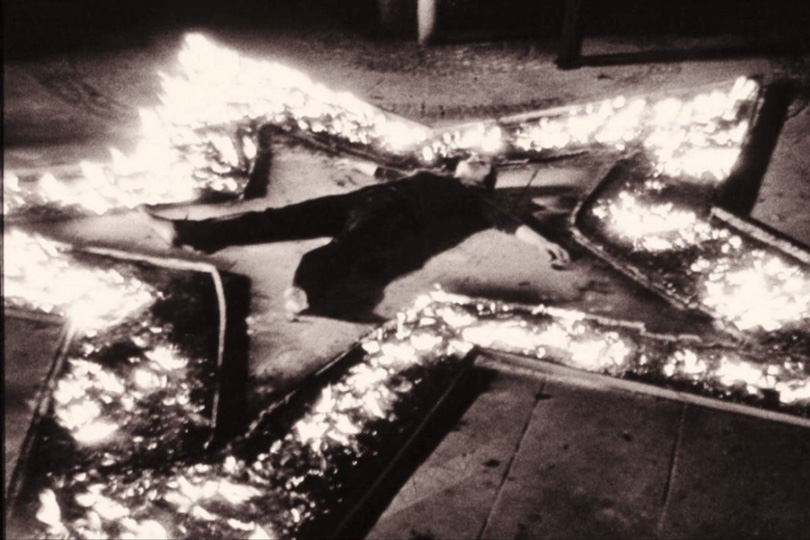
- My first impression of Marina is how incredibly strong and brave she is. She creates art that she knows will bother people. She knows many won’t understand her. She knows it takes a specific headspace to feel what she is portraying, but she continues to create. I think that this speaks to her passion to create for herself, and for a specific audience, rather than to “succeed” or receive recognition. Her undeniable endurance is incredible. Rhythm 5 (1975) was briefly mentioned in the documentary. This piece began with a large wooden pentagram being lit on fire and Marina tossing pieces of herself (hair, nails, etc..) into it, she then threw herself into the flames. This performance was incredibly dangerous, and Marina lost consciousness during it, but she continued to perform despite harming herself and receiving backlash. Despite controversies, she is a very admirable woman and artist. The pure emotion people feel simply by sitting across from her speaks to the impact she has.A quote that stuck out to me was “with Marina, she is never not performing”, I feel this is displayed fantastically with her endurance piece The Lovers (1988), where she and Ulay walked from opposite ends of the Great Wall of China, for 90 days, to symbolize the end of their relationship.
2. When discussing preformance art, state of mind was mentioned multiple times within the documentary.
“it doesn’t matter what kind of work you’re doing as an artist, the most important is from what state of mind. preformance is all state of mind.”
How an artist can take an audience, of any demographic, and move them to feel things, and enter a similar state of mind to which the artist is in is a beautiful and important ability.
“you have to create your own charismatic space” “for most pieces, people stop and look for 30 seconds. People stay here all day”.
Preformance art considers so much more than just how ‘cool’ something will look. It is about changing a space, and untimatly changing people. Creating something that doesn’t just change a headspace for a moment, but becomes something that people look back on and reflect on those feelings many times.
3. Preformance art is constantly resisting what is commercially considered art, even as art styles change. When preformance is how the art is being communicated, the medium is the body, this is directly challenging the viewer. The art we see most frequently is created to appease an audience, it’s familiar and safe, the mane goal is to look pleasent. With preformance, if you are not willing to feel the emotion, you won’t understand the art. That is incredibly challenging to market to an audience, as many people simply do not understand, or wont LET themselves understand. Just based off of what I saw in the documentary, I didn’t particularly notice Marina compromising to fit in to these social ideals, although I could be wrong, if I am not I consider that incredibly admirable.
1 Kilometer ; The Cost of Going Nowhere
A trend in my art style is creating based on what I’m currently passionate about.
To me, a kilometre has so many meanings, but in my current headspace, I knew I wanted to make this about travel by car. As a commuter student in a long-distance relationship, and someone whose car is my most prized possession, there were a lot of different ideas flooding through my brain. I reflected on what an overarching theme in all of these concepts was: I pollute our planet, A LOT!
To briefly summarize my ‘performance’, driving one kilometre is such a minuscule act in our minds; it’s a couple of seconds in the car. We all know cars are not good for our planet, but do we really know just how bad they are? Do we really recognize the magnitude of one kilometre?
Most of us are ‘environmentally conscious’, we don’t use plastic utensils, cups, straws, or bags.
My “muse” for the math in this project is my dad’s Dodge Ram.
This truck burns 0.2L (200mL) of gas per kilometre. If I gave you a jar with 200mL of water in it, that would not make an impact.
Burning 200mL of gas produces roughly 500g of CO2.
Producing 1kg of plastic emits roughly 2-6kg of CO2.
That means the emissions of 200mL of gas is equivalent to 0.5kg of plastic.
300 plastic straws
30 plastic lids
18 plastic forks
15 grocery bags
9 plastic cups
Using this amount of plastic would eat up our conscience; many of us would never use these things, it is incredibly immoral.
The production of each of these emits the same amount of CO2 as driving just one kilometre. Driving across campus is a task we view as insignificant, but that is equivalent to using nearly 100 plastic forks. Why are we so woke when it comes to using a straw but not driving down the street?
I wanted to make everyone as angry as I was. I want us all to reflect on whether driving one kilometre is worth avoiding that 15 minutes of exercise. If you wouldn’t use 300 plastic straws in one day, why will you drive that one kilometre?
One Feat, Three Ways
Paulina Oliveros Notes
Before learning about Pauline Oliveros, I thought of listening as something mostly passive, just hearing what’s around me while doing something else. I don’t notice the sounds around me as I focus on my phone or even on the people around me. Oliveros’s idea of Deep Listening challenges that habit by suggesting that listening is an intentional, embodied act, centred on presence. When she describes listening as a spiritual path and an embodied practice, it makes me realize how rarely I listen without preparing a response. Especially in conversations, I often listen to reply rather than to understand. If I listened “through my whole body,” I imagine I would notice tone shifts, silence, rhythm, and even my own physical reactions. Listening would become like a relationship instead of a transaction. Her idea that “play is the greatest research tool” also reframes sound as something exploratory rather than controlled. Deep Listening suggests that connection begins with attention, and that paying attention fully is both an ethical and creative act.
Audio Art
SHEBAD
Concept Portrait
The Body of Christ
The subject of my conceptual portrait is my grandfather. He was a single parent to my mother and uncle, and a father figure to me for a long time. His health has been on a rapid decline over the last year and a half, and my mother has been his primary supporter. I rarely see him anymore, as he lives far away, due to school and work obligations, and because of how mentally difficult it is. Over the past few weeks, every 2-5 days, an ambulance has been called to his house early in the morning, and he has been taken to Peterborough hospital. This past week was his 69th birthday, and he was taken in an ambulance early in the morning. They let him go home that night, and we had a phone call. He was so excited to tell me this story; every day that he gets brought in to the hospital, he jokes with the nurses that they need to bring him Timbits. He is extremely diabetic, and they can not do that. On his birthday, one of his nurses came to tell him she brought him a surprise. When she returned, she told him it was her birthday as well, and she had gotten them Timbits to share. He reminded her he couldn’t eat sugars like that, and she reminded him that he’s in the hospital all the time without having the Timbits, it was his birthday, and they wouldn’t be the thing that killed him. They shared the Timbits, and it meant the world to him.
For this piece, I recorded my mother and me sharing a large platter of Timbits while we spoke about my grandpa. He will not be here much longer, but our memories of him will be, and it is important to keep him alive even if it’s in the form of chatting over some sweets.
Something that really spoke to me after crit was the mentioning of how society almost normalizes older men being “drinkers”. Because this is such a “normal” character trait, our whole lives we never thought drinking would kill him, we thought his drinking would kill us, and I think there’s something interesting in that itself. I also appreciated the association with alcohol and violence, especially against women. As the two women in his life, my mom and I, really, really resonate with that. I ended up cutting out the part of the conversation where we spoke about the abuse we endured because I didn’t feel like I was ready to show that, but it definitely would push this project further. Our conclusion from that discussion was that our mourning might not look “normal”, just as our love and devotion to the man who hurt us for so many years doesn’t look “normal”. But our actions and our feelings aren’t for anyone else, they are for us. This is where the conceptual choice of not showing a full conversation or enough context to truly understand who or what we are discussing came from, because our relationship with him and our grief only has to make sense to us.
Zine
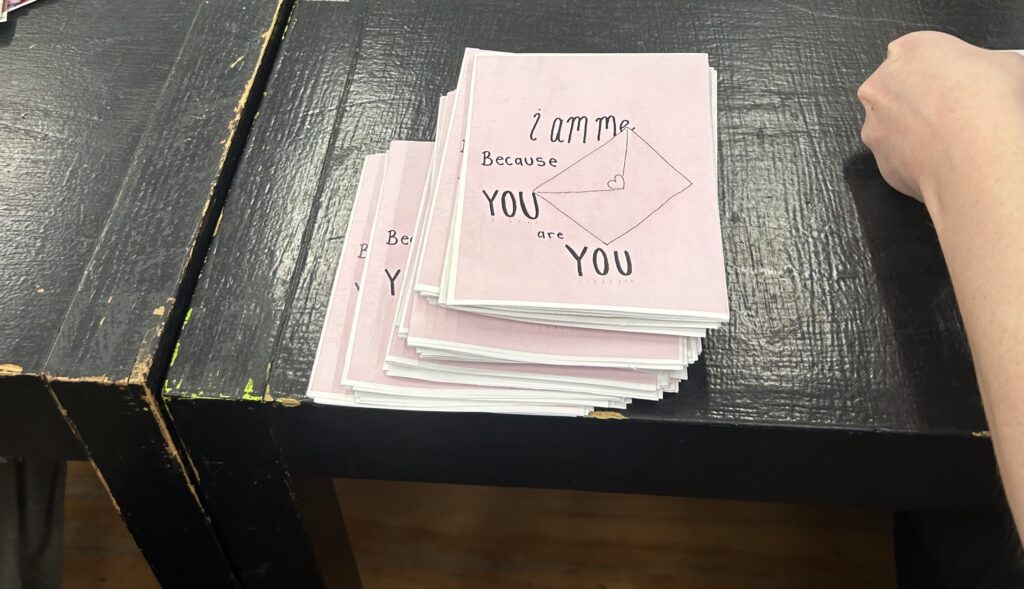
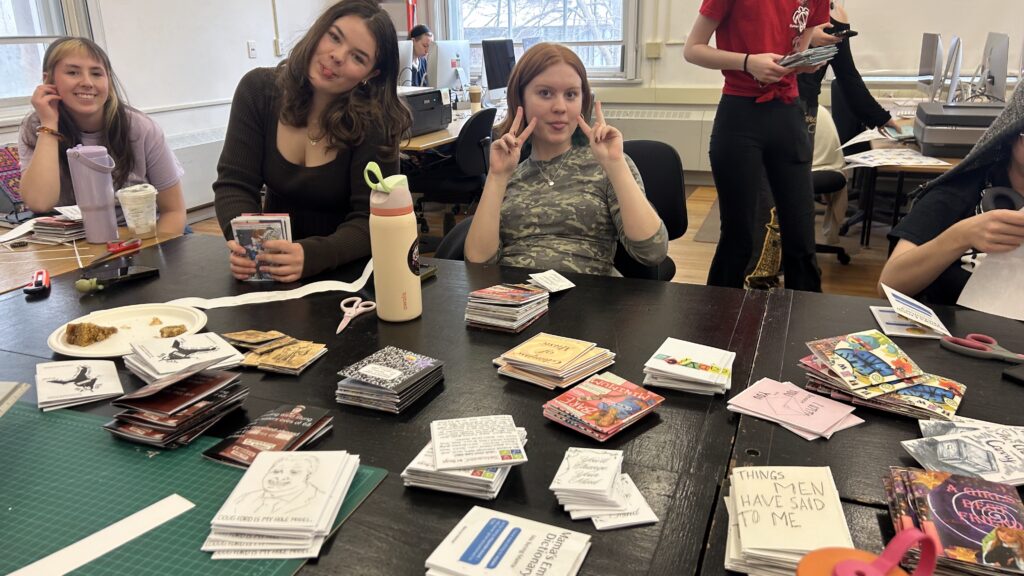
i am me Because YOU are YOU, is inspired by beauty standards. My goal was to speak to the way being the “quirky” girl has turned into something that is either objectified, or something that makes one unable to be taken seriously. I was the “quirky” girl who expressed myself through my appearance for so long, but in highschool I found I was being objectified by many (men…), while at the same time they wouldn’t treat me like I was smart or capable, because I didnt present as their idea of a “proper woman”. I let men steal my sparkle. In short, this is about embracing femininity, embracing what makes us us, taking up space, and most of all appreciating beauty. I wanted to communicate how grateful I am to now get to surround myself with the most beautiful, smart, capable, and serious women (and fem presenting individuals), all while they express themselves in “quirky” ways.
Leave a Reply
You must be logged in to post a comment.