I am a second-year studio art major with a minor in media and cinema studies. I have always been interested in the nuances underlying art and the reaction a work can provoke so I planned on attending a University in the arts field but wasn’t sure where.
Guelph’s campus and community is what convinced me to enrol in its studio art program. I want to continue expanding my knowledge of art mediums, especially in the digital landscape, which is what made me take experimental studio.
ASSIGNMENTS
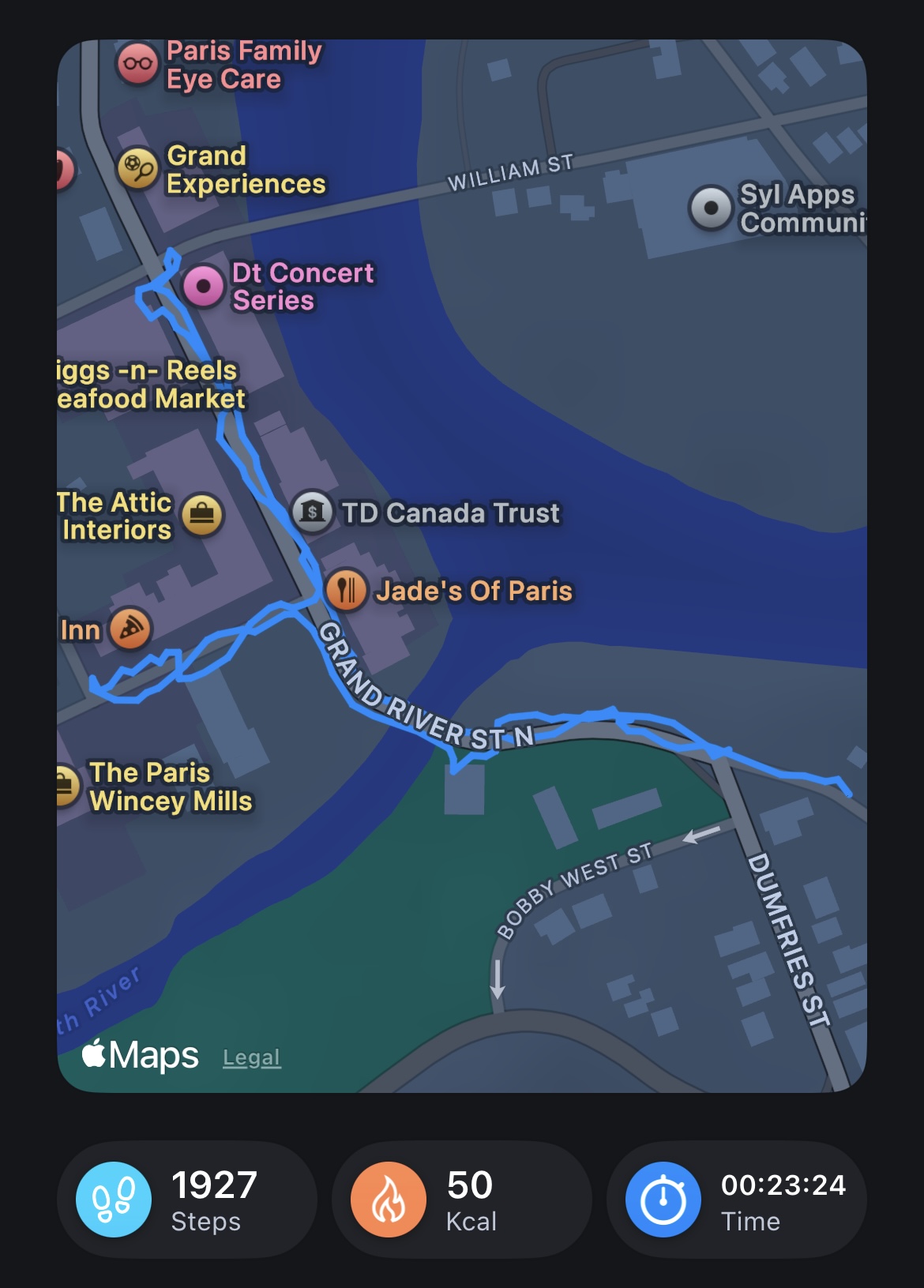
To represent a kilometre, I decided to go on a kilometre walk and document every advertisement that I came across. My original idea was to collect receipts and sew them together to measure out to a kilometre, however, time and material become major restraints.
Consumerism has been a growing interest of mine, certainly due to the landfills most trending items find themselves in. So, building off my previous idea I decided to explore the role and impact of advertising on over consumption within real life.
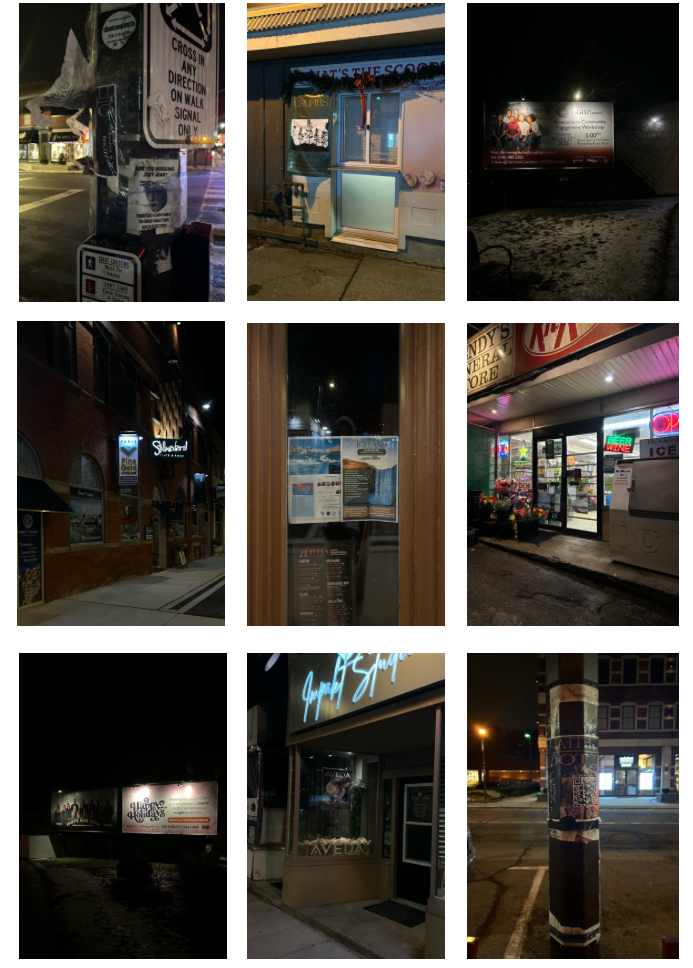
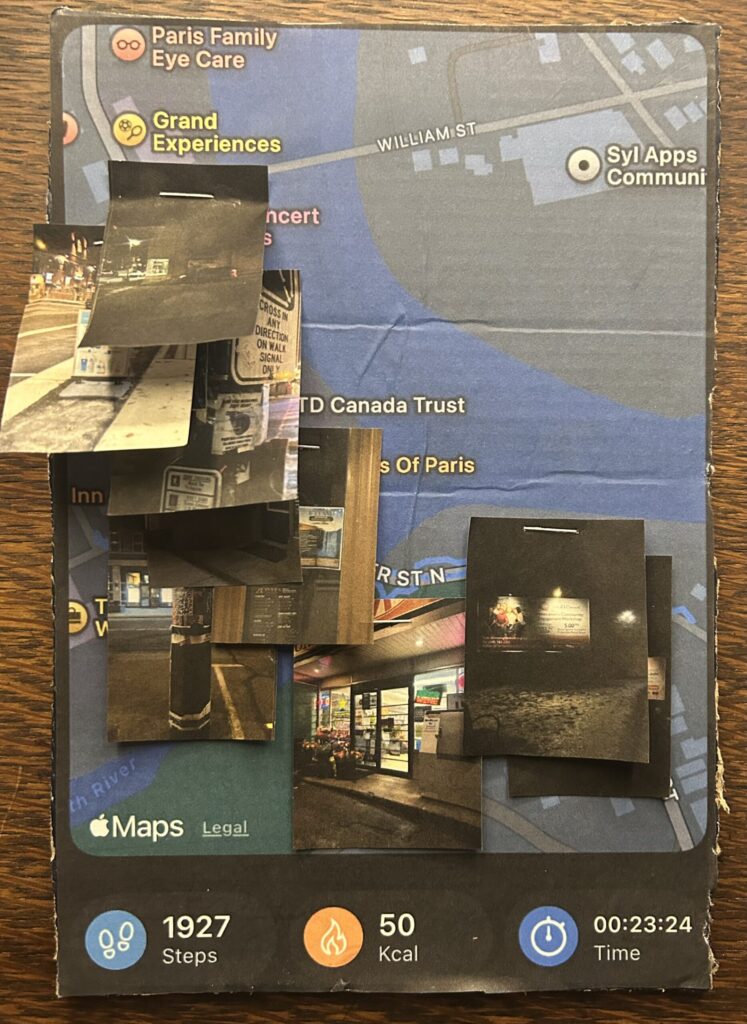
When I think of advertisements my mind immediately resorts to digital marketing (commercials, pop-up ads, sponsorships, etc.) since ads predominate the digital realm. I wanted to challenge myself and see how many I can find in a mere kilometre.
Process/Measuring
I used a pedometer app to measure the precise kilometre I walked and displayed the advertisements posted alongside. I decided to walk through the town I grew up in, it yielded a lot more results than a section of Cambridge & Hamilton I did because more stores were condensed in a smaller area.
Materials & Presentation
I digitally recorded my findings but decided to physically create a document of the walk to give the piece both a digital and physical essence. I used my phone camera, paper, cardboard, glue, and staples to make the work presented on the left. By presenting the physical advertisements, physically despite capturing it all digitally I wanted to juxtapose my predisposed ideas of ads, which are digitally crafted and presented yet seek to sell physical commodities. By doing this I hope to promote discourse regarding the influence, and influx of advertisements, as well as, it’s harmful role in consumerism.
Results/Thoughts
I had a great time documenting and creating this work, I believe the display encapsulates my ideas most accurately and clearly. Nevertheless, if I were to do it again, I would make the presentation look cleaner and test out a variety of areas/walks to compare and contrast the density of advertisements in different areas.
The one-shot
Sealing Envelopes
For our feat, Dani and I chose to repeat the action of licking and sealing envelopes. I think seeing an outdated method of communication utilized at the rate of communication today raises important questions about how we connect through digital technologies. Shooting the videos in a sterile appearing environment helped emphasize the act itself; to do it again I would bring it a step further with attire and align it with the atmosphere. Moreover, I would experiment further with camera angles and different ways of performing the gesture.
the sequence
The Sequence
Dani had creative freedom to produce the edited video. In the future I would approach this project in a manner where we both contributed to each section of the videos to create our best work. I would spend more time story-booking our ideas to make the videos flow better and make them feel complete.
The Loop
Final Thoughts
This was my first time creating video art and I had fun editing and creating the animation, watching the drawings come together into the video was cool to see. I produced the uncut video as well as the animation, I am very proud how the animation turned out; however, the gesture itself is rather boring. Experimenting further could have yielded me more content to pick amongst.
“Sweet Sixteen”
The original idea I brought to the round table was to re-create the frequent sounds I would hear growing up while trying to fall asleep. Attempting to capture the particular sounds I wanted to make apart of my audio was too tricky, and while trying to get a good audio of my dogs barking, I got lost in my old journals I began keeping at 12. My nostalgia led to my current piece, wherein I read aloud journal entries I wrote at 15 while overlaying multiple clips of my friends and I goofing around at 15 from cam corner videos I recorded at the time. I never thought about the relationship between my internal thoughts and my external actions and behaviour, and in creating this complete story of my experience being 15 I have realized my tendency to think in black and white. I wanted it to be hard to listen to both simultaneously to express that quality and for the clips of laughter to act as a distraction to my monologue of sorts since I would hangout with my friends to avoid thinking too much. “Sweet Sixteen” encapsulates gray area and ambivalence which I find myself experiencing more often than not.
Micah Lexier, A Portrait of David, 1994
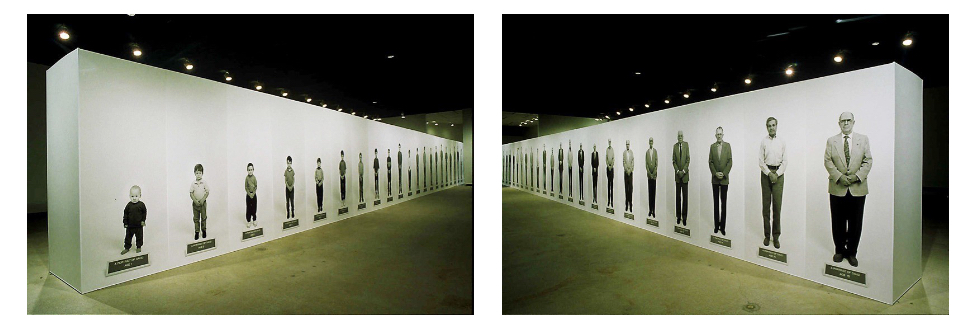
Along with the Perfect Lovers clock piece, Lexier’s collaborative visualization of self intrigued me the most among the pieces we viewed. They made me reflect on the singular moments and years which construct our lives but also how moments merge together to create a unified picture.
Approaching this assignment, I wasn’t sure who I would represent or how and began thinking about my connections with the people in my life. My sister and I were incredibly close growing up but don’t get to see much of each other anymore. One way we remain connected to going to concerts together of our favourite artists, music has always been our primary bonding device, and I thought utilizing that connection for this assignment would not only accurately represent who she is but our relationship to one another.
I often associate past times or people with the music I listened to during them or with them, hearing or seeing those songs years later carries memories along with it. I want to represent that through my conceptual portrait; however, I have two ideas to approach it in particular:
Idea One: burn a cd with 23 songs: each representative of a year of my sister’s life
Idea Two: place my sisters cd collection in order of first purchased to most recently within a cd holder, and have the collection be the piece
Conceptual Portrait Planning
After the round table I wanted to change my idea completely, it didn’t feel like enough of a system. I pivoted to portraying my relationship with my parents because I have never made them the focus of my art, unlike my sister, and I figured I would be happier with the resultant work.
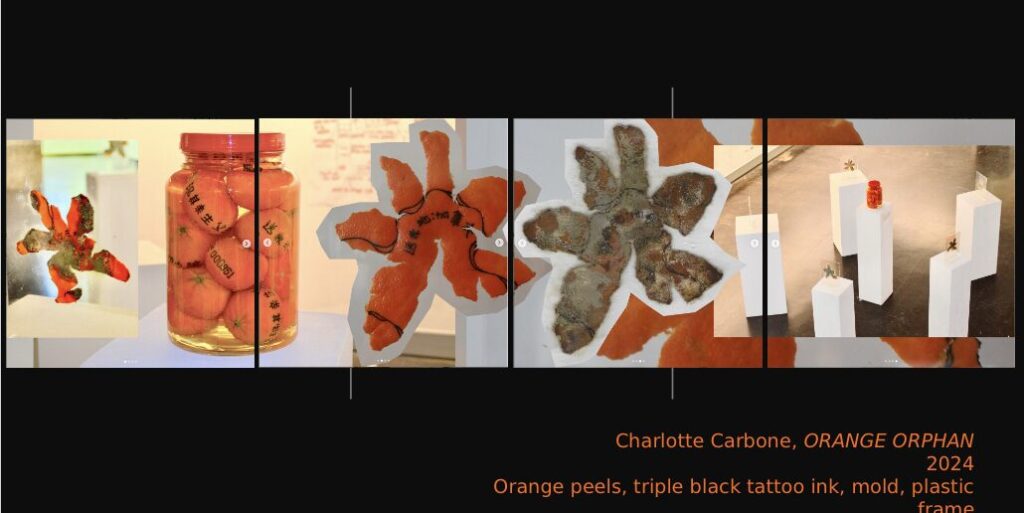
I found Charlotte Carbone’s ORANGE ORPHAN incredibly visually captivating, and it got me thinking about the potential influence submerging items in liquid could have within a piece.
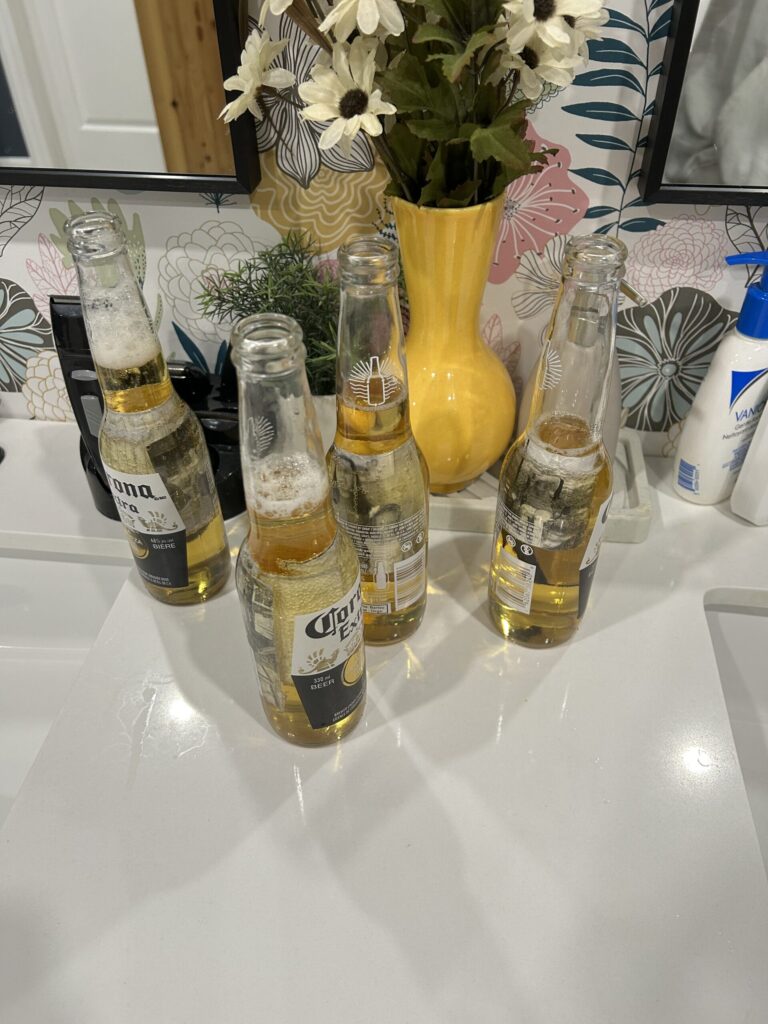
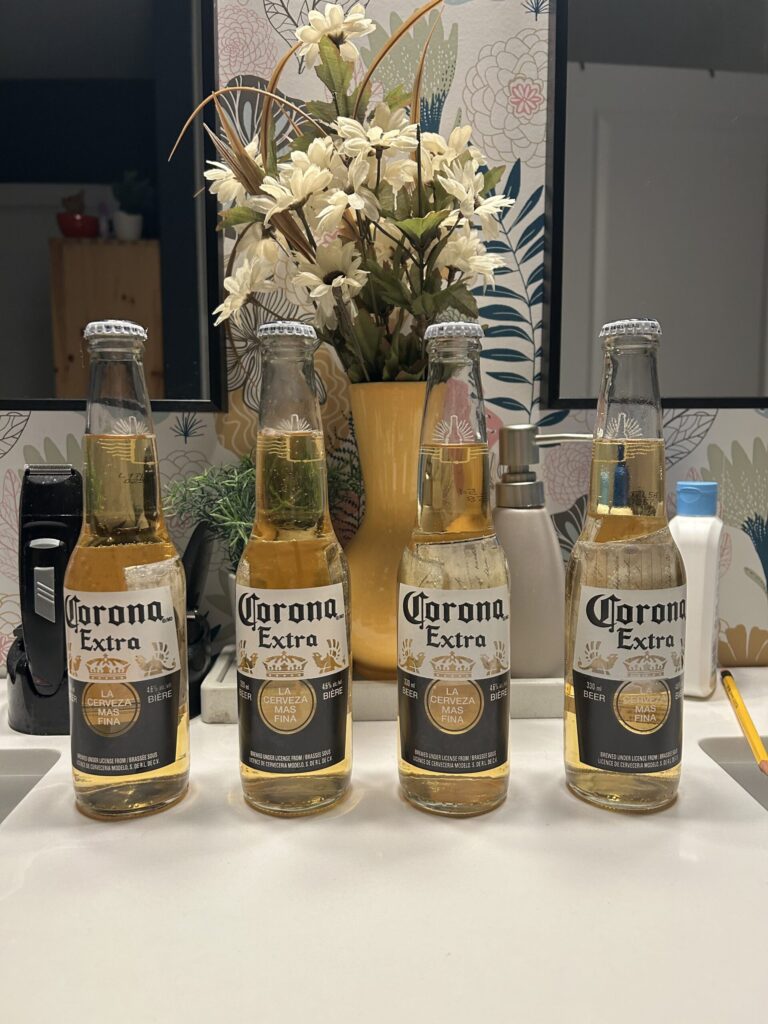
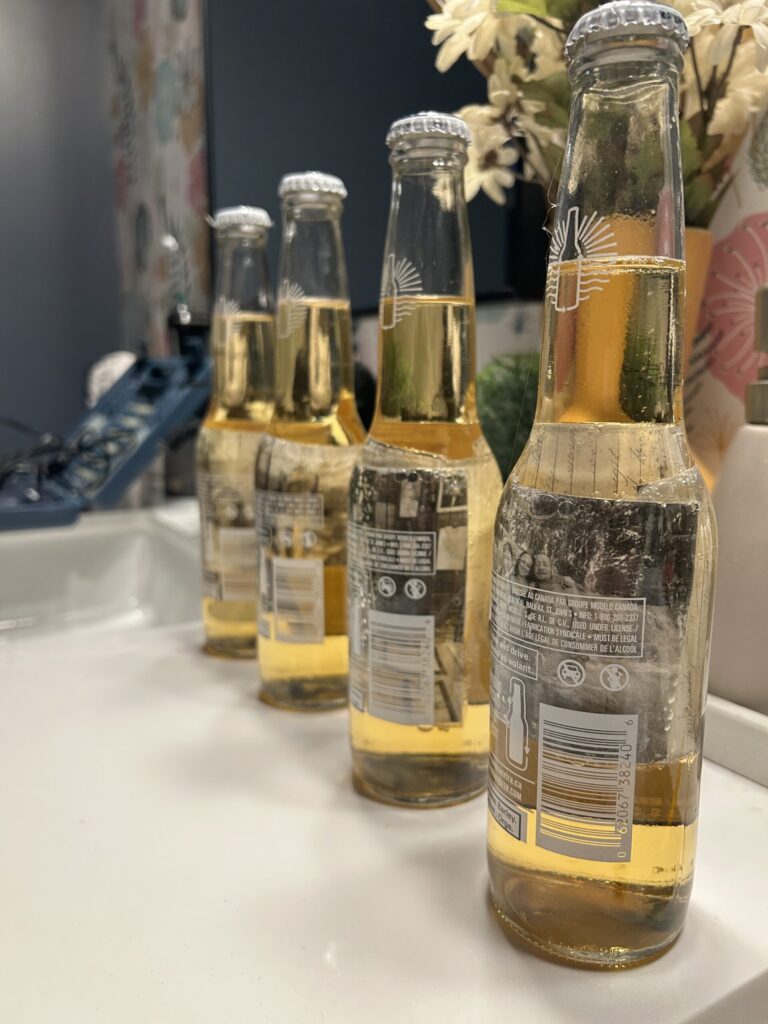
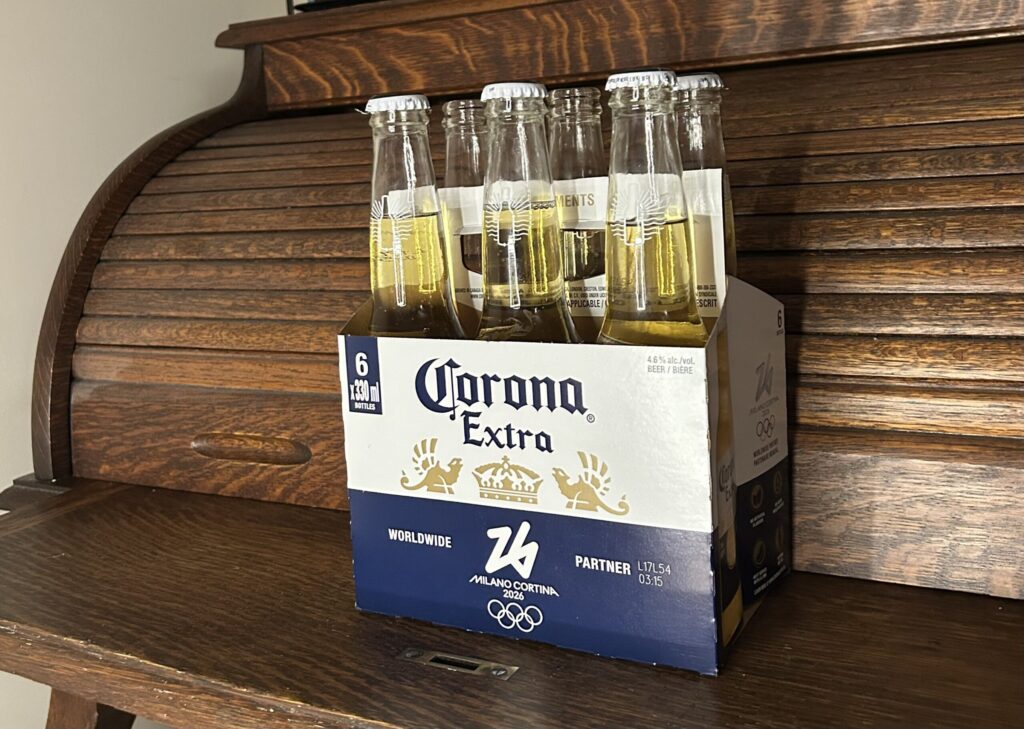
My final work is a six pack of Corona Extra: each bottle containing a single memory with my parents through an image taken during it, with some also containing scanned pages of my journal about my thoughts after it as well. The piece symbolizes how memories we make together end up soiled through alcohol use; the two empty bottles representing my parents and their lack of memory towards our times together. During critique, I spoke about maybe not laminating the images I put inside the bottles to see how they would deteriorate however I do think my concept makes more sense having them as is since the memories remain permanent in my mind. The title signifies their response upon mentioning any these memories as they happened, encapsulating not only what they say but how I feel.
That’s not what happened.


I had difficult time conceiving an idea for my zine, I wanted to share a niche interest but ended up thinking of topics of interest to me recently. How media has shifted recently with its portrayal and expectations of women with surgery, online exploitation, and generally planting more insecurities in women’s heads. My counter-archive then is a mainstream account but viewed through a critical framework.
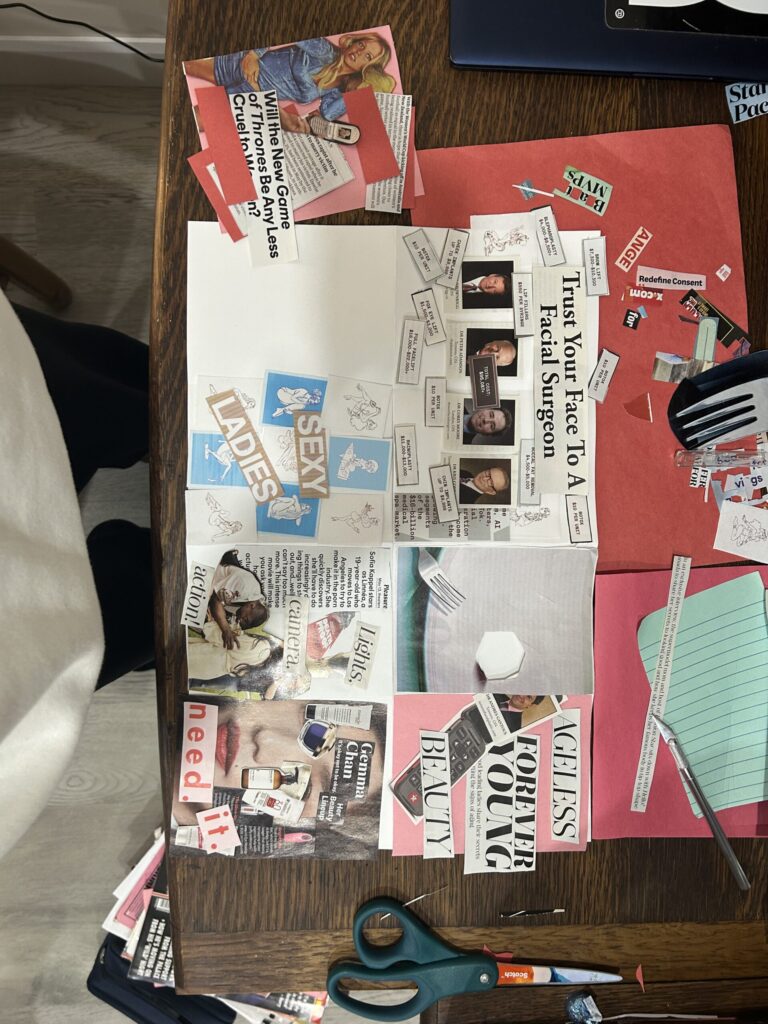
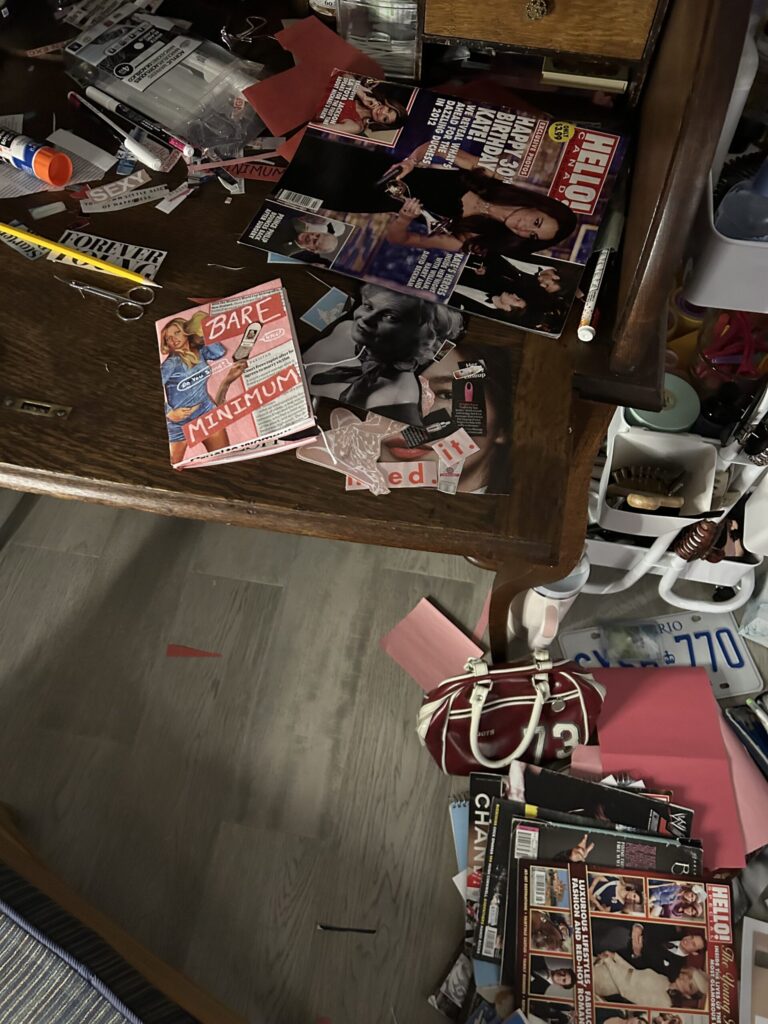
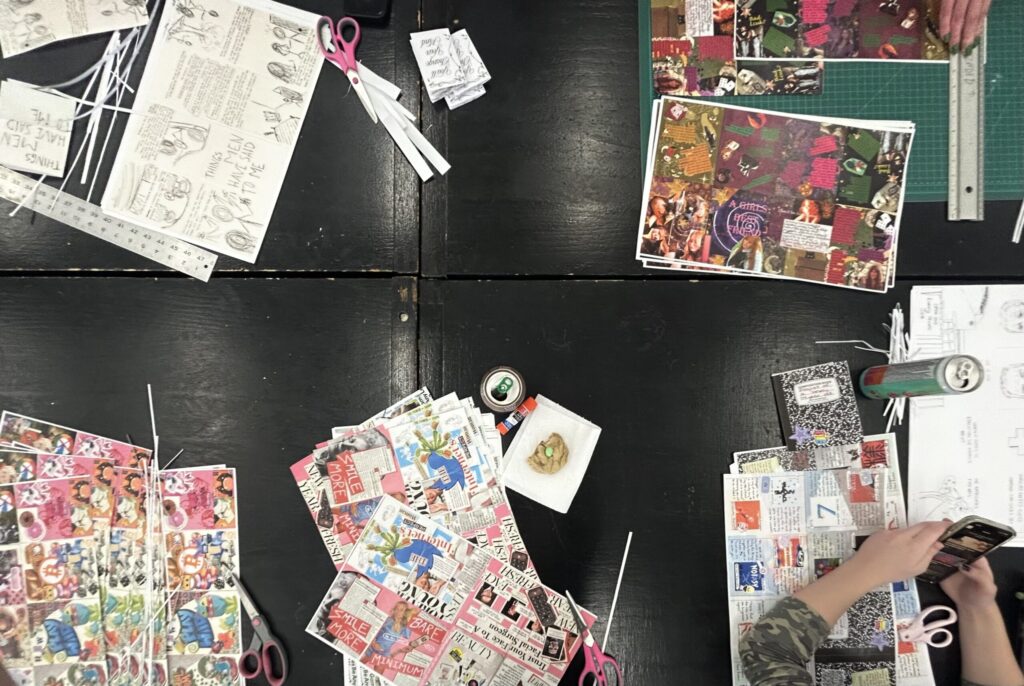
I decided to make a satire account of the media’s perfect woman through found images and text from magazines. I wanted to take a traditional approach to creating my zine because I wanted it to feel similar to feminist zines from the Riot Grrl era but with a modern perspective. Through emphasizing the normalized yet concerning actions that media has been increasingly encouraging women to make I wanted to show the corporations underlying intentions and how women can feel like they have to meet these unreasonable expectations.
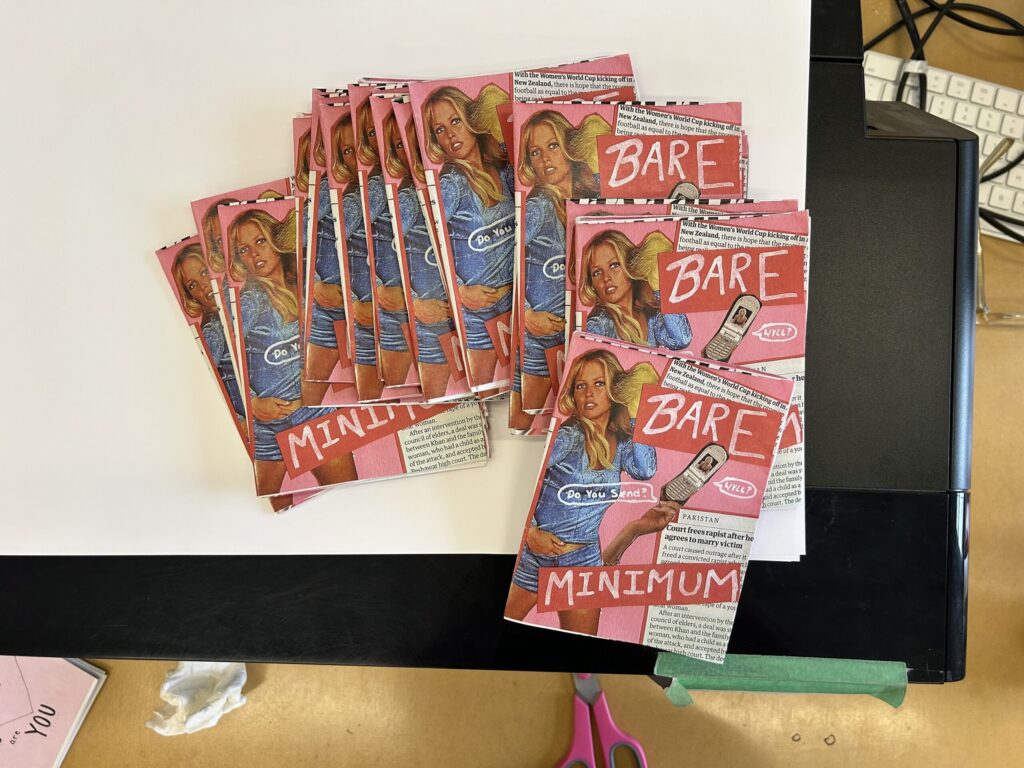
The title, Bare Minimum, references the minimal expectations of men, as well as how portrayals of women online have been increasingly sexualized.
RESPONSES & REFLECTIONS
Pg. 2: NYT article by Zoey Poll; Pg. 3: Toronto Galleries Reflection;
Pg. 4: Pauline Oliveros Deep Listening
Marina Abramovic: The Artist is Present
Grace K
What are some of your first impressions of Marina Abramovic’s performance works, based on the documentary?
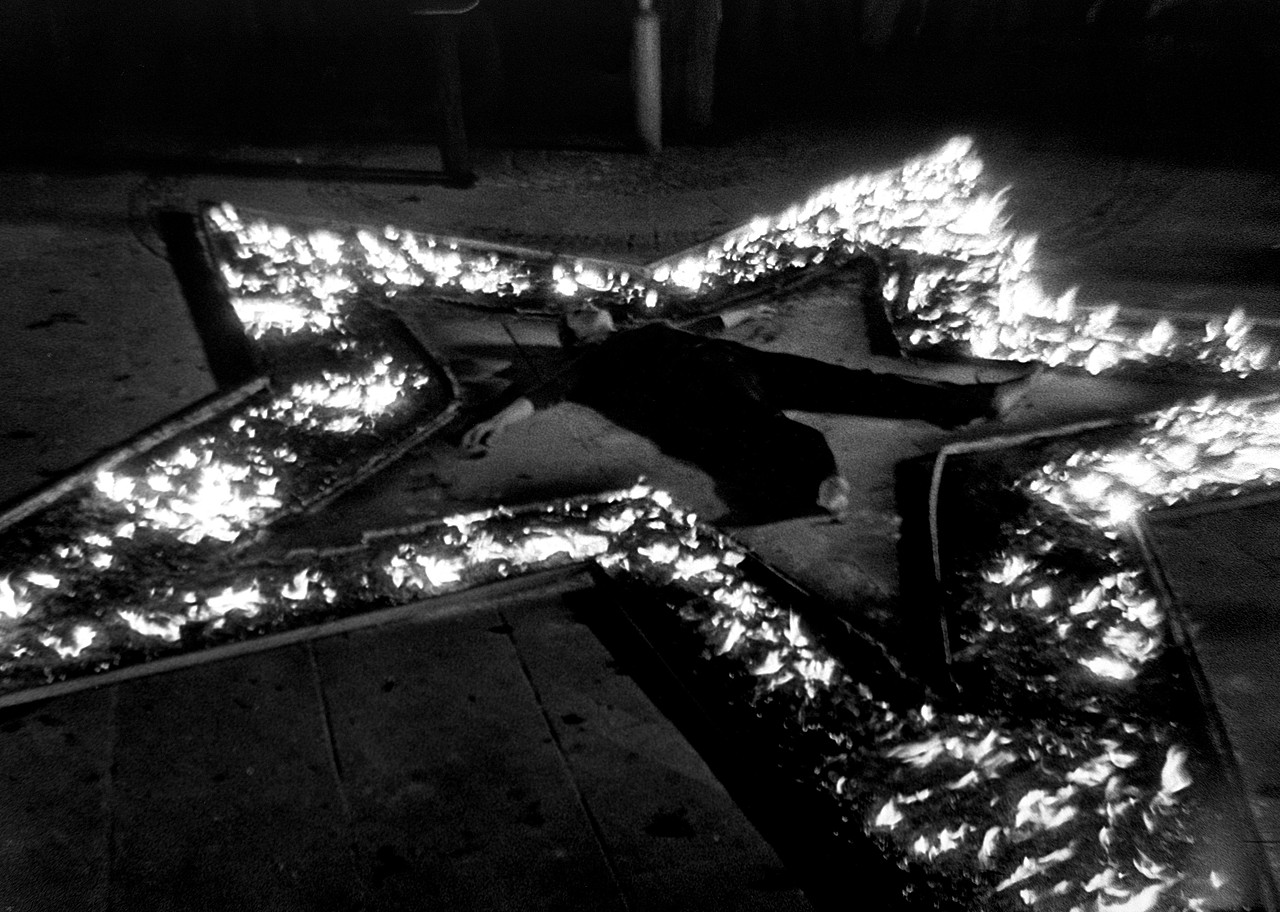
I had seen Abramovic’s performances of The Artist is Present and Rhythm 0 on social media years before watching this documentary, specifically her performances of endurance: sitting in silence with strangers and, in Rhythm 0, allowing them to do whatever they wish to her. They always stayed with me because of their unique and revealing nature of humanity. The documentary allowed me to discover her oeuvre, and despite its violence, I found myself admiring her dedication to her art. Her work walks the line between art and shock value, sometimes stepping to one side or the other. For example, in her work Rhythm 5, she carves a pentagram into herself, a rather grotesque and uncomfortable sight, which I do not believe was a necessity to convey the meaning of the work. Nevertheless, Rhythm 0 was a novel work that showcased people’s capabilities and destructive tendencies, despite likely causing Abramovic more pain than Rhythm 5. I can understand why people would see it as unethical and problematic; however, her work has pioneered performance art, and when presented in the proper context, it can be incredibly moving, inspiring, and almost unbelievable.
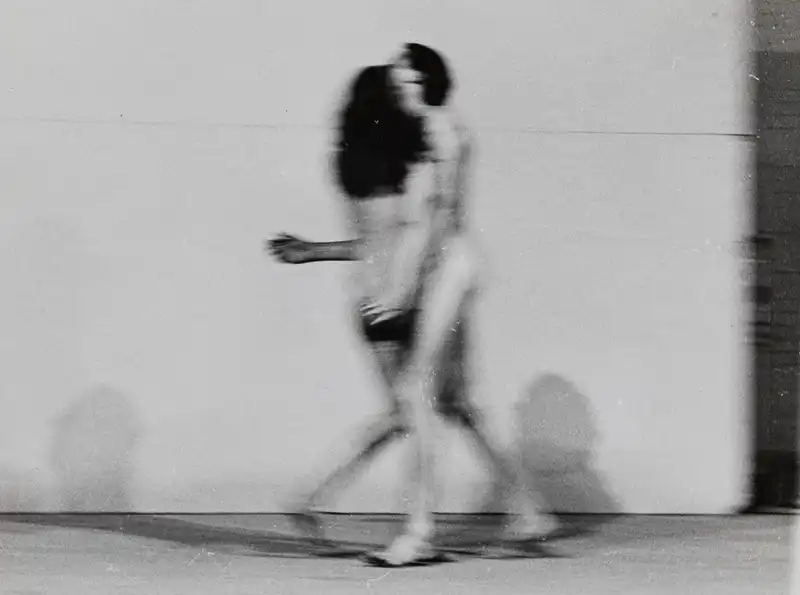
What have you learned about features of performance art based on Abramovic’s work? Consider her quote, “When you perform it is a knife and your blood, when you act it is a fake knife and ketchup.”
Performance art requires as much physical exertion as mental effort; it takes immense confidence, strength, courage, and determination to build a career in performance. Viewing Abramovic’s works changed my perspective on what performance art is and can be. For example, her work with Ulay Relation in Space felt pointless and harmful when I first saw it. However, as I kept watching and learning about the medium and her works, I realized it captures life in a way no painting could. The art is as alive as the audience; everything that occurs may be more real than life itself. The audience and their provoked emotions become a component of the art. It transforms the viewer through a unique experience, exemplified by some of the people who sat across from Abramovic in The Artist is Present. When interviewed afterwards, many told the documentary that it altered their lives, showing that it is distinctly different from conventional art media.
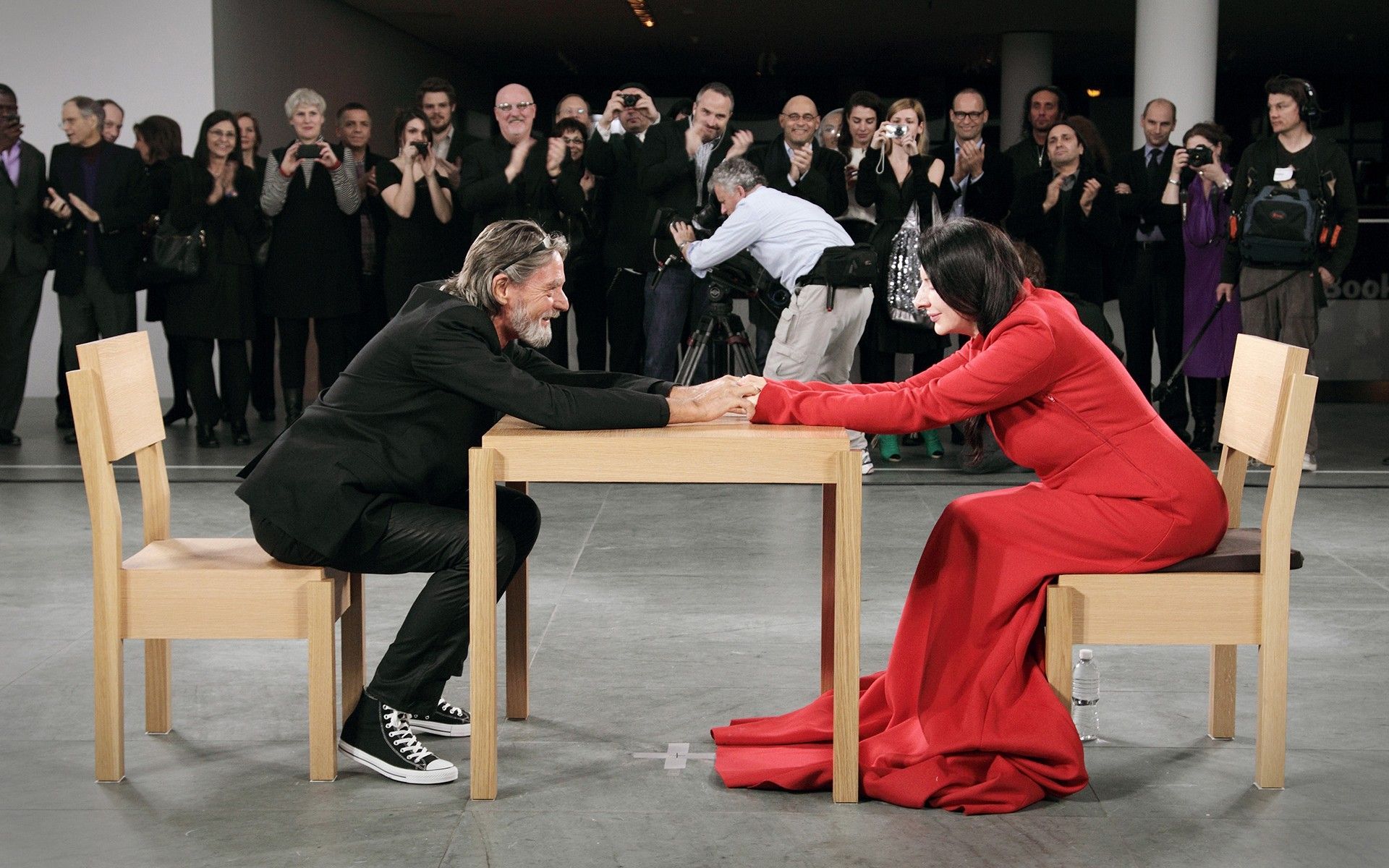
Discuss the ways performance art resists many museum and commercial artworld conventions. How does Abramovic solve/negotiate some of these challenges, and do you find these compromises add to, or undermine the ideas at play in her work?
Public art is generally expected to remain in a single spot, be available for most of the day, and be static, allowing museums to display a variety of work consistently and efficiently. Performance art disobeys all previous conventions of art; it has no monetary value, is limited, requires performers, requires more space, and can be unpredictable. Having an exhibition as a performer would not be possible, since each work requires the performer at all times. To address this, Abramovic’s exhibition at the MOMA included earlier performances of hers that used other performers to execute the works. Seeing the same performance with different performers separates the artist from the art, making the meanings feel more communal but also less of an experience. What is unique about performance art is that an audience is together viewing and thinking about the same work, and being in a gallery setting makes them assume a gallery mindset. The viewer does not put as much thought or attention into works that would otherwise have the whole room’s eyes.
Leave a Reply
You must be logged in to post a comment.