press the buttons for a shortcut !!
she/they
2nd Year BCAHW Studio Art Major
hihi !!
welcome to my blog ~
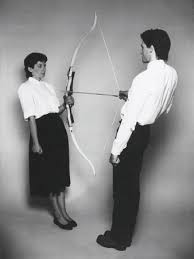
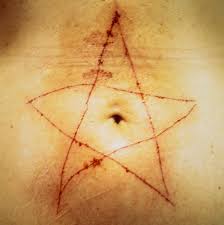
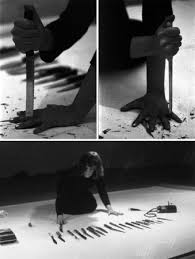
Marina Abramović “The Artist is Present” Documentary Discussion Question
First impression from the documentary –
Her works are very creative and bold, engaging with the audience and have power messages that stretch the definition of art.
Discuss the ways performance art resists many museum and commercial art world conventions. How does Abramović solve/negotiate some of these challenges, and do you find these compromises add to, or undermine the ideas at play in her work?
Performance art is an alternative form of art where the medium is the human body and the performer performs to an audience in an intimate shared experience. It challenges the traditional painting practices in museums and the commercial art world as it greatly differs from the mere aesthetically pleasing static object to view (and is a commodity to commercialise). It is dynamic and live action; interacting with the audience in ways that aren’t conventional (demanding them to participate and pay attention), and also making them question the meaning and of what counts as art itself – stretching their mental definition. Additionally, instead of seeing only the final polished product – the art itself is the concept and execution of the process.
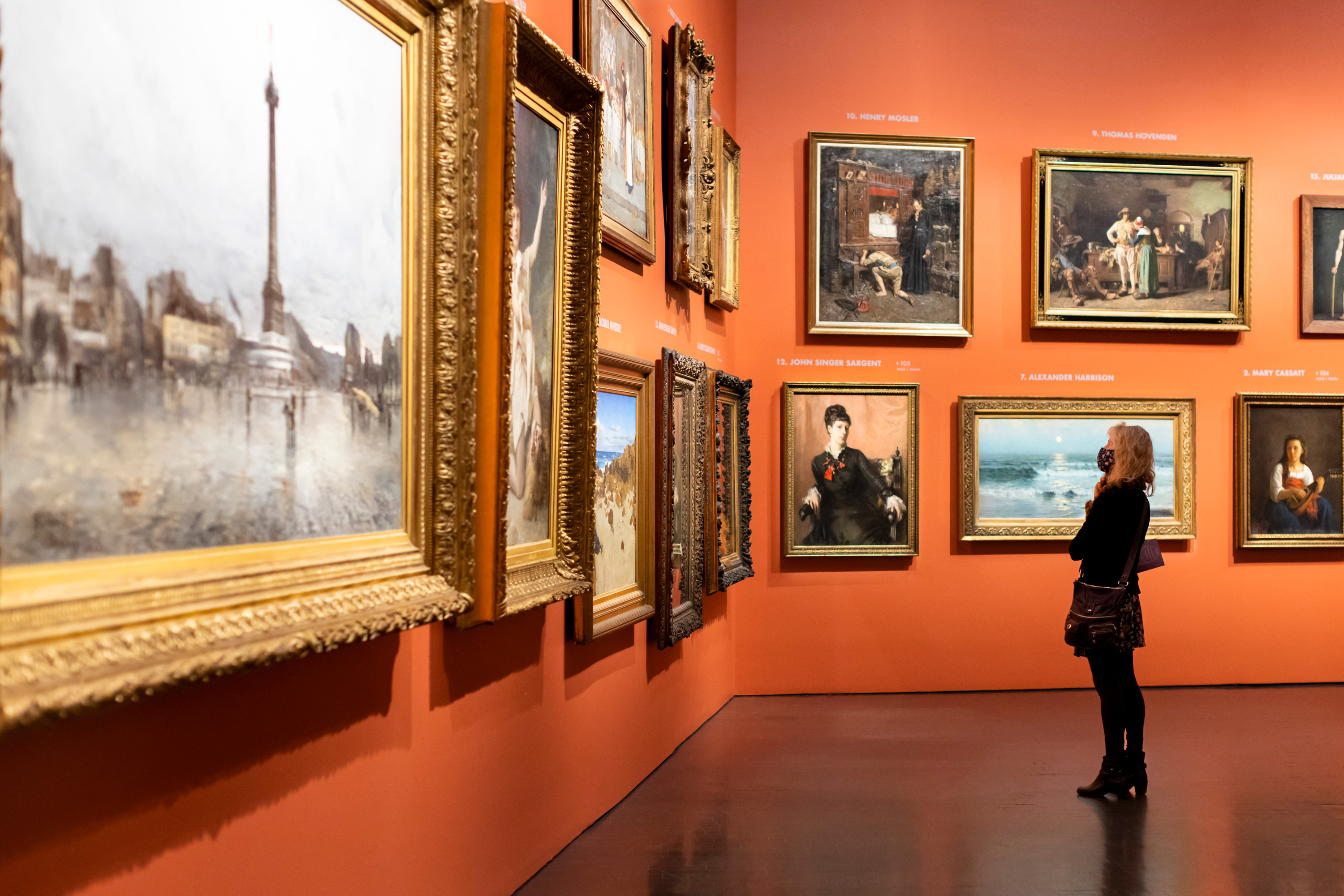
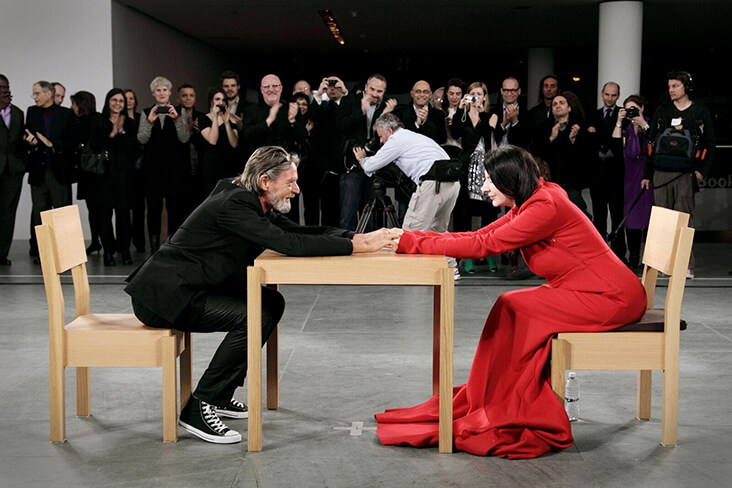

Marina Abramović negotiates some of these challenges to these conventions with different elements like standard video projections to present her past works in the museum (utilising “static” visuals and audio for the viewers to watch), hosting a “Clean the House” workshop with 30 other young artists seeking to re-perform her 5 previous pieces at the exhibition (training them to focus on their state of mind in the present), and herself being physically present in the location to perform her work “The Artist is Present” in MoMA day in and day out for 3 months. I find that these compromises add to the ideas playing around in her work. You can experience and interact with both sides of art ideology, and it clearly demonstrates Abramović’s vision for her performance art in an emotional and interactive way.

Make a Kilometre
Final Project – 1 km of Scrolling. (Video)
by Maria Nguyen
I chose to make it into a 5-minute portrait video format because I thought it would have been the best method to showcase what scrolling on Tiktok for 1 km would have looked like. With the time constraints, I had to speed the screen recording up 20x to keep it short.
- The reason why I chose to scroll for 1 km was because I thought it was quite fitting for this day and age of social media and mindlessly consuming
- It made me take a step back and sort of see just how much content you can consume mindlessly (sometimes you don’t remember the videos you just watched) – and how much time it takes from our precious lives
I was also just curious how long and how many videos it would take to scroll for a whole km. Personally, when I watch short form videos I like to watch each video fully and look at comments if I am interested, so it was cool to actually experience the fast scrolling motion of just seeing glimpses of the multitude of videos.
To describe details in the video, I start with a plain title card and using a relevant phone transition I show 3 of my process photos (including a flashing images disclaimer) to present my methodology in proving it was exactly 1 km. Then, there is a recording of my finger physically swiping up on a few Tiktoks, signifying the start of the tedious process – further transitioning and zooming into the screen recordings I took as I scrolled. The videos ramp up into 20x speed for the majority of the rest of the video (you can glance at the corners of the screen to see the passage of time passing and the battery percentage going down). At the end, I purposefully made it so that there would be a “time limit” pop-up to show on screen, which forces myself to exit the Tiktok app, to make it a full circle moment. Personally, I have a 1 hour limit on Tiktok to stop myself from scrolling and wasting my time for hours – I thought it would be nice to demonstrate how to be more mindful of your screen-time and how you use it.
In a gallery context, I would say there are many different ways it could be presented. The video itself could also be slowed down to the original speed (around 2 hours), to demonstrate just how long it takes to scroll for that far – it would be mesmerizing to view the swiping of the infinite-like short videos. On one of the walls there could also be a projection or copy hung up of my in-progress Tallying and proof of the 1 km calculation. On another wall, there could be an infographic in the layout of the Screen-time page on phone settings that have information of how much free time you have in your lifetime, and how much of it you would be using on scrolling.
The short video version could also be looped and shown on a large screen in the space, or there could be an interactive experience where the viewer has access to watch the video on a smaller phone screen, just as if they are scrolling themselves (like there are multiple stands with different phones available for people to see and scroll/pause the video to see what the image was). Going into more detail, there could even be a space in the gallery where people (viewers, or even performers?) are able to be cozy and lounge around with their phones, which can further illustrate the message of wasting time watching content on your phone. In a similar case, we can also invite the viewers themselves to scroll for 1 km on a pre-set phone that automatically stops once they have scrolled for 6666.66666667 Tiktok videos, to experience it for themselves.
Work In Progress Photos
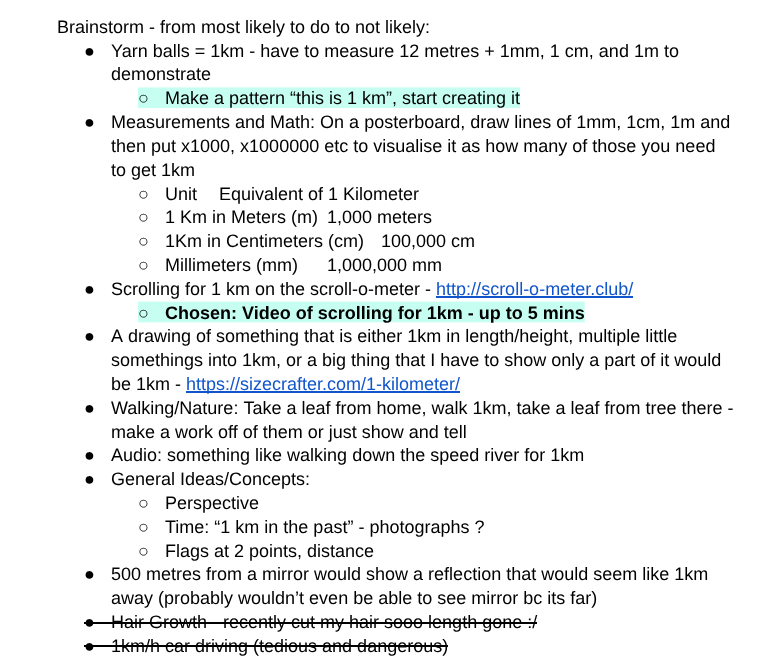
Here you can see my initial ideas, slight research, and inspiration ~
After having a short consultation with Michelle, I decided to commit to the Scrolling for 1 km idea because I thought it was very relevant to today’s issue with over-saturation and over-consumption of media and content online.
My original idea/reference was to just scroll for 1 km (or 0.621371 miles) on the website Scroll-O-Meter Club – but it wouldn’t really have been my original work/project. So I decided to scroll on Tiktok, an app that is short form video focused, and where I think it’s the worst place to scroll (in my opinion) because it can be very addictive and tends to take away a lot of my time.
These are photos of me measuring the phone screen (15 cm or 0.15 m), and also downloading the App onto my Dad’s phone (Both my Dad and I’s phone screens are both 15 cm, I had to switch between them because I wanted to have a blank algorithm for my personal FYP privacy, he had to leave so I created a new blank account on my own phone near the end).
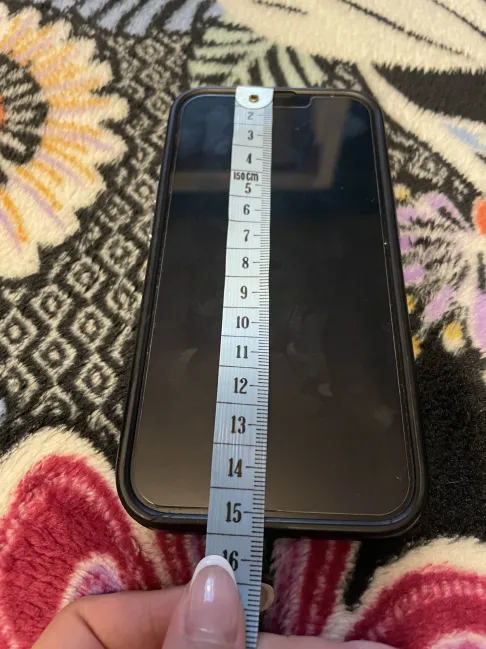

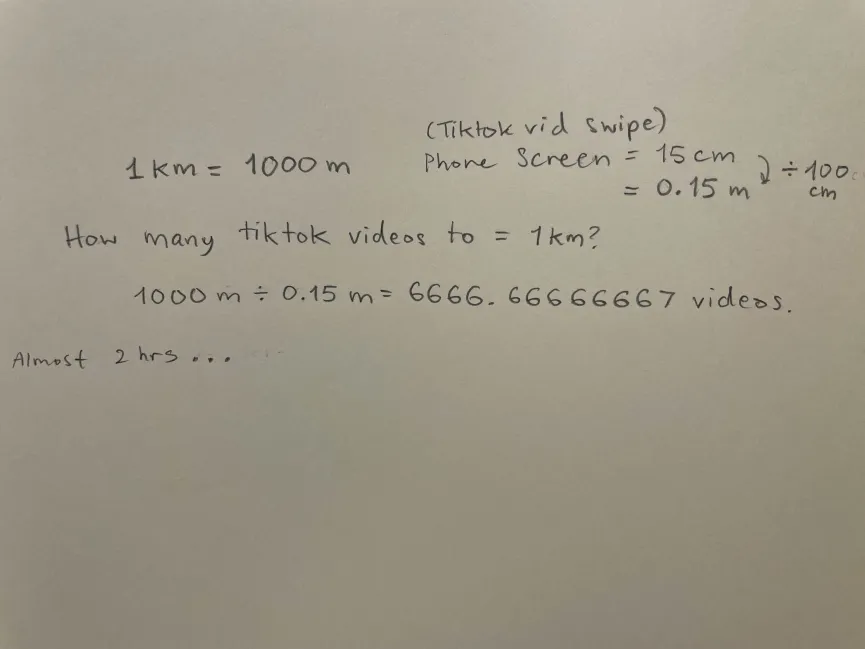
Methodology
At first, I found it hard to keep track of my counting with many distractions in the background (like my family walking in to ask a question, the sound of the videos playing too loud, etc.) as I was counting to 100 out loud. So, I switched my system to only count out loud to 10 while keeping track on my finger/using tallies.
As I was scrolling away with my right finger/thumb, my left hand was keeping count of the amount of videos I was scrolling through. Each finger was = to 10 videos, and I switched palm sides every 50 videos (5 fingers). When my “back” palm was complete, I rushed to tally it down (with my left handwriting) so every Tally = 100 videos.
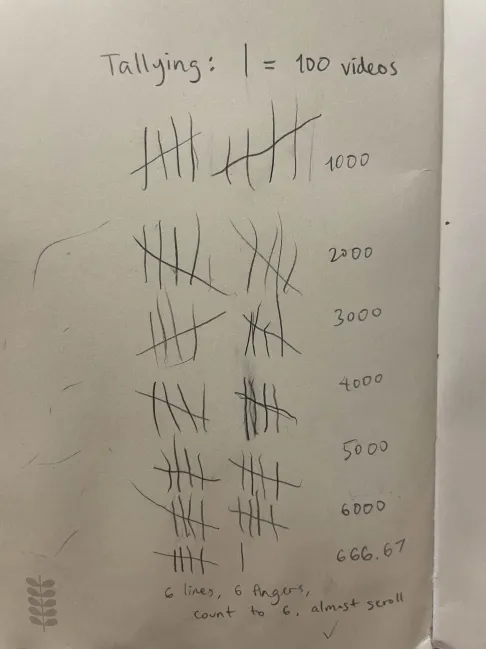
While filming the shots and screen-recordings, I used the CapCut App to edit my video. As I went along, I added the new recordings to the timeline and sped it up accordingly to match the 5 minute time-restraint, while also considering giving myself time to explain myself with the 3 process photos. I had to mute the audio down to 0 because I thought it would be too distracting to hear the 1-second high-pitched fast sound clips buzzing through while I would be explaining myself. Additionally, I was intentional with the transitions (ex. phone-holding at the start, transitions to look like swipes on a screen, blending the entering app and scrolling irl with my hand shot to the screen recording, and the screen time-limit/leaving the app).
NYT Dance Article
Turning the Gestures of Everyday Life Into Art
1. Describe the work discussed in the article and the unique challenges – as well as the unique gifts – that comes with attempting to archive personal movements?
This article focuses on the work of Katja Heitmann, a choreographer who is interested in the mannerisms, movements, and habits of people. The project, “Motus Mori” (aka ‘movement that is dying out’) includes a group of ten dancers that strive to keep the archive of gestures alive. These movements can serve many purposes, like self-soothing, habitual, and ritualistic – every body moves in their own unique way.
The unique challenges that come with attempting personal movements are that it is quite muscle memory dependent, as there is not much documentation other than a minimal note card per participant/donor. With the methodology being focused on the ephemeral, it is moment to moment and specific to that time and space. It is also difficult to be present at the installation for hours on end, interacting with the public (social aspect). You must be mindful of all movements and minute details of gestures, and your body is always constantly training (If you don’t use it, you lose it).
During the process of archiving personal mannerisms with the body, some unique gifts that become apparent are the ability to contain and embody a whole essence of a person just through the meticulous study and archival of their movements. Another gift would be the precious connection the dancer would have with the volunteer, as they trust the dancer with the knowledge of their insecurities and trauma.
2. Discuss one or two examples of movements in the article – what strikes you about them?
A few examples of some movements in the article are Tjan’s hiding his thumbs, and Heitmann’s father who would pull in his stomach when passing in front of a studio mirror. They strike me as both (as stated in the article with Tjan’s gesture) arrangements that let the body take up less space in the world. It’s very interesting to me, because I can relate in the same ways with my own little mannerisms (I sometimes do the same thing, even when I don’t notice it often). It might be an unconscious arrangement that may be related to low self-esteem, insecurities or shyness (not feeling like you’re worth enough to take up space in the world, hiding from being seen, or societal pressures to look a certain way when you aren’t at that standard with the tucking in the stomach – which I did as a kid when I was in pictures).
3. Describe the habitual movements/unconscious gestures, tics, etc. of 3 people you know well. How do individual body parts move, and how does the whole body interact? What about facial expressions, and emotional valence of the movement? How does body type inform the movement? What do these examples of small movements mean and imply?
The three people that I shall be describing here are my brother, my cousin, and myself (because I know myself best!). I will be jotting down some examples per person + implications/why we do them:
1 – Myself
- Head jerking
- to get hair out of my face
- Twisting wrist/fingers
- to “crack” and remove tension from it
- Face picking (scratching, rubbing nose, rubbing eyes, picking acne)
- Pushing glasses up nose
- Playing with necklace
- Fidgeting with fingers (rubbing hands, etc.), tapping on objects
- Squeezing sleeves/playing with edge of shirt/sweater
- When anxious/nervous before something happens
- Covering mouth with hand (when shocked, while eating, etc.)
2 – My Cousin
- Playing with the ends of her hair – brushing it through with fingers, tugging on section
- No emotion, focused (while studying)
- Implies hair is crusty after showering (she told me)
- Nail/Finger picking
- Anxious or bored bad habit
- Fidgeting with fingers, tapping on objects
- Bored, needing stimulation
- Pushing up Glasses on nose
- Squeezing sleeves/playing with edge of shirt/sweater
- When anxious/nervous before something happens
3 – My Brother
- Moving wrist up/down in repeated motion to “crack” it (palm upwards)
- Roughing up hair
- Implies wanting hair to be a certain way, intentional (but also became a habit)
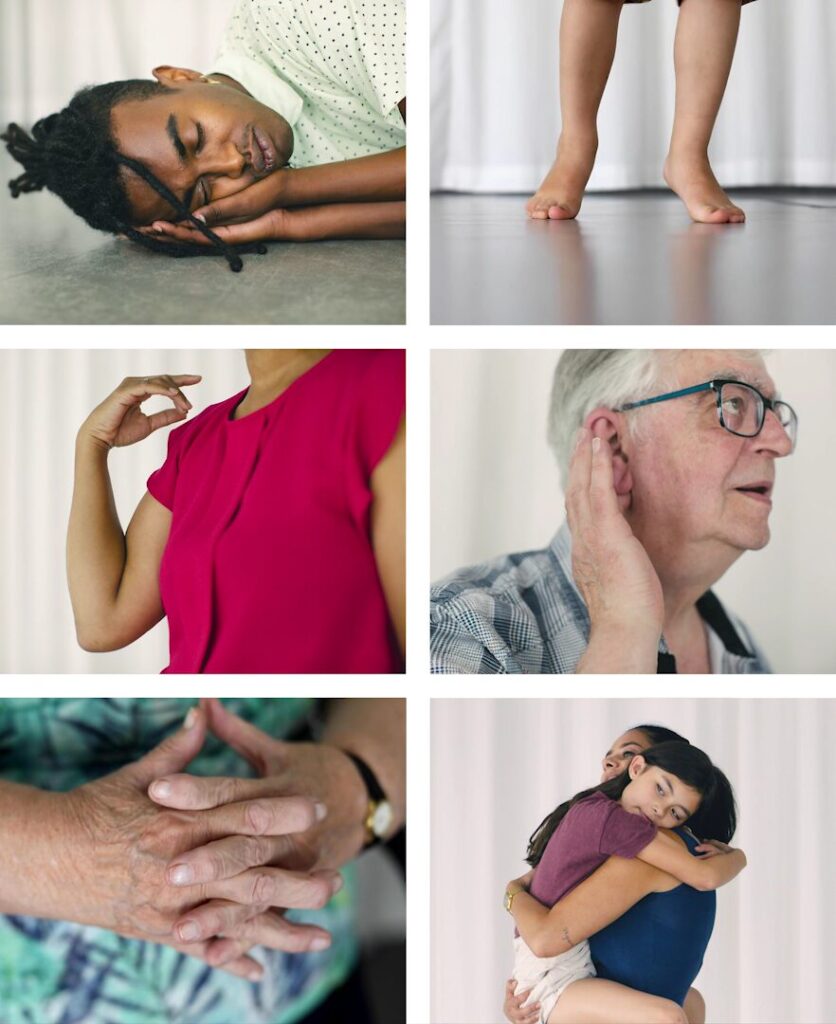
These examples of small movements are a compilation of different habits/mannerisms that we do at certain moments. They imply ways of being that we want of ourselves (like physical appearance wise – adjusting hair, glasses, clothing, etc. or self-soothing gestures we became accustomed throughout our lives that became part of our daily routines). Most of the time these movements are done without much emotion or without thought because it is so ingrained in our routine– it almost becomes second nature to us. Some mannerisms were specific to coping with feelings like boredom, anxiety, and stress/tension in the body. Interestingly, I wonder if it is because we are all related or because we all live near each other but I noticed that we shared many of the same gestures together. It could have been passed on from our parents and families.
AGG Visit
Warden’s Watch, 2025
Michelle Wilson
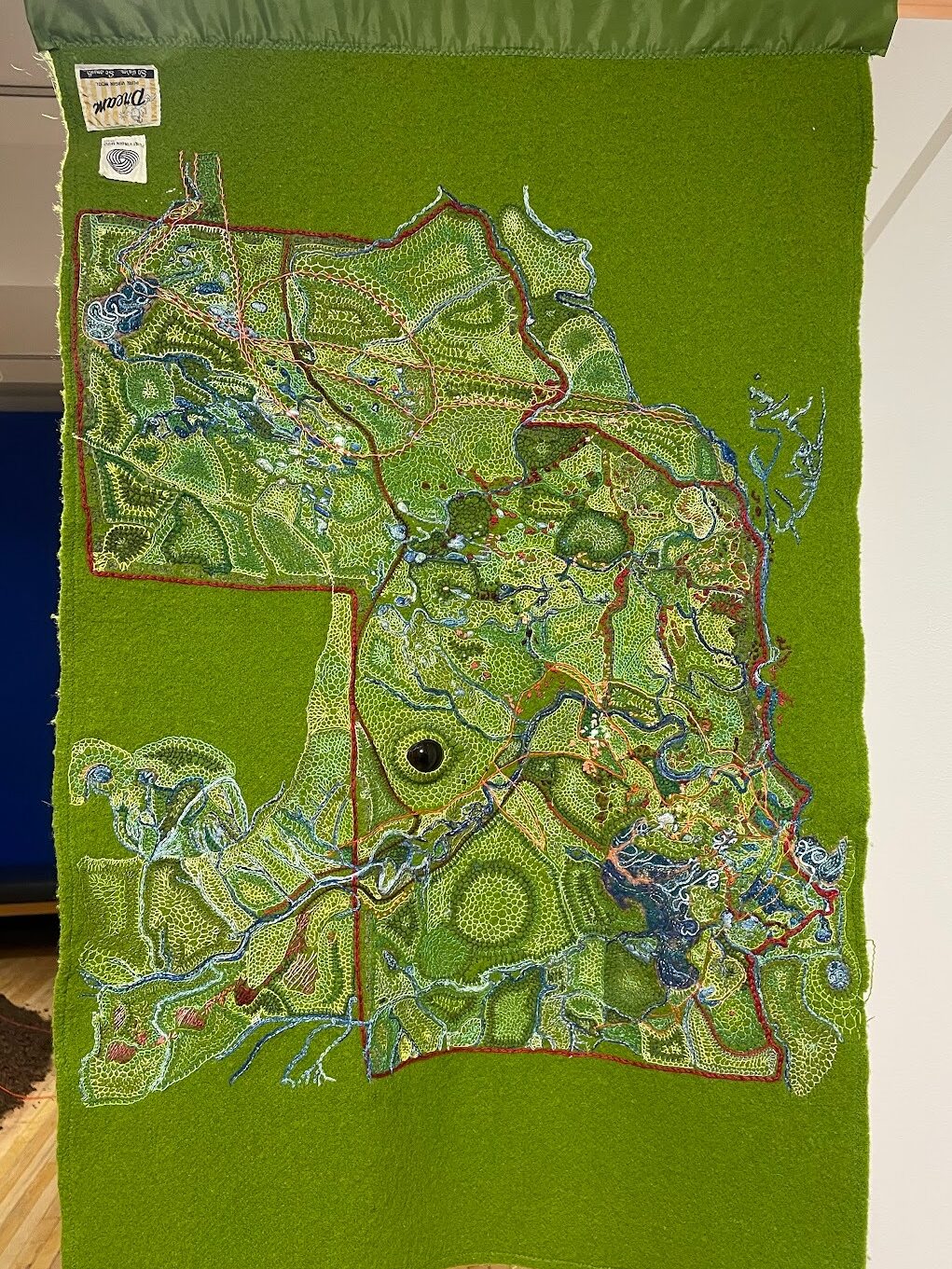
This work is a powerful examination and conversation of how industries extract from the land (like hydroelectric projects and pollution), and how it transforms the environment on an ongoing basis. Wardens used to record their patrols on this map of the land of Wood Buffalo National Park (located in northeastern Alberta and southeastern Northwest Territories).
This work is relevant to my own research interests and practice as I enjoy working with textiles and crafts, and I would like to make more pieces with my hands in the sense of using materials such as embroidery thread and wool. Currently, I know crochet, basic knitting techniques, and have dabbled in sewing and cross-stitching but I would love to try felting wool and create soft sculptures and more works of the sort (ex. In high school, I created a collaborative quilt/blanket made of knitted/crocheted squares). Additionally, I am interested in the archival map motif, using a map (place and time) as a symbol to communicate a historical story (whether it be personal or directed towards a certain topic like Canada’s park systems). The bright colours glistened from the lighting which drew my eye to the piece, and glass bison eye was especially a very striking focal point for me because it was almost like the bison was staring back at me (but it was also such a cool way to incorporate other materials into the textile work!). At first, I thought it was the eye of an elephant because the map had lines/area shapes that looked like the start of a trunk for me. I also absolutely love the visuality of the textures that almost look like the bison’s skin but are really sewn in details.
ICFWYWM, 2022
Devlin Macpherson
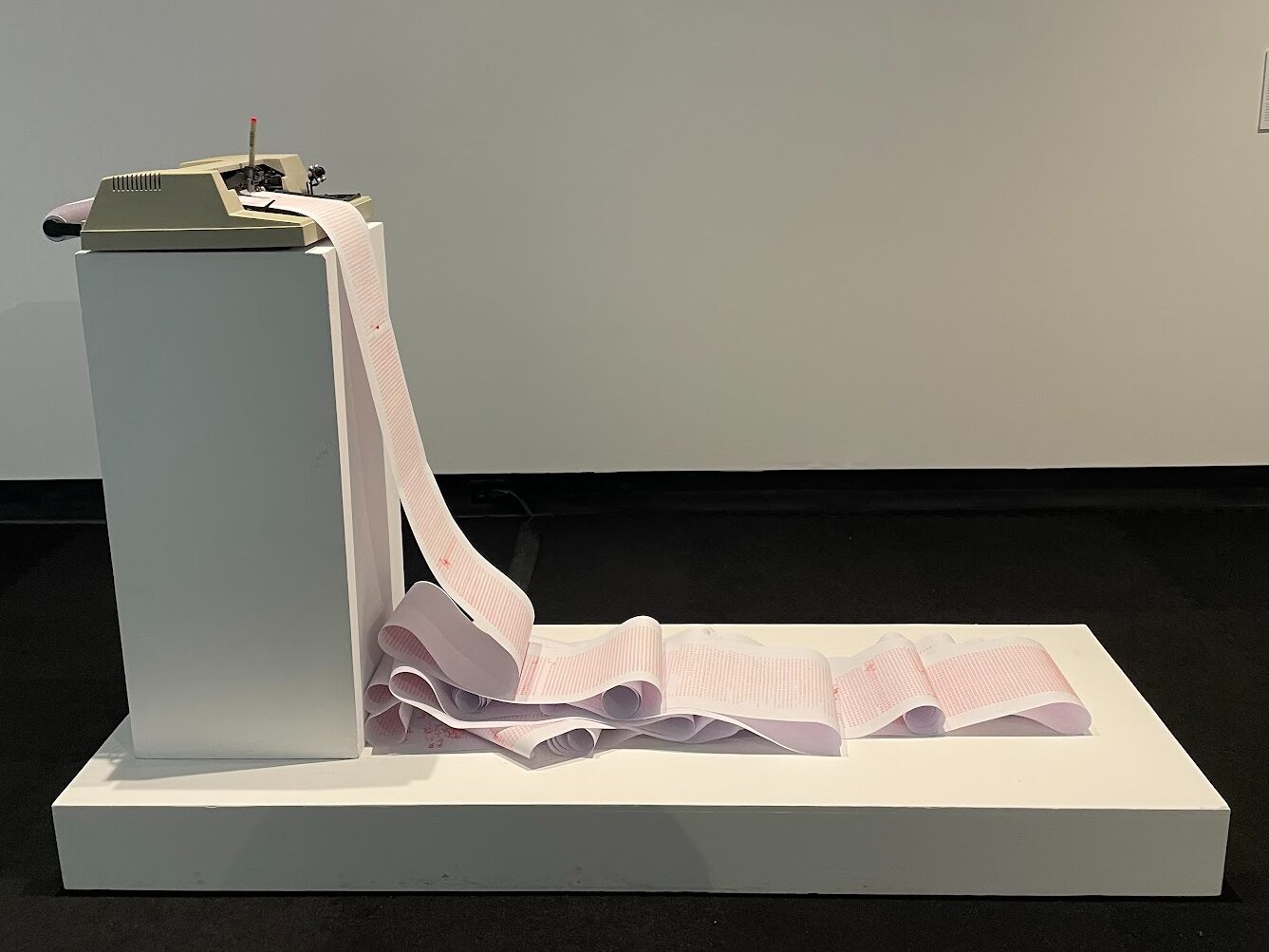
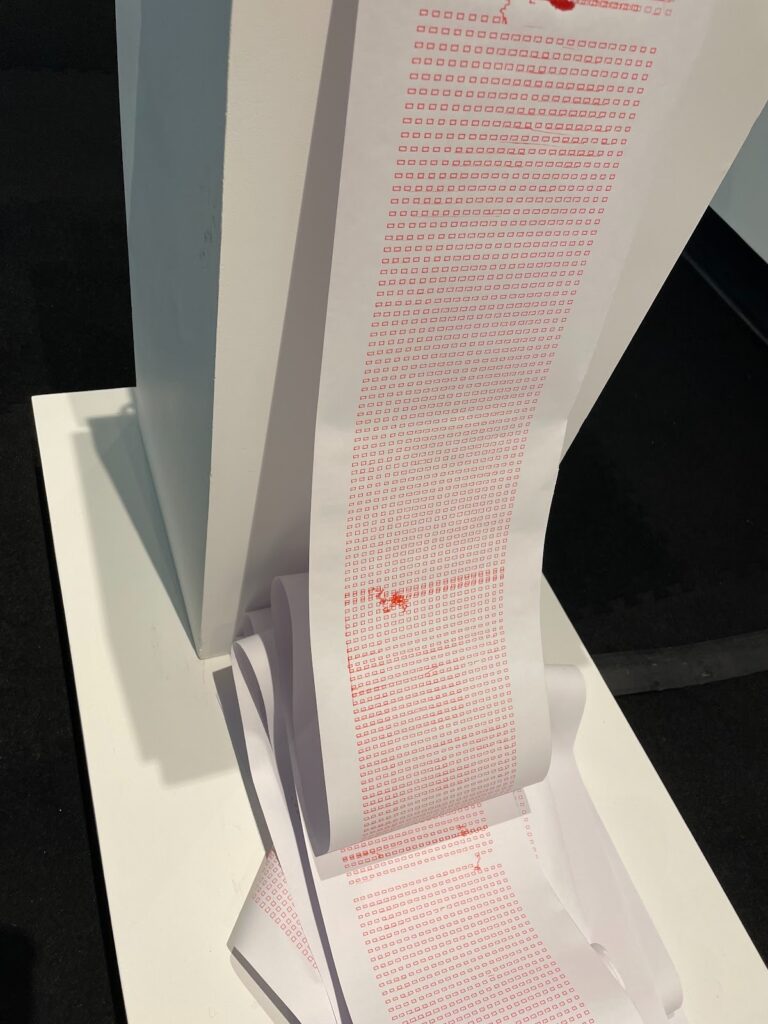
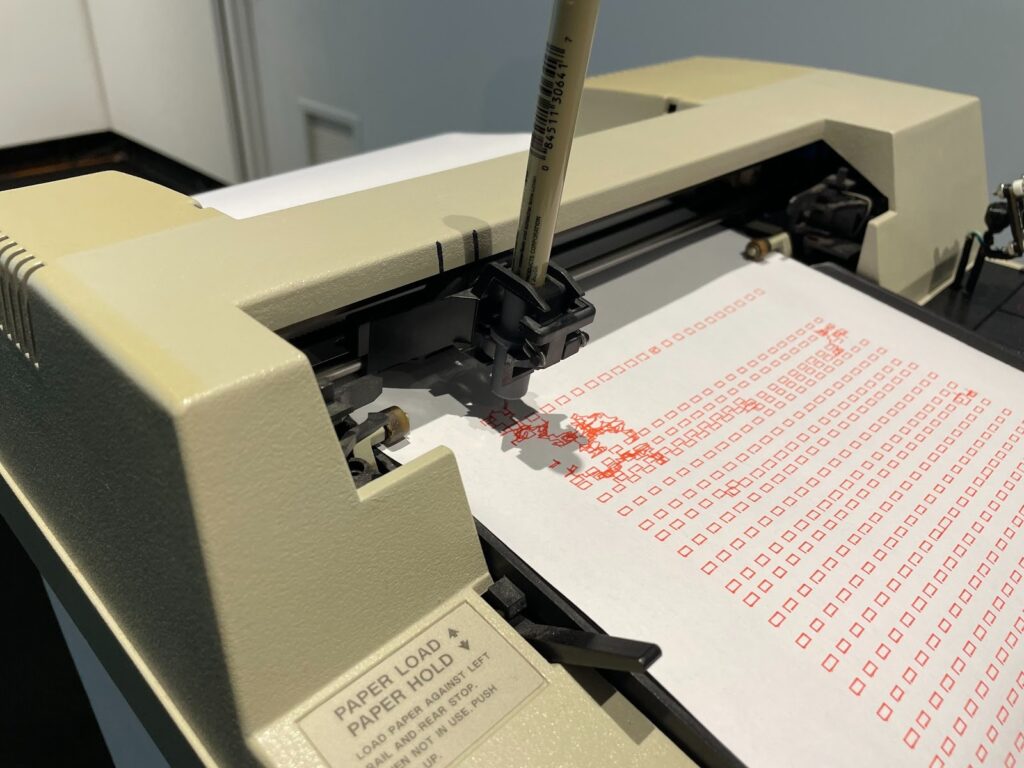
This piece is a machine programmed to plot pen marks (in perfect small squares) with orange permanent marker onto a roll of paper, however, with the attention of a viewer (or many) being detected by the face detector, the machine is then programmed to ‘mess up’ those perfect lines/squares because its ‘nervous and erratic’ from the attention it is receiving while being under observation. There were mechanical beep sounds of the pen plotting, and it became especially frantic when it sensed there was a person watching (increasing as more people were there). Macpherson delves into observation, the influence of the audience, and interference with this work. The audience is prompted to leave the machine alone, to be empathetic and provide the same respect and autonomy we give ourselves.
This work is relevant to my own research interests and practice as the themes explored here of observation, interference, and the power of the audience is very intriguing to me. I consider myself as an avid observer and listener with my introverted tendencies, so I may be one of those people staring and taking in the visual information in front of me (as part of the audience). However, I can also place myself as the subject of viewership, where I can especially relate to the nervousness and feeling of being watched while working on a task. Mentally, this would affect me in a large way and could be a block to my true focus on the task because I am preoccupied with others watching me (making me self-conscious of my every move, which could lead to me being more accident-prone than before).
During my experience of the works in the gallery, I began to appreciate the deep history of bison rooted in the land and immerse myself in the stories being told by the works by the amazing artists in the gallery. I learned that artworks can have a variety of interactive aspects to it, like the touch-activated thread which can play voice-recordings/audio, watching the time-lapse of the fossils decompose back into the environment, and the face recognition software which affects the way the machine works on its pen plotting. Overall, I thoroughly enjoyed my visit at the AGG (and I might visit it again during my CREA*2000 lecture to learn even more about it!).
One Feat, Three Ways
Video Art Assignment – Drinking
I love the interpretations from the critique about drinking/party culture or just the (peer/societal) pressures of having to finish the action (of drinking – but it can be applied broadly to many situations). I feel like the “race” between Ella and I, and the “tear leak” drip from Rhiannon’s mouth especially fit well for that. The cranberry juice itself was also very tart, and we all felt sick by the end of our filming (even with watering it down, too much sugar) – this can be an obvious connection to how drinking alcohol could make you feel sick because its literally poison to the body, with vomiting/nausea being a common side effect.
In the final videos, I took the feedback and adjusted them accordingly to those notions. Our group decided to keep the last clip in the edited video 2 of Rhiannon watering down the drink because it fits well with fighting the norm, but it has a cute and playful spin to it.
Pauline Oliveros
Reflection Question:
Pauline Oliveros describes listening as both a spiritual path and an embodied practice, one that fosters empathy, respect, and attention to the world around us. She reminds us that “play is the greatest research tool” and that “people aren’t listening very well,” suggesting that true listening requires openness, curiosity, and presence.
Reflect on your own experiences of listening — to sound, to others, to your environment, or to yourself. How does Oliveros’s idea of deep listening challenge the way you typically give attention? In what ways might listening through your whole body, or approaching sound as a form of play and research, change your understanding of connection, communication, or creativity?
After engaging with Pauline Oliveros’s ideas through the documentary, I’ve started to realize how I often approach listening as background rather than presence. I usually focus on words or melodies, but Oliveros’s view reframes listening as a full-bodied, mindful act that connects inner awareness with the world around me. It’s very in-the-moment, being spiritually present and aware of yourself and the environment around you.This notion challenges me to slow down and notice subtleties: the tone of someone’s voice, the rhythm of my own breath, or the ambient sounds I usually tune out in so called “silence”. For example, the sounds of birds and animals chirping and moving around, the elements/weather, vehicles, and the tuning of the radio were mentioned in the documentary – sometimes I notice them, but maybe it’s not enough.
I also find that in this day and age, many people are preoccupied with digital screens and might be listening to content almost all the time (like listening to music, watching long/short term videos and shows on streaming services, etc. – this is very relatable to me). This distracts many of us and takes away the change to be as mindful. As another thought, an interest I have is Autonomous Sensory Meridian Response (ASMR), which I sometimes like to watch/listen to relax before bed, or to be entertained. In this realm, “ASMRtists” are free to be very mindful with creating deliberate sounds, experimenting to find sounds that give you “tingles,” something that I thought was fitting to mention during this Audio Art project. I think it’s interesting how musicians and ASMRtists can have both masters and beginners, but they can all create sounds differently + it’s very subjective to the personal experience of sounds (whether they are good or bad, some people love a certain sound/tune, others can hate it).
Approaching sound as a form of play and research also feels freeing as a concept. It changes the mindset of being task-related into a creative, exploratory process. I remember last year in CREA*1000 I learned about the Improv Lab in MCKN, and participated in a workshop group facilitated by a Music Therapist (Priya Zalis, Clinical Improvisation in Music Psychotherapy) where I took instruments available to me (including vocals) and worked together with the group to improvise sound. Deep Listening reminds me that true connection and empathy come from being fully present, receptive, and curious. Listening not just with my ears, but with my whole self.
Audio Art
Generational Relationships to Vietlish – By: Maria Nguyen
This piece is an amalgamation of various perspectives from my family and myself of the story of their relationship to language – specifically with accounts of learning Vietnamese and English (in the respective language they are comfortable speaking in), or their level of knowledge.
It reflects my personal experience as a second-generation Vietnamese-Canadian and my connection to language, family, and heritage. I wanted to capture how time and cultural blending influence the generational transfer of Vietnamese within my family. My inspiration was Emeka Ogboh’s Song of the Germans (2015), as I recognized the usage of other languages and culture as a root for this project was possible.
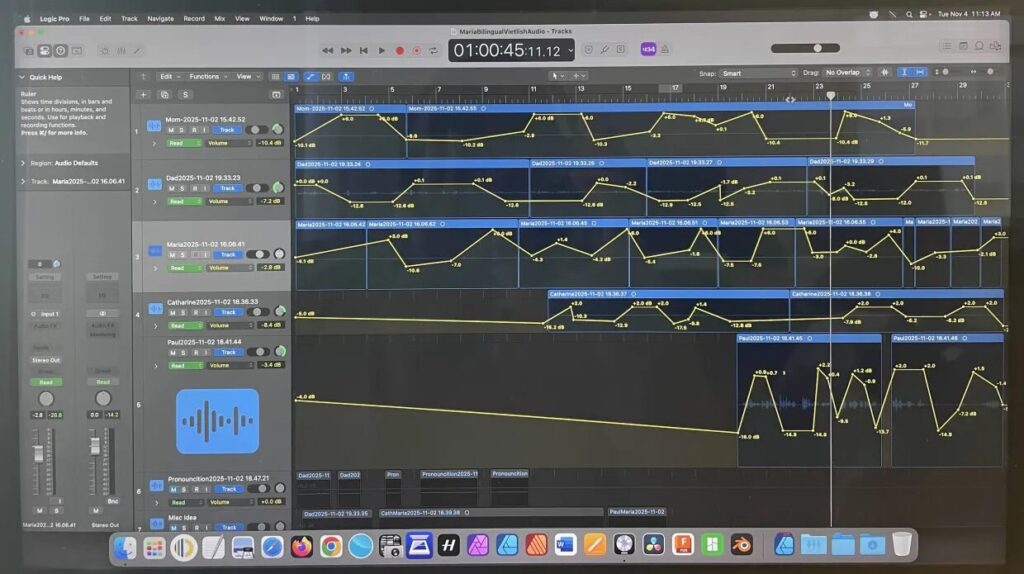
Using layering, volume automation, and audio panning, I positioned each speaker; my parents to the left, myself in the centre, and my younger cousins to the right – to symbolize a left-to-right passage of time and language shift. My parents’ steady voices represent the cultural foundation, while my cousins’ English speech and attempts at Vietnamese exhibit gradual loss. I chose not to include translations, emphasizing the personal and self-explanatory nature of the piece. Creating this was both cathartic and meaningful, and through thoughtful editing, I believe it successfully conveys the emotional and auditory story of our evolving linguistic identity.
Conceptual Portrait
Idea Proposal
I want to create a portrait of my cousin (“Chị Tran” was what I called her), who passed away last year.
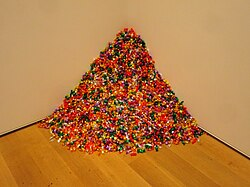
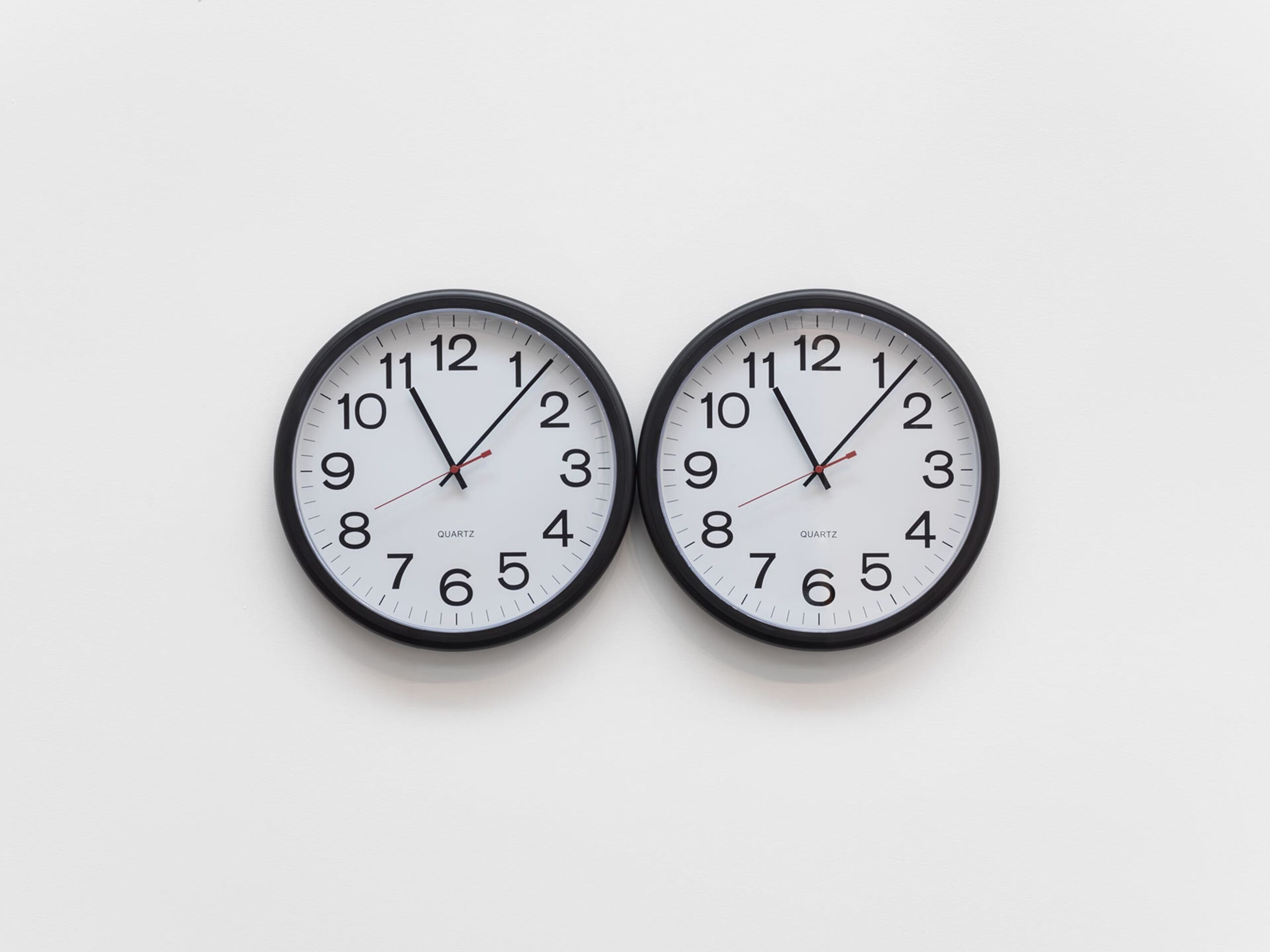
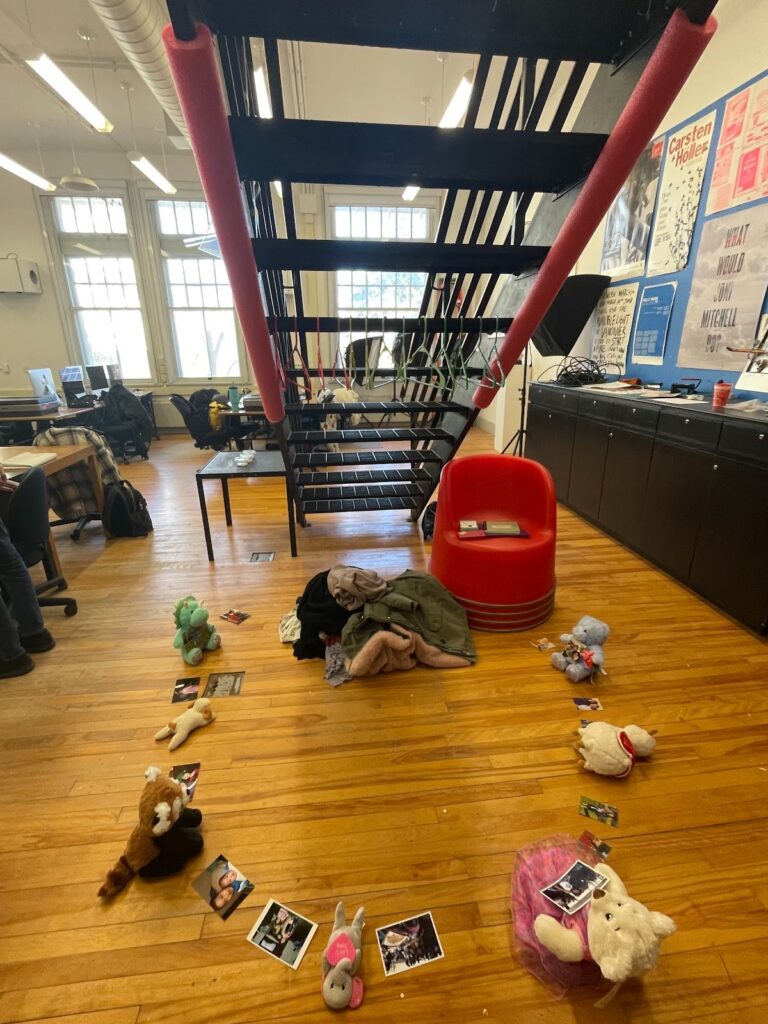
The system I was thinking of using was to make an installation and/or collage, using her belongings that I have – I also had the idea of a conceptual portrait of the “inner child” (initially for myself), so this could be something I could incorporate into my piece. Some objects I have of hers are clothes, notebooks, a necklace, and stuffed animals. I also feel like I can use my relationship to her as well in my piece with shared objects or certain things that remind me of her. My artist reference is Felix Gonzalez Torres, with his pieces like Untitled (Portrait of Ross in L.A.) and “Untitled” (Perfect Lovers) – I don’t think I will go as minimalist in my work as he does though. I also was influenced by Spring who incorporates ashes (remains) into the art piece.
Portrait of Chị Tran – By: Maria Nguyen
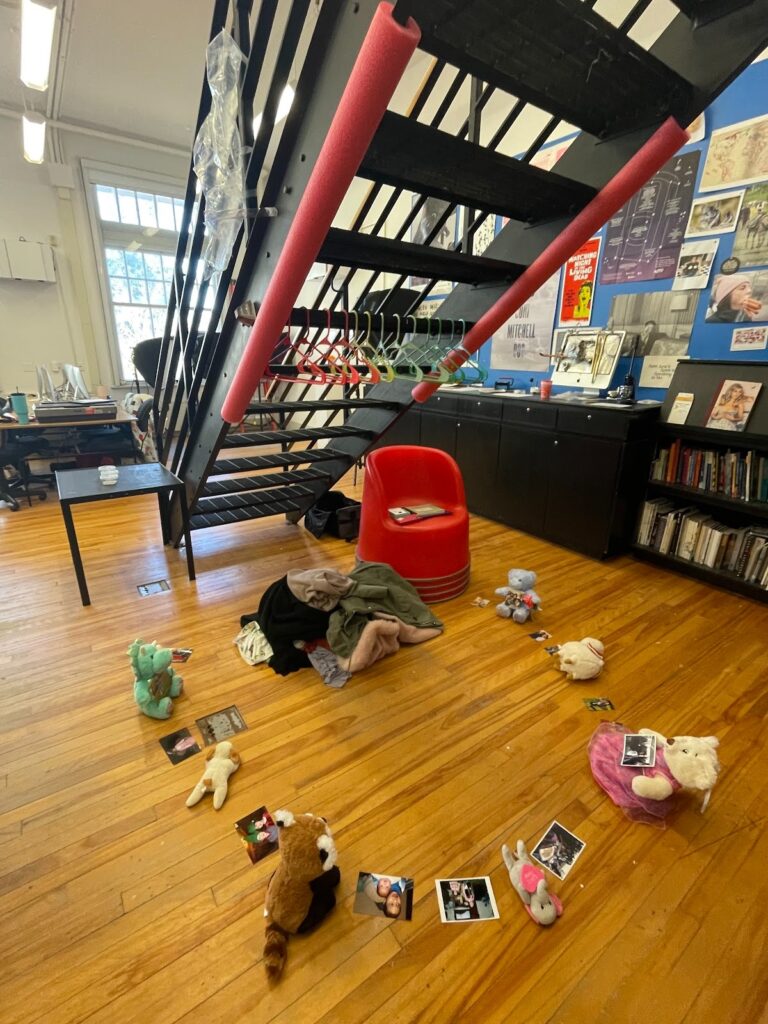
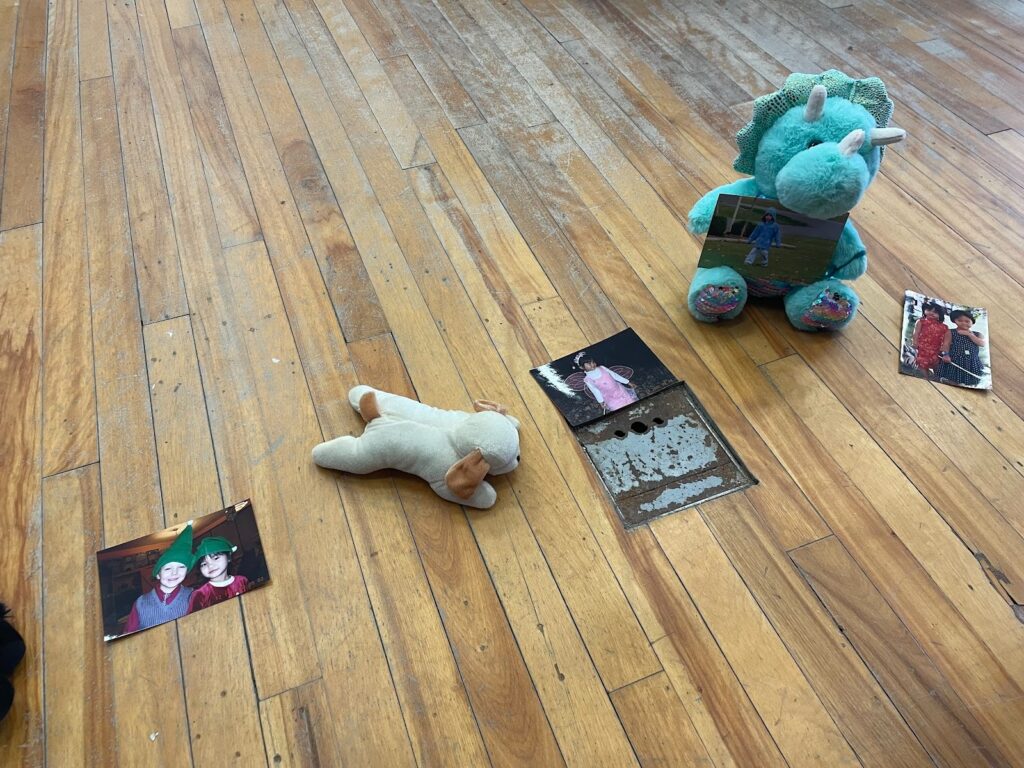
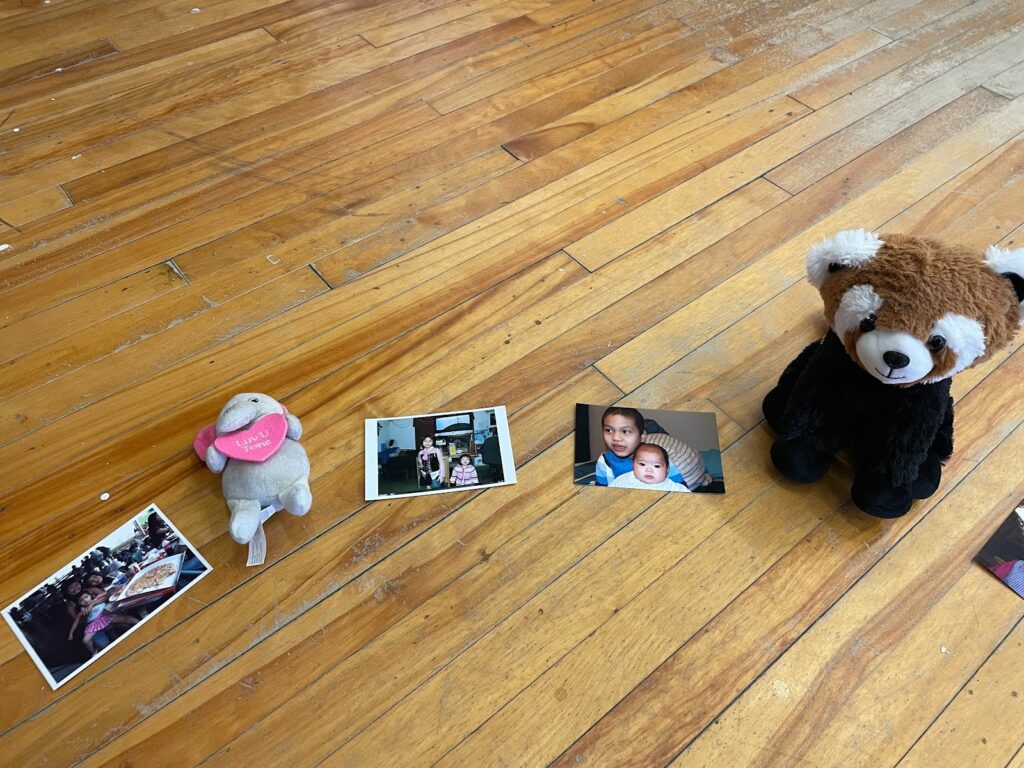
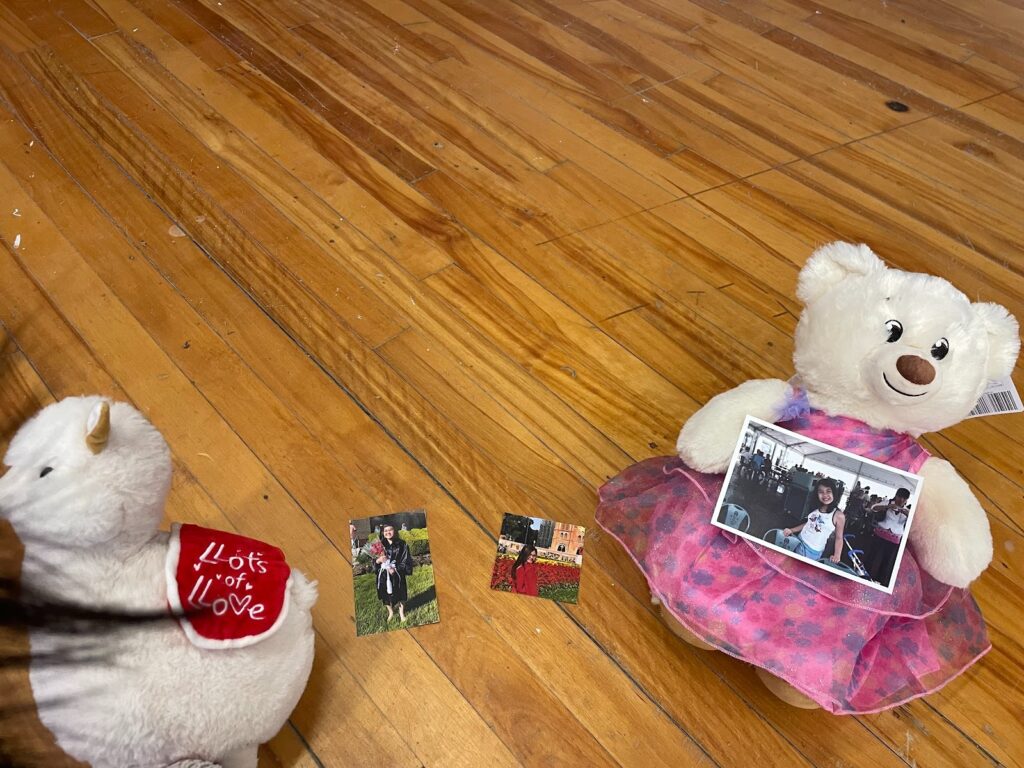
In memory of my older cousin who passed away last year, I decided to create a conceptual portrait in the form of a performance / installation art piece. My system was to use her belongings, her remains, in the sense that I can feel her absence. Her clothing, hangers, stuffed animals, and photographs taken of her in the past were some objects included in this installation. The action of hanging up her piled up clothing (and wearing it) is an embodiment of my everyday life, the ritual I participate in everyday of choosing an outfit for the day in my closet. I am giving her clothes a new life.
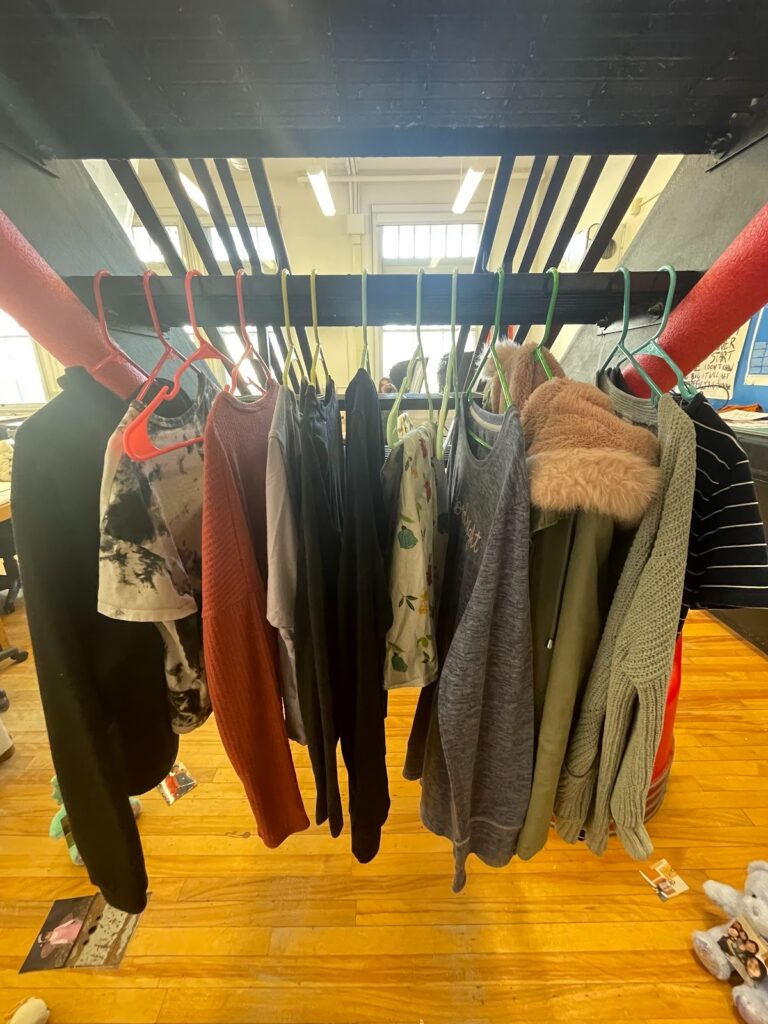
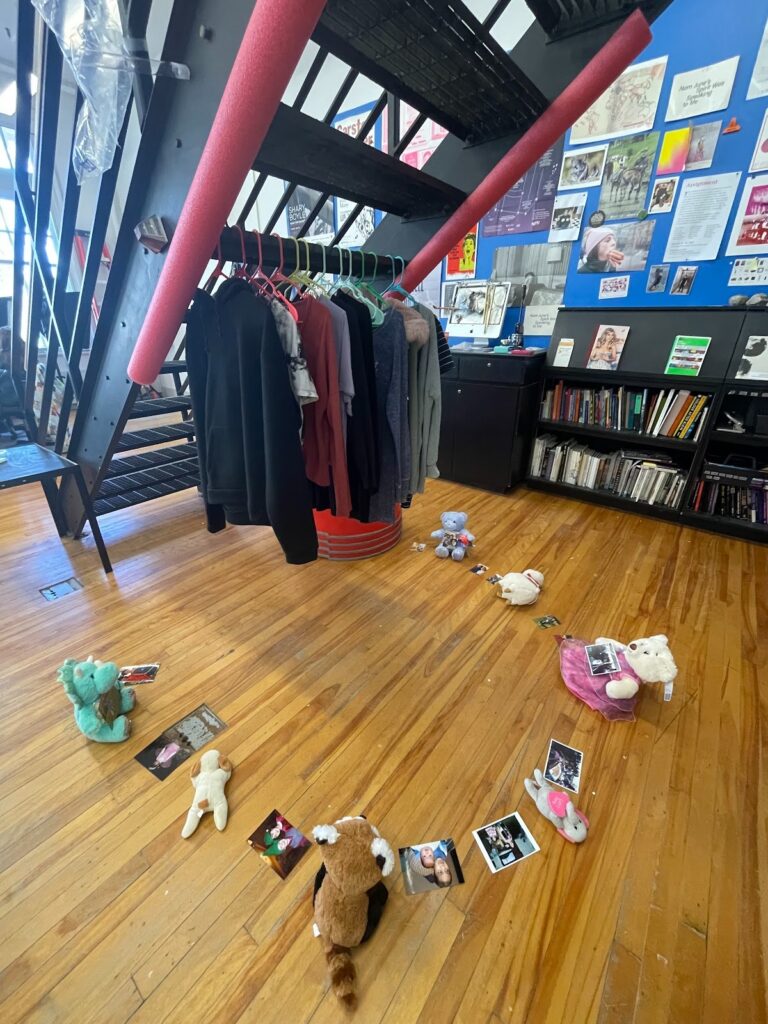
The hangers were ordered in a rainbow-colour coordination, as I have memories of ordering it this way in her closet when I came to visit during one of my yearly visits (she also loved everything rainbow).
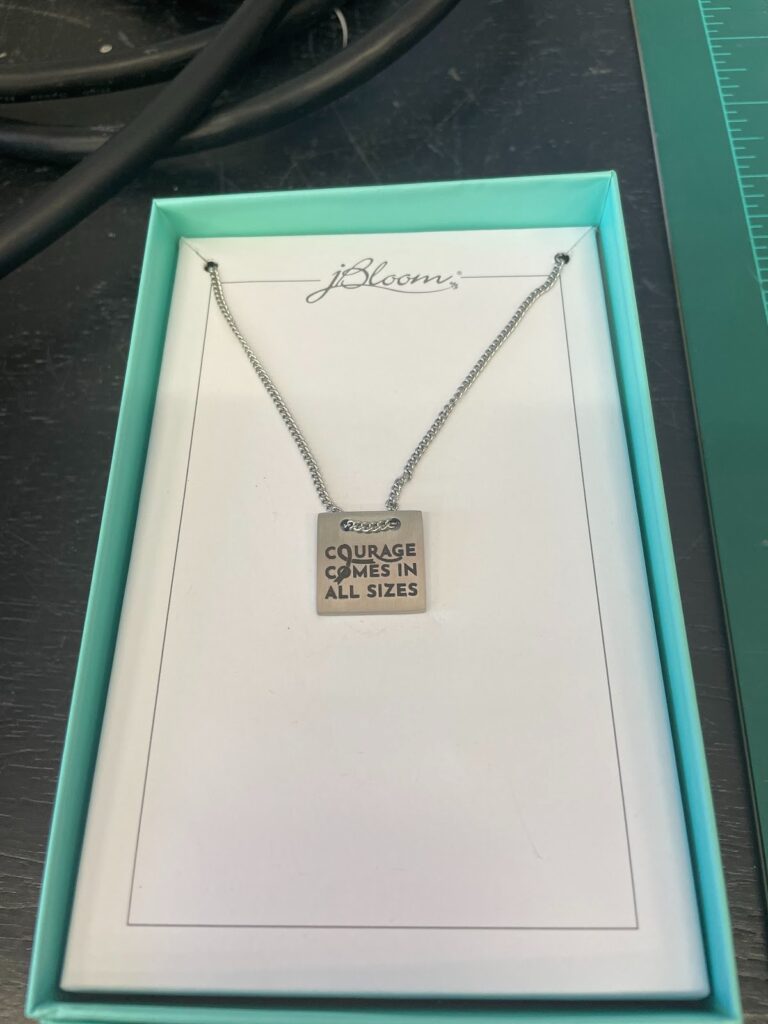
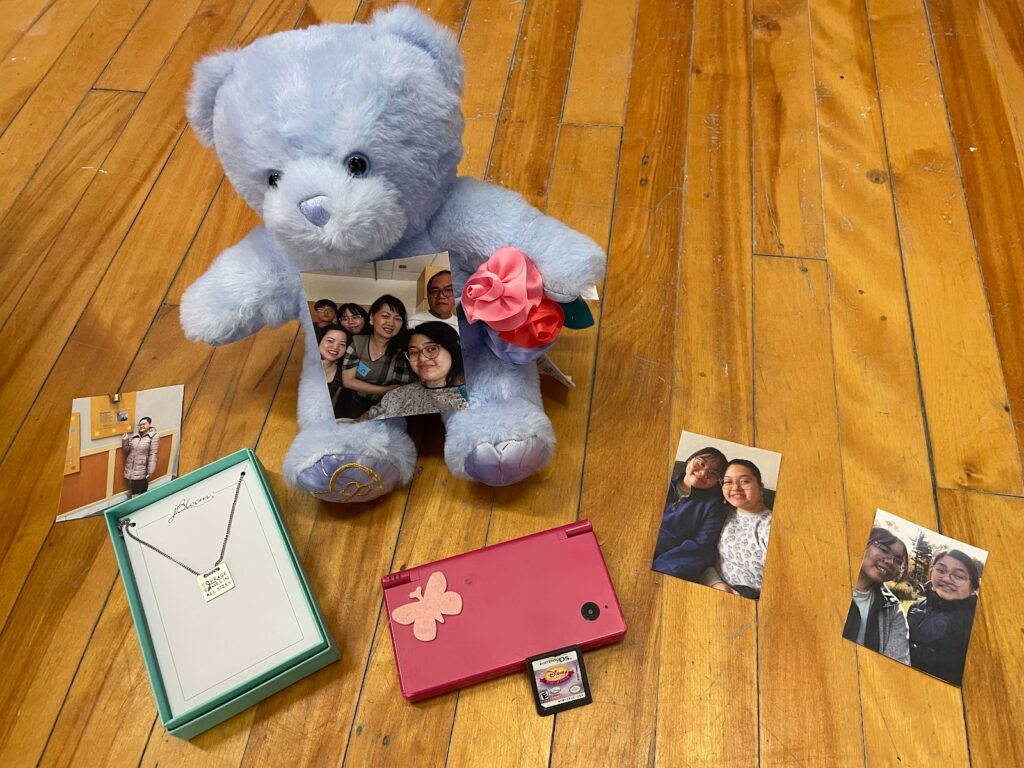
I incorporated her necklace, with the message engraved “Courage comes in all sizes,” with a ribbon on it to signify her pediatric brain cancer, which was a core part of her identity.
Additionally, at the end of the performance I played the game “Disney Princess: Magical Jewels” on the Nintendo DSi, which holds many fond memories between Chị Tran and I because she was the one that gifted both the DSi and game to me, along with speaking the dialogue to me when I didn’t know how to read English at the time (2011). In this piece, there are precious parts and memories of her that are interwoven into my life, which indicates our close (sister-like) connection.
Extra photos!
Counter-Archive Zine
Re: Presentation – By: Maria Nguyen
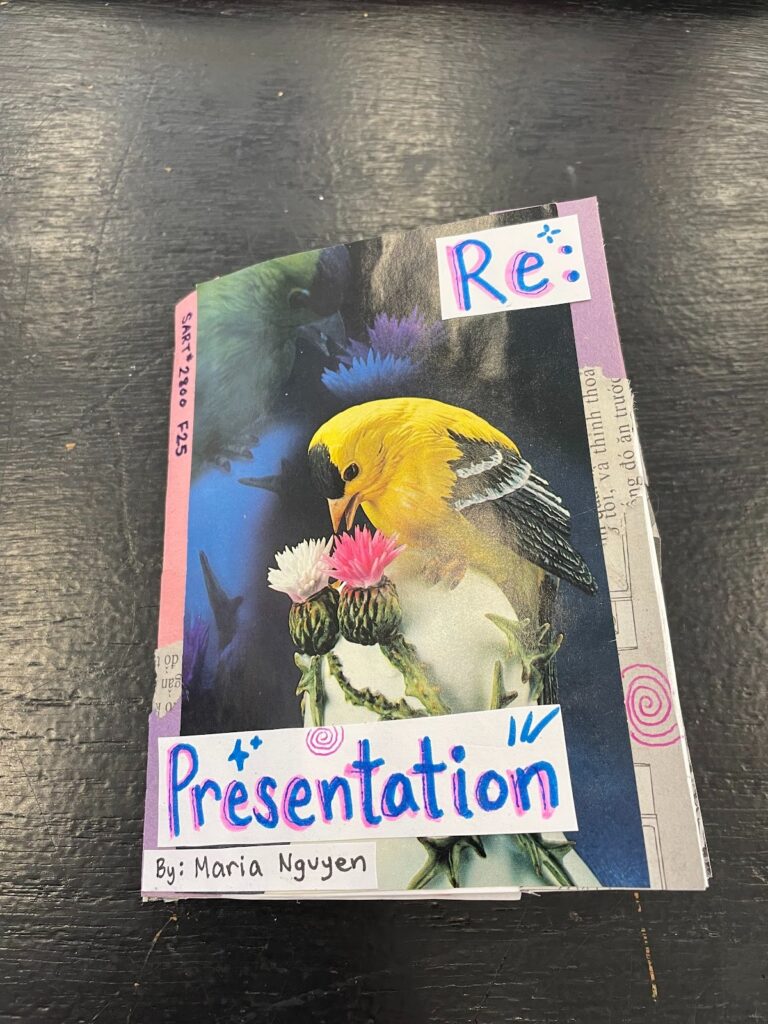
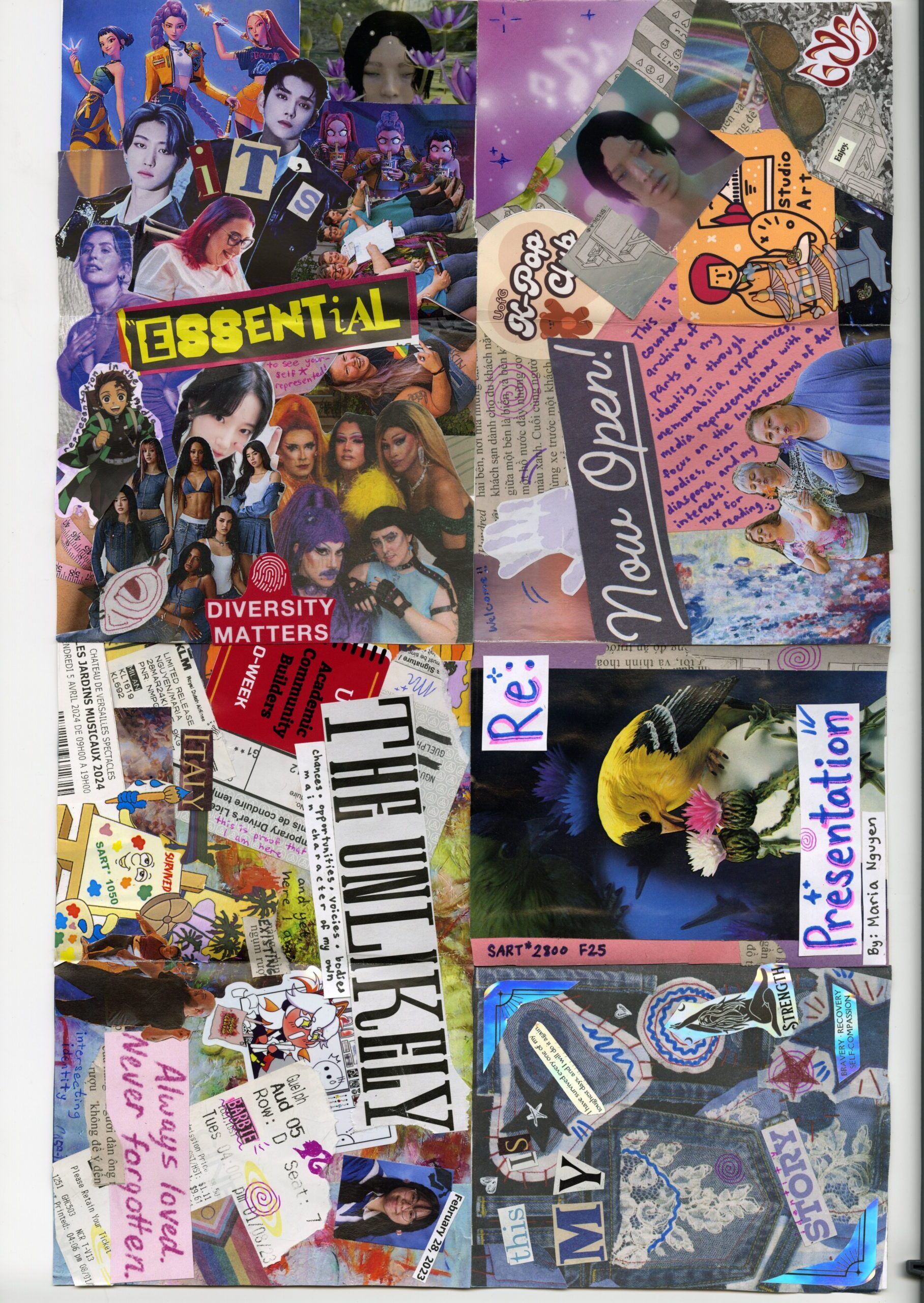
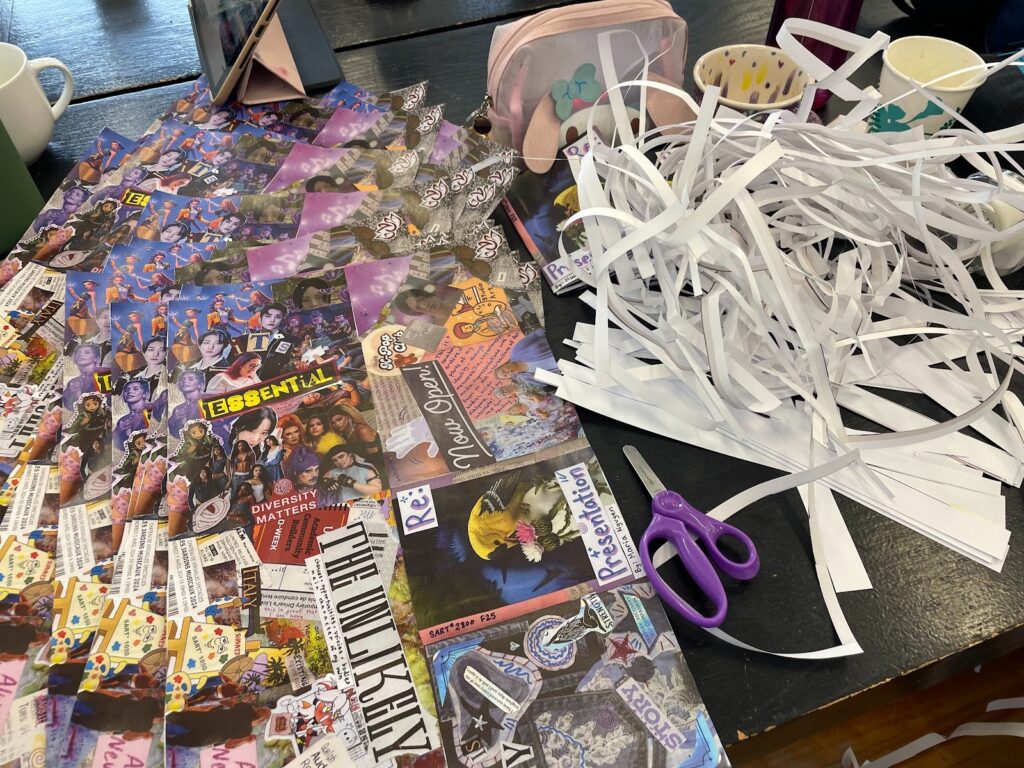
This zine is a counter-archive created from the fragments that shaped me; screens, scraps, stories, and small proofs of my existence. I gathered media representations I grew up (and collected in recent years like K-pop Demon Hunters) clinging onto as an Asian, fat, and queer person. I dive into these intersections of my identity and incorporate aspects of it throughout this counter-archive zine. I additionally include memorabilia from my life such as a Barbie movie receipt, stickers from volunteering, conventions, or from clubs I’m a part of, travelling ephemera, temporary drivers licence and my high-school graduation photo. These pieces come together to become a record that resists the narrow presentations offered to me (when I was younger) and re-presents my identity in my own way – I get to tell my own story.
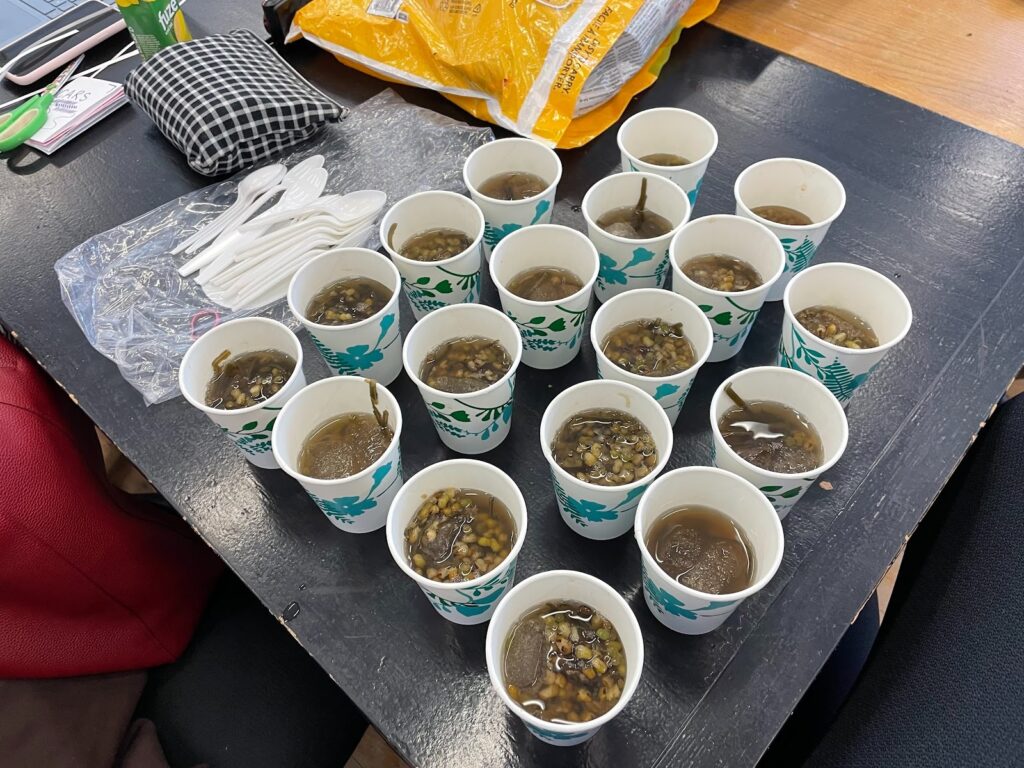
This is what I brought to the potluck: Chè đậu xanh (Mung bean sweet soup)! It’s a refreshing Vietnamese dessert that would typically be eaten in the hot climate to be cooled off.
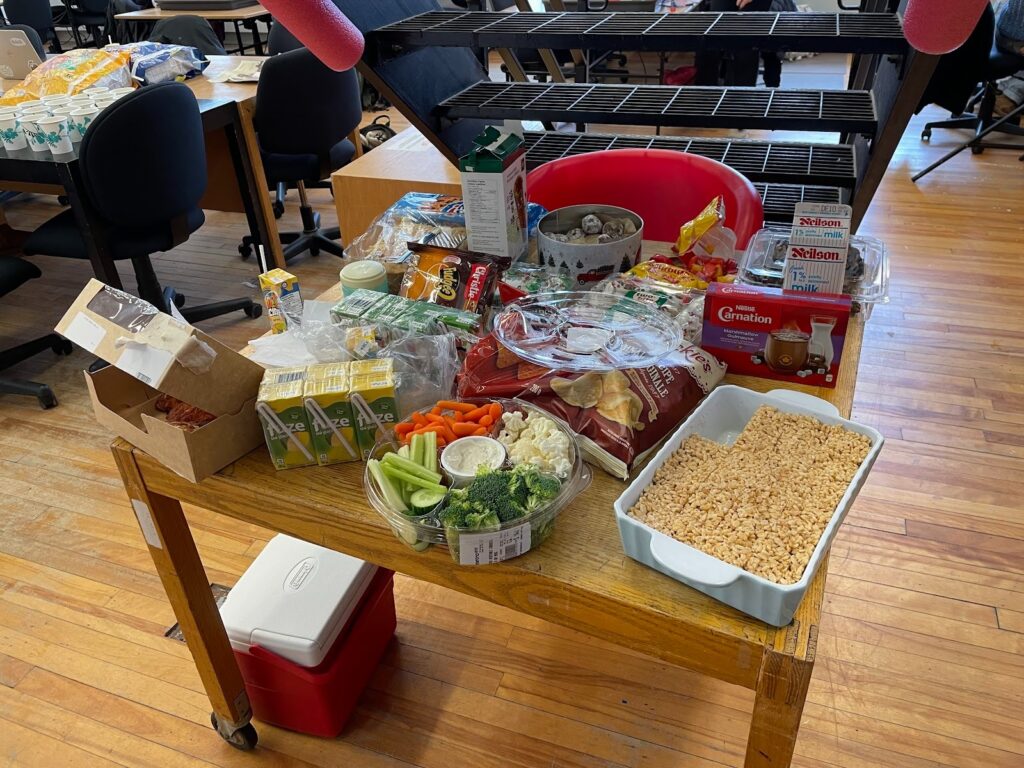
The end-of-term party was pretty fun! The zines that I have read were super interesting and lovely. I really wished I could have gotten to grab all of the zine copies but I was so focused on creating my own copies that I missed out on looking at some of the other ones TT (if you didn’t grab mine yet, I still have 1 more copy on hand with me, and I believe Michelle has the rest when I left them in the Studio room – if you would like my last copy please find me on instagram @mari_ng.uyen or mnguye30@uoguelph.ca !! I would also like to get more copies of zines that I don’t have yet ~)

Overall, I really enjoyed my time in this course with the challenging conceptual assignments and being able to see all of the wonderful and creative minds at work from my peers! I do wish I could have connected more with people in this course – hopefully I’ll see you all around in the future ; )
Leave a Reply
You must be logged in to post a comment.