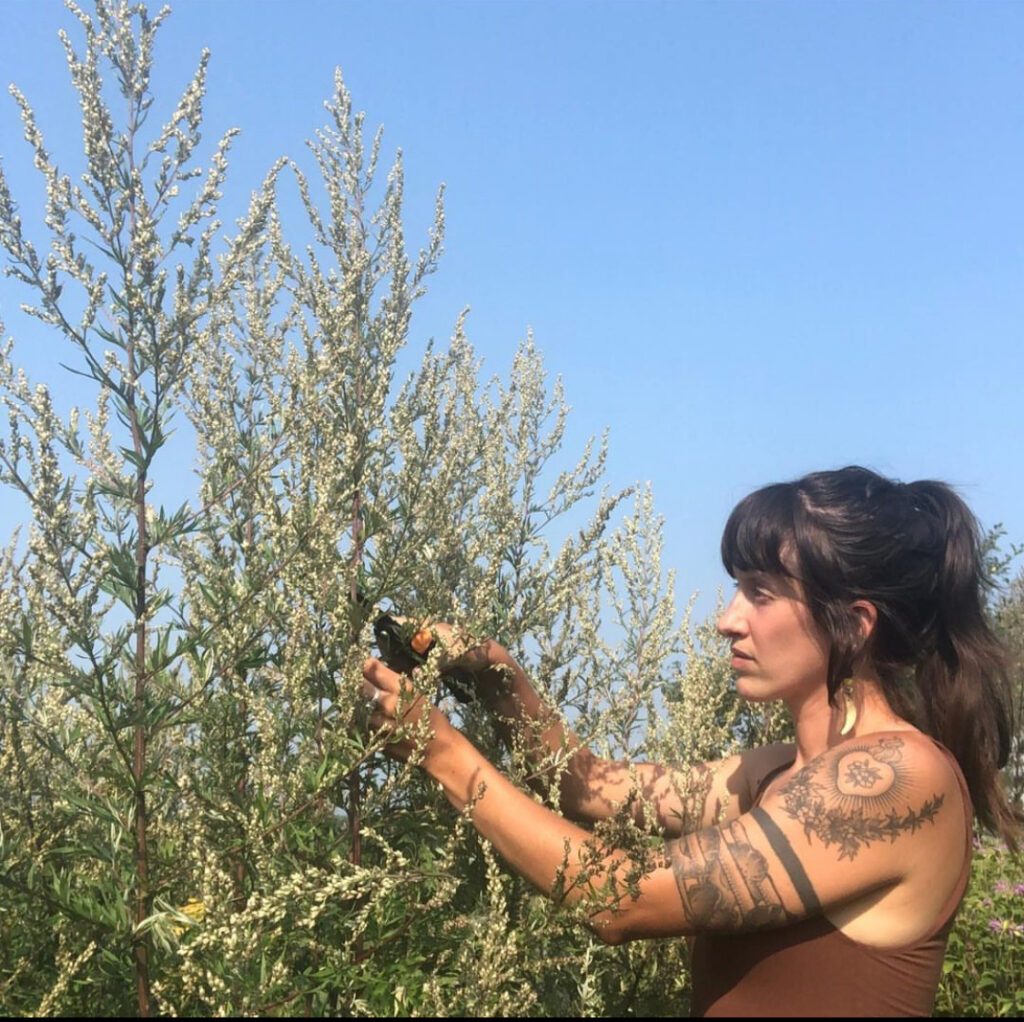
Hi, I’m Dani. I’m excited to be back in school to write, research and make art at the intersection of land, liberation, queerness, and craft. Outside of school, I study and teach about plant medicine, ecology, and land-based art. Here’s me with one of my fave plants, mugwort =]
Make a Kilometre
For this project, I conducted a plant species index of every plant I could discern in one kilometre of urban green space.
I live near the Eramosa River Trail, a foot/bike path that runs along the Eramosa River between Victoria Road Park and the Gosling Bridge. I used Google Maps to map out exactly a kilometre of the trail from the end of my street to a nearby park.
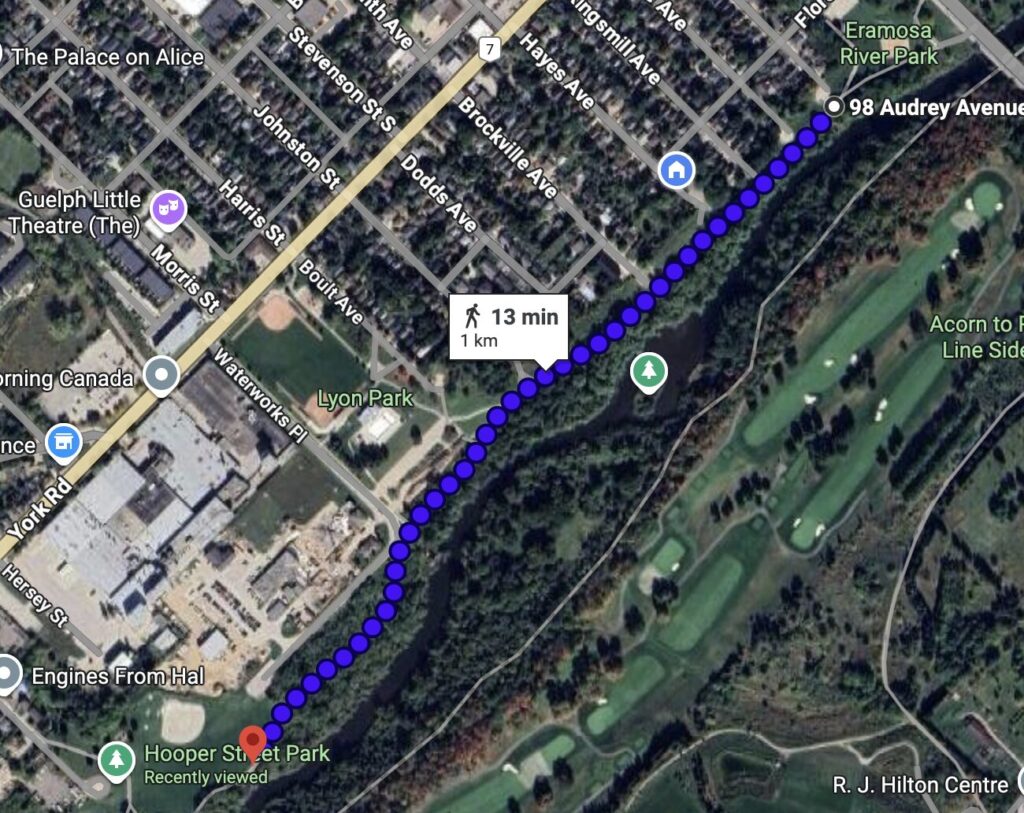
I walked this kilometre in each direction on Sunday, January 11th from 3-4:30 pm, taking notes on the notes app on my phone. It was interesting to rely exclusively on stems, bark, seedpods and dried leaves as ID features instead of foliage and flowers.
Species list, heading west:
Highbush cranberry
Crack willow
Manitoba maple
Vitis spp. (wild grape)
Canada goldenrod
Cup plant
Bittersweet nightshade
Red oak
Burdock
Pagoda dogwood
Rosa multiflora.
Eastern white cedar
Tamarack
Mystery maple
Motherwort <3
Red maple
White spruce
Black cherry
White pine
Clematis
Buttercup
Zigzag goldenrod
Mystery grass 1
Mullein
Bull thistle
Mystery viburnum
Rumex spp. (dock)
Black raspberry
American basswood
Ninebark
Japanese barberry
Plantain
Mystery grass 2
Wild currant
Wild cucumber
Buckthorn
Aster
Heading east:
Red cedar
Staghorn sumac
Chicory
Queen Anne’s lace
Catnip
Red osier dogwood
Canada yew
White ash
Teasel
Mystery spiky tree
Black walnut
Total: 48
FEAT
Sequence
Animation
Conceptual Portrait
The prompt for this assignment, to consider representing a person not by what they look like, but by what they make or do, made me immediately think of one of my best friends. byron is an outdoor educator, wildlife tracker, and artist, and one of the most intelligent and curious people I know.
byron’s built an incredibly deep and broad body of knowledge of the natural world through self-study. An essential tool in this journey has been what he calls a “question book.” Spend five minutes outside with byron and he will inevitably start to wonder about something he notices. A tiny, battered notebook emerges from the breast pocket of a well-worn canvas jacket, and the question is scrawled inside. What’s impressive about this practice is that he actually follows up on each question, answering most by consulting his extensive library of field guides and natural history books, and online databases of scientific journals.
For the past decade of being dear friends and colleagues with byron, I have seen many question books come and go. A committed archivist, byron saves them all. I thought it would be interesting to create a portrait of my friend through documentation of the question books, by scanning or photographing them and presenting them alongside data like dates and major events in his life. These images and text could be installed in a gallery space in chronological order, creating a timeline of this period in byron’s life.
My artist reference is Kelly Marks’ In and Out (1997-ongoing). I was inspired by Marks’ documentation of the repetitive action of showing up to work as an artist, which to me echoes byron’s commitment to his vocation as a naturalist through the ongoing and rigorous work of curiosity and research. Whereas Marks is archiving and gesturing towards her artistic labour under capitalism, byron’s question books archive the expansiveness of his knowledge.