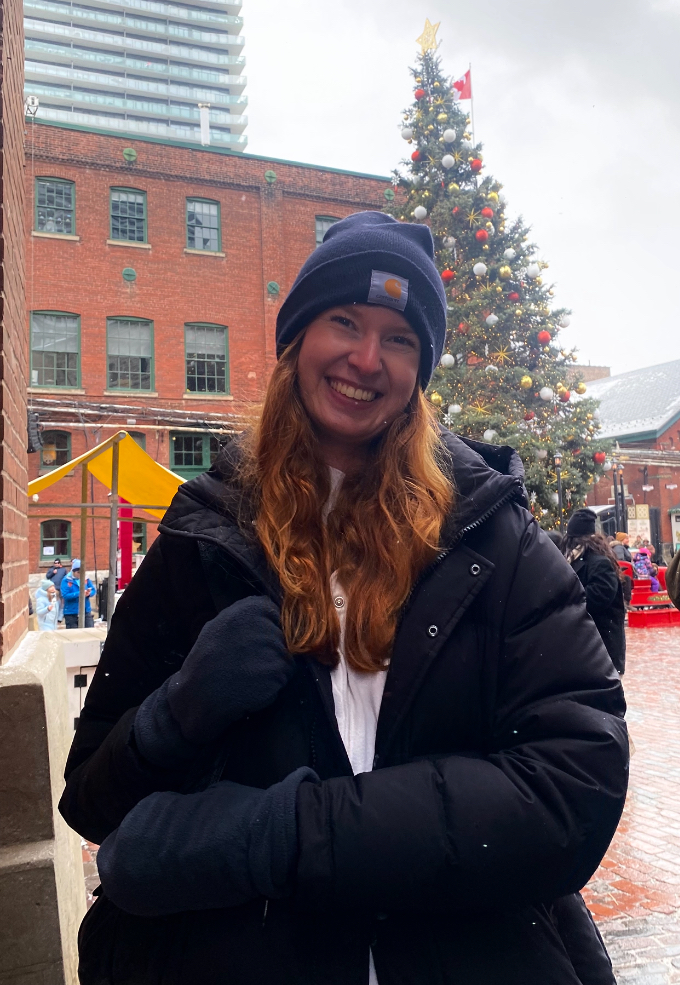
Hi, my name is Julia! I’m a second-year studio art major with a minor in English. I started in the Bachelor of Arts general program last year and decided to declare my major in studio art after falling in love with the program. However, by the end of high school, I was pretty certain that I wanted to do something with studio art, but it wasn’t until a few months in that I realized that this was what I wanted to do. My goal from this is to become a high school teacher and be able to express my love of art to other people ( and hopefully inspire them as well).
Documentary – “The Artist is Present” By Marina Abramovic
Questions:
- What are some of your first impressions of Marina Abramovic’s performance works, based on the documentary? Use an image/example of one or two works to describe aspects you admire, and aspects you might agree are problematic.
My first impression of her work was that it was very intense. As much as I love art, I cannot even think about sacrificing my entire life for it. For that, I admire her strength, perseverance, patience, and confidence that she brings to all her work. However, I do agree that various aspects of her work are controversial. For example, both images ( and most of her pieces) in a way risk her health, and there comes a point where you wonder if it is worth it to risk your life for the sake of performance, potentially. Along with everyone who is included in her performances as well.
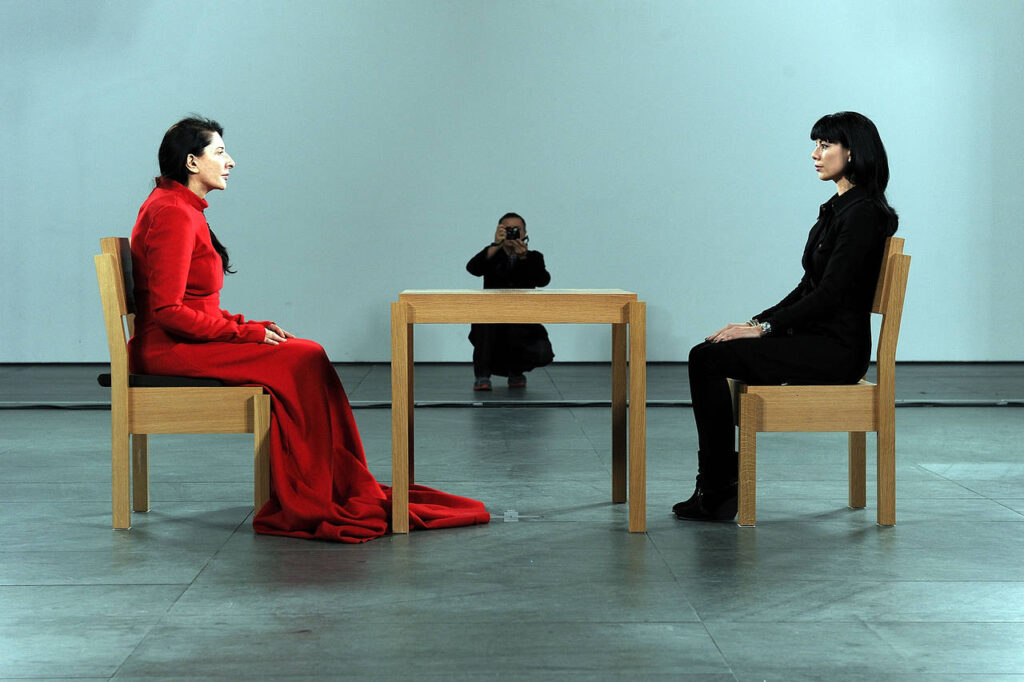
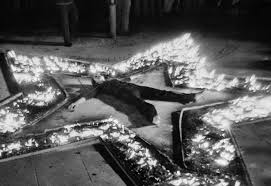
- What have you learned about the features of performance art based on Abramovic’s work? Name a few key features according to her examples. Include an image to illustrate. Consider her quote, “When you perform, it is like a knife and your blood, when you act, it is like a fake knife and ketchup.”
I learned how interactive and personal performance art is based on watching the documentary. For example, the importance of actions in relation to presence and time. I feel like that quote represents how she is performing reality, opposed to illusion, which is then part of the way she uses art to convey emotion, I think. Having the realistic element to it makes people think more about it and feel more.
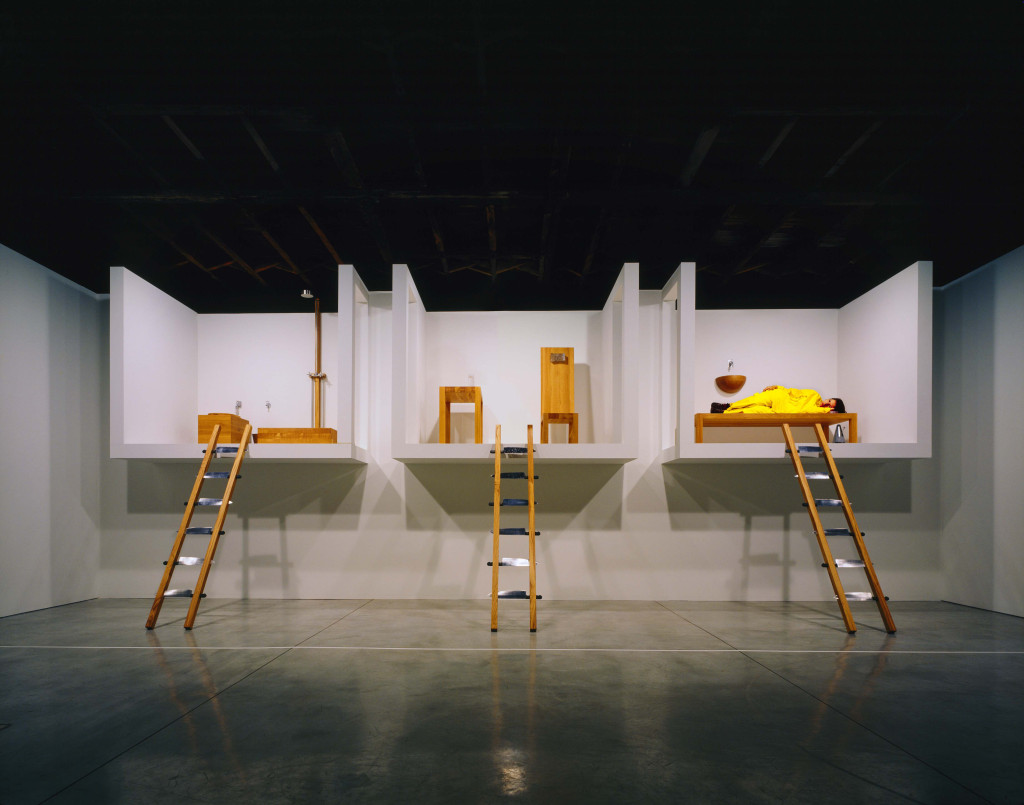
- Discuss the ways performance art resists many museum and commercial art world conventions. How does Abramovic solve/negotiate some of these challenges, and do you find these compromises add to, or undermine, the ideas at play in her work?
Performance art resists many typical art world conventions in multiple ways. I feel like one of the main aspects of performance art that challenges this is the fact that performance is not a physical object; without video, there’s no record of it. Performance art becomes a moment, not a piece. Abramovic negotiates these challenges by performing in a way that creates an impact/ reaction, maybe? Her interactions with her audience, for example, create an impact both on the audience and whoever participates, making it memorable. Which, in this case, can become more of an artwork, or just as much as a typical, conventional artwork found in museums.
Km Assignment – Mind Exercise
For this project, I wanted to compare walking to typing to emphasise the automatic process that both hold and how they are a part of our daily lives.
To do this, I walked a Km, which ended up taking me 10:50 minutes, and I then typed for the same amount of time.
I find that when I write, I often reach a state of mind where I can type without thinking about it (when I have a good idea, when I have to do a repetitive task, etc.), and I reach a point where I can just keep typing. Another example could be typing out notes in class. I find that often I’m typing but not really retaining anything I’m writing down.
Which could be seen as just as much an exercise as walking in a way (and could often be just as productive, just mentally, instead of physically).
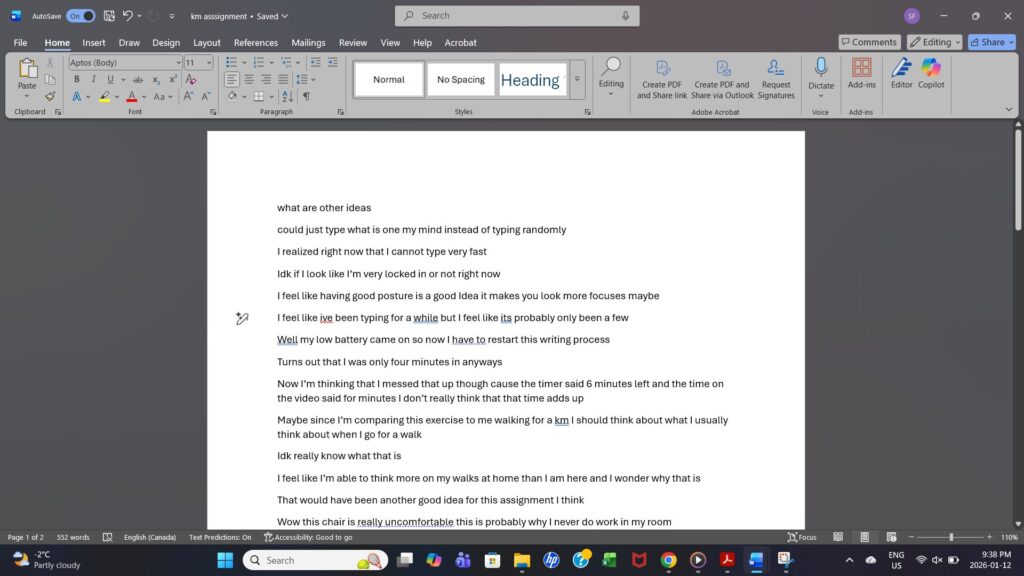
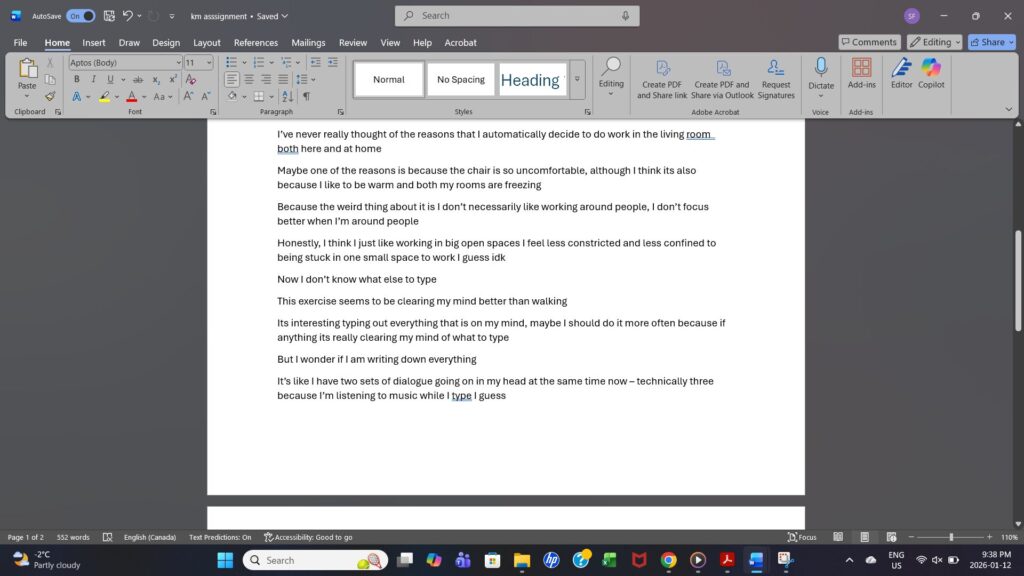
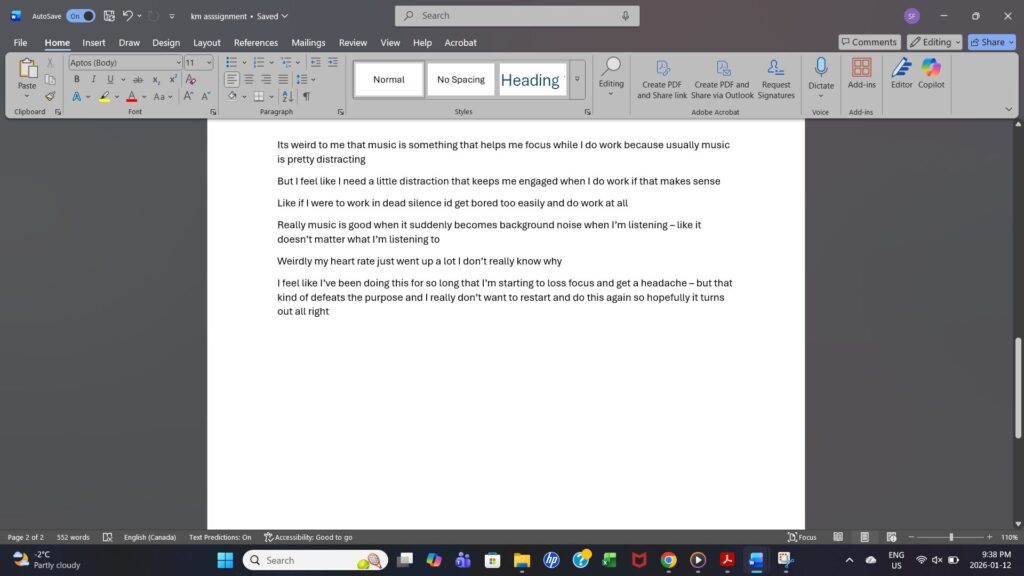
During this time, to emphasise my point about being able to reach this robot-like state of typing, I decided to write my stream of consciousness:
One Feat, 3 ways Video Project – Stella, Ella, Ola
Stella, Ella Ola – Video one – unedited
Stella, Ella, Ola – Edited
Stella, Ella, Ola – Animated
Turning the Gestures of Everyday Life Into Art – The New York Times
- Describe the work discussed in the article and the unique challenges, as well as the unique gifts that come with attending to the archive’s personal movements
Katja Heitmann collected the movements of others by holding auditions to collect “donations” of gestures. In doing so, she essentially created an art installation based on everyday gestures through the process of unconscious gestures and remembering. While watching other people’s movements and recalling them, I think it’s interesting how the dancers overcome the challenge of remembering them. Through the actions of the dancers reinterpreting others’ gestures, it also reveals something about their personality.
2. Discuss one or two examples of movement in the article – what strikes you about them?
One example that stood out to me was the dancer describing how over a year ago she was surveying the actions of a 40 year old Ghanian women, and she noticed she was still copying her actions unconsciously in her sleep. I think that really goes to show when you’re with other people so consistantly you start to pick up on their habits and actions, along with how it is often something that is done without thinking. Which also could relate to how you not only pick up on others’ movements but also their personality and interests, which I think is also interesting. Another example that stood out to me was Tjan, and how he discovered that he tended to try to make himself take up less space as a result of this installation. I think it’s interesting how other people can discover things about you that you don’t even know. I also like how, with the discovery of this, he actually worked to overcome this by making small adjustments in his life.
I also like the idea of none of the movements being photographed or filmed and how it goes along with the quote, “In our current society, we are trying to capture humanity in data,” and how, in doing so, it creates something that is missing. Making the concept of the art almost counteracts this and brings some of the missing movement back.
3. Describe the habitual movements/unconscious gestures, tics, etc. of 3 people you know well. How do individual body parts move, and how does the whole body interact? How does the body type inform the movement? What do these examples of small movements imply?
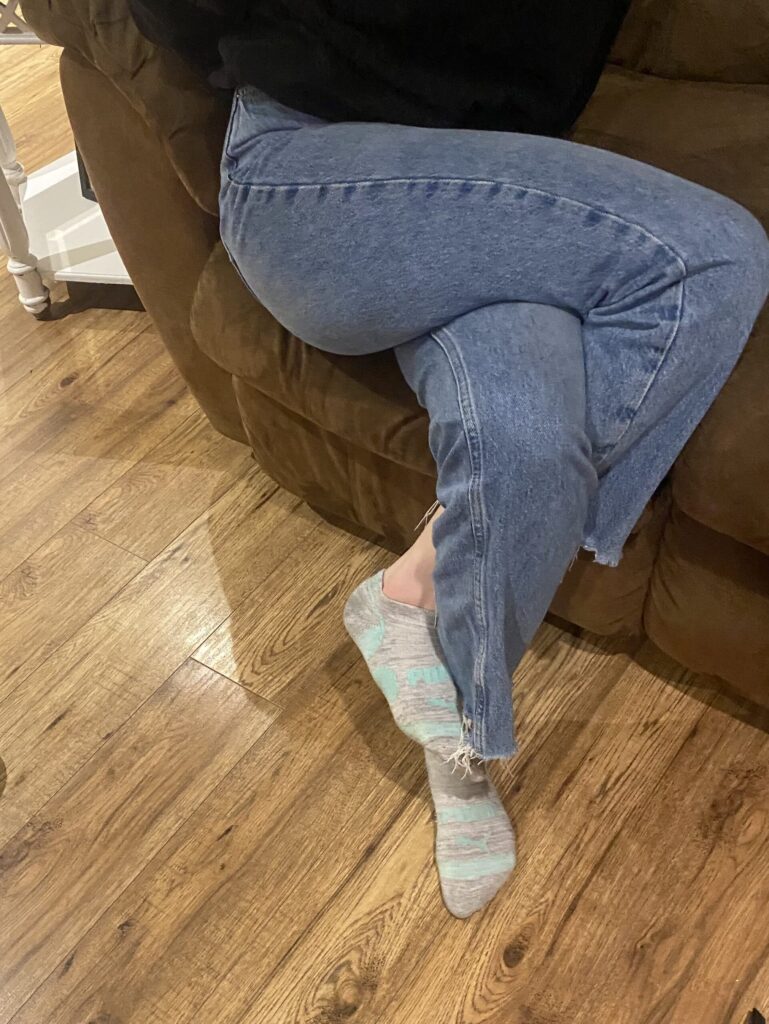
My sister often twists her legs ( picture below its hard to describe) in a way that looks unsettling or uncomfortable to most people. Either when she is standing or sitting down. She usually does it when she is comfortable/ relaxing, or focusing. Which I can tell because it is usually when she is zoning out as well. I think it also has to do with her body type, as she also has long legs, and it could maybe be a way to confine space? This is something that I also do now occasionally, usually when I am standing, though. My brother rubs his ankles together, which is also something he does when he is deep in focus as well. For example, he is playing video games right now and has been for a while. Which means he could also be doing it unconsciously for movement when he lacks it. One gesture that I catch myself doing is fiddling with my necklace or earrings (which is something that I notice when I am not wearing either). I usually do this for several reasons, I think. However, it is usually because I’m either anxious or excited about something. For example, when I’m having a conversation with someone, or when I’m writing.
Field Trip!
Catherine Blackburn – sKIN
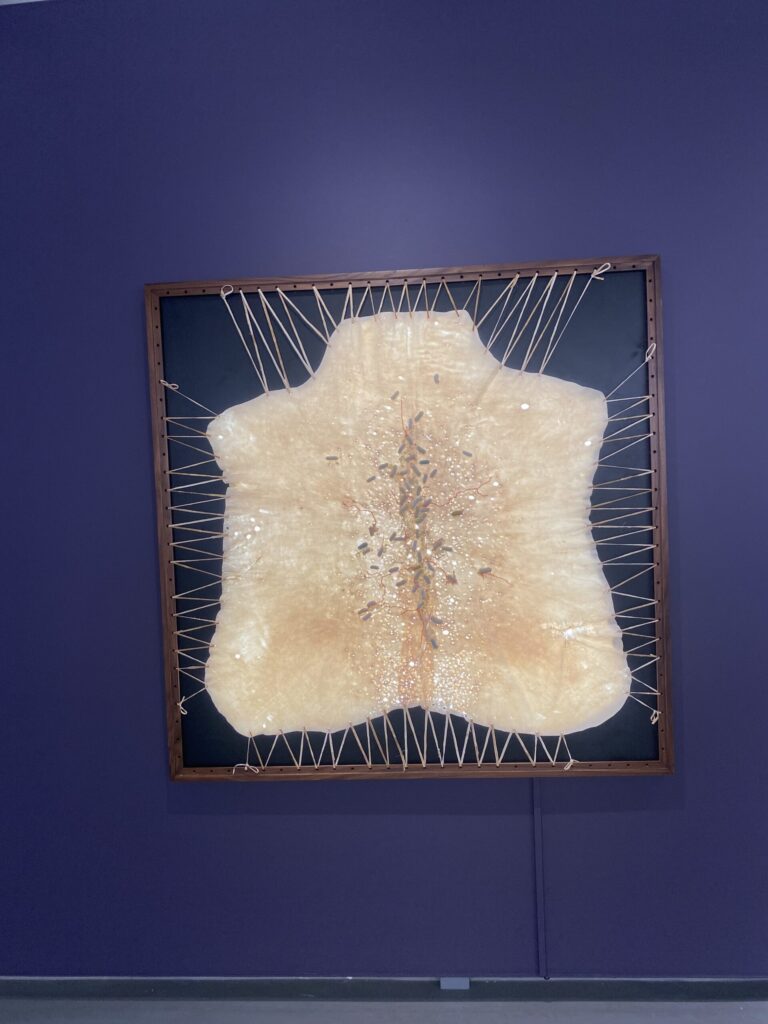
Lucy Raven’s “sKIN” work particularly stood out to me in the way that it is presented, but also the deeper meaning behind it. The work displays the scars on the back of a Caribu placed by a parasite ( a warble fly ). The stitching is made visible in order to honour the caribou’s endurance and the intimate knowledge of the Denesuline lifeways (who are known as the Caribou people). Which leaves the presence of the marks to mark their shared resilience of adaptation to the factors of population decline. I like the way that she portrayed this concept and how she turned the scars into something beautiful through illumination and intricate beadwork. I think that it brings a more powerful meaning to the message she is trying to convey.
Lucy Raven – Murderers Bar
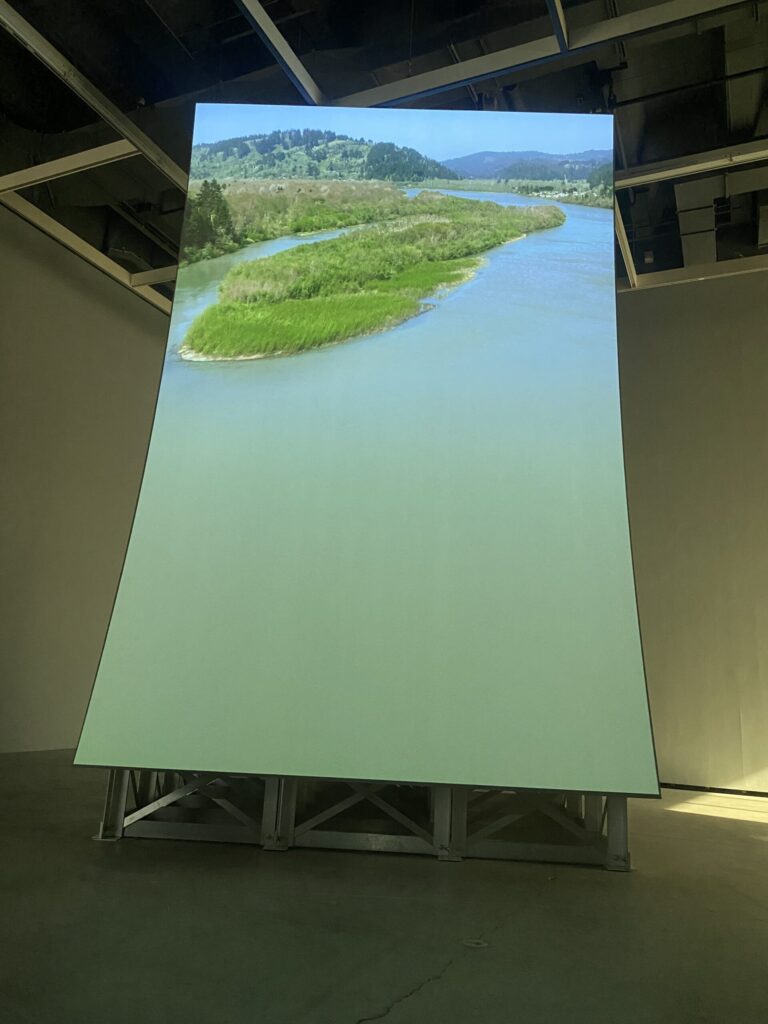
Lucy Raven’s “Murderer’s Bar” also had a significant impact on me as well. To start, I think the way that it was portrayed was quite effective and important in grabbing my attention, with the large screen, a dark room, and loud speakers. It made me feel like I was actually there (which made me a little motion sick as well). I really liked the use of camera angles and sound effects to survey the area. It makes you able to view it in a way that you wouldn’t be able to see otherwise, which I think is really cool. Some specific parts of the video that stuck with me were when the drone was flying over the edge of the dam. To me, it felt very suspenseful and more alert, which I thought was interesting. I also thought the drone going in and out of the water was unique as well, especially how it felt like it was never-ending and almost uncomfortable. which is also why I liked the image on the left, because I finally felt some kind of relief after the drone left the water.
Audio Assignment – Are You Still There?
Description:
Looking back at an old video, I made the realisation that as a child, I used to sing a lot (and be more outgoing in general), and now I don’t (or can’t). Which made me wonder why this is?
As a child, you are usually unaware of what is expected of you and what behaviours you are supposed to obey, which means that there is little fear about what other people think of you, leaving you to feel more free.
Eventually, you become aware of how you are supposed to act. In my case, I felt like this meant I had to be quiet and listen all the time. I let this affect my life so much that now, as an adult, I feel like I’m unable to express myself fully. Especially in terms of voicing my opinions/ ideas/emotions, or simply being able to sing.
In this assignment, I wanted to express my concept by showing how this pressure has affected me, and I thought that the best way to do that would be through my own voice.
Through the recording, I begin with the sound from a video of me singing in my kiddie pool from when I was three. In this video, I was aware I was being watched, but I didn’t mind; there were no feelings of embarrassment or thoughts that I was being too loud. I was just happy to be able to dance and sing because it brought me joy. As the video goes on, I wanted to show how being consciously aware of what others expected of me made me feel like I was too much. This ultimately made me feel small and like I should not try to take up space. In doing so, it made me lose the ability to be able to express myself. By the end of the video, I wanted to portray how, even now that I am fully aware of the effects this has had on me, I am still unable to break free from this fully, and that, as much as I try to, I can’t seem to reach the same level of confidence and ambition that my younger self had.
Pauline Oliveros – Deep Listening
Prompt: Reflect on your own experiences of listening – to sound, to others, to your own environment, or to yourself. How does Oliveros’s idea of deep listening challenge the way you typically give attention? In what ways might listening through your whole body, or approaching sound as a form of play and research, change your understanding of connection, communication, or creativity?
Pauline Oliveros’s idea of deep listening made me realise that the amount of attention that I typically give to my surroundings is nowhere near enough. Even if I think I’m paying a good amount of attention to someone or some sound, my mind is still usually partly elsewhere. I think that I think too much; I’m never fully in a moment, even when I want to be, which ultimately restricts me from being fully open to my surroundings. This made me realise that the only time I am fully aware and present is when my body breaks down from the stress of moving too quickly, forcing me to pay attention. Usually, only then do I take the time to slow down and pay full attention, and listen. I always feel way better after I do, but I also feel like I get too busy to do it more often. I think that when I do, though, listening through your whole body is the only way to truly understand and learn (and make connections) anything about other people and even yourself. It’s amazing how much you can learn and connect when you just pay full attention for even a few minutes.
Conceptual Portrait
Concept idea:
I would like to buy a pair of high heels and cut off the heel (maybe glue the heel back on) in order to represent how I think I am viewed in society, as well as other girls who are taller than average. As I think it is probably fair to say, my height is typically the first thing that people notice about me.
There’s a pressure (especially from men) that makes me seem like I should be smaller. Especially in the stares tall women get, the uncertainty that is produced by them, the way I’m treated, and the various comments about my height that I get. I want to show how this sometimes makes me feel, and how it can change my appearance. By cutting off the heel, it shows how something that was once practical (fine the way it is) turns into something ugly and useless. I also want to express that this is not the way that I view myself, but the way I think other people view me and how that infiltrates my thoughts.
Jenni Granholm
Jenni Granholm is interested in the invisible struggles that everyone faces. She creates images that reflect the emotions that come with the pressures that women face living in a society where it seems like we are bound and living under the weight of expectations and demands.
She often hides her face in images to express this, but uses soft pastel colours to hold onto a feminine quality.