“Sehnsucht”: Zine Project
Open for Surprise Poster!!!!
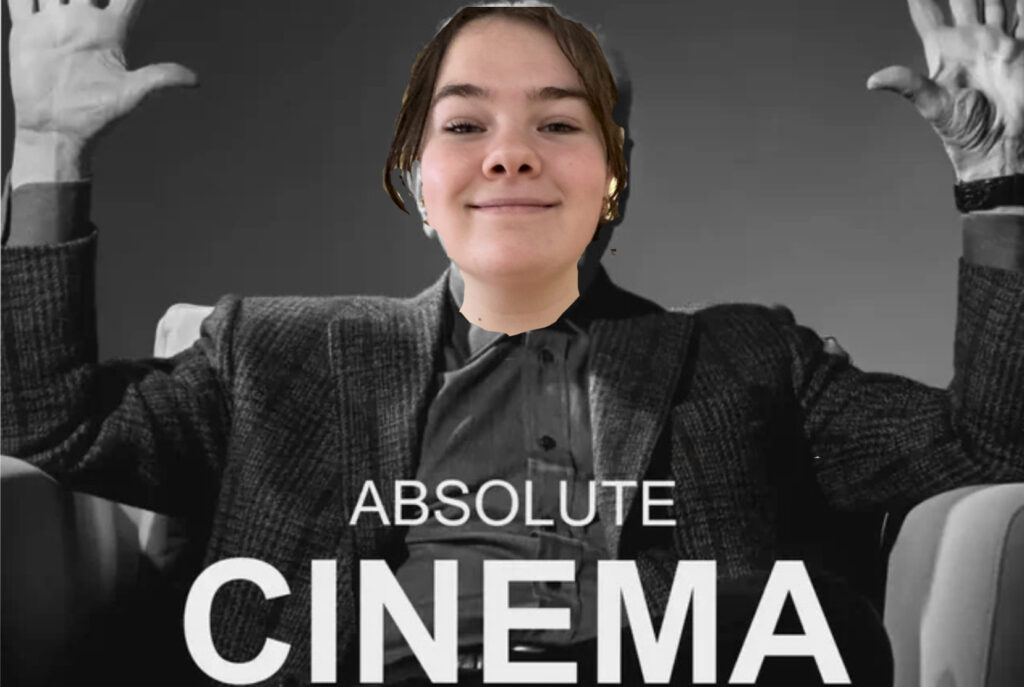
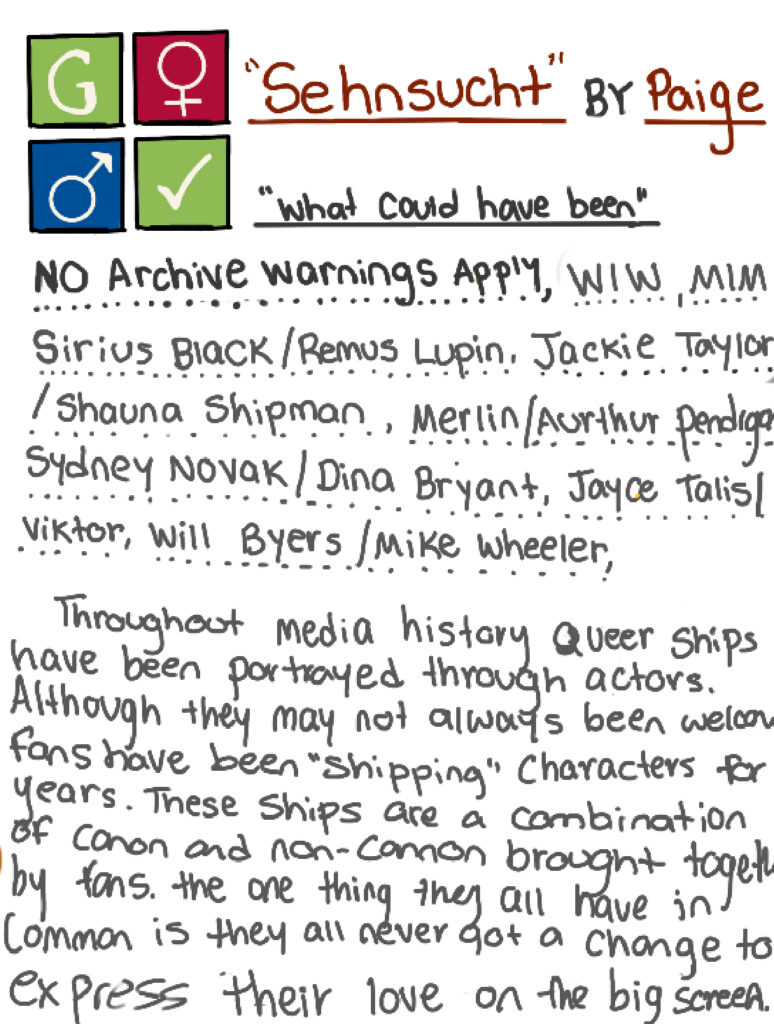
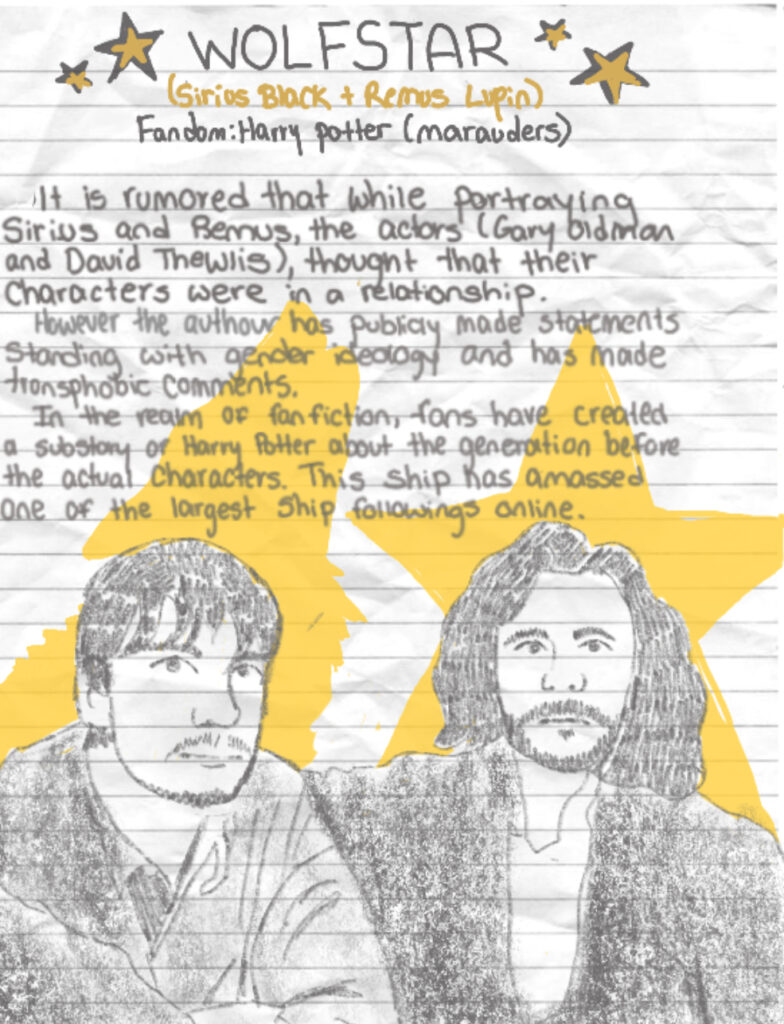
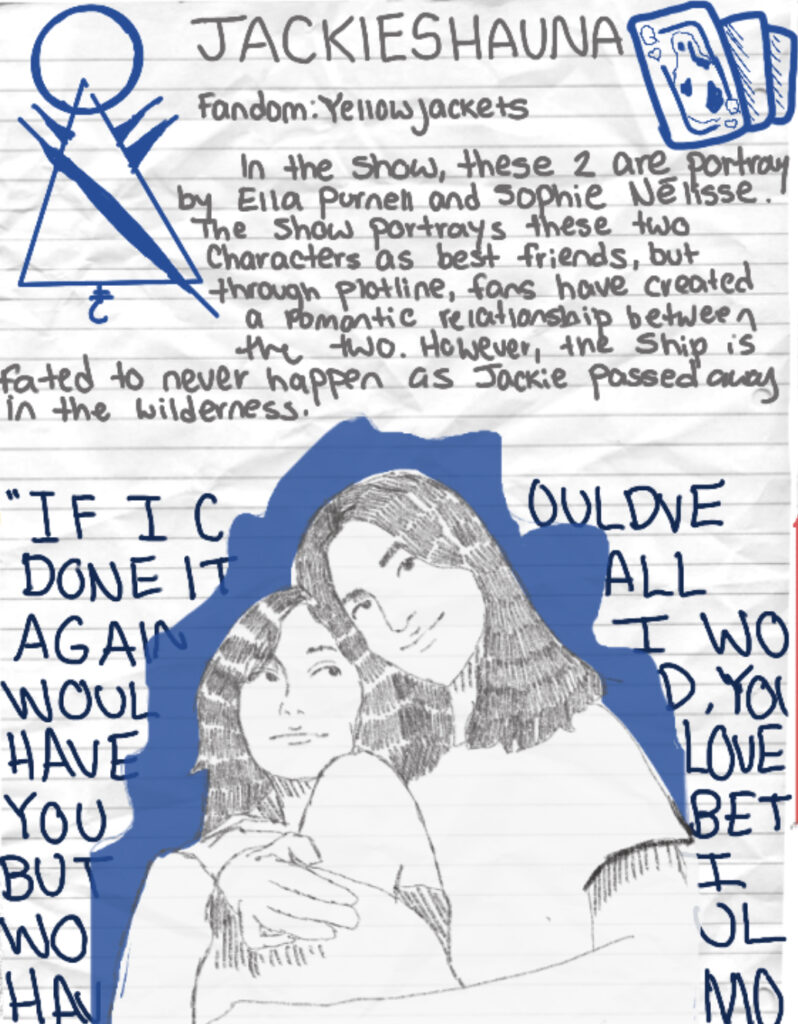
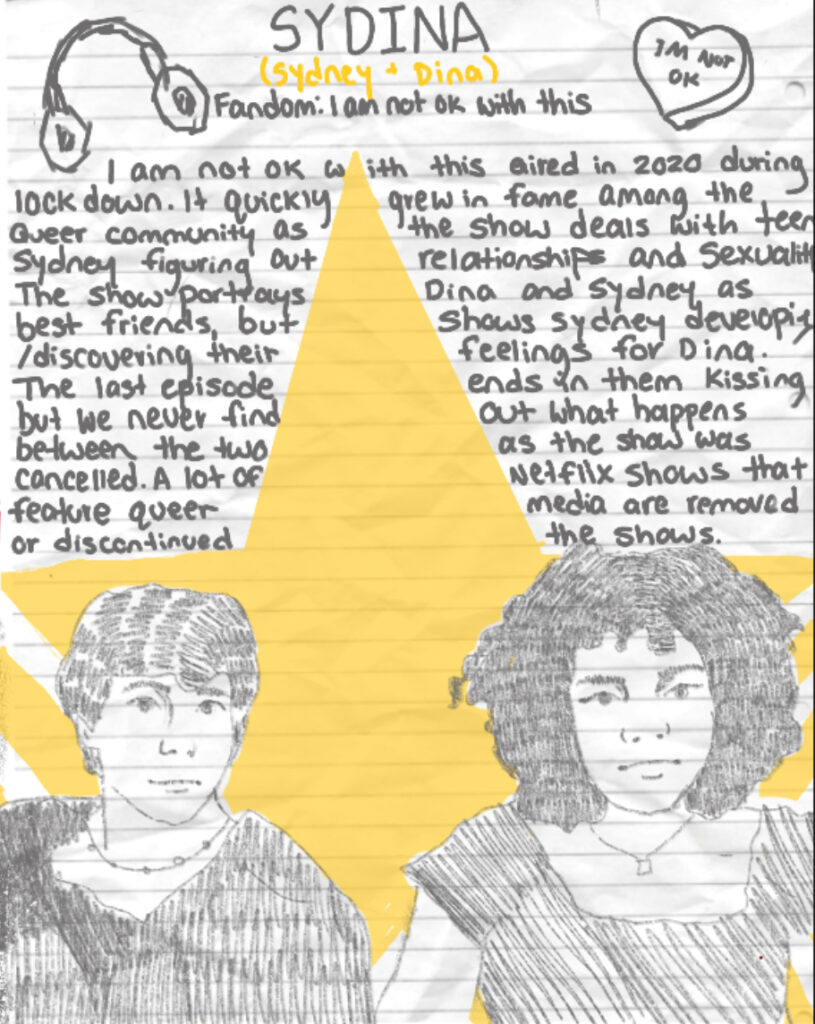
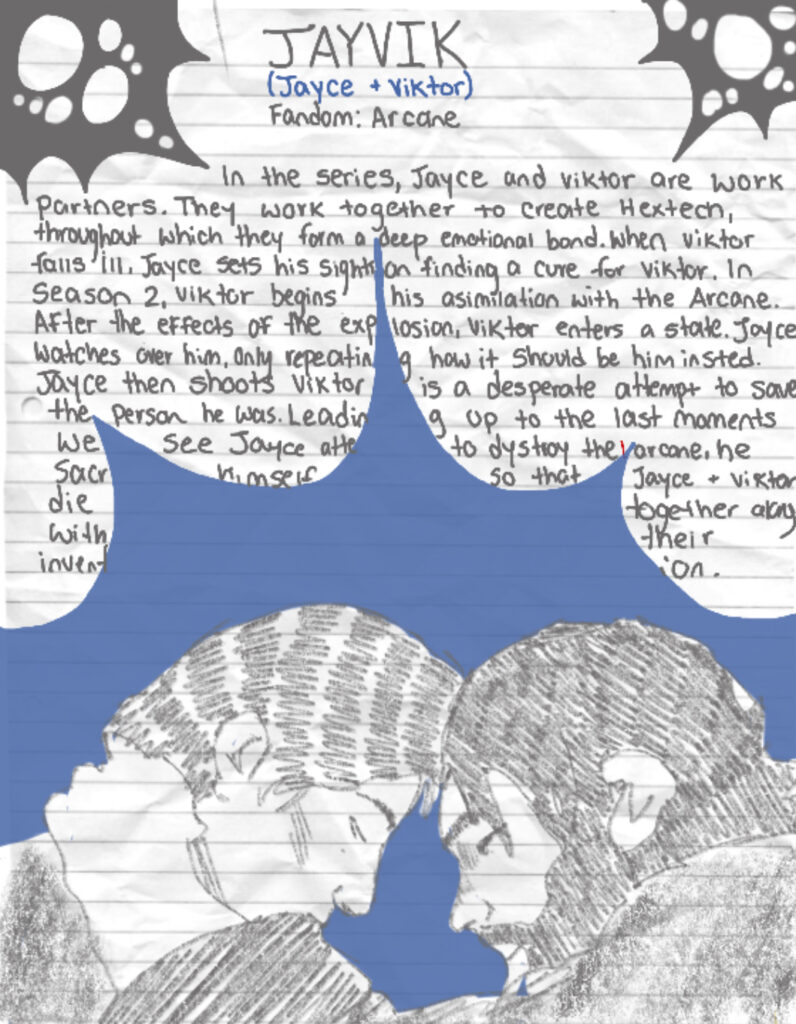
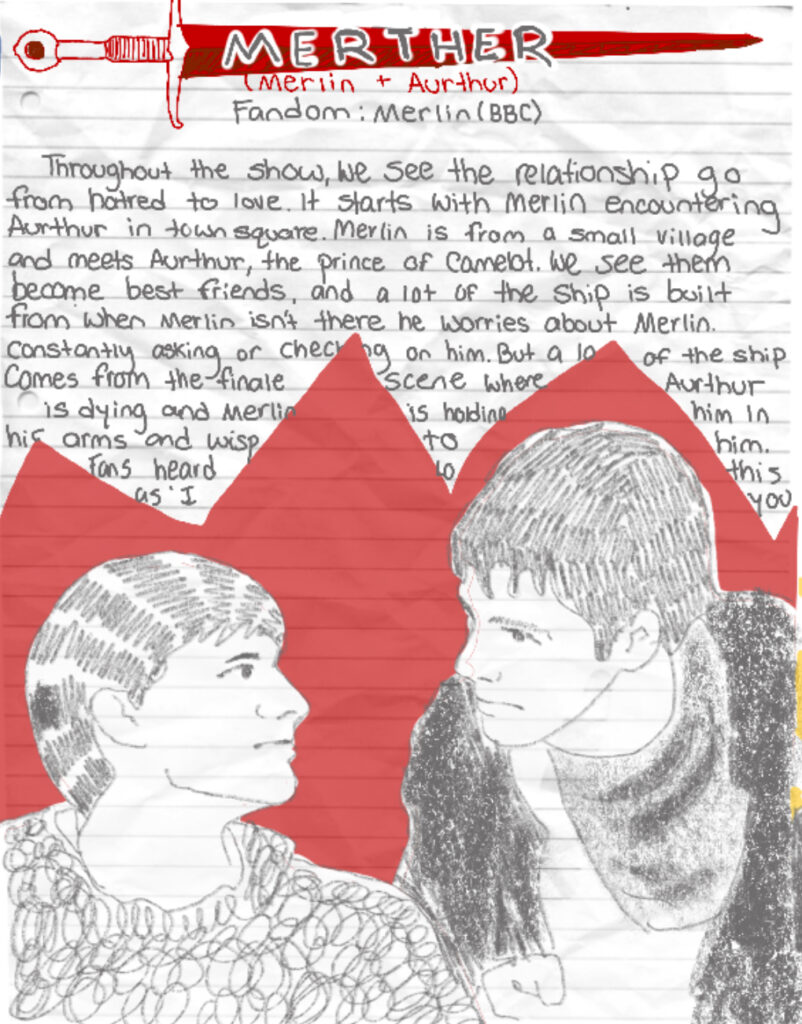
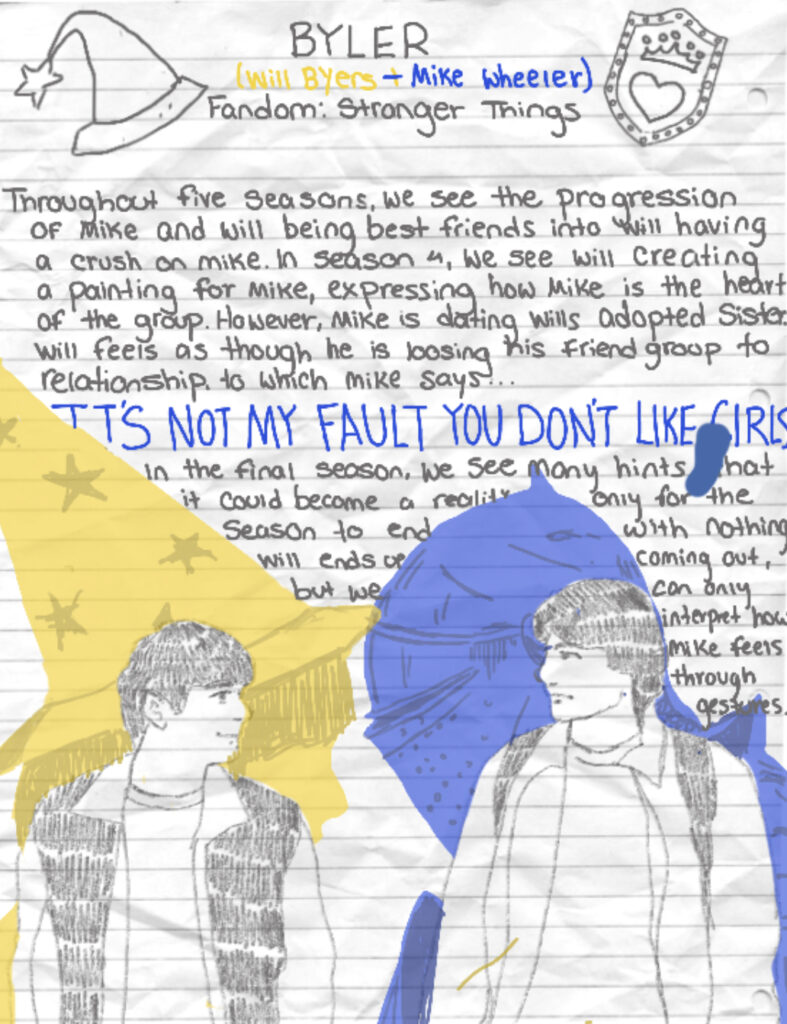
My zine is focused on queer ships, specifically those of which were never seen through. From being non-canon or the show spontaneously ending, these ships are some of the biggest in media put together by fans. Each page focuses on a different “ship” (couple), layered with a drawing and their importance in queer media written behind. I choose to make the cover look like an Ao3 novel as a lot of these ships are born from fan stories written on the site and it is through the power of this creative writing website that we see theories and alternate timelines of the stories.
Wolfstar for example, which comes from Harry Potter is the 2nd biggest ship (most written on) on Ao3, their names alone result in 70,002 stories. Fans have created this whole alternate timeline about Harry Potter’s Parents, which has grown so much in popularity it rivals the books and movies themselves. This idea sparks from the actors from the movies stating how they believed that the two characters were in a relationship when filming.
I really wanted to focus on the ships who we didn’t get to see together in their original media as it shows that even today, networks and creators do not allow or create these queer plotlines due to deep rooted homophobia or fear of the viewer reactions. A tik tok went viral recently where a woman was asking “why do we have to have LGBTQ+ representation in all of the shows”, her ignorance was responded to on a massive level. People are responding to the part where she talks about why they are trying to normalize it, showing just how long queer ships have been discarded from our media.
If Only A “9 to 5”: Conceptual Portrait
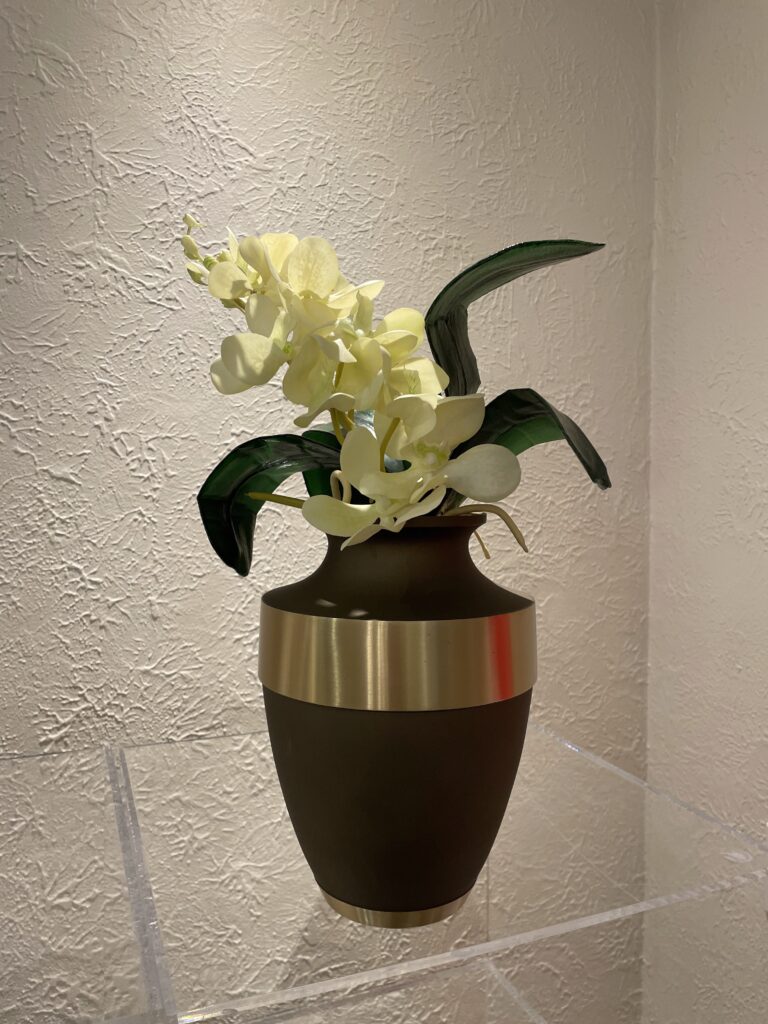
This portrait is about my mum and her relationship with work: it depicts an urn filled with orchids on a glass pedestal. My mom works as a funeral director and deals with themes of death every day, but despite the grieving mood, she remains optimistic, helping those around her and being an amazing mother. Flowers are used as a gift to the dead, something beautiful to commemorate someone’s passing; however, flowers can also be a gift. My mom receives flowers during holidays, and she still admires them, especially orchids, which are her favourite flowers.
The urn symbolizes this commitment and how she’s “working into the grave”. The flowers symbolize beauty and life, the energy she gives to her work and our family. Although it is only one picture, over time I hope to develop the piece into a collection of images or a live installation piece. Throughout the images/ pieces, the flowers would lessen and will slowly die, showing how much my mom gives to the job, but how much the job takes away from her.
Lastly, this piece also symbolizes the relationship between my mom and I, through our connections of loving our jobs but pushing ourselves to help others. Her funeral directing and me with teaching. Together we form a cycle of life.
Conceptual Portrait Proposal:
A Receipt of Life; Installation piece
- Inspiration/ system like Kelly Mark, In & Out (from lecture)
- Yoko Ono Music of the Mind (2024) -> in the Tate Modern
Never Ending Thoughts: Audio Art Assignment
For my Audio Art piece, I wanted to focus on the unheard or unrecognized sound. I choose to do a self portrait, translating my inner thoughts into a livable experience for everyone. When I saw the Requiem for a Glacier by Paul Walde, it inspired me to try and translate a sound that is already there and turn it into something understandable to people.
My portrait is a layered sound of my inner turmoil, beginning with a simple statement “just focus”. I layered myself reading from my marketing textbook, choosing to add in myself saying “just focus, lock in” playing throughout the video as a sign of repetition and grounding. As more audio clips get added you start to lose this looping audio which adds to the chaos of the piece, symbolising how my thoughts get muddled in things that are unimportant or random thoughts. Some audio clips are simply tics I have picked up from online media, whilst others are timetables of what I’m doing or recounts of past events.
I played with the gain of some clips and chose to split up some clips to get louder or quieter, depending on where they are in the audio track. I moved the direction of the sound, centering audio to the left or right so it moves around the headphones. Overall, my finished product is quite an accurate representation of what it sounds like inside my head and at critique had a few people tell me I perfectly encapsulated their own inside turmoil too.
Pauline Oliveros: Deep Listening
Reflect on your own experiences of listening — to sound, to others, to your environment, or to yourself. How does Oliveros’s idea of deep listening challenge the way you typically give attention? In what ways might listening through your whole body, or approaching sound as a form of play and research, change your understanding of connection, communication, or creativity?
- I have always been very attuned to the noises happening around me, the blowing fan, a ringing of the alarm system, etc. So hearing about Pauline Oliveros’s approach of Deep Listening really resonated with me as it was something I was in some respect already doing. I have always been very aware of the noises I create by just existing too, how heavy I walk, my breathing patterns, and the tapping of my fingers on a keyboard.What really stuck with me was the idea that she creates these beautiful and whimsy pieces out of noises that have grown up annoying me. I think Pauline gives way to the thoughts of truly taking the time to listen and experience the noises you are hearing to how they weave together. I think that approaching sound as beautiful and expressing it by using everyday sounds creates a connection that can resonate with everyone and makes a collective experience for everyone to enjoy.
Stella, Ella, Ola: One Feat, Three Ways
Stella, Ella, Ola: Repetition
Stella, Ella, Ola: Edited
Stella, Ella, Ola: Loop
A Journey of Time: Travel a Km
My Concept:
My concept for representing a kilometer (km) is through the use of Minecraft. My idea was to calculate how many blocks it would take for me to travel a kilometer and then have my avatar run that distance, allowing a comparison of time and potential factors that could slow me down. At first, I assumed I would be within the average time frame to complete a kilometer, but when it actually came time to run it, I found that, much like in the real world, a lot of outside factors can affect your timing.
On a deeper level, I wanted to represent what a kilometer means—how much effort it takes, how much preparation is involved, and what a kilometer represents in terms of the passage of time. In the video, I begin at my house and then venture out, only starting the timer when I begin the sprint. Along the way, I encounter a lake, mountainous terrain, and the need to eat, not unlike if I had actually done the run myself. All of these factors slowed me down, along with the fact that I had never played in third-person mode before, which I found made it very difficult to break blocks and make jumps.
Near the end of the sprint, I slowly climb a mountain, carving out a path to make my way to the top. Once at the summit, I admire the view and then jump off the mountain, losing all my items and resetting back to where I started, only to begin the same journey again. I framed the ending this way to put into perspective how much effort and struggle can go into achieving something as simple as a kilometer. Once you die in the game, you have to start again, building up your materials to get back to where you were in order to complete another kilometer.
I think this shows growth and the idea that progress is not linear. It is really about what the kilometer means to you or what it represents in your journey. Did I just waste 43 minutes running through Minecraft just to die at the end? Was it pointless, or does it represent growth?
Precision of Measurement:
In Minecraft, the idea of a kilometer averages at 1,000 blocks. Instead of something like 500 steps, this form of representation brings attention to the idea of a digital kilometer and what it means to travel a distance while not really moving at all. Through research, I found that one Minecraft block equals one meter; therefore, a kilometer in Minecraft is represented by 1,000 blocks.
Originally, I wanted to build a tower upward amassing 1,000 blocks, but upon further research, I learned this was impossible, as it exceeds the world’s maximum build height. This is where the idea for the sprint came from. To walk a kilometer would take around 8–10 minutes, but by enabling the sprint feature, the average sprint speed makes it take around 2.5–3.5 minutes. When sprinting, you move at about 5.6 meters (blocks) per second, meaning the quickest a kilometer can be completed is around 2.5 minutes.
However, during my sprint, I encountered water, used a boat, and faced the challenge of climbing a mountain, which significantly slowed my speed. In addition, I encountered biome difficulties, which made my kilometer take approximately 40–42 minutes. This presents an imaginative and original way of thinking about or experiencing a kilometer.
Creativity & Idea:
The idea of Minecraft came from my recent found love of building, especially in teams/groups. In class, I expressed my ideas as physical movement, but upon further reflection, I thought it would be cool to discover a more imaginative way of travel. I really wanted to reflect the idea of travelling distances without really moving at all. In Minecraft, you get to explore new planes of land and experience different biomes. It can be played solo or in groups, and can really be about whatever you want. I think video games are an amazing immersive way to explore, so although I might not physically be exploring a mile, I can travel hundreds of km in a shorter and creative format
Media & Materials:
My media itself is very simple, as Minecraft can be explored almost anywhere. I chose Minecraft over other games because I believe Minecraft allows you to connect and explore unlike any other game. When we talk about different ways to represent a kilometer, we cannot rule out the idea of digital connection, especially when so much of our lives are online.
The Artist is Present, Marina Abramovic: Discussion Questions
- During the beginning of the documentary, my thoughts about Marina Abramovic’s work were very much centered around confusion and trying to understand what kind of deeper meaning there could possibly be, as we were just seeing the flashes of her work. As the video continued on I gained respect for her and a great understanding of her work/ messages. I think the way they set up the documentary was very much telling of her life story, there was something one of the interviewers said about how you’re looking at many different Mariana’s and how she is a product of both of her parents. I think that line is very impactful as it gives us a deep insight into the history of her and how her mind wraps around the deep ideals of her artwork. Understanding the juxtaposition between her parents and her grandma and how she felt a sense of safety or love from this spiritual figure instead of her own parents, who were the opposite of comforting, really sets the tone of the documentary from early on. I admire her dedication and willingness to be so open to us as the viewers and as she talks about this idea that art should be a shared experience of the artist and their performance, kinda reinforces how personal and vulnerabile you have to be to interpret her works and truly work towards understanding the bigger picture. I would definitely agree that some of her pieces are pretty problematic, I find the ones where she is in a constant state of harm to herself, harder to watch as she is putting herself in these situations but it’s scary to see it repeated over and over with almost no emotion put into them.
- I learned how personal performance work can become, I mean this in the sense that when you give your soul to your performance work it shows. When she sat in the museum, not saying anything but just staring, I could only imagine what it would be like to be in the other chair. Something about the way she gave every person almost a part of her soul was so heartbreaking and the way she almost turned into a reflection for people’s inner self was so breathtaking to watch. Even though I wasn’t in the chair, I could feel her emotion through the documentary and it’s almost like you have an inner dialogue with her in the chair which almost creates questions that only you yourself can answer. Her quote inspires the idea that you have to give everything your all, putting your heart and soul into something will translate through if you let it.
- For as long as art spans, there has always been an idea of perfectionism and that to create art is to create almost divine pieces that reflect perfection. I think performance art especially really speaks through this idea and a few people always come through when I’m learning about past artists, people like Mariana and Yoko Ono, who create this incomparable work meant to set itself apart in a field of perfectionism. She talks about questioning the idea that “Art must be beautiful” (11:07) and that artists have to be beautiful and I think this isn’t true at all. Art is meant to be raw and true
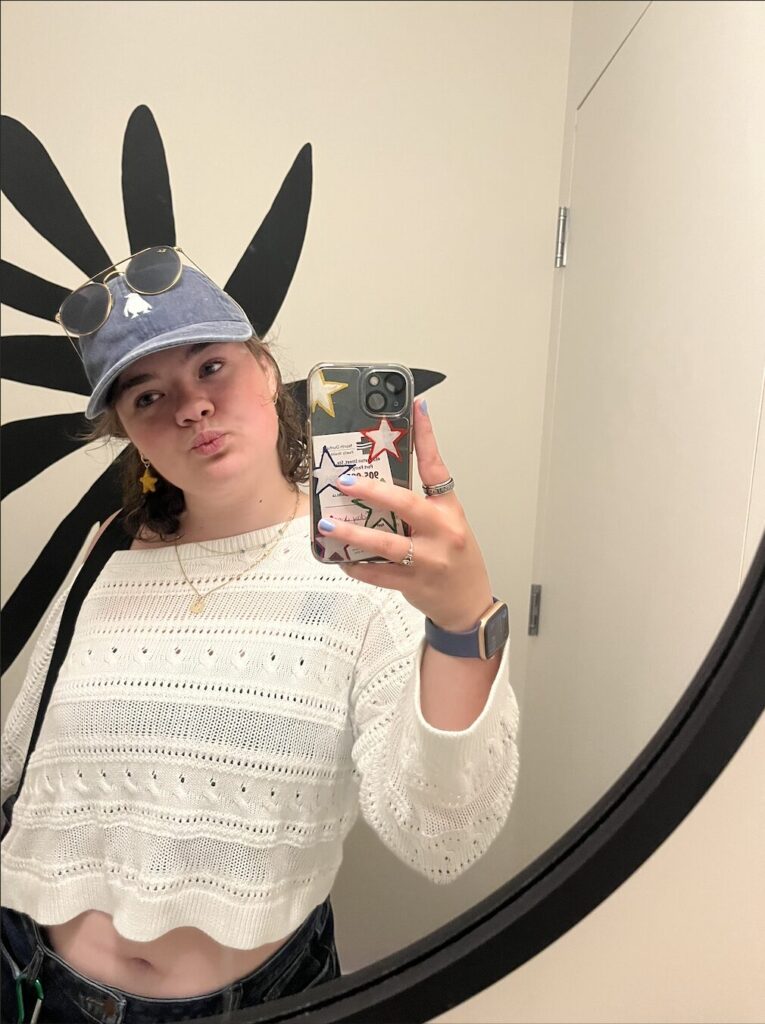
Hi, my name is Paige 🙂 I’m a second year studio art major with a minor in marketing. Last semester I took painting 1 and truly fell back in love with art and physical media. When I graduated high school I was super uncertain about what I wanted to do in university and the job field. Visual arts was always my favorite course in school and I was encouraged to pursue the path into university, however, during last year and last semester I truly fell back in love with creating art. My current future plan is to become a primary school teacher but also get my two teachable’s to become a visual arts teacher. I am excited to continue learning all the different forms of art through this class and others, and explore all the different forms art has to offer.