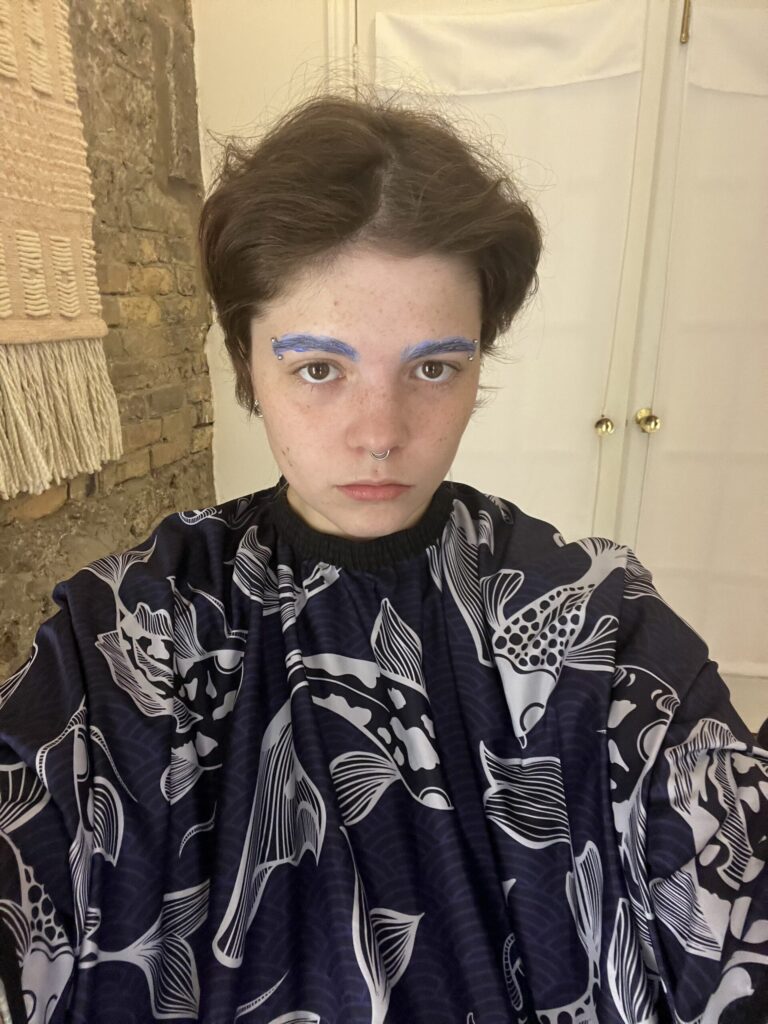
hiiii!!
as it says above, I am Lakyn. specifically this is me getting my brows bleached. why? who knows.
I am a Studio Art Major and SXGN Minor. I am a multidisciplinary artist and I love to use multiple medias; I try not to limit myself.
I have 3 cats, please ask to see pictures. you didn’t ask? okay. here’s a picture of them
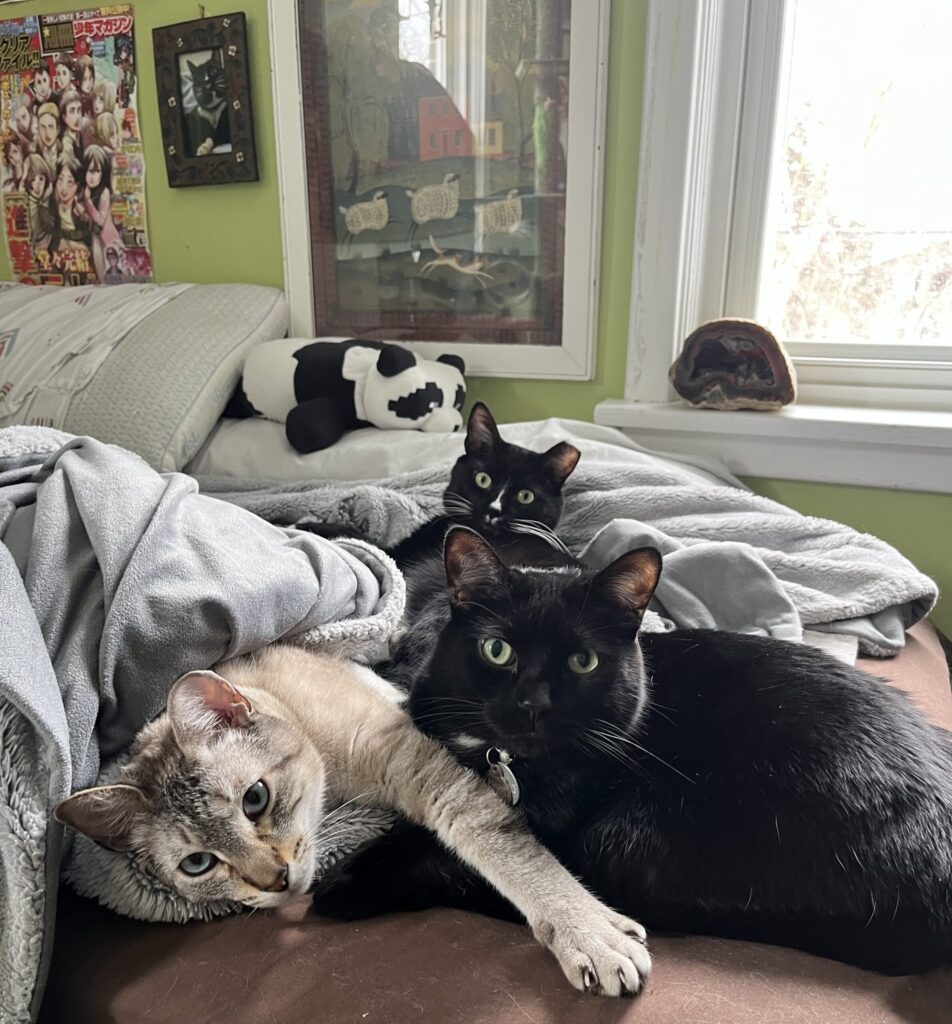
Kirby, Yuki, and Boyd
Reflection on Documentary “The Artist is Present”
1. What are some of your first impressions of Marina Abramovic’s performance works, based on the documentary? Use an image/example of one or two works to describe aspects you admire, and aspects you might agree are problematic?
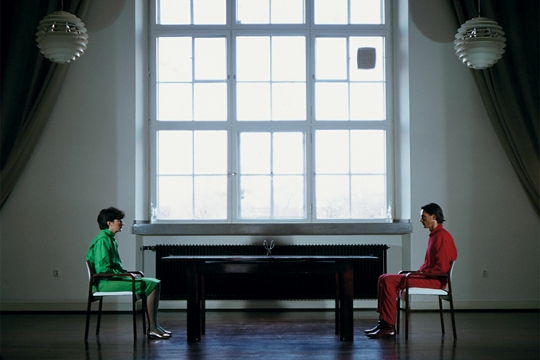
My first impression of Marina was me being completely captivated by her. Everything in her work is deliberate and thought out, and she does it with such genius and grace. I adored her ability to work in groups, and her choice to use, teach, and liberate young artists in such a monumental moment such as her exhibition at MoMA. I also admire the guts it takes to do some of the work she does, and her drive to make sure they are completed. In her series of works titled “Relation”, her and Ulay test the absolute limits of psychological and physical being, and in such a raw way too. In the documentary her and Ulay discuss the piece where they had to sit, unmoving for as long as they could, Ulay ultimately giving up but Marina continued as if she dint the piece wouldn’t be completed and everything would be pointless. Even at MoMA when she was in pain and her colleagues were trying to convince her to stop, but she says that’s the LAST thing she will do. NO interventions, just her raw stamina and brain power.
2. What have you learned about features of performance art based on Abramovic’s work? Name a few key features according to her precedents. Include an image to illustrate. Consider her quote, “When you perform it is a knife and your blood, when you act it is a fake knife and ketchup.”
Something I learned about performance art based on her work is what kind of mindset you need to be in to be able to successfully and so full wholeheartedly use one’s own body as the art tool. Her quote “When you perform it is a knife and your blood, when you act it is a fake knife and ketchup” really speaks to exactly why she is so good at what she does. This type of performance art is not about presenting an illusion, as an illusion doesn’t give the raw, uncomfortable feelings that Marinas works give. For example Relation In Space where her and Ulay ran into each other at increasing speeds, while naked. The sounds of their slapping bodies, the injuries, the silence from both of them. It created an energy, as Marina says a “third energy”. I don’t believe that would’ve been possible if it were an illusion of some sort, if the effects of the performance didn’t carry on even after.
”A Kilometre to Death”
For our first project we had to create a piece that equaled a kilometer while thinking of such kilometer in a conceptual way. My piece is a performance video titled “A Kilometer to Death”. In the video you see overlaying shots of me walking in a cemetery, the cemetery on its own, a candle being lit and a candle burning. These distorted shots are periodically and abruptly interrupted by the sound of a deep ticking clock. This audio addition represents the kilometre itself, as each tick is the 96.1~ meters per minute I walked to get there. This piece is a critique on the westernized and colonized views of death, and heavily reflects the work of the Queer Death Studies group.
When beginning this first project of the semester, I immediately knew I wanted to challenge myself. I have never done a performance video/audio piece before, and this was a great opportunity for me to start heavily relying on theory and queer studies to aid in my meaning making and conceptualize my art.
I started by thinking of distance as subjective, then distance as time which is also subjective, and that became an unsolvable loop in my head. I then decided to look and see what was exactly a kilometre away from my front door and discovered the cemetery I often frequent on late night walks; St. Joseph’s Cemetery attached to the Lourdes Catholic School. From that I used death as a reference point for my piece, and subsequently searched “queer theory and death” on Google. There I found the QDS, aka Queer Death Studies.
The QDS is a group of artists and theorists who look at death in a non-binary way using an interdisciplinary approach to understanding and studying death. A big part of their research is examining the negative effects of westernized and colonized perspectives of death, and working with fellow artists and theorists break down such perspectives. They explain their usage of Queer; how the word itself describes a non-binary approach to their studies. On their homepage they have a link to an article that encompasses everything they do, and there were many quotes that stuck out to me and became important in my project. I highly recommend reading it!!!!!!!!
“This understands death, not as an exceptional moment in human life, but as a process of transformation that forms part of life itself” (Radmoska, et al,.2020).
“Reclaiming instead an indigenous cosmology and philosophy, in which the dead are not left behind in a temporarily inaccessible and forever congealed past, but are present and potentially active in the here and now” (Radmoska, et al,.2020).
”These in-appropriated others are those humans and non-humans whose deaths often go unnoticed. Those who are deindividualized as a mass death which is understood as collateral damage in the service of ‘higher purposes’” (Radmoska, et al,.2020).
Each element of my piece connects somehow to the studies of the QDS. First, the clock ticking. Each tick not only represents the physical kilometere I walked to get there, but it also serves as a sort of countdown. The QDS critiques the westernized, heteronormative idea of birth-marriage-kids-death, death being the absolute big fantastical end of one’s life. So, by spreading out the ticks I am mimicking this countdown to death we often think of in western societies through my kilometre. I wanted to even further critique this by representing indigenous cosmology; the candle. The candle for me represented the life that the dead are still living in other realms. By overlaying a candle in almost every shot of the video I am further critiquing the colonization of death and even colonization as a whole; we are on stolen land, and committed (and continue to commit) genocide on the Indigenous peoples way of living, thinking, and believing.
The clips and location are developed within the QDS theories as well. By taking shots of many graves at once, I am critiquing the de-individualization of death that happens through thinking of mass-death as collateral damage. I never show a specific name or singular gravestone, and this specific cemetery has many broken, forgotten and even empty/unmarked gravestones. St.Joseph’s cemetery itself is a true physical example of the effects of colonialism on death, with clear connections of class, social status, culture, religion, and wealth factoring into the quality, size, longevity, and archival importance of the different gravesites.
By merging the videos and audio into one I am using the measurable distance of a Kilometre to expand on and encompass just a brief part of the work of the QDS. If you got this far I, again, HIGHLY encourage everyone to read the journal article linked on their website. I hope and believe it will blow your mind as much as it did mine.
Radomska, M., Mehrabi, T., & Lykke, N. (2020). Queer Death Studies: Death, Dying and Mourning from a Queerfeminist Perspective. Australian Feminist Studies, 35(104), 81–100. https://doi.org/10.1080/08164649.2020.1811952
Art Gallery of Guelph Field Trip
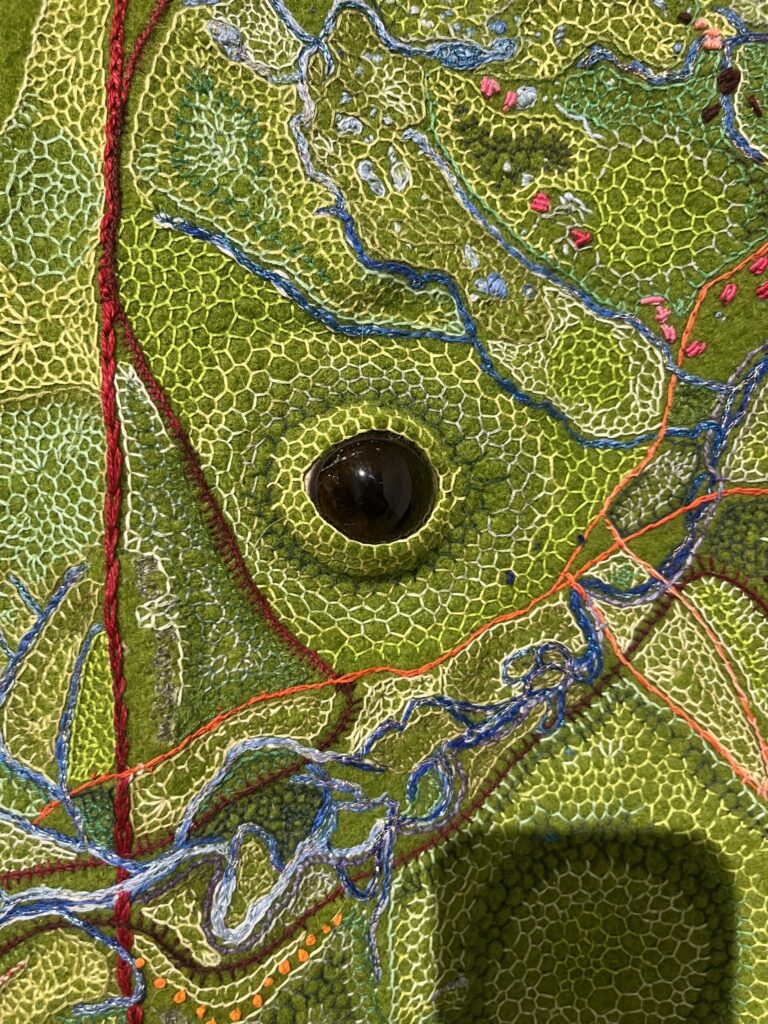
Wardens Watch, 2025
Michelle Wilson
This piece by our wonderful talented Professor Michelle Wilson is one of many that stuck out to me during our visit. Michelle discussed how this pice represents the surveillance of Indigenous peoples in Canadas Park systems. With a seemingly “neutral” monitoring of bison, we see through the archives and maps of the park wardens that the intentions and truly insidious; this monitoring of bison is really the monitoring of indigenous communities.
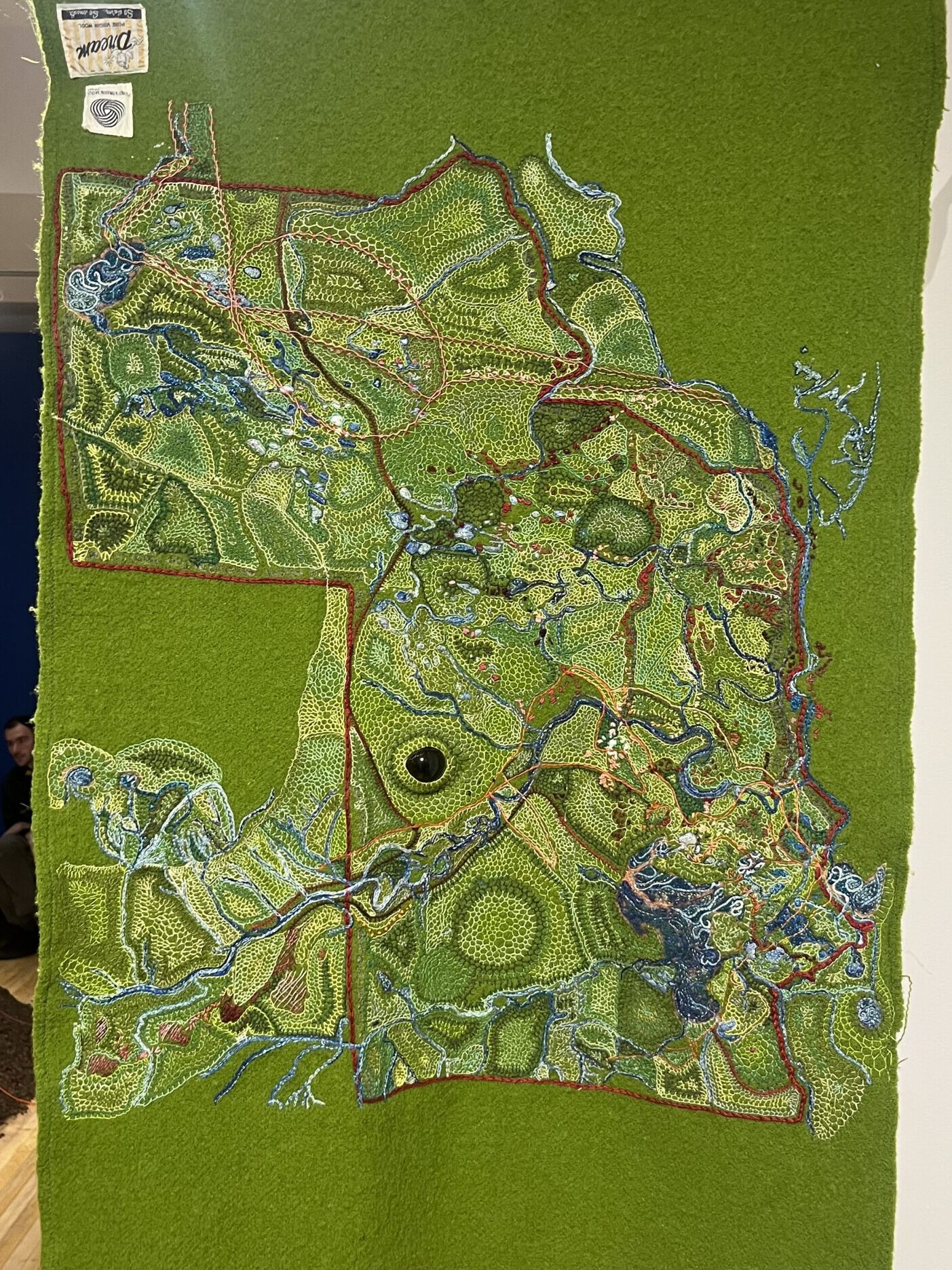
One thing that Michelle said that stuck out to me was how she said the natural materials in this piece are threatening the institution of the Canada Parks and warden paths. This connection critiques how colonial institutions have seen indigenous ways of life as threatening. This reminded me of the research I did for my KM assignment; how colonial systems of death have destroyed Indigenous cosmology and culture around death. To me we had, in a way, similar ways of thinking/deconstructing the importance of our works.
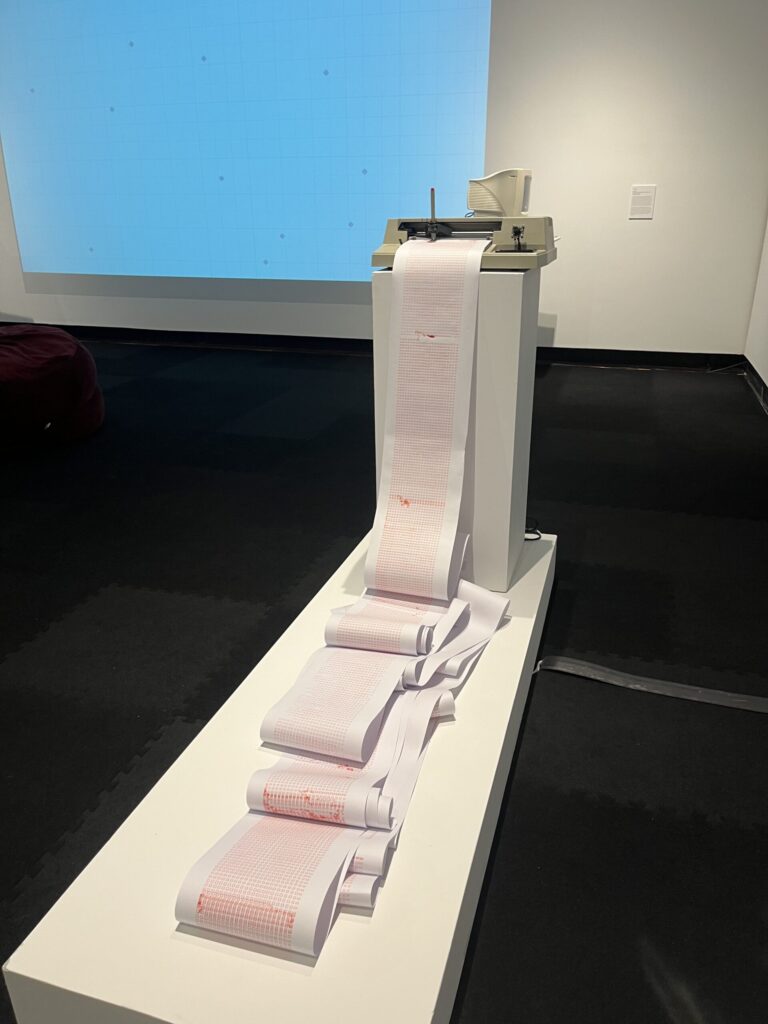
ICFWYWM, 2022
Devlin Macpherson
Robot gets nervous and anxious and cant complete basic task when it sees peoples faces. Me. I am robot.
I definitely felt a weird connection to this piece, almost as if I related to the machine and saw it as kin. This is what made it stick out to me; I have not stopped thinking about it since.
When I first saw it I kept saying “awww poor guy”, and then I tried to observe it away from the facial sensor to stop it from being so anxious. This is pure personification of a machine; I was and actively am offering empathy to an object that is simply a program of 0’s and 1’s. Even me calling it “it” is me giving this machine pronouns, as if it, he, she, or they care about how it’s addressed.
The paper it previously got nervous all over being left out was also very striking to me, like I was entering the personal sphere of a living being. It further personifies it by adding a sense of vulnerability and nakedness.
This entire curation of pieces, aka The Soft Internet Theory, was very inspirational for me. It opened my eyes to the possibility of curation, and what kind of themes or methods of art I can do in the future. This is what sculpture can be??? Wow. Amazing. How are there so many talented young/new artists?? All in all it was an absolutely beautiful, full emersion experience.
One Feat Three Ways
Initially when discussing an idea/theme/direction for this assignment we focused on chronic pain in the context of everyday activity and movements eg. sitting in a chair. We thought of the contortion of the body, and how those with chronic pain are usually more comfortable in positions that those who don’t experience it would not be.
We didn’t fully narrow down our ideas until our studio filming session, then an idea Michelle gave us stuck out; filming Olivia trying to sleep and us leaving the room. This helped with our final decision in what we were going to invoke on the viewers Vulnerability, exposure, and entering one’s private sphere. The act of sleeping is so much harder for those with chronic pain; we can’t help but toss and turn or be light sleepers because our minds are focused on finding the right position for each joint, regulating temperature, and many more things. After discussing amongst us, we discovered Olivia was the one of the 3 of us that didn’t experience daily chronic pain, so we thought it wold be a great idea for her to be the “performer”.
We set her on two tables with just a thin blanket for her to lay on, and she brought her own pillow from home. We took multiple clips, some of her with a blanket over her, but we decided on the no blanket clips as her costuming was too good to hide. We went with nude, skin tight clothing to represent nakedness, furthering the vulnerability of the gesture.
I was the one that did the Video 2: Edited Gesture (with input from my group mates of course) and I wanted to make an edit that branched off from our initial idea of contortion of the body. I created what I called “The Olivia Worm”, where I essentially collaged Olivias body back together using clips I took of just her hand, face, torso, and legs. All of these clips were filmed in the same way the gesture one was; we left the room and allowed the camera to capture her raw, unintentional micro movements. By editing them together in a video collage, I wanted to represent the stiffness of joints and body parts, how us people with chronic pain often feel disconnected and “wrong”. Also by slowly raising the audio and using a zoom effect, I wanted to invoke the feeling of disturbed sleep because of such disconnectedness.
During our critique we were told it was very surrealist; which I personally didn’t think about when making it. I think it was a great description because my edited video is like a dreamscape where Olivia is in an out of sleep. It merges reality and a dream like state, which is something we wanted to make the views feel. This added to the vulnerability; who wouldn’t feel out of place in someone’s dream?
New York Times Article: Turning the Gestures of Everyday life Into Art – Katja Heitmann
1. Describe the work discussed in the article and the unique challenges – as well as the unique gifts- that come with attempting to archive personal movements?
The works in this article are a beautiful example of the power of archiving. I think a unique challenge was the pure amount of gestures one could possibly archive. When we think of data archiving there is a limit; with technology there is always an end point, a hard-drive being too full, a computer crashing and deleting everything. When the body is the form of archive and when you are archiving any and every gesture a human could possibly make, it is endless. Yes people die and so do their gestures, but by allowing the performers to learn and mimic these gestures, and even by that person having family, that gesture will always exist no matter what. Whether the gesture be something a grandchild picks up, or something a performer starts to recognize as unique and can associate a name with the gesture. This seems like a lot of work, and something Heitmann and predecessors could be doing for all of eternity. Although this seems like a huge challenge, it also seems like a unique gift. While it may be impossible to see an ending point, that in itself makes it beautiful. Everyone has a fingerprint, a specific vocabulary. So much so that it as helped people with loss, Heitmann getting interviews for hospice centres to learn gestures for soon to be grieving families. So, while its never ends and that scary and intimidating, that exactly what makes it so beautiful.
2. Discuss one or two examples of movements in the article – what strikes you about them?
The first example of a gesture that stuck out to me was Tjans, the director of the Royal Academy of Art in The Hague. He said he realized that he tends to arrange his body so that it takes up less space. “The dancer who interviewed him “discovered that I hide my thumbs,” he said, flattening them onto his palms. “I had never thought about that, but it was exactly right.” He then goes on to make personal changes like wearing a bright yellow jacket, so even if his body language is trying to take up less space, his jacket is not. I really resonated with this because recently I have also been trying to “take up more space”. I’ve added more colour to my wardrobe, and I have started doing things without thinking about others not liking it; eg shaving off my eyebrows. It would be very interesting to see someone analyze my own gestures, and if my changes have impacted them.
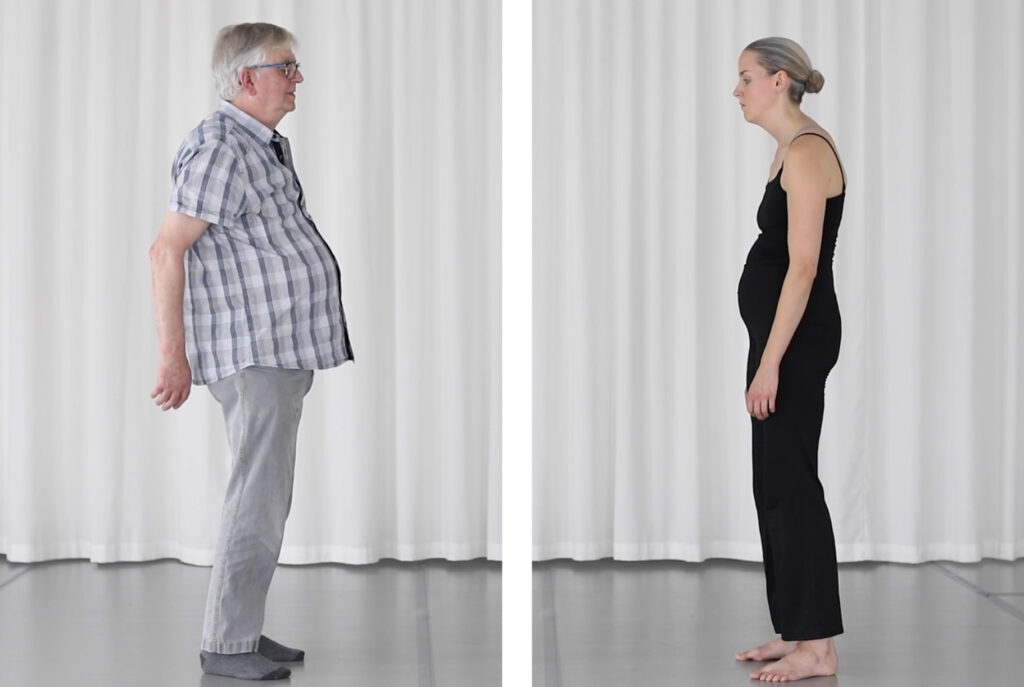
This video from the article also stuck out to me, specifically because of how accurately this performer captured the mans cadence. Even immediately, her posture is spot on, and she looks as though she has the wear and tear of an older man’s body, despite obviously being young.
3. Describe the habitual movements/unconscious gestures, tics, etc. of 3 people you know well. How do individual body parts move, and how does the whole body interact? What about facial expressions, and emotional valence of the movement? How does body type inform the movement? What do these examples of small movements mean and imply?
The first one I can think of is my roommate; they rated growing their hair out and ever since have been twirling a long piece in the back around their finger. It happens in a very specific location and circumstance though. If we are sitting on the couch and their arm is resting on the back above them, that’s when they do it. I have always interpreted it as a moment of focusing, like they are trying to ground themselves. As it usually happens while watching a movie or if we are having a lengthy conversation.
The second one I can think of is a phrase I picked up from a friend: “yip yip!”. They used to text it to me a lot, and even say it in person, and slowly I started to as well. I think it’s supposed to be like a small excited dog, which I think is hilarious. I must’ve like it enough to start saying it. It is a way to give a response that’s very happy and overjoyed. Hence the small dog yipping.
The third one is something my Nan does. She likes to give a small smile and nod to something, even if she has no idea what you said. Sometimes she will add in a chuckle and a “yeah”. I think this has stemmed from her being hard of hearing for a wile but too stubborn to admit it. So really the gesture itself is stubbornness. Even if you call her out, she will say she did hear you, then if you ask her to repeat she will finally admit she didn’t and laugh about it. She is an amazing human, and can turn anything into a fn time. I think I could also observe the gesture through that lens; no matter what she wants you to be happy and feel seen.
Pauline Oliveros Reflection: My Relationship to Music
When watching the documentary about Pauline Oliveros, I started to reflect on my own experiences with sound. To say I was moved by the documentary and her story is a complete understatement. As a music enjoyer, seeing the impact she had on digital sound and the techniques she used was fascinating and inspiring.
When reflecting on my own experiences of listening, I realized it’s not very often that I am not wearing my headphones. I tend to have issues with audio processing, sometimes environments are too loud or too quiet, so if I don’t have at least some form of headphone or earbud, I feel very panicked very quickly. Oliveros’ idea of deep listening started to make me break down what I listen to and why, and what contexts or environments play a role in what I decide to listen to. For example, I realized when I am on the bus I enjoy immersing myself in a playlist or whatever 10 songs I am prioritizing that week. Most of the time it’s songs that make me feel comfortable; but what does it mean to be comfortable when listening to a song? For me it seems to be familiarity, a song where I know every lyric, melody, bass tone, and strum of a guitar. When I listen to these songs it truly is a full body experience. The excitement of knowing the song by heart (that happens when you listen to it 10 times a day) or even my ability to come up with music videos in my imagination. This proved to me how important sound was to improving my creativity. Even when I am painting I have a playlist going, and my speed and enjoyment depends a lot on what’s playing.
I then started to observe other ways I enjoy music, and one of those ways is through hearing. I love making playlists for people with a rollercoaster of genres, and I often think of others and what songs remind me of them when listening. I will pay attention to peoples taste in music, and recommend new artists or an adjacent genre I think they would like. Then I remembered the documentary, and how important collaboration and community was to Pauline, and how she thought sound and active listening was THE way to make connections. Without even realizing it, this is exactly what I have been doing. To me it was just a thing I did, but now I realize it’s been a way of fostering my relationships, and strengthening new connections.
So, even though I knew how important sound was to me, by researching my own relationship to it and why that relationship even exists, it made me realize how big of a role it plays in everything I do creatively and how important it is to the connections I make with others.
AUDIO ASSIGNMENT: iwillbereadyforsomethingalittledifferent
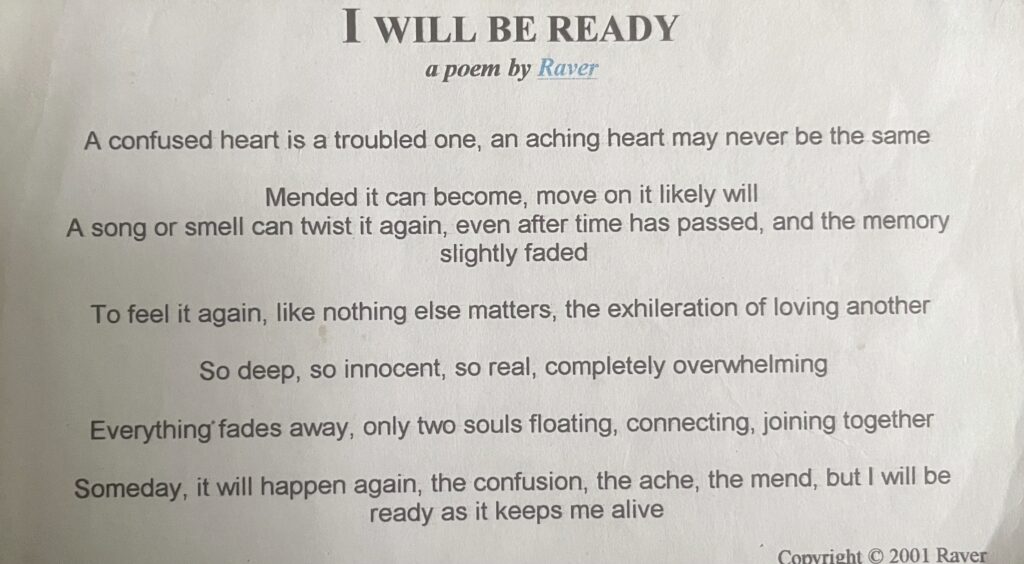
The poems. Written by my Dad, David, in 2001 for the website poet.com, screen name Raver.
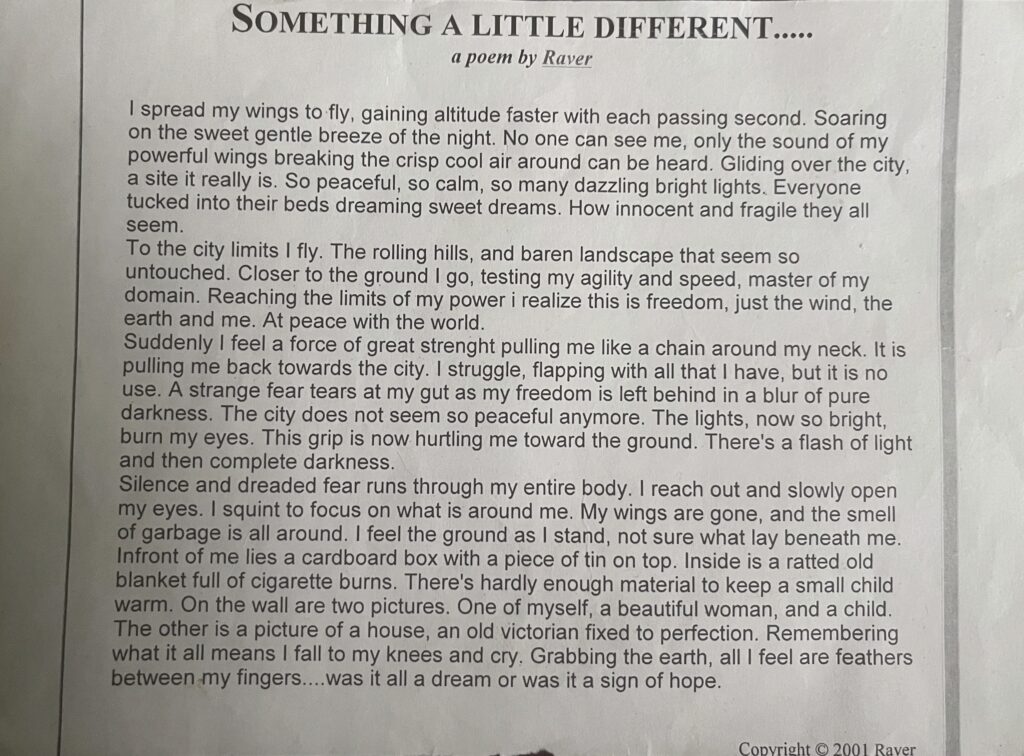
One of the poems, “Something A Little Different” is about my Dad, as a bird, going back to the city only to realize it’s not the same. It’s very dark, depressing, and almost violent. Even though I wasn’t there when he wrote it, I could feel his sense of panic to be returning to an unfamiliar, no longer gratifying place.
The other poem, “I Will Be Ready” is about the complications of love, and how my Dad will push past the obstacles and overwhelming feelings, even accepting them.
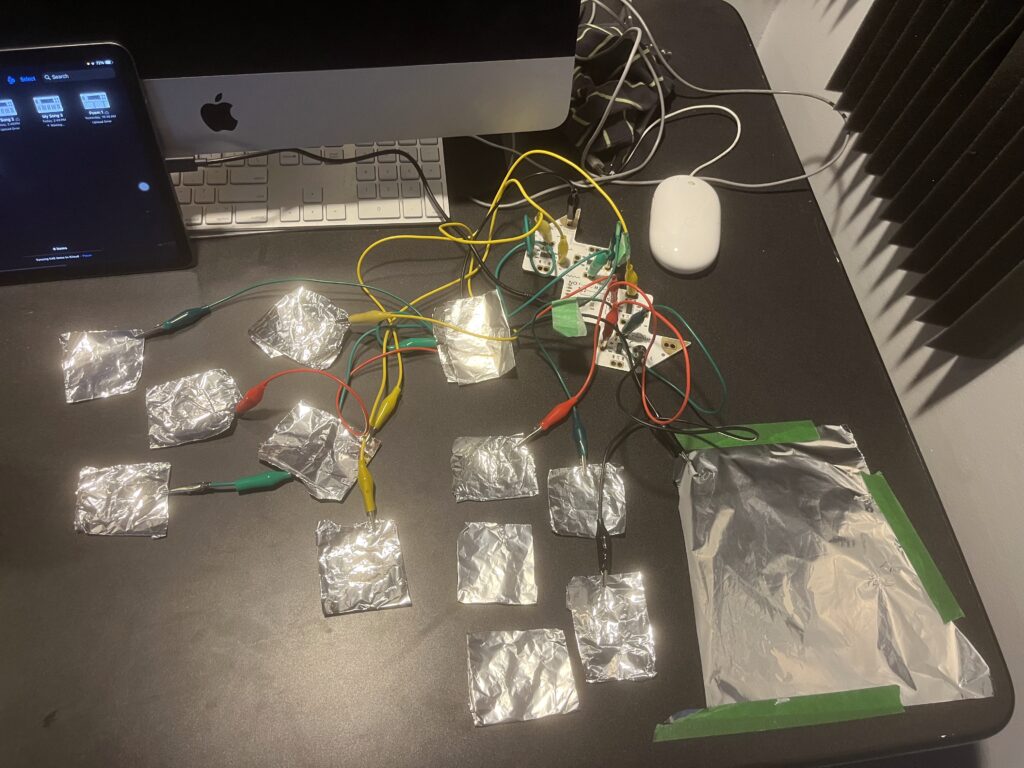
Initially I tried to use the synth to spell them out, but as I said that drained any emotion or understanding to be made available to the viewer. So instead I used intuition. In my head I tend to create soundtracks to scenarios I am in, so I thought I would let go of the heavy procedural idea I had and just feel it. I first recorded audio of myself reading the poems aloud. I didn’t know at first if I would use them in the final, but after reading them in my own way and hearing the inflictions I unnoticeably put into my voice, I knew i had to layer them in. While making the “soundtrack” I played by own recording back to myself, closed my eyes, and payed attention to the spaces I left, the ups and downs, and the story being told. This resulted in a very dark, atmospheric vibe. It also helped that I picked a very drowned out synth sound called “Mission to Saturn”. when editing, I knew panning would play an important role in this assignment. I had two poems, but one soundtrack for both. So, I decided to play one voice in the left, one in the right, and the music in the centre. This way people could move around the room and hear a different poem, or hear both at the same time. This to me added a level of uncertainty and an overwhelming feeling. How does listening to both change the context of an individual poem? Or ow does listening to one change how the audience listens to the other? Will one pay attention to the actual words being said or does the intensity of the music affect their perception of something so literal?
Conceptual Portrait: Informal Artist Statement
A few weeks ago I received a stack court documents and transaction slips from my Dad, all pertaining to the custody battle between him and my Mom and the FRO involvement.
I decided the system or rule I would set for myself was to use these documents to create a timeline of my own, based on my own memories and understandings of what was happening behind the scenes. My Mom and Dad tended to tell me different stories, wanting me to “pick a side”. By combing through these documents and displaying them as a timeline I hope to create my own story. This will not only be a conceptual portrait of my father, its a portrait of mine and his relationship, his and my moms, all three of us, and even our relationship to money and the court/FRO system.
I have envelops, all dated “Lakyn 2003” and so on, so those will be the basis for my timeline production. I want to find documents that match those dates, as well as find pictures of me when I was that age to add along with each year. I also want to photocopy everything and black out some of the information, I believe this will give the viewers a biased and skewed understanding of what they see, just as I did navigating the relationships all these years. Viewers will also notice that it is just me in the documents, despite having siblings, so I believe assumptions will be made, and people will start to create their own timelines and fill in the blanks of my family dynamics. I want it to replicate a crime scene, a space where I am piecing together incomplete and biased information, one side of a big complicated story.
One artist that inspired me was a recently graduated student of this program named Bella Lanci. She did an installation work about her autoimmune disorders where she filled an entire wall of the Zavitz gallery with all medical paperwork from the time she was diagnosed until now. It was so raw, and forces the viewer to acknowledge something often invisible, so I want to achieve the same thing with my piece.
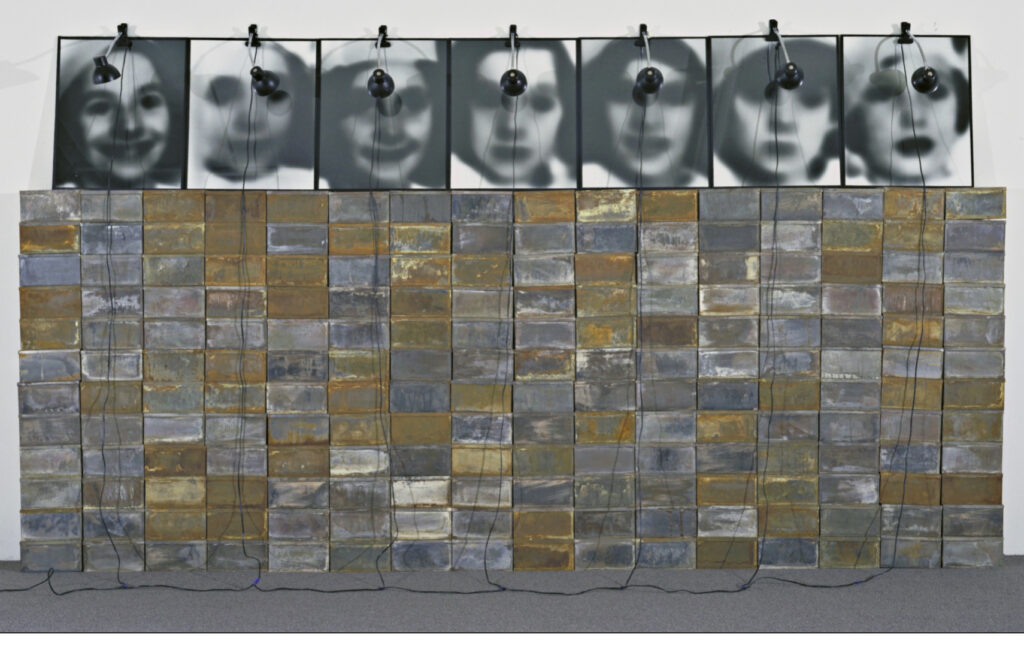
Another artist inspiration, this one from class, was Christian Boltanski. He did a work called “The Storehouse” which mimics a memorial, but they are just pictures of random people from newspapers and tin boxes. He was an inspiration because of his use of archiving as a system, but in a way that creates a narrative so to speak. This is why I am choosing to do an installation that replicates a crime scene, but uses archived documents. Just like Boltanski’s work, it evokes strong feelings that are hard to place and understand.
OVERSHARE: the past of an absent father
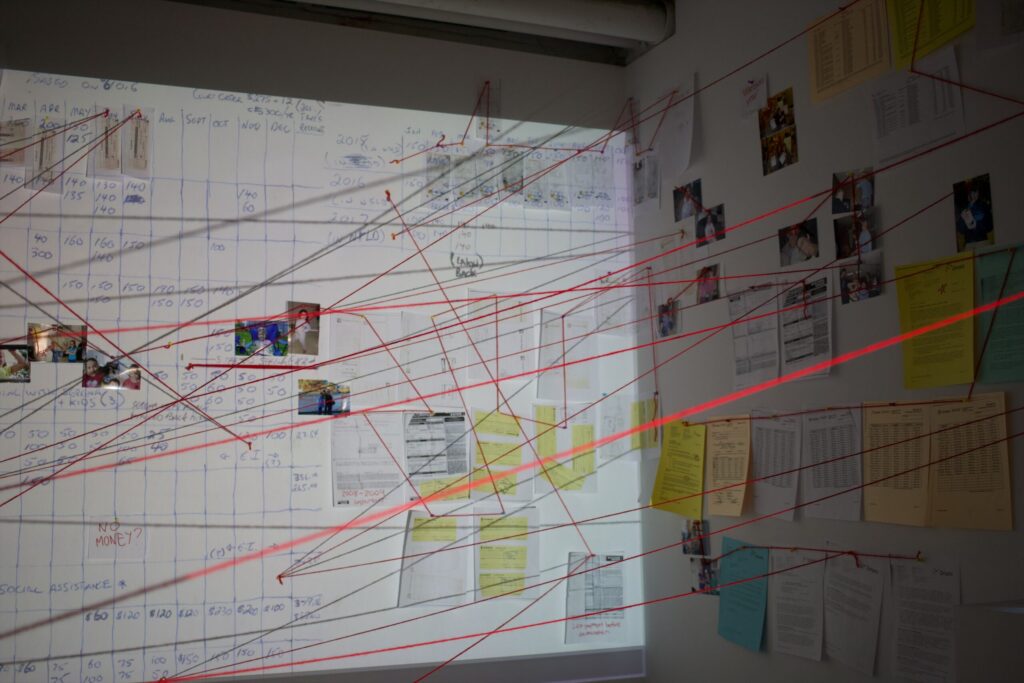
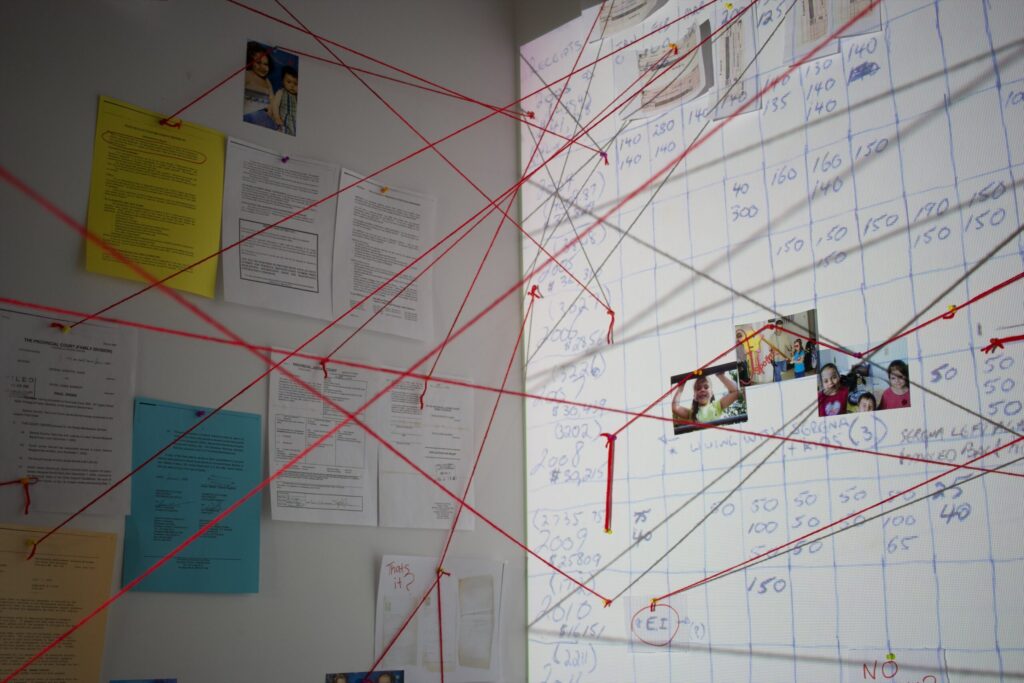
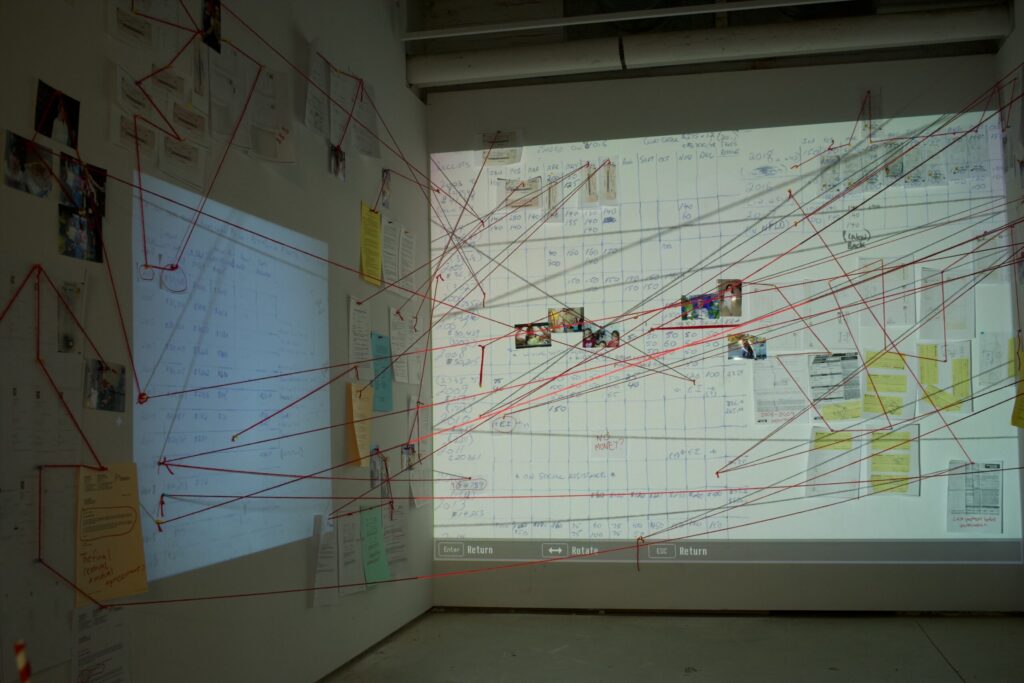
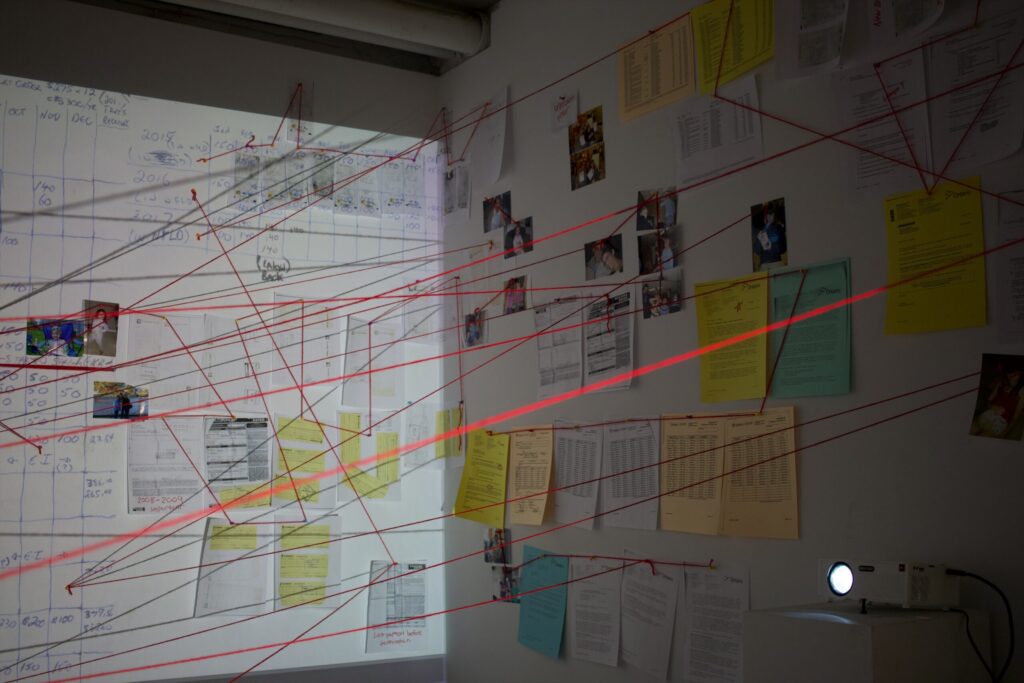
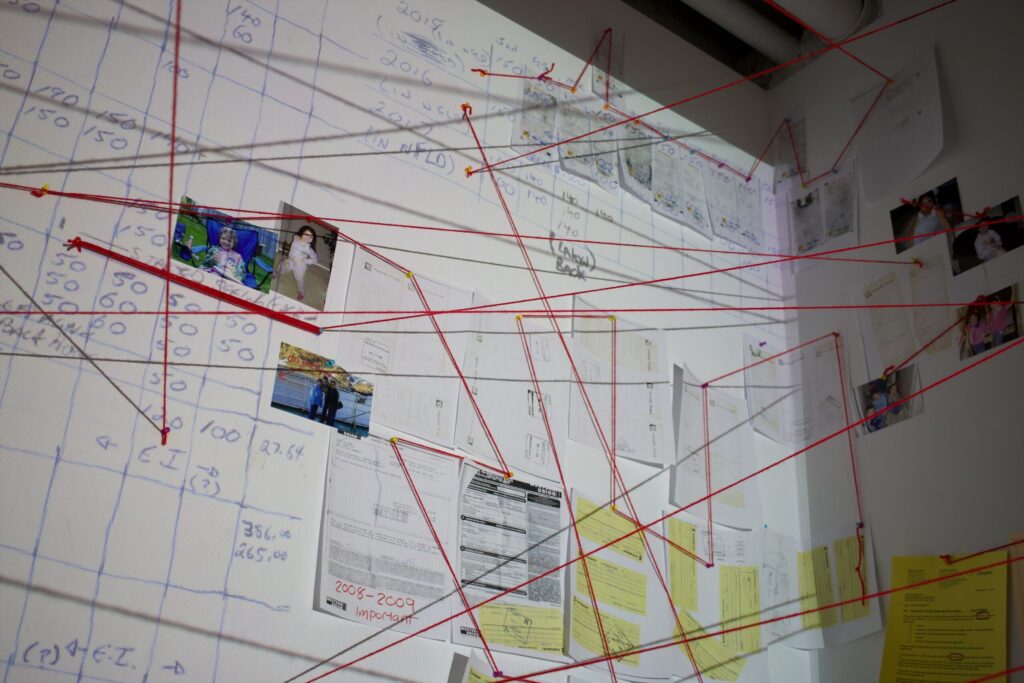
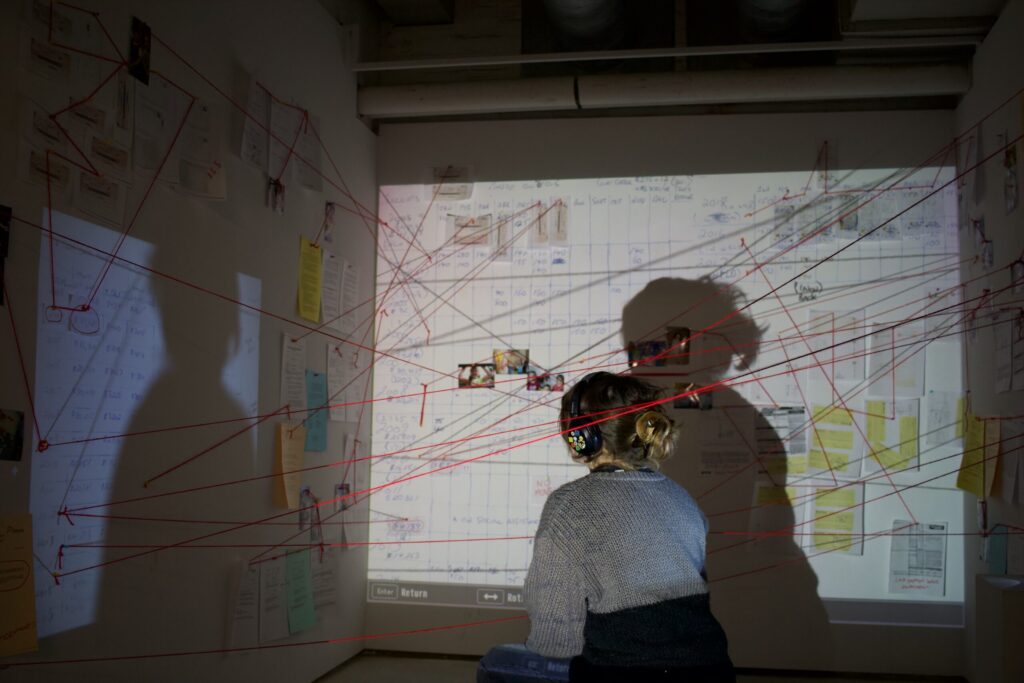
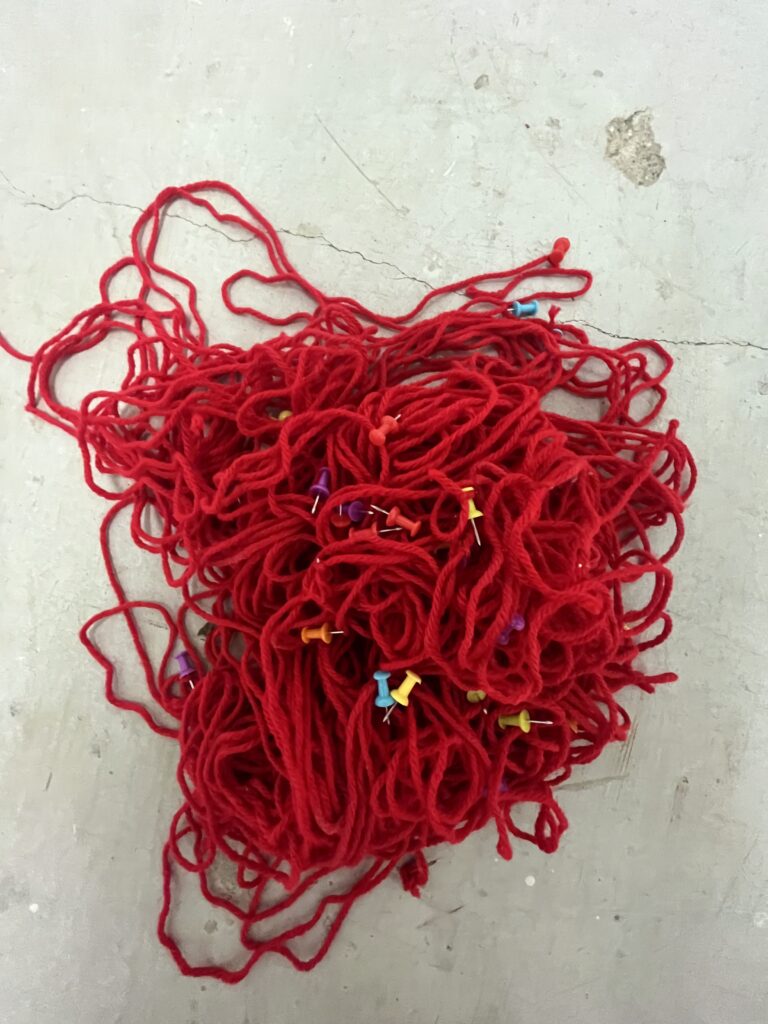
the finished product! after 4 days of prep and 7 hours of set up, it was finally done.
using the sculpture gallery (I rented it out for 2 days) I created the exact immersive space I hoped to (on a slightly smaller scale)
this was so fun to do and I hope everyone that came to visit got to see a little too closely into my families life and maybe judge my dad a little too hard (he is okay with that).

Leave a Reply
You must be logged in to post a comment.