Hello! ☻
My name is Olivia, and this year I’m beginning my second year in the Creative Arts Health and Wellness program…
In my free time, I love to paint, draw, sew, and crochet! Through my art, I especially enjoy utilizing textile, and mixing and combining all sorts of different media!
The Artist Is Present ~ Marina Abramovic
Through the screening of “The Artist Is Present” by Marina Abramovic, I’ve come to understand performance art as a raw and fearless expression of self that is intimate and vulnerable in nature. Abramovic utilizes her body as her medium and derives her immense physical strength and stamina which make her performances possible, from her audiences. Since her physical being is used to create her art, it was evident that those close to her, and even Abramovic herself, have difficulty separating her identity and sense of self from her art; the lines between both are very blurred. Clips in this documentary presented pervious lovers of Abramovic almost trying to rationalize within themselves how to perceive and go about interacting with Marina. She seemingly is always performing, and they never know who or what the true Marina is. I think that this truly encapsulates the all encompassing nature of performance art, and without that quality it would not be as striking, provocative, and touching as the work presented by Abramovic.
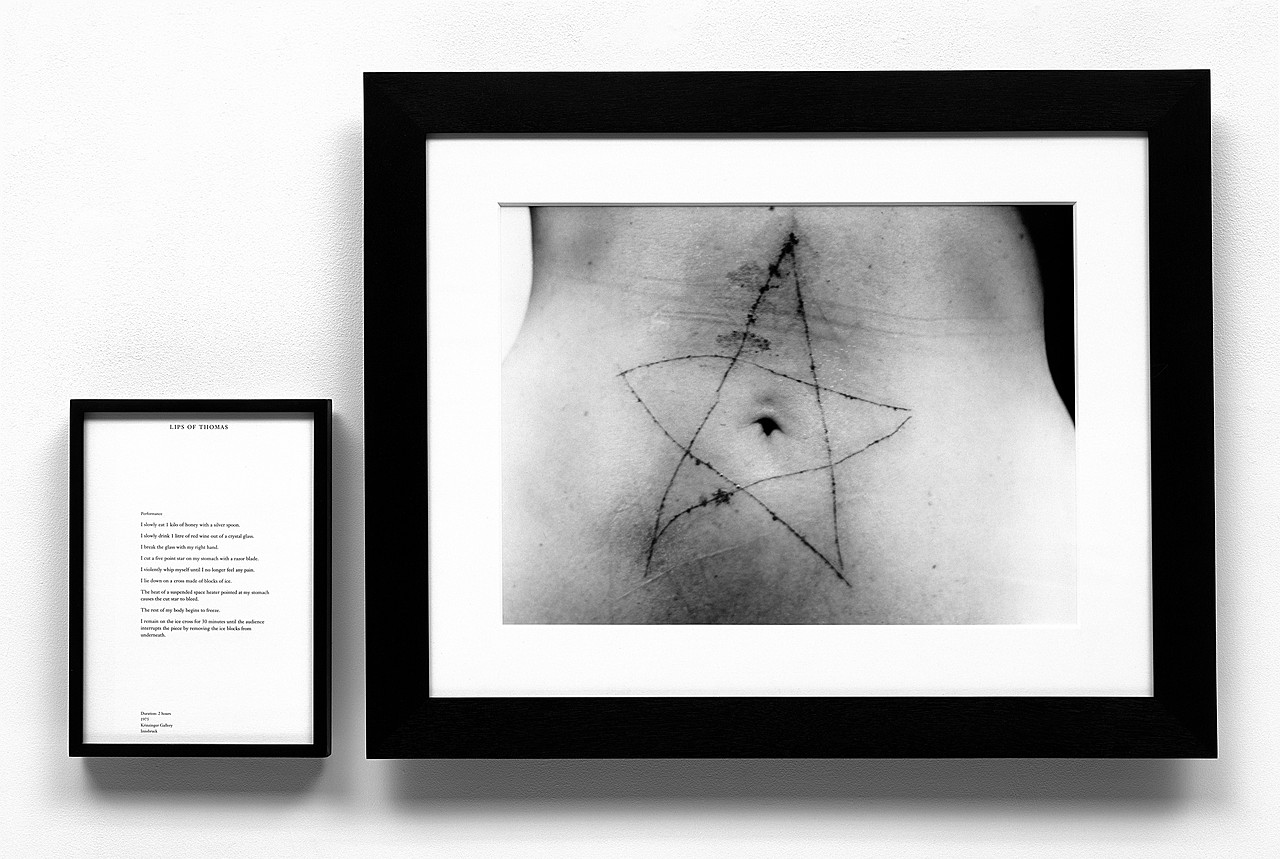
In 1975, she produced the work entitled Lips of Thomas which for me was her most memorable piece shown in the documentary due to it’s shocking and graphic nature. Part of the performance involved her inflicting acts of torture upon her physical body by cutting a pentagram into her stomach which she later used a whip upon. Not only does her physical endurance and high tolerance for pain make this piece so memorable, but the mental aspect of the difficulty behind such a feat is honestly inconceivable for me. This is a truly authentic choice of expression that is unconcerned with the public’s perception

In the performance of “The Artist is Present”, Marina set up a small table and two opposite facing chairs; one for her, and one for a member of the audience. As an audience member would take a seat, Abramovic would sit in silence and stare into the eyes of the individual. Whether it was a stranger or someone she knew for many years, each participant was given the same treatment and attention on her end. Abramovic becomes a mirror of the other person, mirroring themselves back means the piece is not necessarily about her, she becomes a vessel for the purpose of the performance. I think one of the factors contributing to the poignant depth of this piece is the space it creates to pause and slow down in the fast paced world we live in. It left participants transformed after experiencing the piece.
Assignment 1 ~ A KM
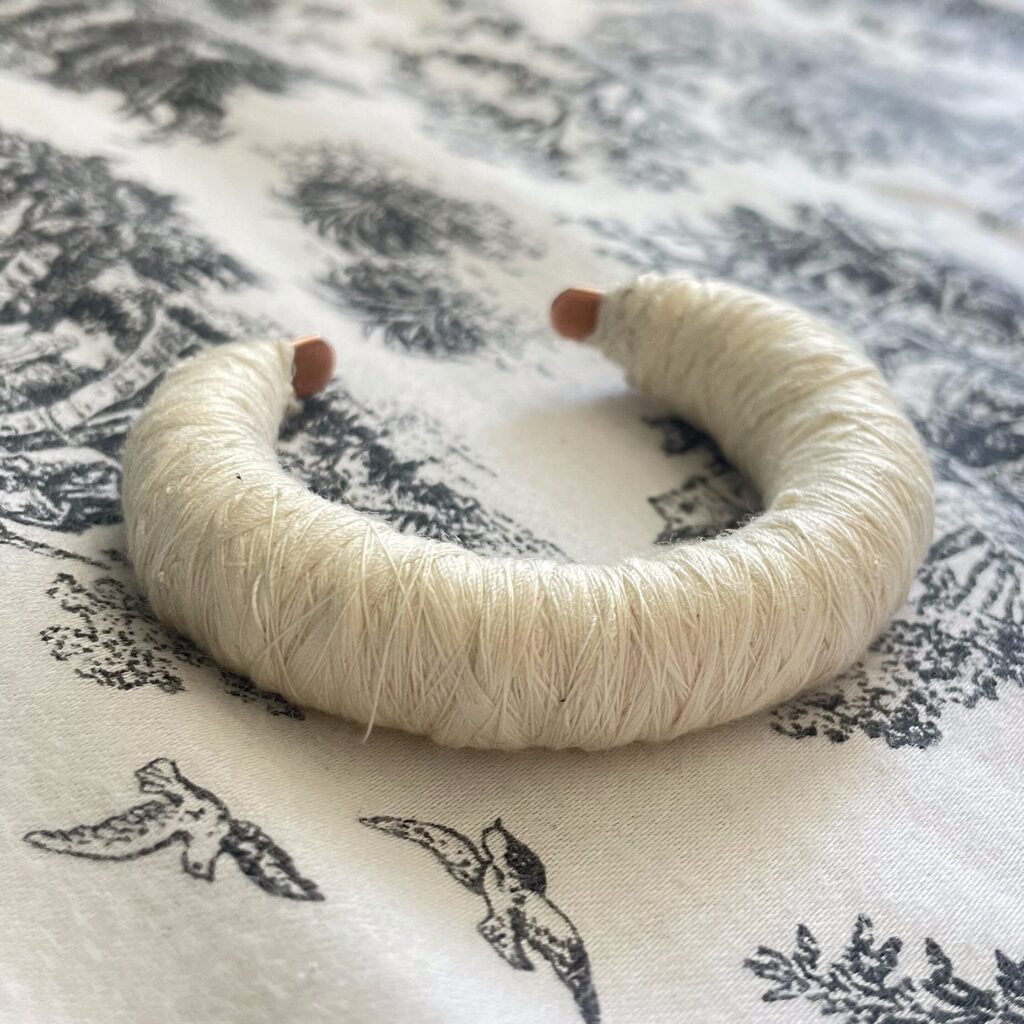
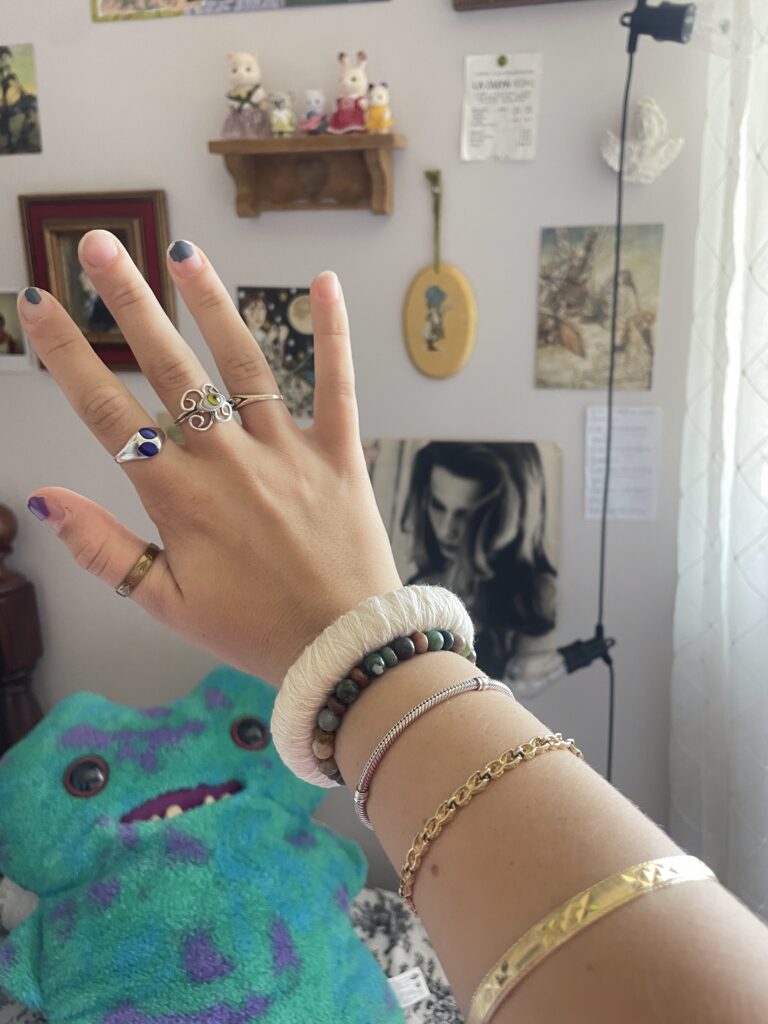
In order to represent a kilometre in an innovative way that challenges our initial understandings of distance and measurement, I decided to create a “wearable kilometre” in the form of a bracelet.
When visualizing a kilometre, the first thing that came to mind for me was point A to point B somewhere on the map. I picture a road, bridge, trail, or path. A distance we must travel by car, bike, or on foot. Coming up with a new way to think about a concept as abstract as a distance was initially something that kind of stumped me. I then began to think about what materials could be outstretched to the length of a kilometre. I personally really enjoy working in fabric and textile, so things like yarn, rope, ribbon, or thread were some my instinctual ideas. I also really enjoy the idea that if my piece were to be unravelled, it would be one long piece of material at the length of a kilometre, even though no one would be able to guess it were that long when looking at the finished piece. The concept of being able to be made and remade is also impactful to me.
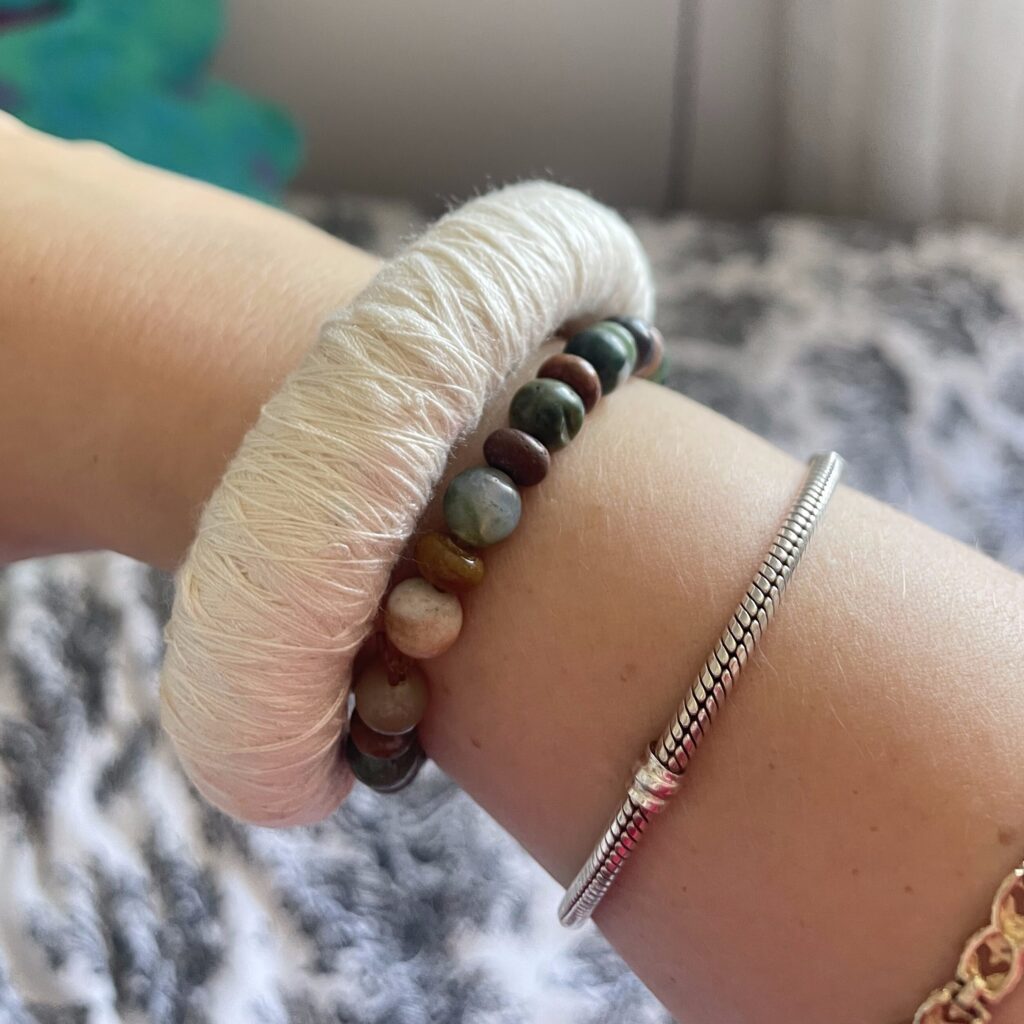
I wanted to find a way for my final piece to be personal in some way, so I landed on a piece that I could wear upon my physical body, presenting it performatively almost. I decided that a bracelet created from one kilometre of wrapped string would be the most doable within the time constraint. Jewelry is something that holds great importance for me. I love wearing bracelets, necklaces, and rings every day. They make me feel confident and more like myself; they are a beautiful tool of self-expression.
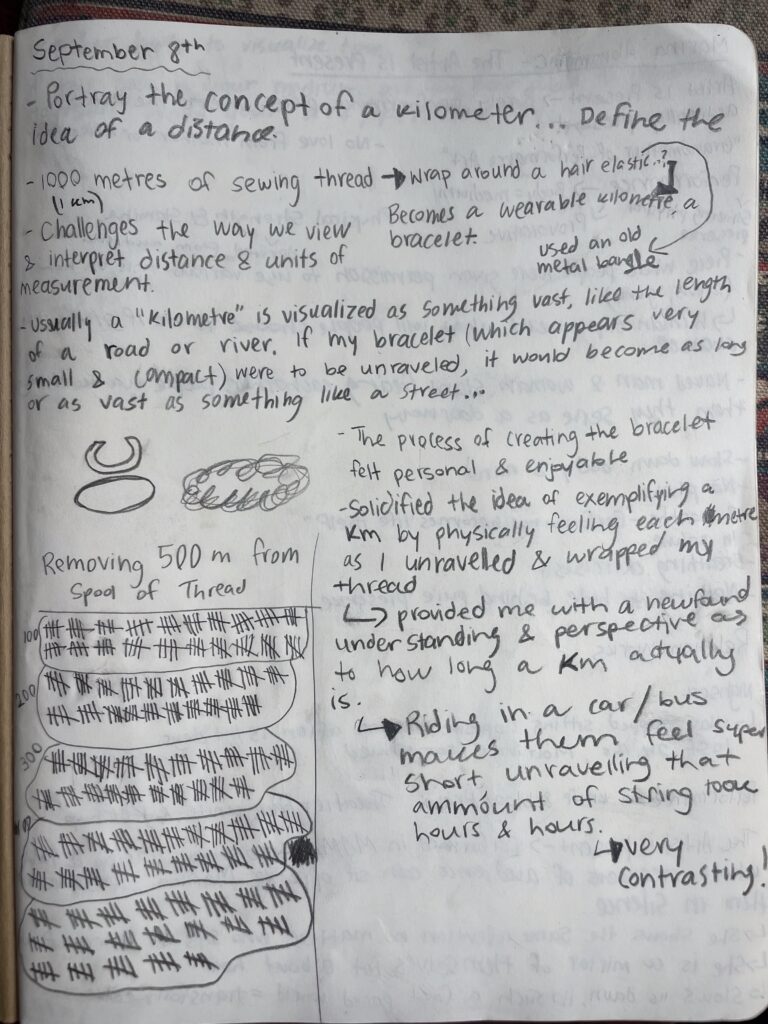
Planning notes and concept formation.

I began with 1.5 km of thread; unfortunately, this was the closest to exactly 1 km that I could find.
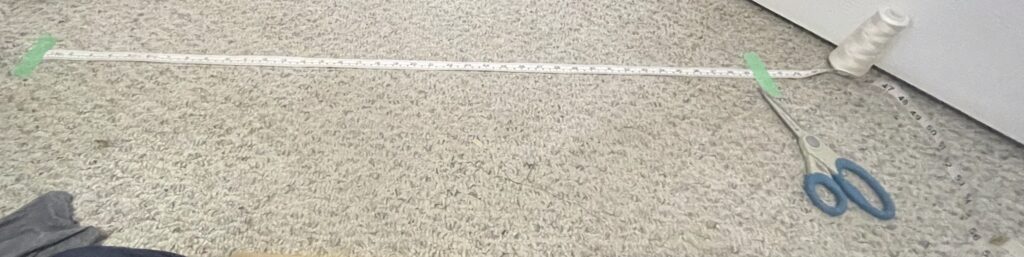
I set up a measuring tape marked at 1 metre. I unravelled and cut off 1 metre intervals of string 500 times in order to be left with exactly 1 km of thread to use in the creation of my bracelet.
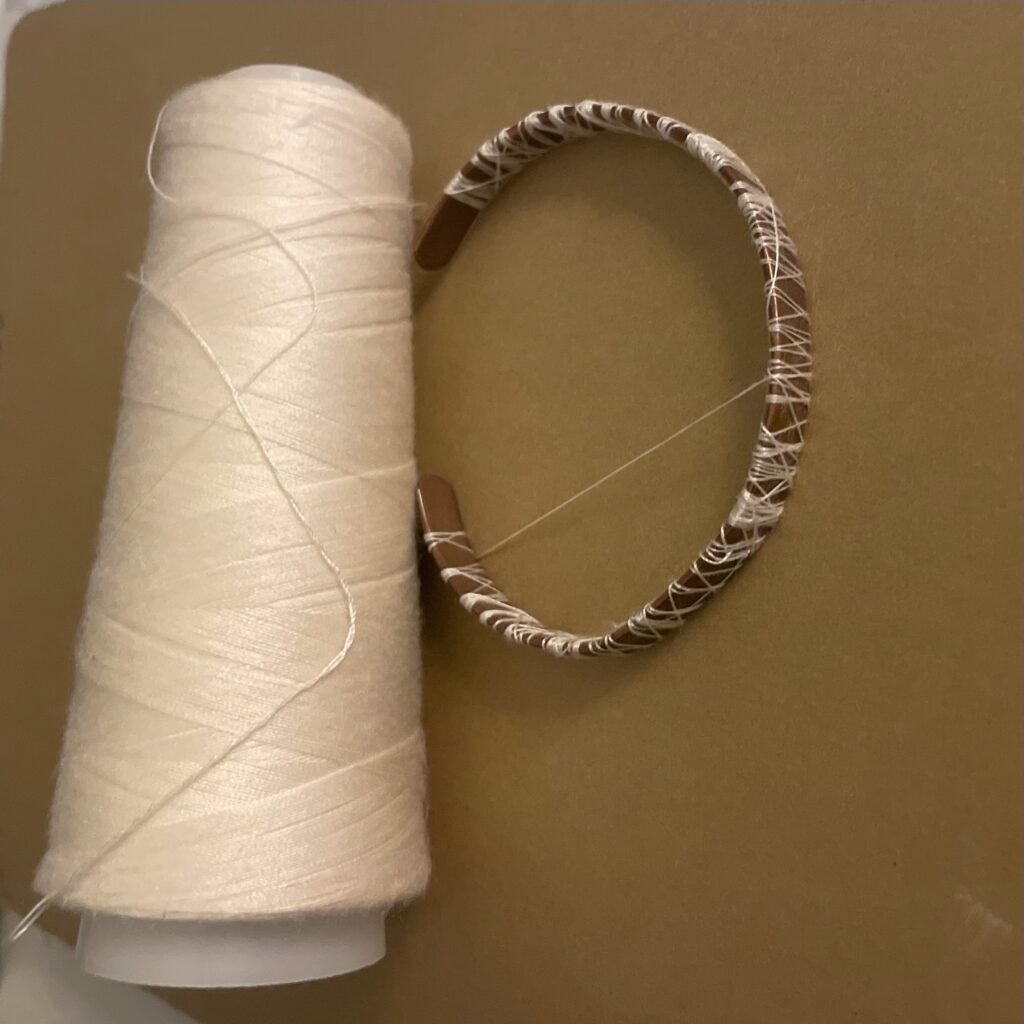
Early stages of wrapping the thread.
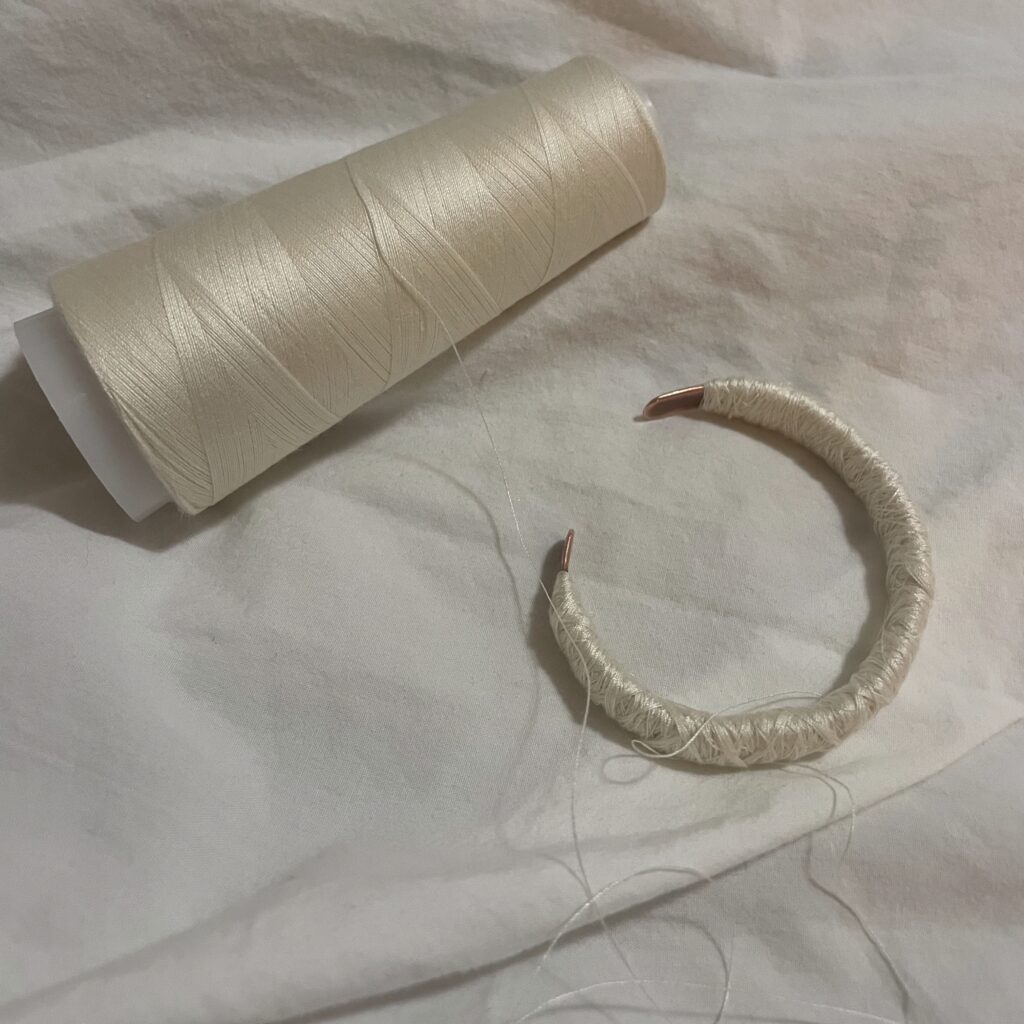
About halfway through the wrapping process.
The “Wearable” Kilometre
Turning the Gestures of Everyday Life into Art
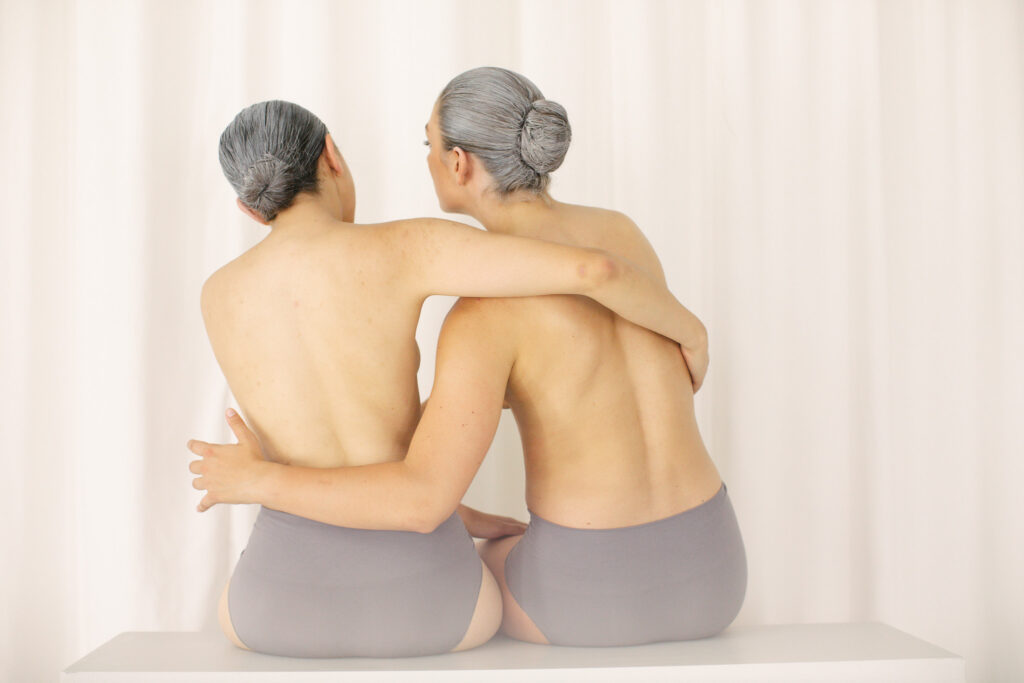
"We archive a lot of information but it's always approached from an efficient and rational point of view. I think we constantly struggle with our own mortality. We are transient but at the same time we long to be everlasting ... I think there's a true beauty in this attempt to hold on to something elusive. So by using movement, the most immaterial human heritage. We can show this paradox."
Katja Heitmann
The project Motus Mori by Katja Heitmann attempts to capture a certain essence of humanity that isn’t always valued or considered. The archive of movement that she is creating through these reproductions of the subjects’ subconscious ticks creates a window into some of their most authentic characteristics; painting a picture of what makes these people who they are. As Heitmann puts it, attempting to capture humanity through data allows it to get lost in a sense.
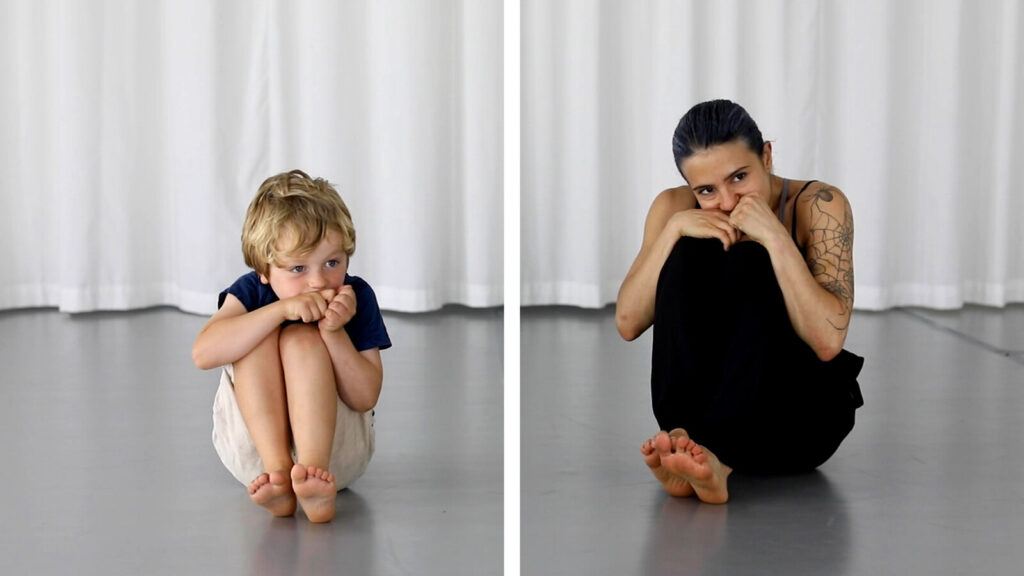
"There is no “good” or “bad” movement, as long as it’s authentic."
Katja Heitmann
This work is rooted in surveillance; noticing the things that most people, not even the subject themselves, would. I love how Heitmann cares only for the genuineness of the movement. As long as the participant comes at it from a place of authenticity, there is no “wrong” way for them to show up in the space. Paring the observation of movement with an open stream of dialogue or conversation allows connections to be made between performer and subject. This introduces new layers of vulnerability and depth to the piece as a whole.
I think that challenges could arise if participants were to enter the space not entirely as themselves, with some sort of mask or guard up. It would compromise the integrity of the project if, for instance, a participant were to censor or alter their natural movements in some way.
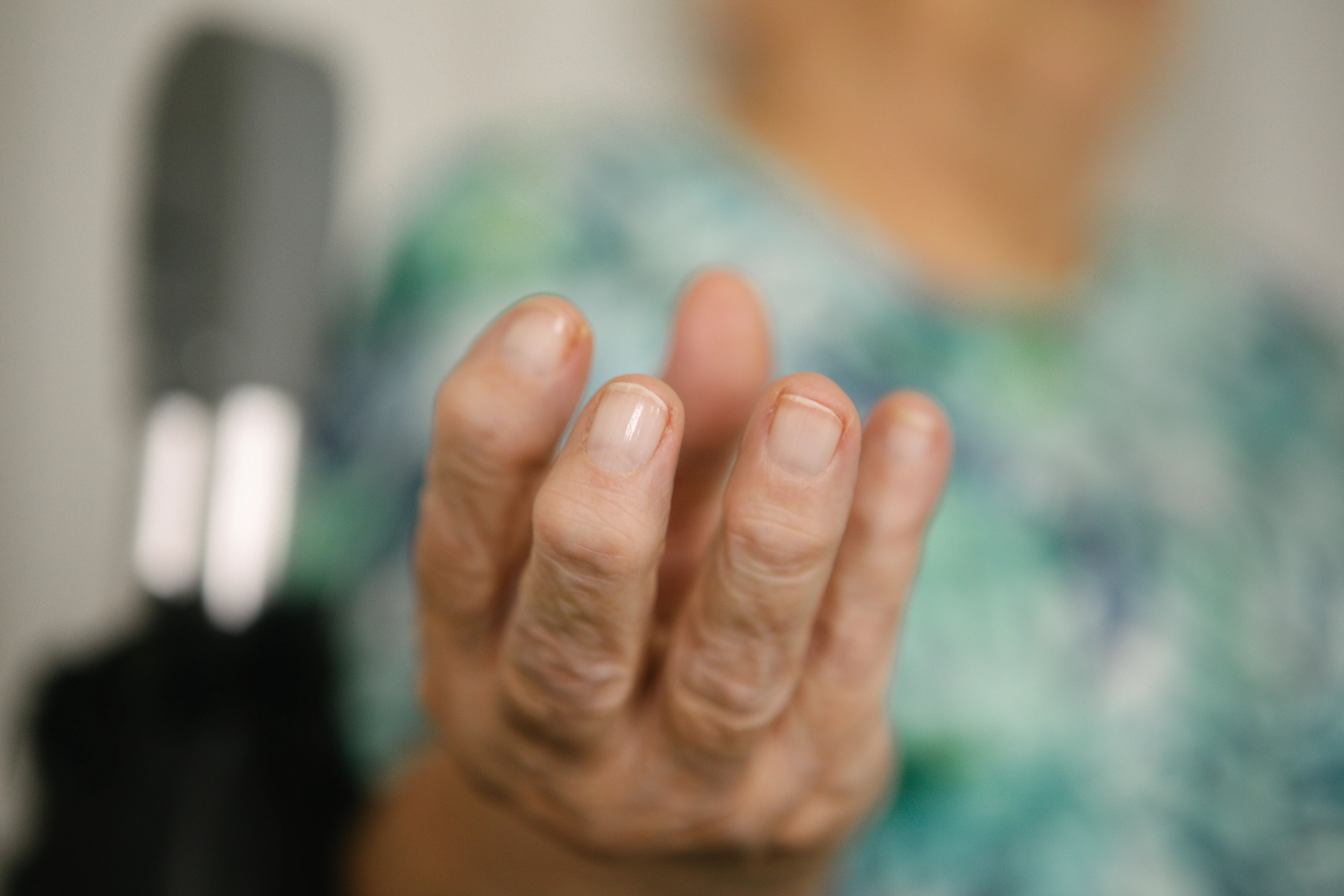
Two Striking Examples of Movement
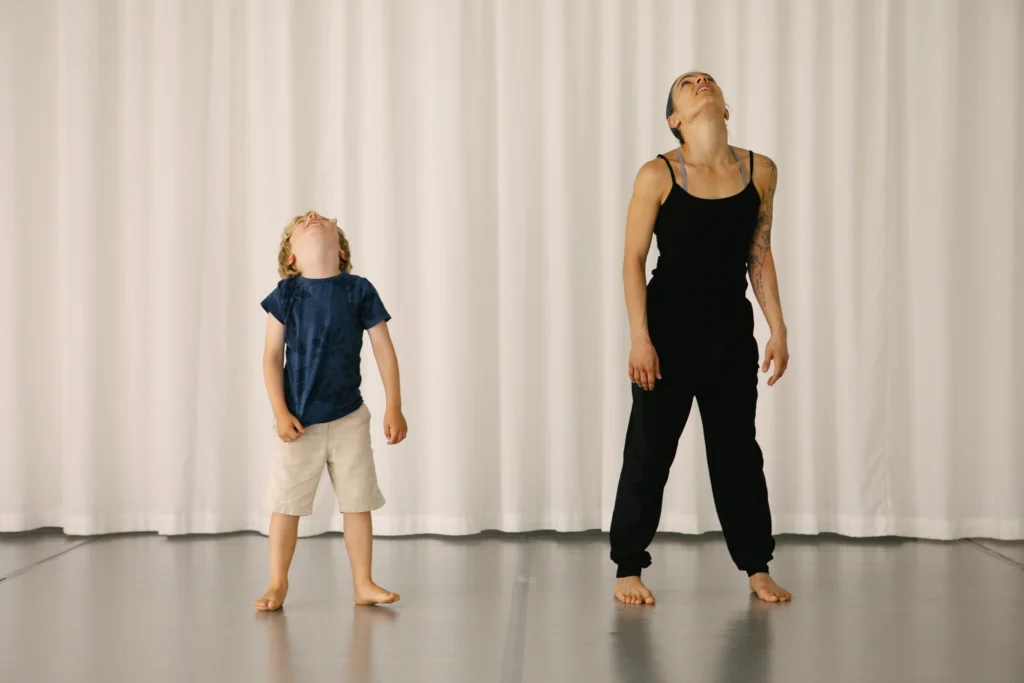
I think that I was most stirred by the movements of the little boy; his movements felt the most unapologetic. Most children seem unable to have a filter when it comes to their movements, demeanour, or speech. This is fascinating and honestly inspirational to witness since I feel like in a lot of ways I have lost, or am fighting to preserve, the uncaring and childlike wonder we all thoughtlessly possessed at one point in time.
Upon reading the article, I was particularly most moved by the movements attempting to resurrect in a sense, and pay homage to individuals who have passed on. For instance, Heitmann herself memorializes and remembers her late father by reenacting the way he would scratch his scalp, or pulled in his stomach when passing in front of a studio mirror. This unique layered approach to the feat of this project is definitely a way of immortalizing the dead that I haven’t considered before. Typically I would remember someone by the time we shared together, words exchanged, or the way they looked. But remembering them by the unique ways in which they moved or fidgeted feels very human and intimate.
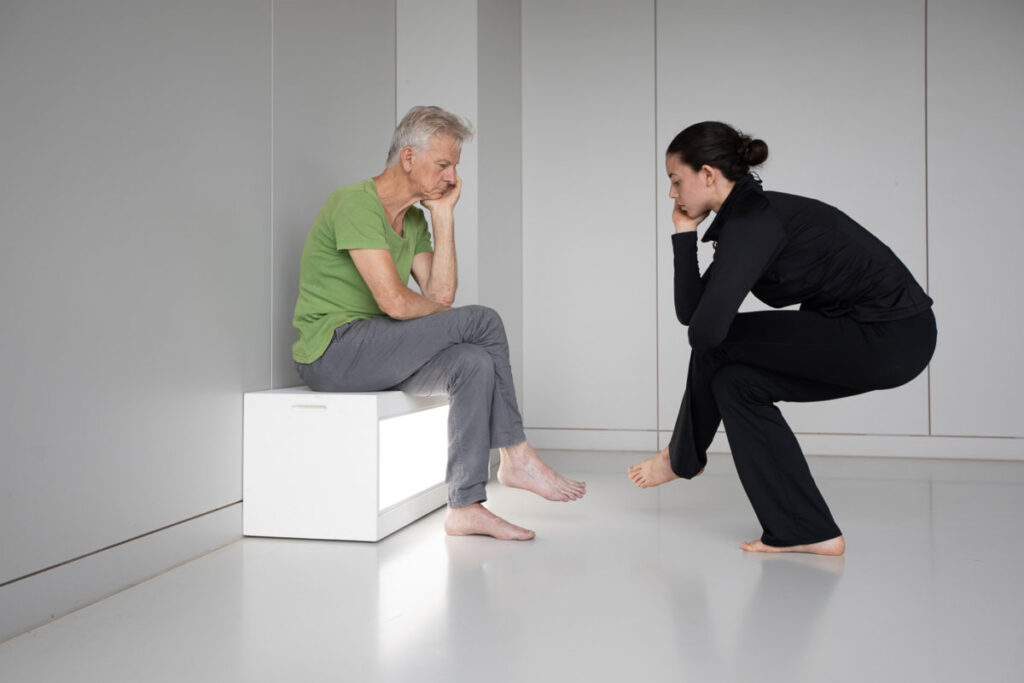
Describe the habitual movements/unconscious gestures, tics, etc. of 3 people you know well…
- My Dad has a subconscious habit of filling lulls in conversation, or just moments of silence with tics relating to his hands. He will bite his nails or tap his fingers on a surface. I feel as though I have adopted these sorts of habits from him. When I find myself feeling in an uncomfortable lull, especially socially, I will attempt to fill this awkwardness with unconscious self-soothing actions such as biting my nails or fidgeting with rings or bracelets. I can imagine that his habits stem from the same place that mine do.
- An unconscious gesture of my Mom’s that I have always noticed is the way she plays with her hair. During moments of silence or while watching TV she would individually examine stands of hair, seemingly in search of a dead end or imperfection. This was always something that sparked my curiosity, I would often ask her about it as a kid.
- I noticed that one of my close friends will sooth himself through leg movements; bouncing up and down or to the side, or rubbing his foot up and down the side of his calf. I notice these movements when he’s opening up emotionally or just sharing his thoughts on a topic or matter. I also notice him engage in these motions in quieter moments, like watching TV, laying down, and trying to fall asleep.
Art Gallery of Guelph Field Trip
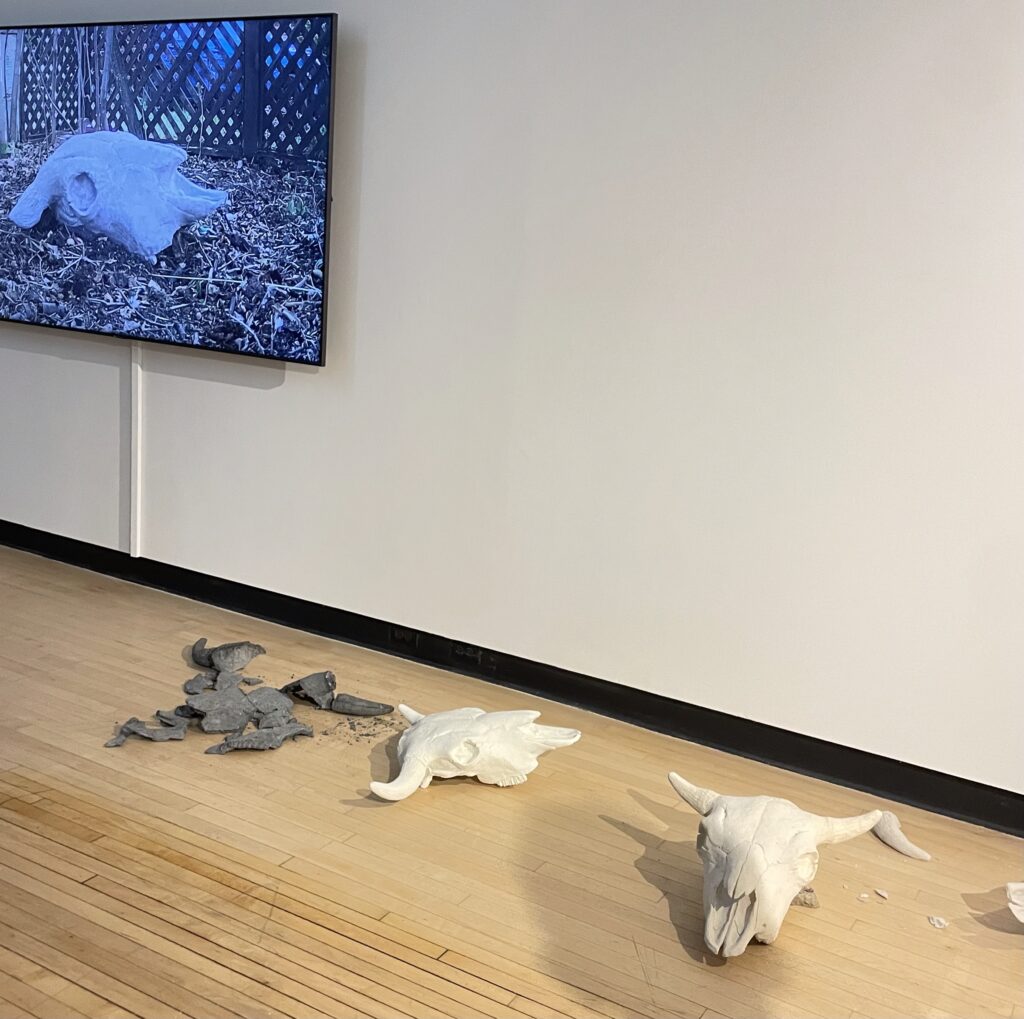
The first piece I’ve chosen to reflect upon is entitled returning to bones (52 days) by Sheri Osden Nault. This piece is a timelapse video documenting the decomposition of a life-sized bison skull that they had cast and created from a mixture of clay and seeds. This piece shows a full progression through a life cycle, as the skull deteriorates it becomes immeshed with the earth its laying upon. I was moved by the fact that after Sheri’s piece has run it’s course, it will provide positive impacts the the soil through fertilization and new growth. This speaks to the relationship between humans and animals with the earth and nature, and the ways in which that relationship is mutually beneficial. This is a dynamic that I feel is central to the world around us and something I wish to explore in my own creations and artistic practice. Through this bison skull’s deterioration, it’s being illustrated that there is no longer a division between the art and it’s surrounding environment, this is immensely moving. It makes the viewer question where that division is or should be within themselves and our earth.
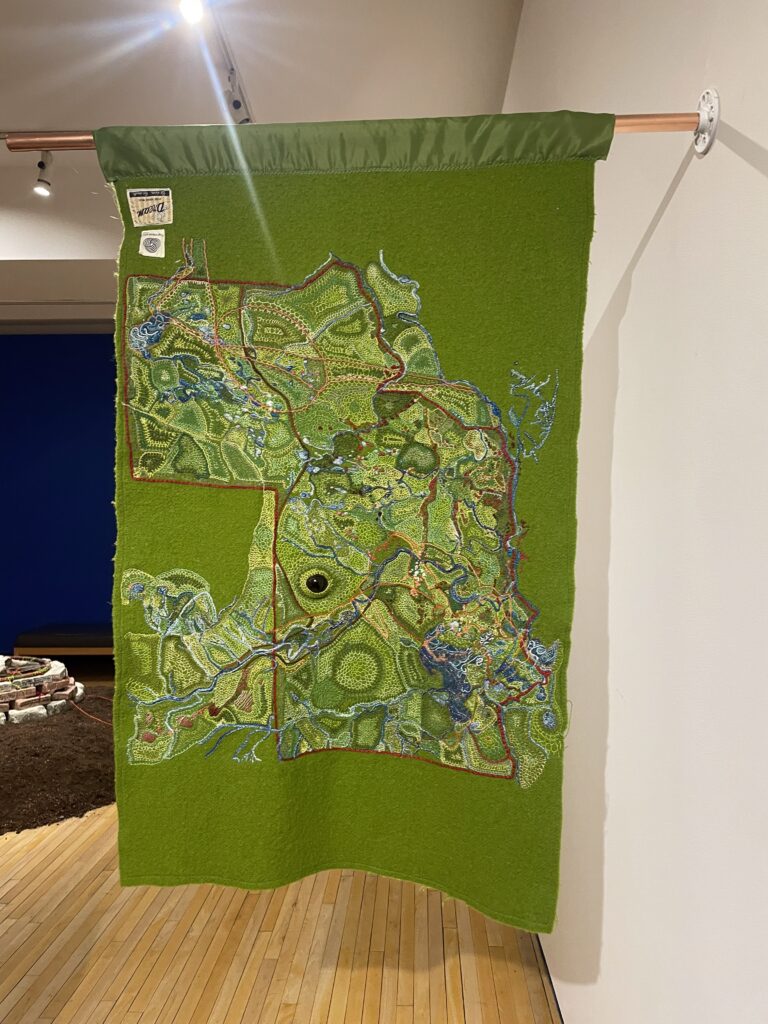
The second piece I’m choosing to reflect upon is entitled Warden’s Watch by Michelle Wilson. This work is a map of Wood Buffalo National Park, but presented in an unconventional medium, challenging western methods of documentation and understandings of land. I was massively inspired by the ways in which the artist is using this embroidered work to convey how this land is like a living organism itself, the use of the glass bison eye really solidified this for me. Within my own artistic practice, I love to experiment with various stitching and embroidery techniques, as well as the use of various fabrics and textures. This piece exemplifies this very well, and is very inspirational for me personally. I was very intrigued by the way that Michelle explained her choice of the green wool blanket, how it was second-hand, has already lived a long life, and felt like a familiar texture to members of the Wood Buffalo community. This adds new layers of depth, sincerity, and humanity to the piece.
One Feat, Three Ways Video Assignment
Toss & Turn
Olivia, Lakyn, & Carly
Video 1: The One-Shot
Video 2: The Sequence
Video 3: The Loop – Rotoscope Animation
My group and I initially were approaching this assignment through the lens of chronic pain; the body contortions that come alongside daily life for those living each day in pain and just trying to function normally. I was the only member of my group that did not have this lived experience, so we were also exploring the meaning and interest that would arise if I were the one to perform the movement.
For our final polished concept, we wanted our movement to be the act of “tossing and turning” as one falls asleep. For someone experiencing chronic pain, the longwinded process of acquiring just the right position to fall asleep comfortably is amplified and extended. We wanted this fact to come across in our video, as well as the intimacy and privateness that comes alongside the bedroom and act of falling asleep. We achieved this by dressing me in skin coloured clothing to mimic nudity; the raw form of the human body. This puts the sole emphasis on my limbs and bodily movements, no distractions from an outfit. This is also a common state that people choose to fall asleep in. The “nudity” also heightens the feeling that this is a very private moment, almost as if someone shouldn’t be watching. We emulated a bed by pushing multiple tables together and laying down blankets and pillows. The hardness of this surface was quite uncomfortable to lay down on which caused me to have to move a lot in order to get truly comfortable. I can imagine that for someone with chronic pain, they would experience something similar, the seemingly never ending act of adjusting but never achieving quite the right position.
Taking on the role of performer meant that I would be left to try to to fall asleep as realistically and naturally as possible. I feel as though this goal was achieved. We played soothing rain sounds, and I was able to reach deep relaxation as if I were really going to take a nap! I tried to not think at all about the movements I was making, I only focused on maintaining relaxation and finding a position that felt genuinely comfortable to me. Watching the video back revealed many movements and twitches I wasn’t even conscious of.
For the animation video, Carly and I worked collaboratively to create a final result of two interpretations of the same gesture overlayed upon one another. We chose a gesture that was not featured in our initial two videos; me falling from a seated position covered in a blanket, to laying down on the pillow. I feel as though this gesture is effective in a loop format because it emulates the frustration and never-ending feelings associated with trying to fall asleep and not being successful. I am proud of the colour palette of our animation because it feels very cohesive, it pulls from colours in our initial two videos, and the differing palettes among overlays can be representative of different versions of self and the various swarming thoughts that always seem to catch up to us before sleep.
Pauline Oliveros Reflection
What stuck with me most about Pauline Oliveros’ notion of “deep listening” was the implication that listening more intently and intentionally has the power to create a deeper and ever-expanding awareness in everyday life. Each day I hope to deepen my connection with the world around me, feel more present, and to just have a more grounded presence within myself. I think that deep listening pushes me further to intentionally achieve the awareness I desire by reframing the act of listening from being something passive, to a heightened continual experience. Whenever I remember Oliveros’ ideas to never stop listening, and to take in every sound no matter what, I find my entire perspective and presence change when this awareness is flipped on like a switch. I tried this for the first time on the day we watched the documentary while waiting for the bus. When I reminded myself to take in my surrounding sounds, I started to notice the differing sounds depending on the size and make of the vehicles. I noticed the sound of my breath against my collar hiked up to brace my face from the wind. I think that the more I practice reminding myself to be more aware, the more it will just happen naturally which is exciting to think about! I think deep listening also challenges my instinct to always listen to super loud music when I’m walking somewhere or taking the bus. Although I enjoy this, it doesn’t make me feel very present or in-tune to my surroundings, it has the opposite effect, it takes me somewhere else, but that also speaks to the power and influence sound can have.

Assignment 3 – Audio Art
trekking alongside words unspoken, 2025
For this audio art assignment, my goal was to create a track that audibly narrates and expresses an overarching theme that I seem to continually endure in various aspects of my life. This audio art piece serving as an outlet for my emotions…
Through this “audio narrative”, I am attempting to capture the trepidation associated with trying to function normally when things are far from such. When you maybe aren’t able to fully express the whole truth about your feelings. When cracks begin to form in masked feelings or personas, in raw and painful ways, and then “normalcy” is seemingly always restored. The cracks are quickly sealed and never mentioned again. This piece for me feels like probably one of the most vulnerable things I’ve ever made.
Process wise, my playing was fully based in intuition. I created around twenty different clips of just experimenting with the different sounds I could make and testing the limits of the medium. This made it easy to edit a lush sounding track since I had lots to work with and layer upon each other.
I gathered inspiration for my piece from John Cage, an artist shown in class who utilizes an orchestra, and it’s structure in an unconventional way. I wanted to use the violin as my sole instrument for producing sound for my piece. Between the ages of around 7-16, I regularly took lessons and practiced the violin. I ended up loosing passion for classical music and all that came alongside it; striving for perfection, and tedious practice. But through this piece I was hoping to reignite my buried passion for music and sound. Framing the use of the instrument in an intuitive way, rather than there being a very black and white sense of right and wrong, allowed me to see the artistic form through a new lens. The process for creating this piece felt very natural and cathartic.
I also was deeply inspired by folk artist Adrianne Lenker. In particular, her tracks entitled; my angel, music for indigo, and, mostly chimes , which are either solely, or predominantly instrumental. Although her music features mostly guitar rather than violin, I hoped to emulate similar raw feelings to those her music invokes. All her instrumentals feel very intuitive and improvisational, there’s a sense of intimacy and an unapologetic authenticity. There is also a feeling of hesitation and tension between her notes which I thoroughly enjoy and tried to achieve in my track as well. To me, it feels like she’s thinking of something, somewhere, someone in particular as she’s creating. Her songs read as messages straight from her heart, and are very moving on the listener’s end.
Assignment 4 – Conceptual Portrait
Conceptual Portrait Proposal
System: Video-record 82 exhales outside in the cold so they are physically visible to represent my grandmother’s 82 years of life
Each breath is an act of remembrance and ritual a ritual practice. Each breath is contained, and fleeting. Breathing is an act that sustains life, one that she was not able to do without assistance from an oxygen tank during the last months of her life.
Lecture Inspiration: Felix Gonzalez-Torres; his use of a numerical value to represent a person, mourning loss, highlighting what was taken, intimacy with little information to the viewer.

“Untitled” (Portrait of Ross in L.A.), 1991
Isobel
This is a conceptual portrait of my grandma. I’ve captured footage of the physical manifestations of my breath in the freezing air each time I exhale. The entirety of the video portrays the completion of a system in which I repeatedly take deep and steady breaths. I stood behind the camera and held a light in front of me, faceup, under the lens so the breaths would be illuminated. For around the the last year of her life, my grandma was no longer able to breath normally or independently without the use of an external tank.
Initially, my plan was to take 82 breaths while reflection was taking place in order to represent my grandmother; each breath representing a year of her life. But, after being in the moment, this no longer seemed like a meaningful or necessary addition to the piece. I also lost count of my breaths pretty quickly, I could’ve kept a tally of some sort, but that would’ve removed attention and focus from my thoughts which was not an option I wanted to take. I wanted this process to feel deeply meditative, which is how deep breathing feels already. Mindful breathing is a coping skill I utilize more and more. But I wanted to elevate this by forcing myself to think about my grandma, the person she was, and all that has been taken from me. This reflection in conjunction with taking these deep and calculated breaths that she was unable to take for so long; in addition the the visual and auditory manifestations of my breath, results in a multi-sensory layered portrait.
Completing this piece ended up being a much more emotionally charged and difficult feat than I initially thought. My grandma’s death occurred pretty recently, and I don’t feel like I have processed it much yet at all. She was someone I deeply trusted and cherished. I felt a deep bond to her which was special since I don’t feel that way towards many others. I did not expect to get emotional, but I don’t usually allow myself to think about difficult things so intensely. The process overall was very healing and eye-opening… especially regarding the way I choose to cope with the difficulties in my life, and perhaps how that needs to change. It was also very cool and inexplicable that just when my emotions took over, and I started to not be able to complete the breaths, a plane flew right above me (truly a paid actor)!
An unexpected effect of this piece is how the process has stuck with me days and weeks after the shoot. Now, every time I’m outside in the cold and I see my breath, I think of her. This brings me an immense sense of peace, its a small way that I’m able to remember her and keep her close to me as I go about my day to day life.
Assignment 5 – ZINES
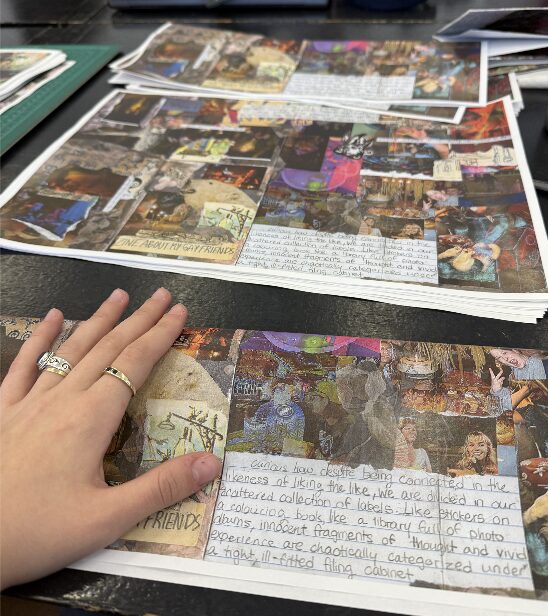
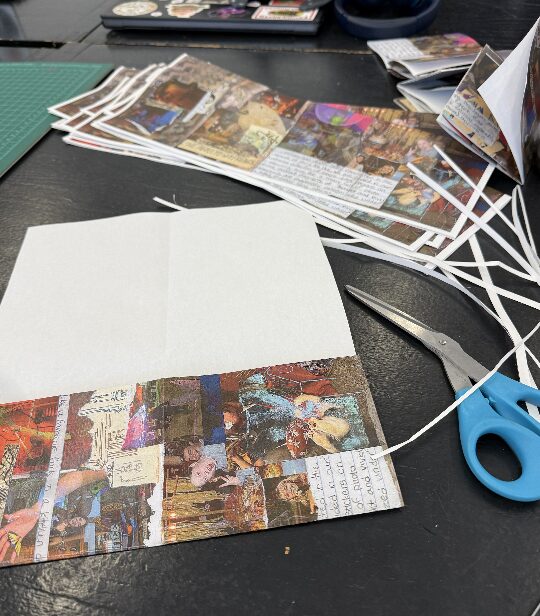
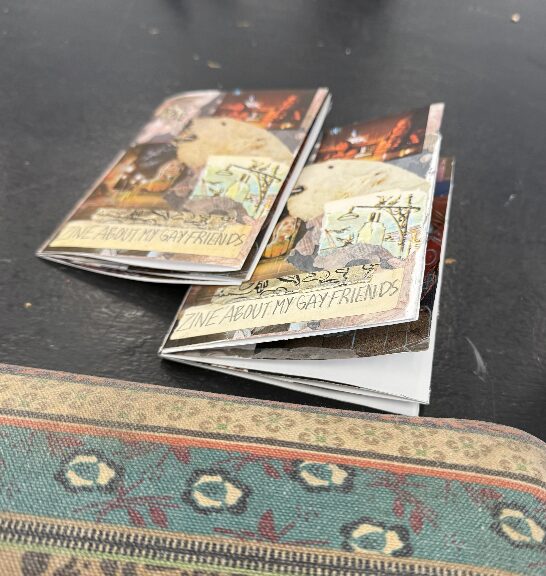
Zine About My Gay Friends
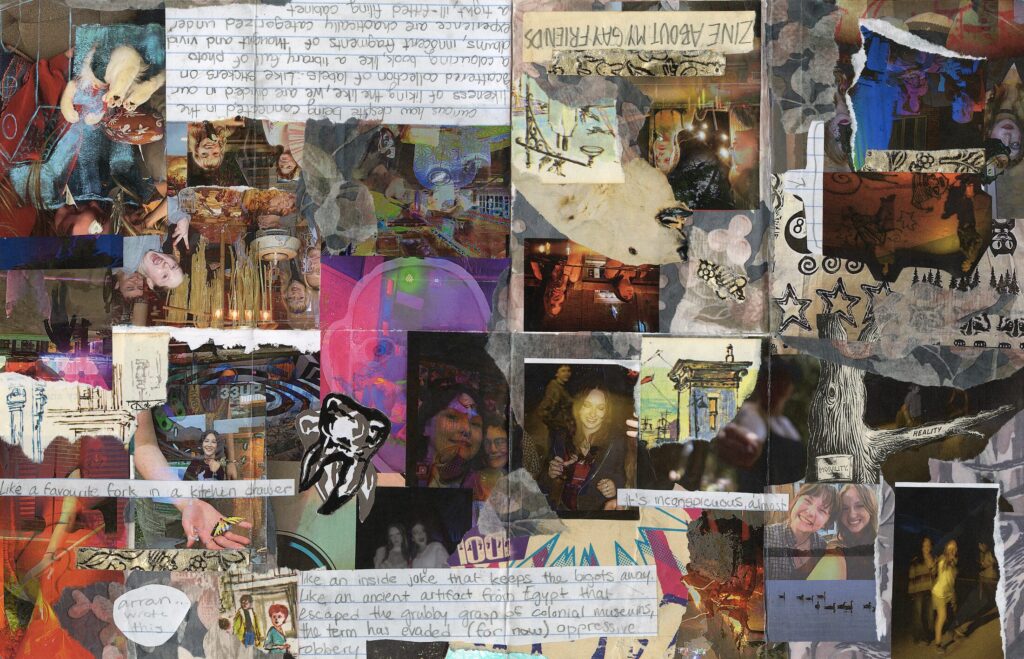
This counter-archive zine is centred around themes of community, friendship, and queerness. The title “Zine About My Gay Friends” is a bold and literal description of the booklet’s contents. I typically would never describe my friends or myself in this way, that’s why I thought the title was fitting. It’s unapologetic, kind of risky, and also a bit uncomfortable. I think it mirrors the ways in which my friends and I choose and desire to show up in the world. This zine serves as an homage to my friends, because without them I would not be the person I am or functional or happy. The safety, comfort, and joy I receive from friendship is something I deeply cherish and will protect at any cost.
This zine is a counter-archive because it provides a glimpse into everyday normalcy for queer people. Even though I don’t think of our hangouts in this way; to us of course it’s just very normal. But us just taking up space, hanging out and being joyful is an act of resistance. This zine also acts as an encapsulation in time; a documentation of the things we do in the present time, how we feel, and our interests.
Process wise, I collaged using a variety of magazine and storybook cutouts. But mostly, I collaged using photo edits and overlays that I printed and cut out. This mimics the passing of time and the way memories kind of fade into one another. Sprinkled throughout the pages as well is the written work of one of my friends 🙂
Leave a Reply
You must be logged in to post a comment.