Introduction
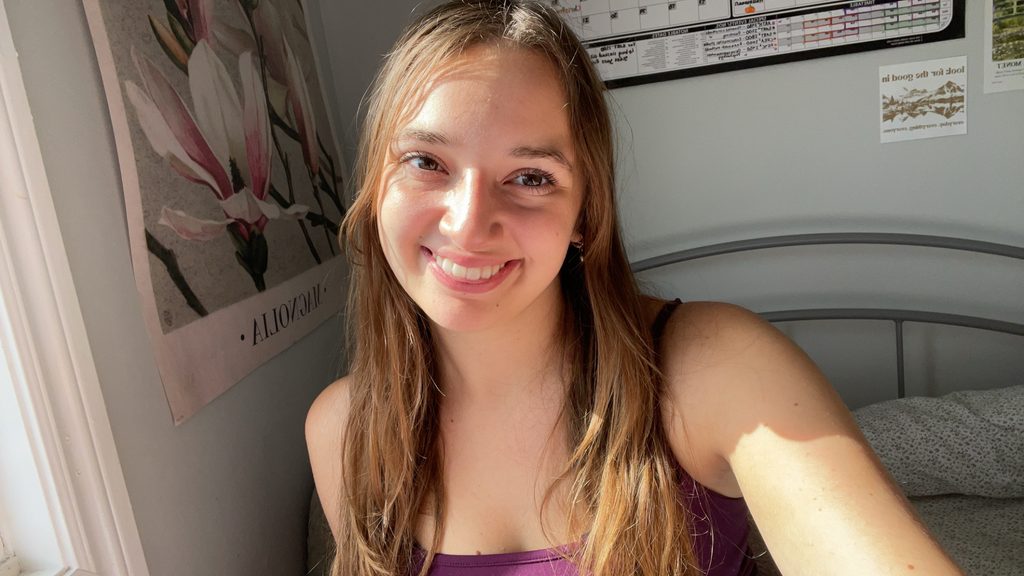
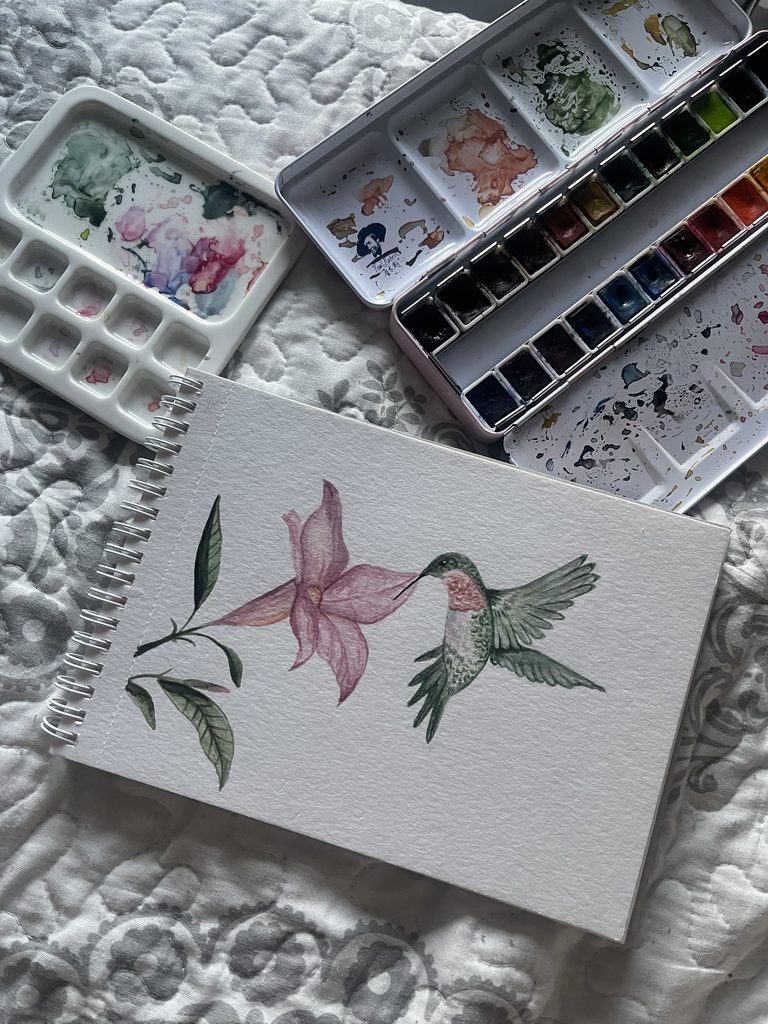
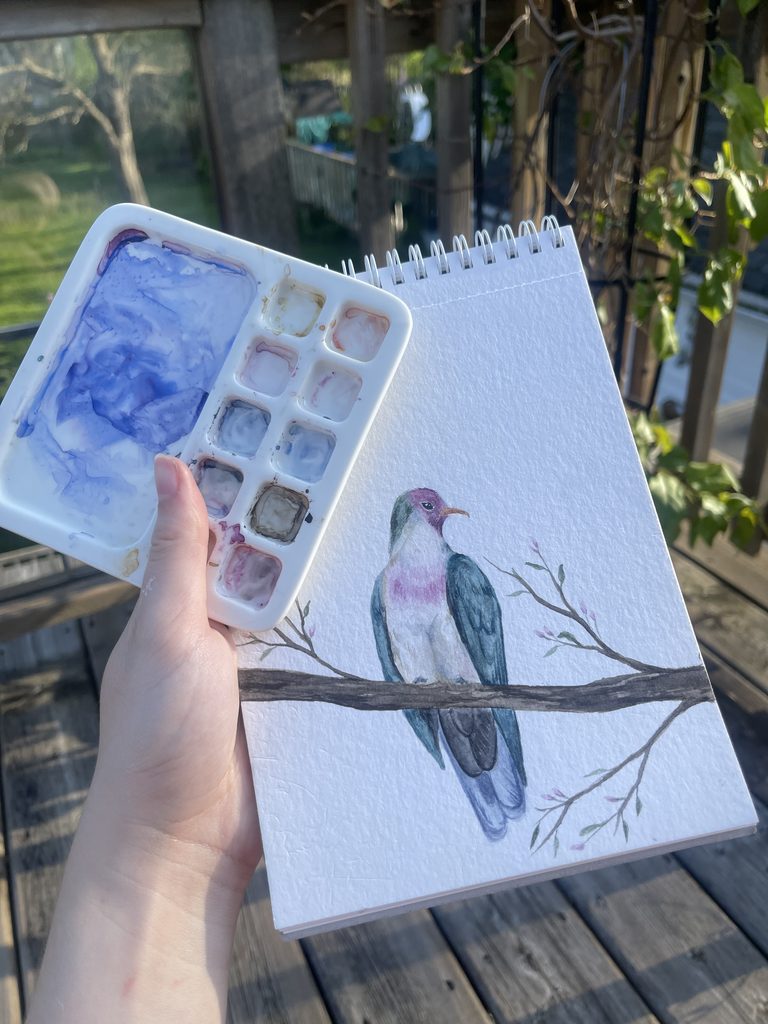
Hi! My name is Alyssa and I am in Creative Arts, Health, and Wellness. I hope to become an art therapist and work with young children. I love all things art, but with a special adoration for watercolors. I love painting animals, especially birds, and you can always find me working in my sketchbook. I am always listening to music while I paint, with some of my favourite artists being Phoebe Bridgers, Noah Kahan, Hozier, and Clairo. When I’m not painting, you can find me baking or reading. I’m a huge fan of poetry, and I’m currently super into Mary Oliver poems! Here is me and some of my artwork! 🙂
The Artist is Present – Marina Abramovic
What are some of your first impressions of Marina’s performance works? Use an image/example of one or two works to describe aspects you admire, and aspects you might agree are problematic?
My first impression of Marina Abramovic’s work is that is intensely personal. It was honestly uncomfortable to watch, and there were many moments where I wished to look away but I couldn’t. It was captivating in a way that made my skin crawl; I needed to know more, but why? Marina’s performance art is nothing like traditional art. Marina uses her body as part of the artwork. I love how she is able to engage the audience in her pieces, and she makes them present in her artwork. In the piece The Artist is Present, Marina makes intense eye contact with each person who sits across from her. I learned that a lot of the people became very emotional, as siting across from Marina evoked a lot of emotions. It gave them an opportunity to reflect. One aspect I find interesting about this performance is how Marina treats every single person with the same respect and utmost attention. Marina mentioned that the experience becomes less about herself, and more about the viewer. One aspect I find problematic is how Marina deliberately put herself in danger in some of her early works, and gave the audience permission to threaten and hurt her. In Rhythm 0, Marina allowed the viewers to use object on her body, demonstrating the speed at which people can become violent ‘when they are given the permission to do so.’ This is a really powerful idea to expose the morbidity of human nature, but it is also very disturbing because it relies on real physical danger.
Discuss the ways performance art resists many museum and commercial art world conventions. How does Abramovic solve/negotiate some of these challenges, and do you find these compromises add to, or undermine the ideas at play in her work?‘
Performance art resists many traditional museum and commercial art world conventions, as it is extremely difficult to treat it as something that can be displayed, owned, or contained. It is not creating a physical piece that can remain in a museum or gallery, but rather a fluid and everchanging piece that exists through the artist, audience, space, and time. Marina’s work relies heavily on the relationship between the audience and the artist. Marina negotiates this by bringing her performances into museums, but still focuses on making the relationship with the audience the main focus. Using the example of ‘The Artist is Present’ performance, people had to sit across from Marina and spend time with her. Even though the performance existed within a museum, it still is not something that can be captured. We have evidence of it happening due to pictures and videos, but we can never truly recreate the experience of being there in the flesh.
A KM Assignment
My project is titled “A Kilometer of Poetry.” It works to translate a physical distance into an experience. It is essentially the process and creation of what happens when I let my thoughts flow and give my subconscious my full attention. I walked exactly one KM in the forest by my house, documenting my precise journey on google maps. I documented my thoughts, observations, sounds, feelings, and questions.
As I walked, I wrote out every single thought that entered my brain. I also stopped every 200 meters to complete a quick sketch, also allowing my brain to pick whatever came to mind.
My walk was a total of 16 minutes and 43 seconds, making sure to account for the time spent sketching. I let my sketches last no longer than a minute and a half, allowing myself to stray from perfection and embrace a style that encapsulated the beauty and unpredictability of any given moment.
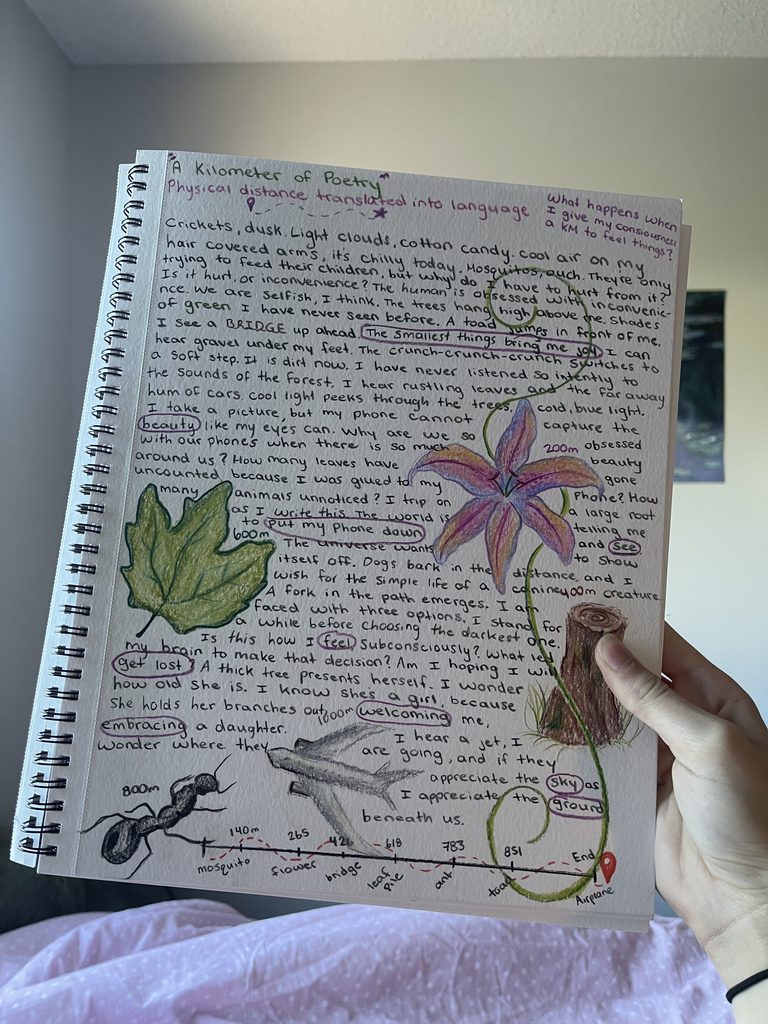
My poem started off quite simple, consisting mostly of really simple observations. I was describing what I could see and hear. Then i got bit by a mosquito, which led to more complex thoughts. “they are just trying to feed their children, but why do I have to hurt from it?” Then I got thinking about how humans often associate inconvenience with something negative. The bite didn’t hurt, but rather, caused a minor inconvenience to my life. i wrote “the human is obsessed with inconvenience, we are the most selfish of creatures”. Something as small as getting bit by a mosquito led to a thought about human behavior. This became a pattern throughout my walk; I would notice something and that would lead me somewhere else mentally.
A really important part of the kilometer for me is when i was typing I wrote “how many leaves have gone uncounted because I was glued to my screen? How many animals unnoticed?” I tripped on a root after I wrote that, so I wrote “the world is asking me to put my phone down and see.” The environment around me wasn’t just something I was observing, but rather becoming a part of. My free verse poem ended up being an entire page, a reflection of the distance I walked through words. As a small reflection after the kilometer was finished, I went through the poem and circled some words that stuck out to me, creating another poem within a poem.
One Feat, Three Ways Assignment
Video #1 – The One Shot Our one-shot video explores the act of one of our group members, Leah, repeatedly saying the phrase ‘I love you’ in an uninterrupted take. The camera records Leah continuously, and the audience is able to observe how the phrase changed through tone, facial expressions, body language, and repetition. The words remain the same. Three simple syllables; I love you. The emotional meaning lies in how the performance shifts from silly to sincere. At first, Leah smiles uncomfortably, as saying something so vulnerable in front of us seems so lighthearted. As the video progresses, we see that Leah’s facial expressions become more intimate. The viewer is encouraged to question who she may be thinking about. What kind of scenario could she be imagining? By presenting the performance in a single, uncut take, we allow these subtle and emotional changes to unfold in real time, creating a sense of vulnerability and intimacy that could be lost through editing.
Video #2 – The Sequence Our sequence video explores the repetition of the phrase “I love you” through the overlapping performances of all three group members; Julia, Leah, and myself. Each member was given roughly a minute and a half to repeatedly say “I love you.” Then, through editing, we layered the recordings over one another while reducing their opacity. As the videos overlap, my group becomes visually connected, creating moments where our movements and expressions align, while at other times, they fall out of sync. The layering transforms a simple expression of love into a shared experience, blurring the line between individual voices and identities. Three separate individuals, all with our own experiences of love. In our video, we are reduced only to a body saying three words. What do they mean to us? How have they changed our lives? I know for a fact I can only answer these questions for myself, and I think that speaks volumes in our project. I will perhaps not ever know what Julia and Leah were thinking while saying those words. We were all thinking of an entirely different scenario with different people, likely in different timelines. Although our bodies occupy the same visual space, our thoughts remain separate. This reminds that, even though we share the same words, we can never fully know the experiences and emotions they hold for someone else.
Video #3 – The Loop (Rotoscope Animation) The third idea revolves around the visualization of the phrase ‘I love you.’ The phrase is represented by different uses of colourful drawings around our faces. Each of us have our own unique visual details, using different colours and placements to create our own interpretations of the phrase. The video combines portraiture with simple hand drawn elements, transforming a simple expression into something visual and deeply personal to each of us. By adding these drawings over our footage, we explore how love can be communicated through more than spoken words.
Turning the Gestures of Everyday Life Into
Art – Katja Heitmann
1. Describe the work discussed in the articles and the unique challenges – as well as the unique gifts – that come with attempting to archive a personal movements? Katja Heitmann’s Motus Mori is a dance project that preserves people’s everyday movements, habits, and mannerisms. Volunteers share gestures they make unconsciously, which can include things such as cracking knuckles, fidgeting with their hands, or moving their hands in a certain way. A team of dancers learn these movements through observation, as well as muscle memory. They then recreate them during live performances. A unique challenge of this project is how difficult the movements are to preserve; they are constantly changing and cannot be captured through photos or written records. The dancers are constantly and repeatedly practicing the gestures in order to keep them alive. This project also brings a unique gift in the sense that it preserves a deeply personal part of someone’s identity that may otherwise be forgotten. These movements can reveal a lot about someone, including their emotions, insecurities, and even secrets that the individual may not even recognize themselves. I think its really cool that the project creates such a human way of remembering people, especially those who have passed, by preserving tiny details of what made them unique.
2. Discuss one or two examples of movements in the article – what strikes you about them? One example that stuck out to me when Mahat Arab’s habit of cracking the knuckles on his left hand whenever he feels anxious, such as when driving or talking to someone on the phone. I think it’s really interesting how a small, simple gesture can be a reflection of someone’s emotional state. He initially described the movements as ‘anxiety hands,’ but having them recreated through dance, he was able to feel a sense of ownership over the habit. This example stuck out to me because I pull my hair when I’m anxious, and I related a lot to his unconscious movements. Becoming aware of these unconscious movements can change the way we understand ourselves. Another example that stuck out to me was the dancer who found herself sleeping in a fetal position, when she normally slept with her limbs stretched out. The movement, she realized, belonged to a woman she had interviewed the previous year. This is really fascinating because it shows how deeply the dancers came to absorb the physical habits of others. It also demonstrates how personal movement’s can live on in other bodies. I often find myself unconsciously picking up tics/gestures of those I spend a lot of time with, creating a sense of connection between two differing individuals. This example reminded me that our identity can be expressed through our bodies in ways that we sometimes don’t even notice.
3. Describe the habitual movements/unconscious gestures, tics, etc., of three people you know well. One habitual movement I have noticed in my dad is that he taps his fingers against the steering wheel to the beat of the song that is playing. He seems to do it without realizing, especially when he is impatient at a red light. I find it interesting how this small movement appears repeatedly, no matter the duration of the car ride or the destination, and almost becomes a part of how I recognize him. The second person is one of my best friends from back home. She always touches her necklace when she is nervous, without interrupting the conversation. This movement seems more automatic, and she may not even realize how often she does it. I think it is interesting how our bodies and hands stay busy even when our attention is focused on something else. Finally, my little sister bounces her leg while sitting or watching a movie. This movement can continue for several minutes without her noticing. It is interesting to think about how a repetitive gesture can become so familiar that it feels like a natural part of someone’s presence and identity. These small habits may seem insignificant to the untrained eye, but they can make each person’s way of moving and living much more distinctive. In all three of these examples, facial expression remains the same, while the emotional valence of them all reflect slightly negative, nervous tendencies. Relating it to Heitmann’s article, these movements demonstrate how everyday gestures can reveal aspects of our experiences and individuality, even when we don’t consciously attach meaning or emotion to them.
Field Trip to MOCA!! 🙂
The first art piece that stood out to me was the short film, Of Wool and Diesel by Rouzbeh Akhbari, that we watched at Mercer Union. This film was visually stunning, and I think that’s why it stuck with me. If I’m being completely honest, I didn’t fully understand the movie. The different languages and fast-paced information made it tricky to keep up with. There were three acts to the short film, each of which I made short jot-notes on in my notes app. The prologue featured a woman singing in a different language, with yellow subtitles translating the beautiful song. A line that stood out to me was “A fixed light asks for nothing, a pulsing light calls out a response.” After the prologue, it transitioned into the first act, called The Crossing, a silent montage of sheep, boats, and the crossing of the Gulf. The next act was The Letters, where a narrator spoke over a montage of hundreds of hand-written letters. The third and final act was The Risk, an underwater shot transforming into a wrecked ship on a beach. This act stood out to me the most. I remember the narrator saying something about how the village people were completely unphased by the blood strewn on the beach. “Perhaps they were used to it,” the narrator read. I really loved this film because there wasn’t a lot of talking, which made each sentence so much heavier. A line that caught my attention was “Some die with a bullet, others die waiting; Some die from bombs thrown from a plane, others from an aching heart.” Really fantastic film and I’m so glad I got to take some souvenirs with me 🙂
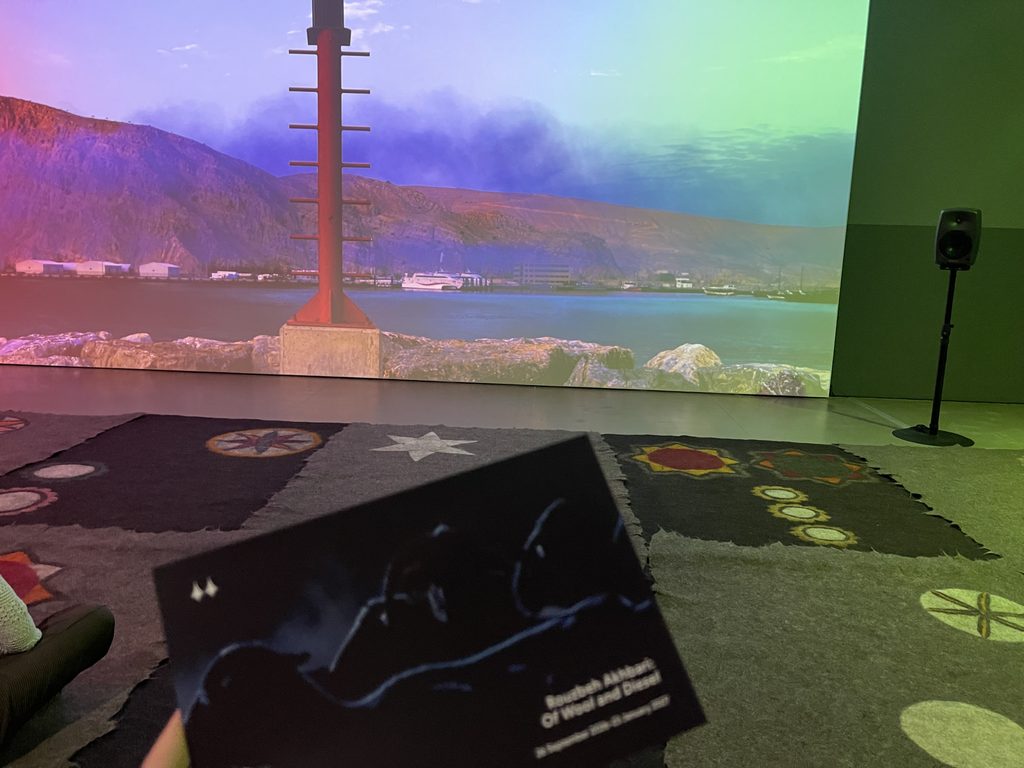
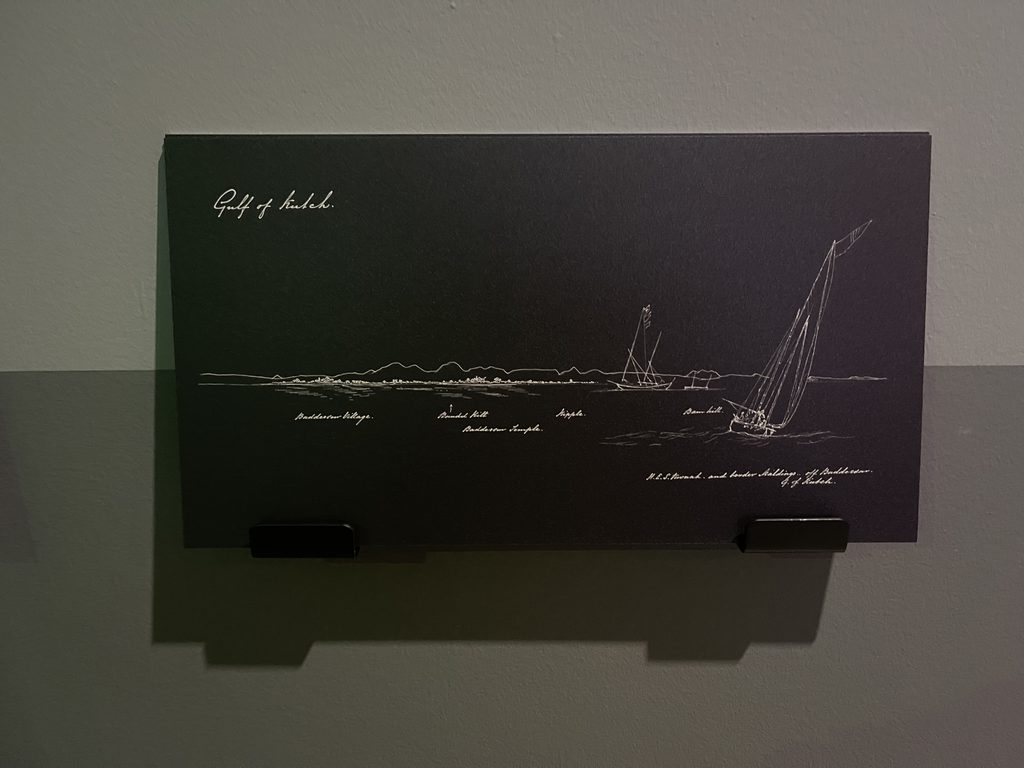
The second art piece that stood out to me was the installation on the third floor of MOCA. Each piece evoked so many questions that will forever be unanswered. I remember saying to one of my friends that I wish there had of been an explanation to the pieces, to which she replied “maybe the whole point is that there isn’t.” These works are by Bharti Kher, an artist whose process involves breaking and remaking things. The works on the third floor are described as ‘part animal and human, part deity and earthling. […] They boldly suggest the ways geometry can organize not only space, but also systems of belief and human experience.” I really loved the two pieces I have attached below. The first one looked to me like someone falling from a great height, an industrial chain keeping them from falling to their imminent death. I also enjoyed formulating thoughts about the bull that appeared to have the stylized, elegant legs of a woman. A very thought-provoking installation that left me with more questions than answers.
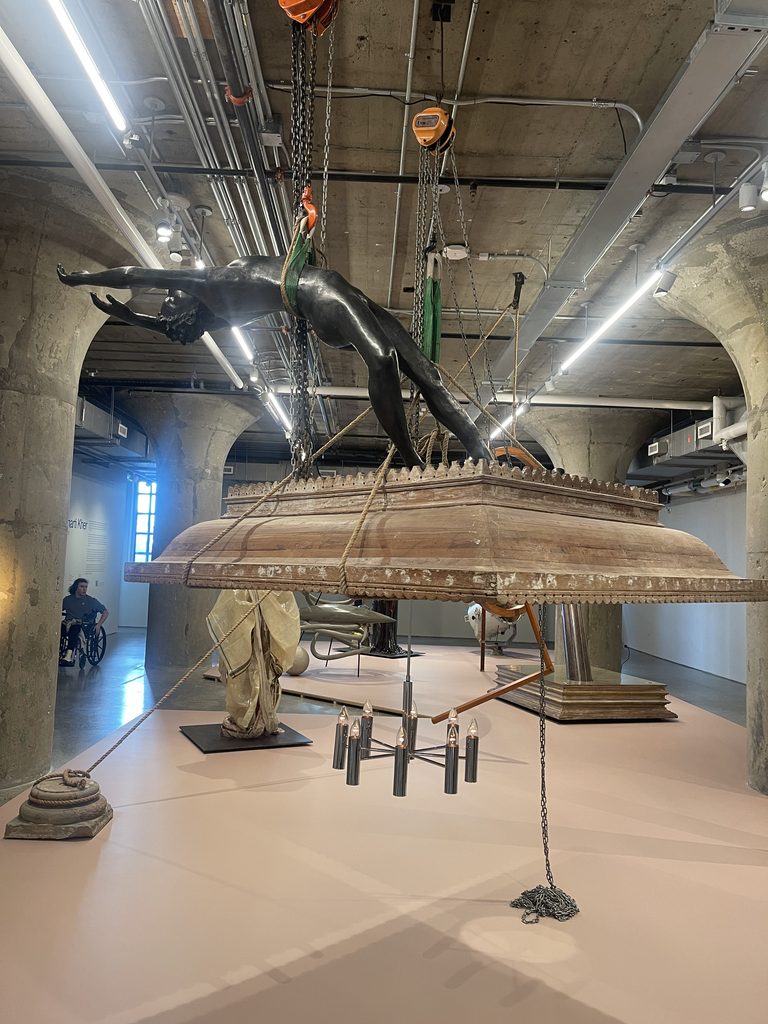
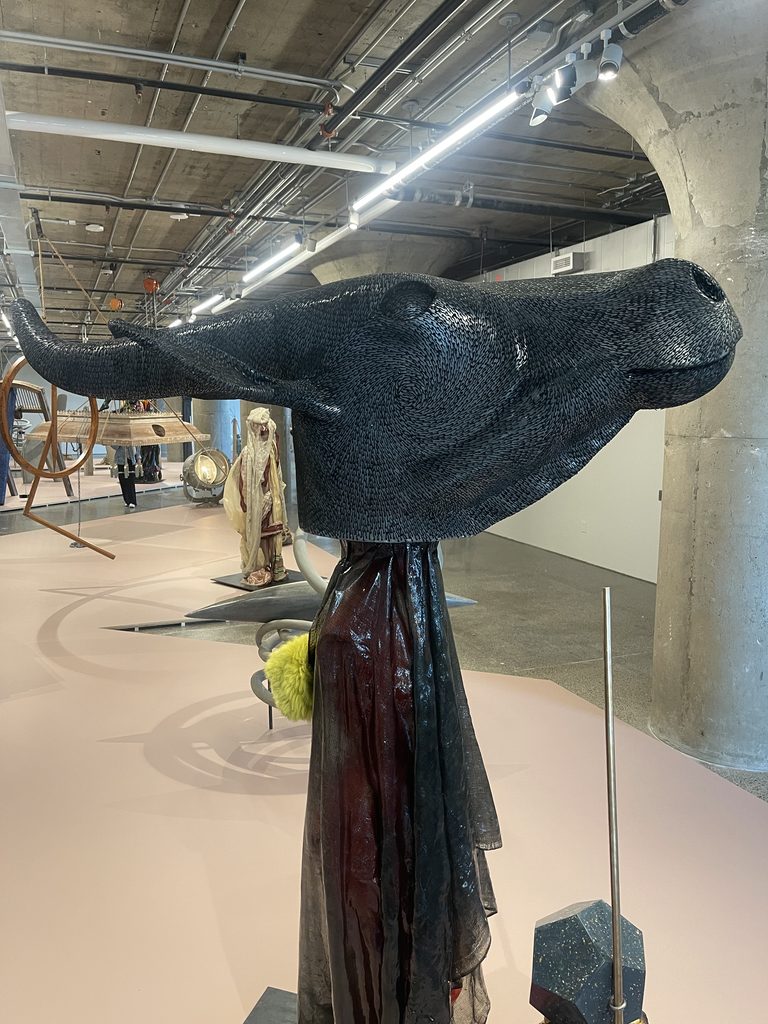
Nature, Interrupted – Audio Assignment
For this assignment, I used a combination of found audios and self-recorded audios to capture thirty seconds of peace and tranquility that is quickly overthrown by the harsh sounds of industrialization. I wanted this piece to have an overwhelming and heavily stimulating transition that allows the listener to feel as if nature is being engulfed by unnatural and fabricated sounds of the city. I wanted the transition to to evoke feelings of tension, anger, and the overloading of sense as the listener is transported from a calm nature scene into the chaos of a busy city. This piece was inspired by the nostalgia and yearning I have for the sounds of my childhood, where I could always hear the familiar songs of birds, running streams, and a symphony of crickets. As I grew up, I lost the ability to hear such sounds. I wondered if I had just stopped listening. I realized while trying to collect audio for the first half of the piece, I hadn’t stopped listening; the nature had slowly been disappearing, slowly been transforming into a dystopia of highways, pollution, and endless noise. Being outside wasn’t a symphony of peace anymore, but rather a cacophony of overconsumption. During the last few seconds of the piece, there is a singular mourning dove coo right after the loudness of the city abruptly stops. This is to create more defined juxtaposition between the two states, and to remind the viewers how beautiful a simple sound could be in the midst of our ever changing modern world.
Pauline Oliveros Documentary
Reflect on your own experiences of listening – to sound, to others, to your environment, or to yourself. How does Oliveros’ ideas of deep listening challenge the way you typically give attention? In what ways might listening through your whole body, or approaching sounds as a form of play and research, change your understanding of connection, communication, or creativity?
Leave a Reply
You must be logged in to post a comment.