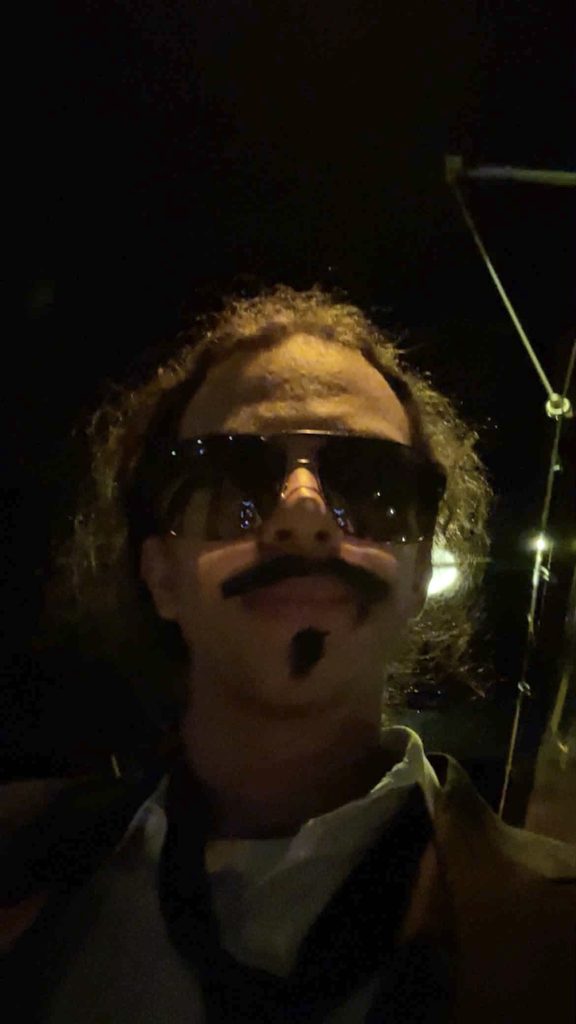
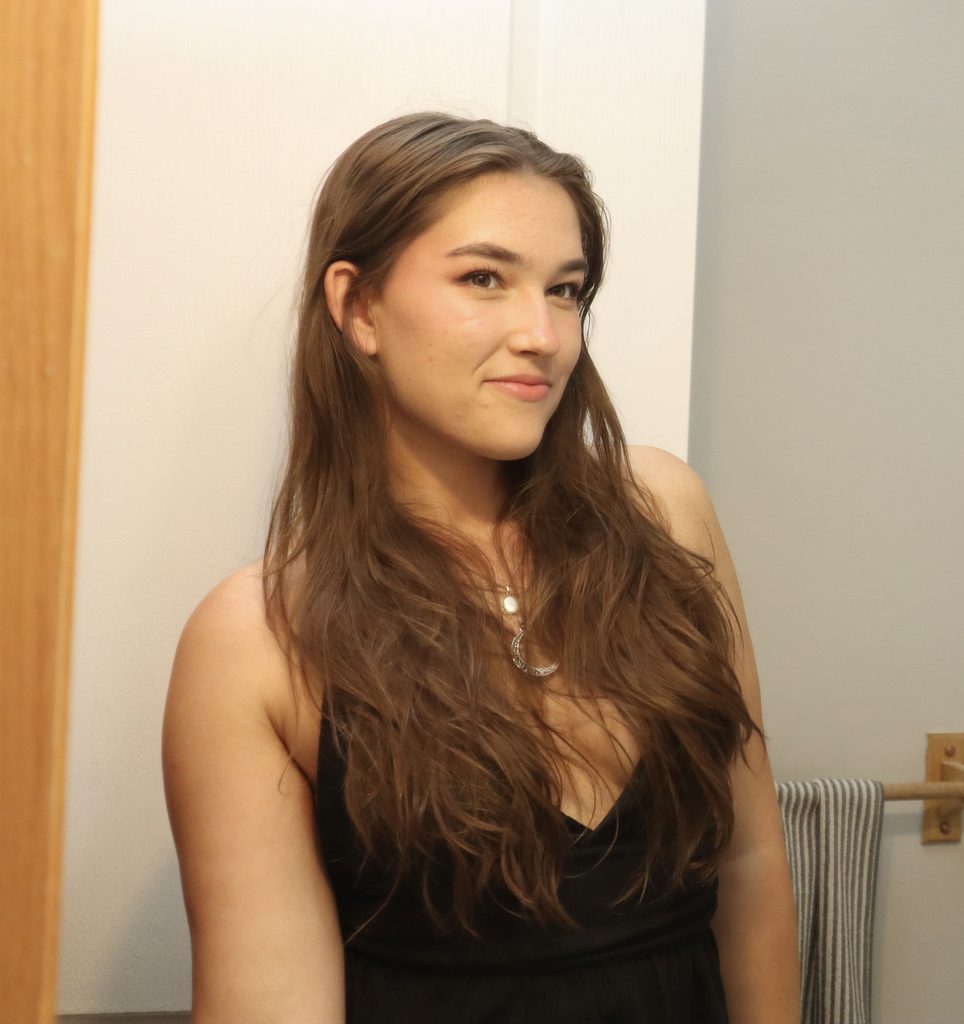
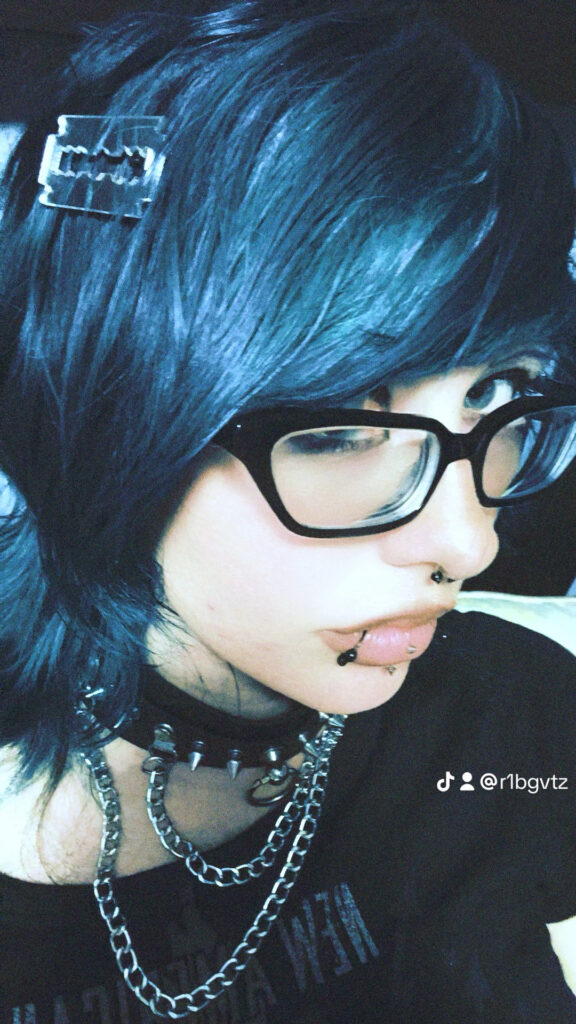
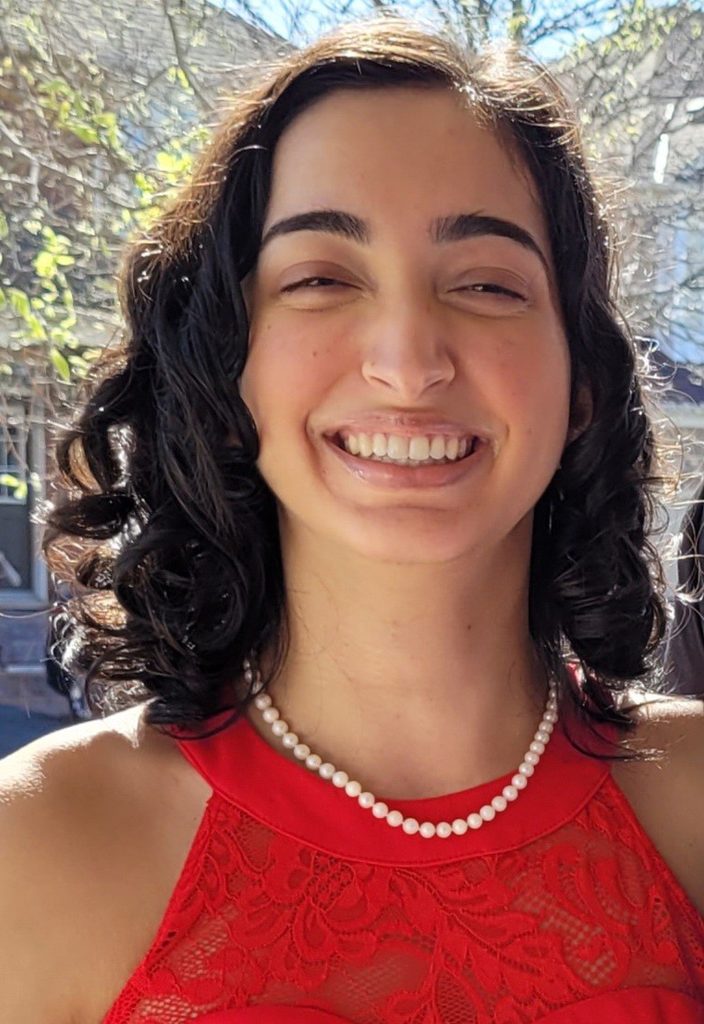
I am a majoring in studio art and minoring in theatre studies. I also enjoy writing poetry and stories, watching lots of movies, and travelling to unfamiliar places. I’d like to become more social and out there, as well as be constantly trying new things. I also want to develop the ability to create in every medium of art possible.
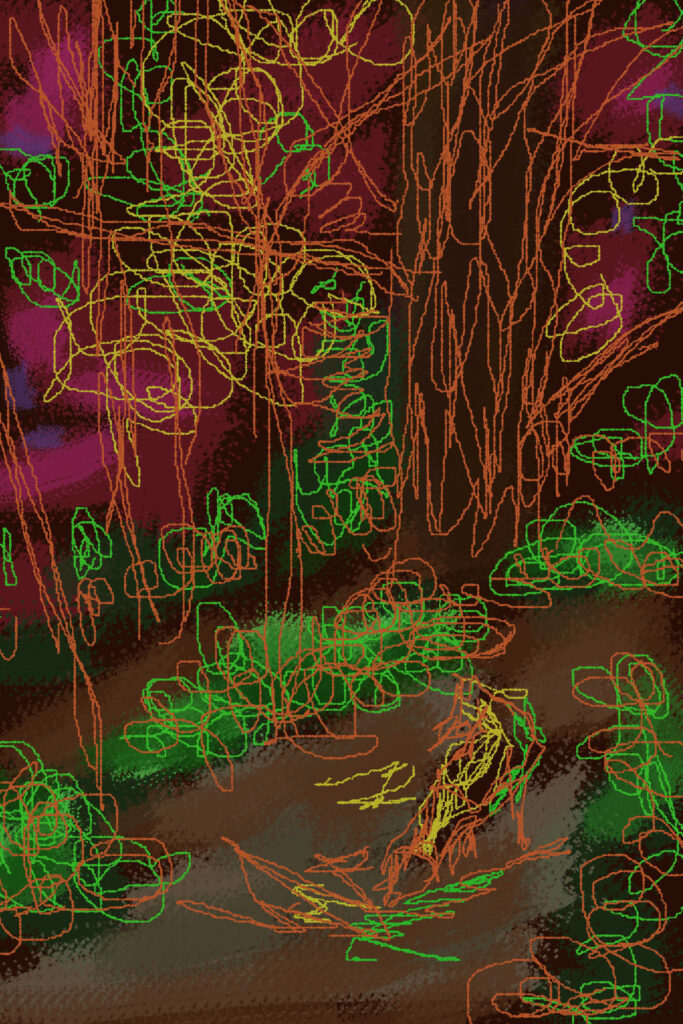
Kilometre of Tree stacks in minecraft
kilometre in minecraft explanation below
was inspired to create my project in minecraft because it’s very sentimental to me. as a kid i would play it for hours with my cousins, and i was always the designated wood collector. i liked mining and replanting trees and i enjoyed supplying wood for everyone because wood is a starting point to everything needed to progress in the game. i liked to be helpful in some way. houses built out of wood also looked very pleasing to me. i also find it interesting that you need wood to start making weapons, like the axe. and you need an axe for better ability chopping wood. there is effort that also must be taken to collect so much wood. especially due to the fact that you must craft other items out of the wood you collect, to be able to collect more wood, furthering the “finish line”. making collecting a certain amount of wood a little harder to attain. i also think the axe to mine wood, wood to get axe can be used as an analogy. needing credentials to earn money, but needing money to earn credentials. or needing prior experience to work a job, but needing a job to gain experience. what could also be said is how minecraft may be affecting my generations understanding of the true finity of resources because of how easily attainable things were in video games. the scene at the end of all trees in the forest on fire is a representation of the destruction we do to our forests. deforestation is a huge problem and we only can plant so many trees, and they take time to grow. so while we rely on trees as resources in so many ways, we also need them to breath and take fruit from. yet we are careless, and they take 100 years to grow to full size. so long that only our grand children would reap the rewards. if we cut down trees faster than they can be replaced we will not be able to live properly. the alternative ways in which we’d be provided life and oxygen will not be ideal.
it’s hardly in my interest to judge others
MYSELF
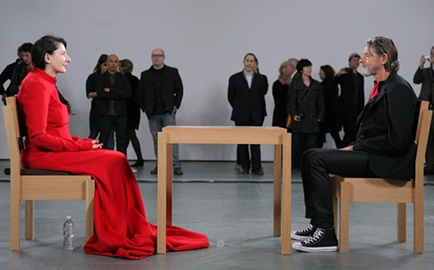
The Artist is Present
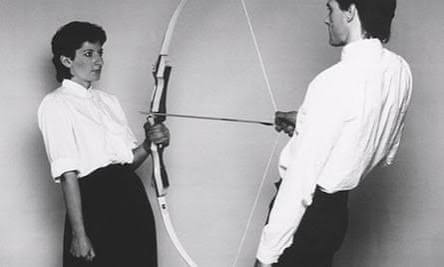
1) What are some of your first impressions of Marina Abramovic’s performance works, based on the documentary? Use an image/example of one or two works to describe aspects you admire, and aspects you might agree are problematic.
She seems to be very in touch with the way she feels things and able to represent them through her performances. Like I think she has this great capability of communicating emotion or life experience with abstract presentation, and maybe that for her is the only way it can be communicated.
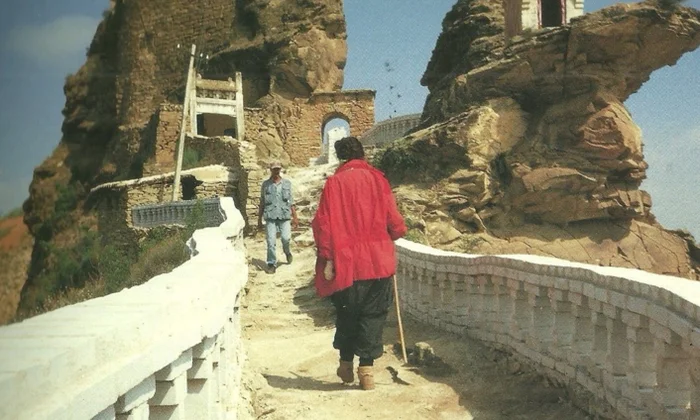
I really liked the walk Marina did with Ulay where they spent 90 days moving toward each other. it’s something to be said about that dedication, and ultimately knowing that after all that walking you will eventually be reunited with the one you love. not thinking of giving up and sacrificing their comfort for the other. and after going through that process ending it by getting married. though they didn’t stay together, i still think it’s beautiful that two human beings shared that kind of experience with one another, and get to add it to their collection of moments. but for me i don’t know if i see any of her work as problematic from what i’ve seen so far. you could see some acts as overly sexual and sinful because of self mutilation, but if this is the way in which the artist chooses to create or perform they have that right. as well, people have this fear of the human body, and in some instances it can be contextually sexual, but the human form needs to be less taboo and understood when theres different contexts. this goes for more aspects in life too, people often ignore context and assume the intention is always the same. my disdain would only be dictated by others opinions, and ultimately wouldn’t matter anyway because the artist gets to decide.
2) What have you learned about features of performance art based on Abramovic’s work? Name a few key features according to here examples. Include an image to illustrate. Consider her quote: “when you perform it is a knife and our blood, when you act it is a fake knife and ketchup.”
It seems that in performance art, the ones involved can get so deeply involved in the performance that they don’t process what they’re putting themselves through. they become so entangled with the performance that they just embody art, or maybe life itself. in a way they are in a state of flow, and it could become meditative. it is free from all worry or care about the way in which society forces us to behave.
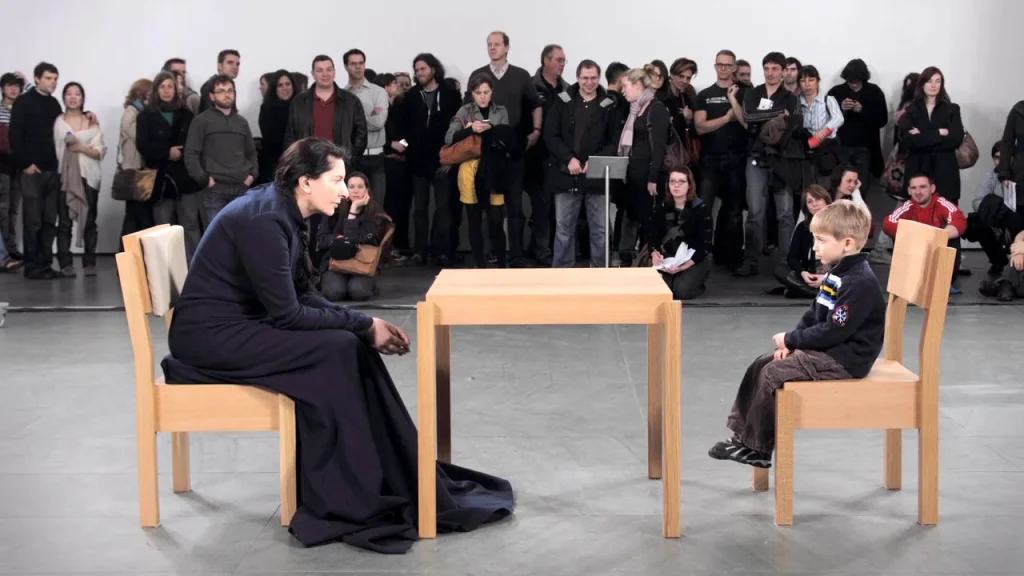
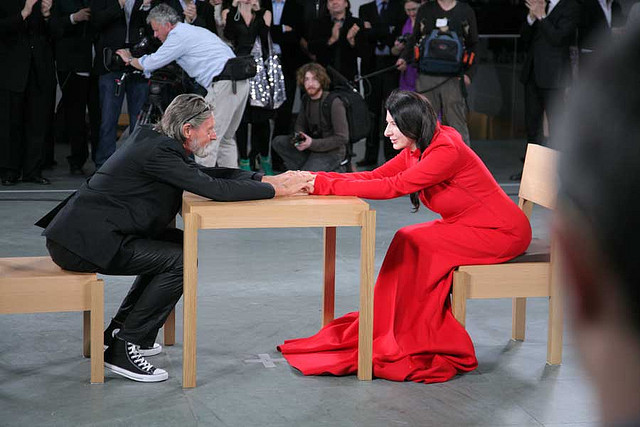
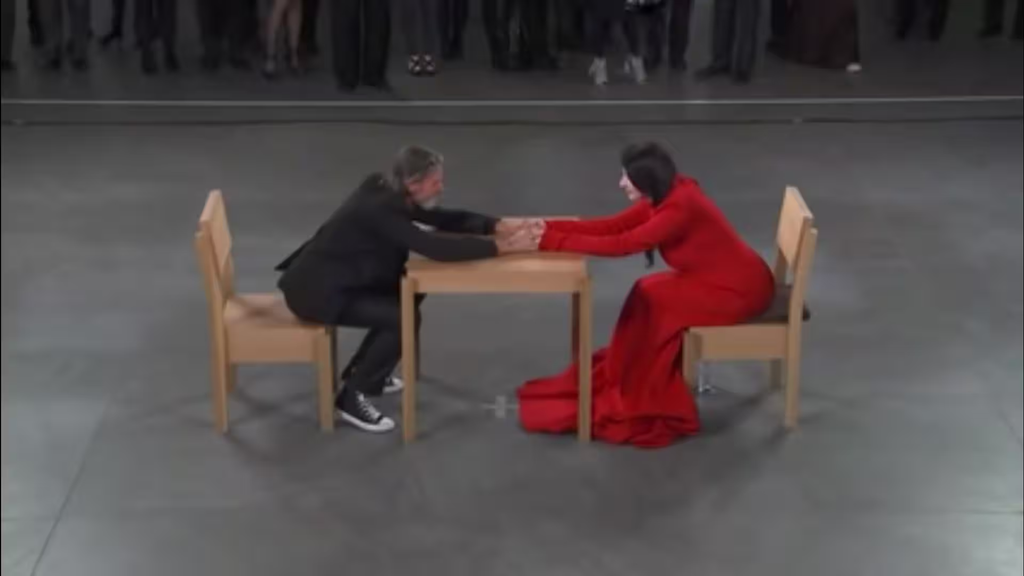
with her performance the artist is present, not only is she sitting in a chair across from whoever takes the seat, she is present. she came with the intention of giving all her attention to those who sit across from her. and remains seated for the entire showing, no distractions and nothing else planned. if you were to sit across from her you would see her, and she would see you. with no words exchanged, unspoken stories get told with how you carry yourself. if you get uncomfortable after some time, if you start crying, if you smile. all of these are reactions to being noticed and seen, and your past experiences through lack of attention, or too much of it can elicit a response inside of you that you will feel. and sitting there, if you allow yourself to be fully present, will make you realize things about yourself you’ve been ignoring.
field trip
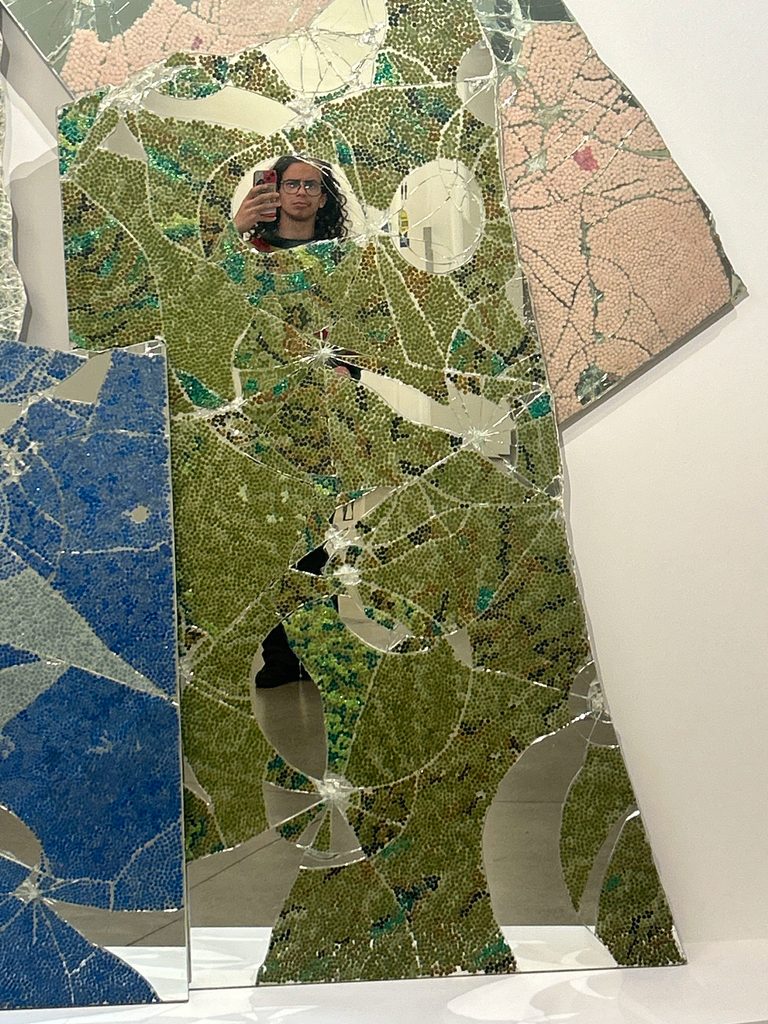
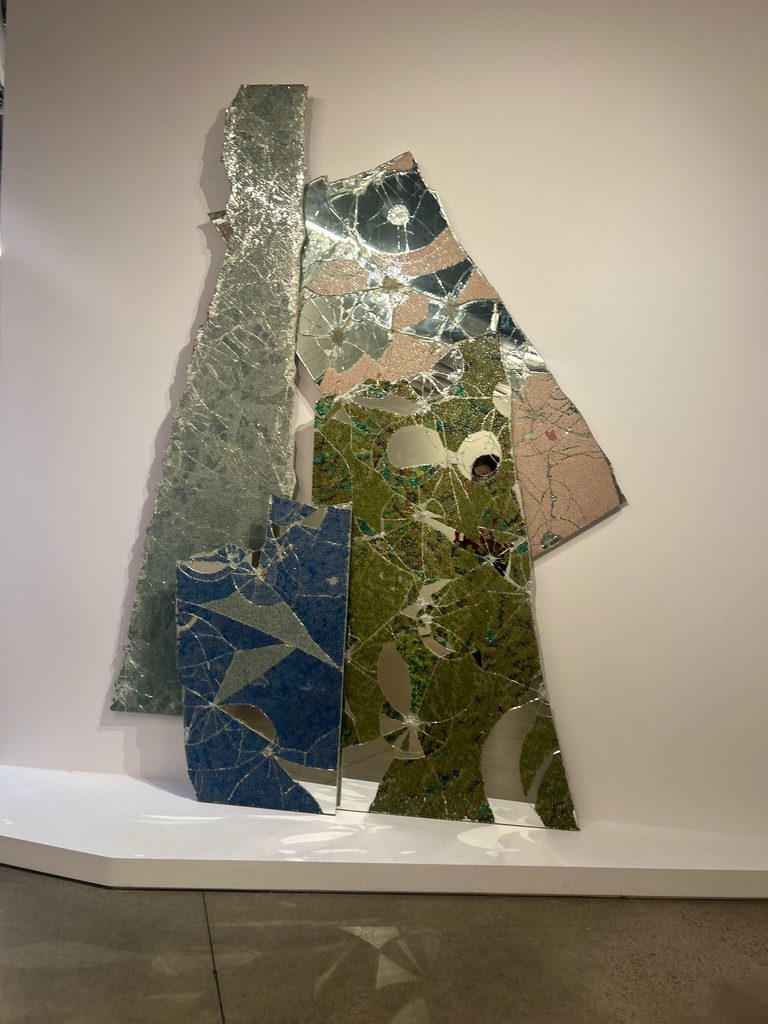
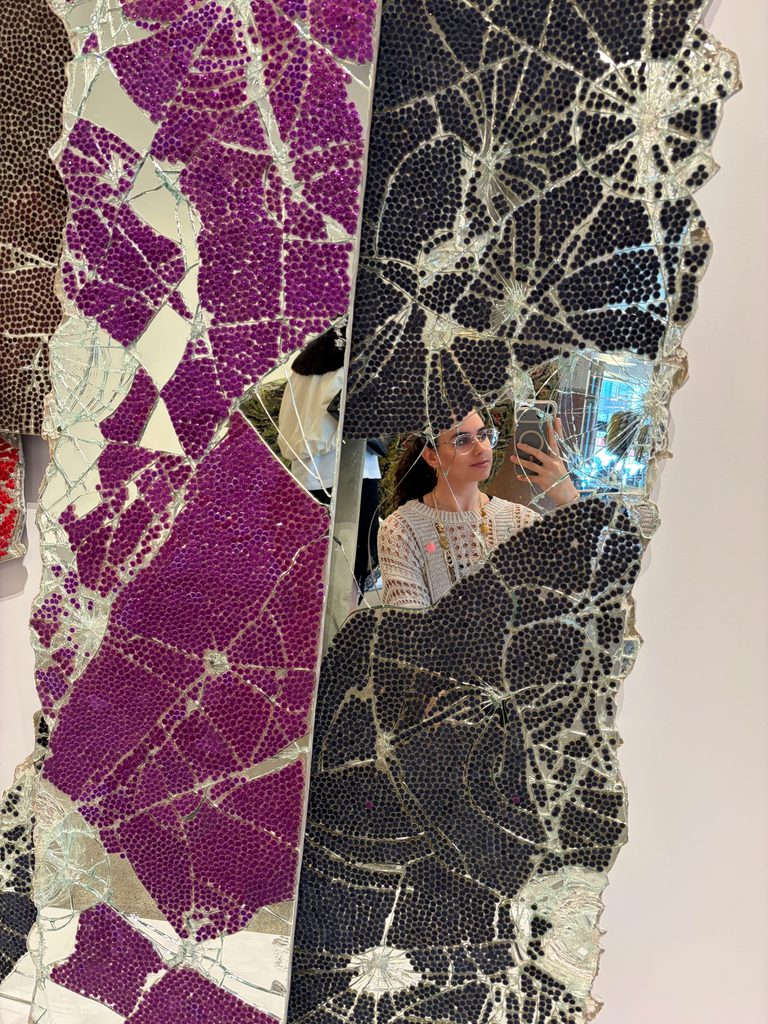
in the fragmented mirror i wondered if there was intention on the fact that you could see yourself in the artwork. it felt to me as though it could be commentary on vanity, and trying to get rid of this idea that we must be perfect, and aware of how we look at all times.
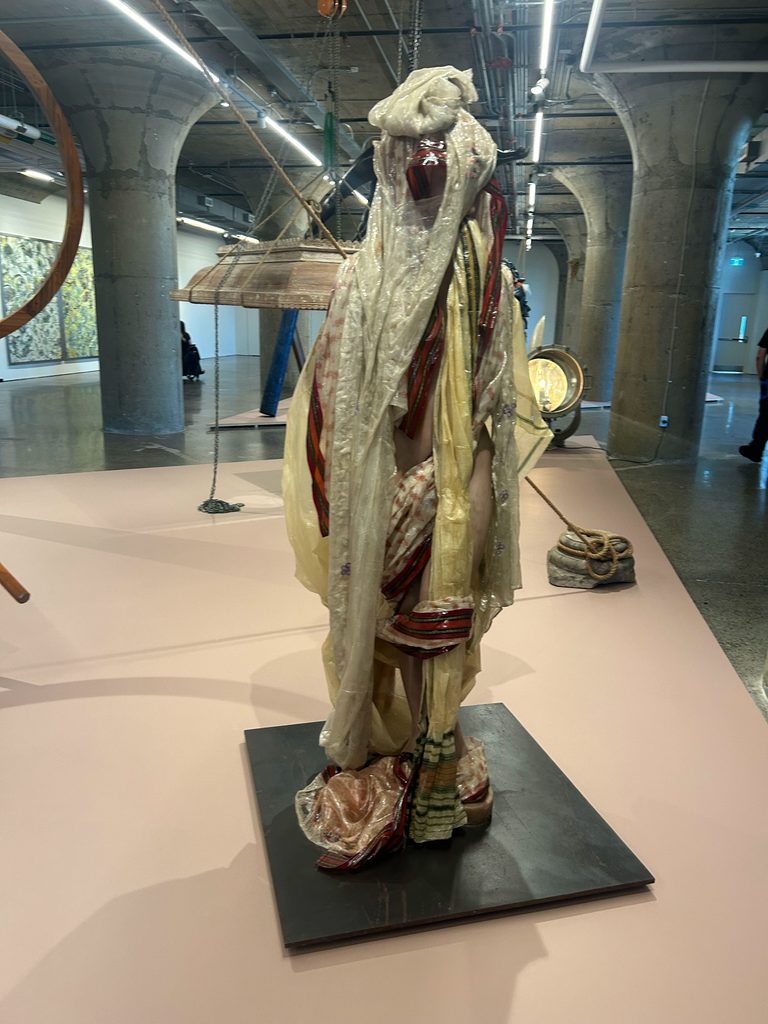
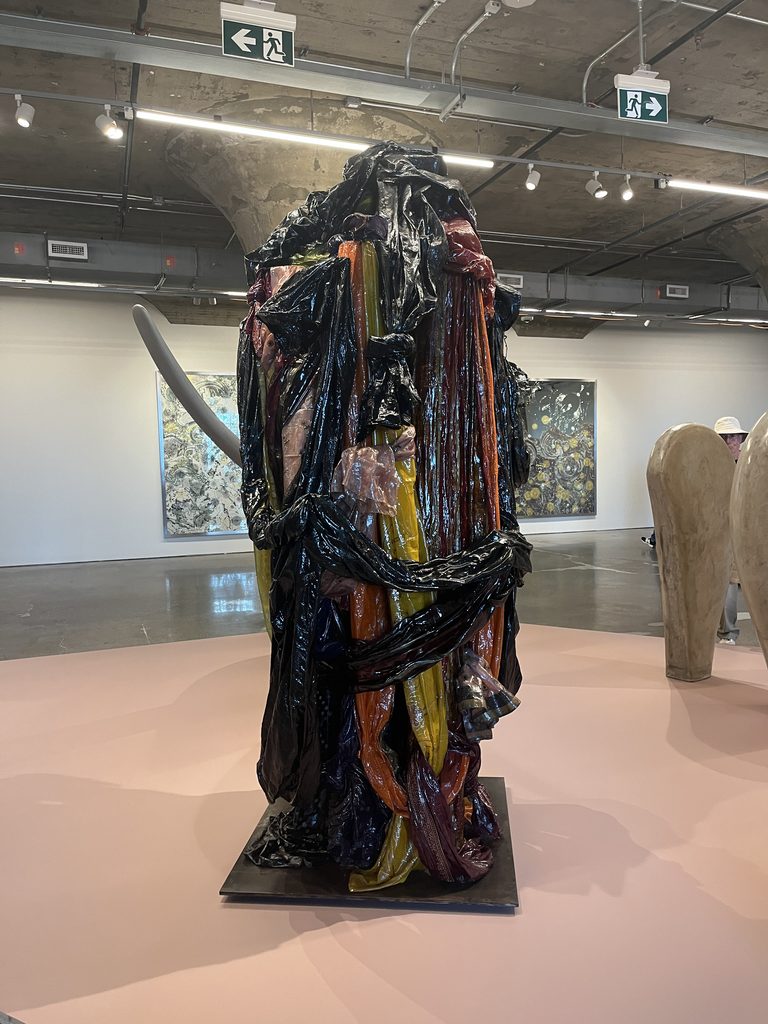
as for the second artwork, the waxy looking wrappings layered, i really just enjoyed the texture of it. the multiple layering of it was very intriguing, and that they used what looks to be clothes to make an entire human like form was interesting. my interpretation of it would be the fact that human beings are made up of multiple layers and never just are never one dimensional.
I’m in my third year of the BCAHW program, majoring in Studio Art. I’m taking this program because I’ve always had an interest in psychology and how the mind works, but I also want to be ale to broaden my skills in art practices.
My name is Julianna, and I am a second year student in the BCAHW (Bachelor of Creative Arts Health & Wellness) program! I chose this program because I was torn between studio/fine arts and psychology, and I thought that this degree was a really cool blend. ‘I’m a really big reader and I love disappearing into a good book. I love writing, painting and going hiking to cool spots with friends.
Documentary Response
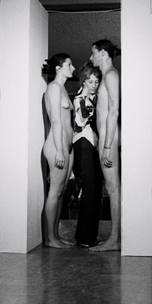
After watching the documentary surrounding the life and work of Marina Abramović, I felt thoroughly shocked. Every piece of her art pushed the human body and mind past the point of exhaustion. She had several audiovisual works spread throughout the gallery exhibition, as well as other artists, whose job was to recreate Marinas pervious works. The most impactful piece in my opinion, was having the two artists fully nude, standing in a doorway. Only the brave could pass though, and even they might have felt uncomfortable. I thought this was a really successful piece. I can however understand how this might be slightly controversial. People don’t always like feeling uncomfortable, and this particular piece could strike up the debate of “is this even art?”. These facts aside, I believe that this piece communicated something deep from within the artists soul.
There were a lot of interesting things about performance art depicted in this documentary. I think the level that Marina, Ulay, and all of the hired artists, went to to achieve their desired outcome was much further than I anticipated. There was a clear goal in Marinas mind, that was unclear to her audience, but they were willing to play ball.
”1 km forest”
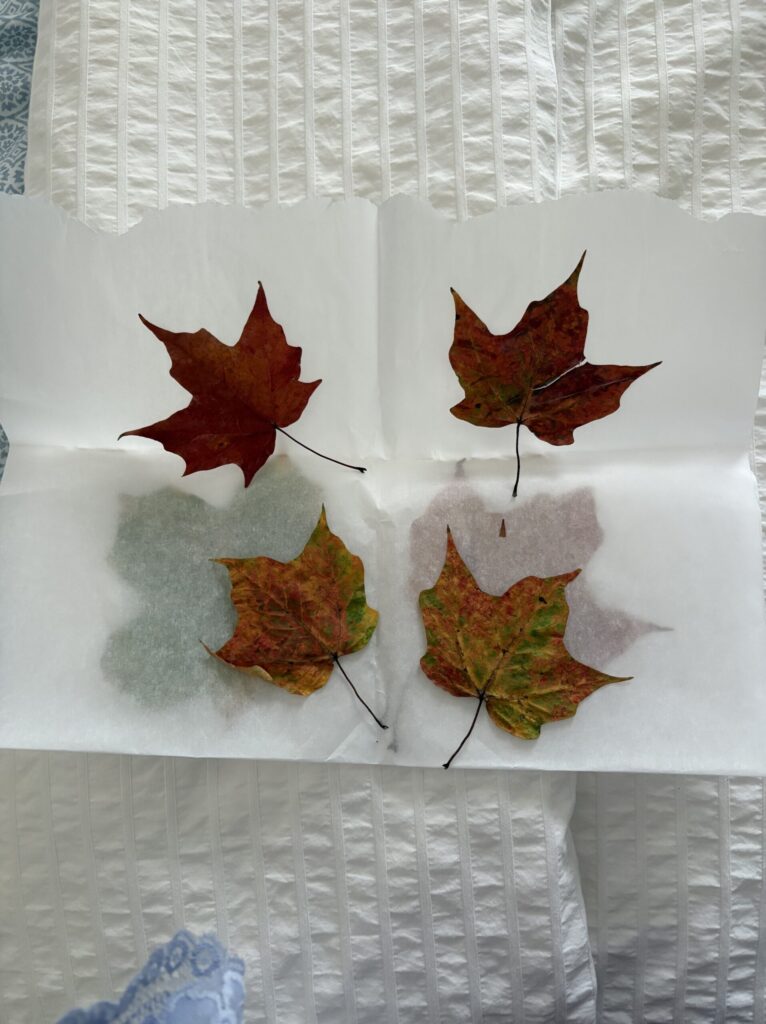
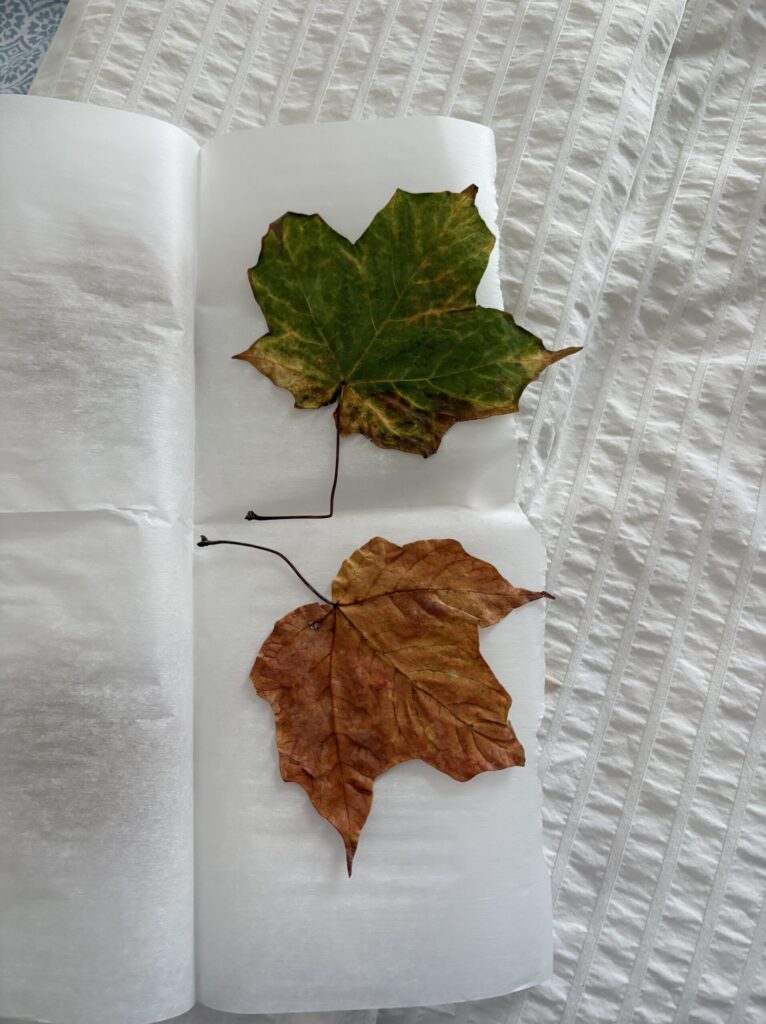
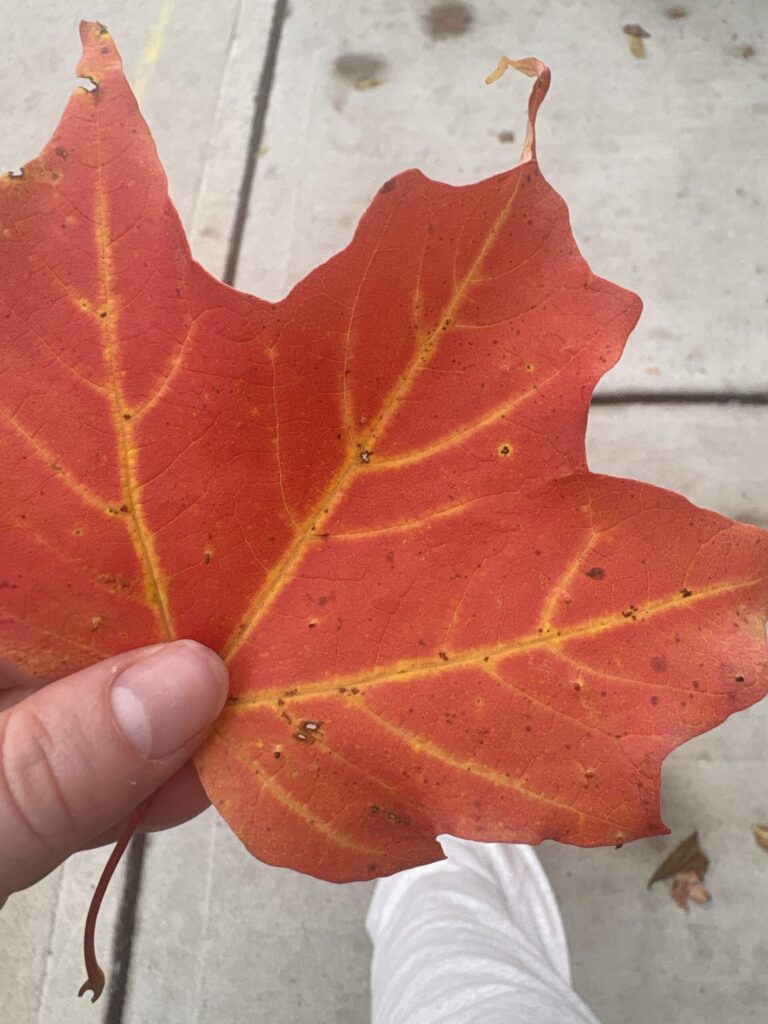
Leaf walks have been a huge part of my life, and they change a little bit every season. Spring and summer tends to turn into “flower walks” or even “stick walks”, and this was always a way my mom kept me busy as a little kid. When I was younger, it was something we could do together, and take a break to ground ourselves in the midst of our busy schedules. When she passed away, I stopped going on these walks for a little while, because there was no one to hold all the little things I found in her pockets. I realized that whenever I was feeling stressed I just really wanted to go on a walk, but for a while I couldn’t bear to collect things as I went. I recently starting finding really beautiful leaves near my new house, and I decided to pick them up and take them home with me.
New York Times Reading Response
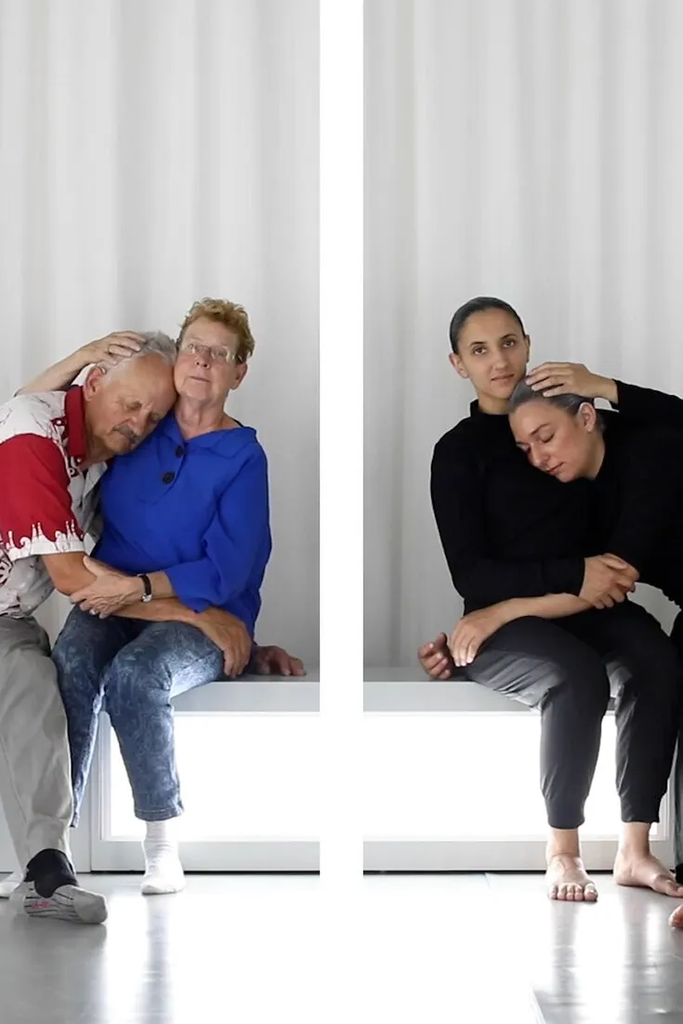
This is an incredibly personal kind of exhibit. Participants and viewers are able to “submit a movement”. This can be something they do, or in most cases, the movement or habit of someone who is no longer with us. This could be something as small as a hand gesture when the person is upset, or the way they used to hug someone. There is a lot of opportunity for vulnerability with an exhibit like this. As the actors preform the movements in real time, the viewers can feel the palpable intimacy in the air. This is an incredibly unique kind of art, which makes it so beautiful. I loved when there were two actors / artists involved in the movement. This added an element of connection between two people that are most likely strangers. There was one movement that struck me in particular, and it was the act of two people sitting and one of the actors slowly moving their head to rest on the other persons shoulder. It was filled with love and tenderness and the way it was portrayed was so intimate. The people closest to me are so very important, and over the years I’ve known them, I’ve been able to read them like books. My best friend’s eyes widen when she gets complimented, as if she’s surprised. I don’t know why she would be, but it’s like she doesn’t quite believe what she’s just heard. My sister talks with her hands all the time, and when she’s getting upset, she tends to flex her fingers before cracking her knuckles. It’s most likely a response to stress. My roommate also talks with her hands a lot, but when she gets stressed she shrugs her shoulders and rolls her neck a lot. I highly doubt that any of them realize these movements, but I have had the pleasure of being a part of their lives and learn what makes their brains work.
Art Gallery Walk
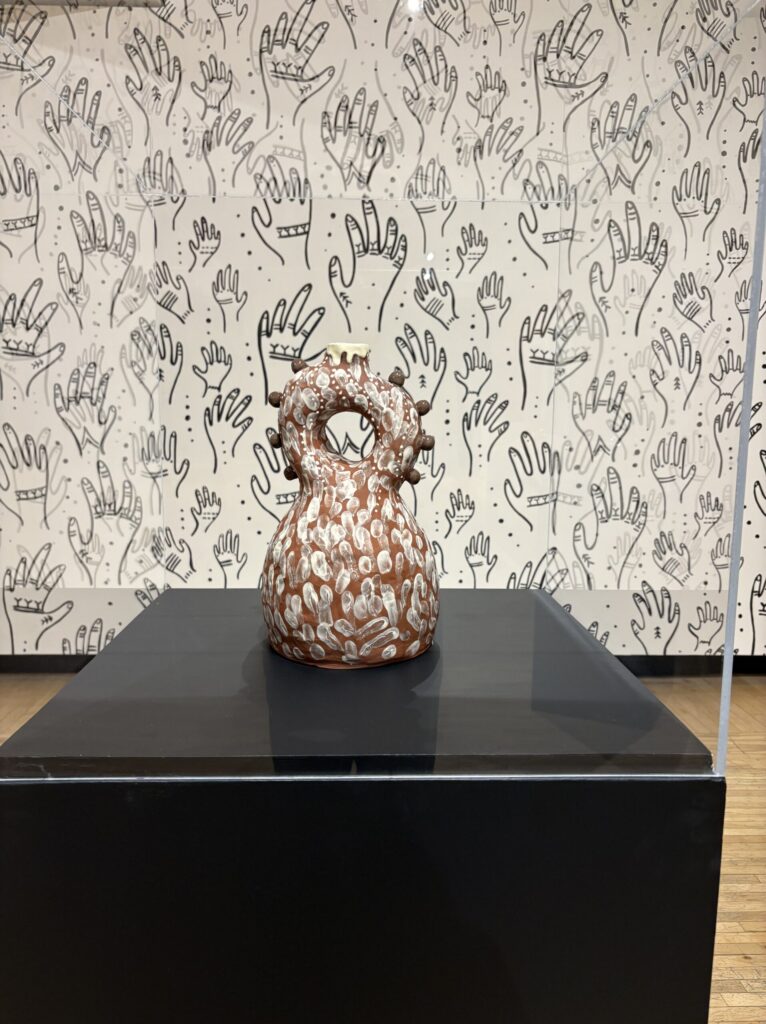
I was unable to attend the field trip to the gallery in Toronto, but I was able to look a little closer to home. I walked to the Art Gallery of Guelph (the AGG) and took a tour of the different exhibits there. The main exhibit was called “Earth Bodies”, which had been curated by Erin Szikora, although there were other smaller exhibits on the upper levels of the gallery. Each exhibit was contributed to by several local and indigenous artists from the area. There were many different kinds of art in this exhibit. Everything from sculpture and painting, to an audio-visual experience. With such a wide variety of works, there were so many to compare and contrast with one another. There were two different sculptural pieces that I really loved, and I thought they would be interesting to compare. The exhibit on the upper level was called “Looking in/looking through”, and was curated by Casper Sutton-Fosman. It was a unique blend of photography and sculpture that really captured the viewers attention, despite the dimly lit room. A piece that really stood out to me was a small sculptural piece of glass, named and created by Charline Dally, “water is transmitting the message”. The small glass sculpture could fit in your palms, and was placed strategically underneath a soft light, that made the surrounding area sparkle and dance. This was an excellent example of curation, because the way this room was put together showcased extreme unity and flow. Your eyes move around the different pedestals with ease, before focusing on the different images on the walls. Personally, I love sculptural pieces, and I often find myself gravitating to glasswork. Mainly because they are often beautiful and abstract, but also because they are on the more naturalistic side of artwork. The freeform shapes and loose edges are quite stimulating to my brain. Leading from that concept, another work that really stood out to me from the main exhibit was an example of pottery. Gayle Uyagaqi Kabloona, who had more than one piece in this exhibit, created “Sun Dog”, a stunning example of painted ceramics, that stood out due to its unique shape and designs. It was placed in a glass box on a small podium, so the viewer could walk all the way around and enjoy the work from all angles. There were two other vases in the same space, all placed in front of a large painting, that covered the back wall. The floating podiums allowed for viewers to walk all around each work, taking them in, while feeling immersed in the space. This was an excellent example of curation, because it made the viewer feel as though they were participating in the art, and like they to were swirling ceramic designs. The AGG never fails to delight anyone who walks through their doors. They effortlessly transport visitors to the realms of the artists and offers new perspectives on real experiences.
One Feat, Three Ways
Video #1 – (The One Shot) Although we each took a video similar to this, making eye contact with the camera and saying “I love you” repeatedly, we decided to submit Leah’s. This video was shot in one continuous and uninterrupted take, so there are some moments where Leah end up breaking character. We wanted to look at facial expressions, body language and tone when completing this assignment and how they change as time goes on, even though the initial phrase stays the same. I will admit that the first few seconds were incredibly uncomfortable, to watch and to say. Saying “I love you” is really vulnerable, and even a little silly, especially when it’s in front of your friends, and you’re speaking to an inanimate object. As the video progresses, she becomes more comfortable, and you can see her facial expressions slip into something more intimate. With the entire video (something like two minutes long) being unedited, you can see everything across her face. This makes the video more interesting in my opinion, because the viewer can see the entire process, which would be lost on someone if the video had cuts and edits.
Video #2 – (The Sequence) The second video has the same concept, however we experimented with some really cool editorial features. We used all our videos and overlapped all of them, as well as changing the opacity of each of our faces so that all three of us are visible and our voices can be heard. This changes the act of saying “I love you” from something singular, to something more profound. Hearing three different voices overlapping actually sounds a little scary at times and there are a few times where all our faces line up and it looks like there’s a fourth person on the screen. In reality, its all three of our faces combined. It’s a little eerie but overall a really cool outcome of our edits.
Video #3 – (Rotoscope) In our third and final video, we looped our best takes and edited our facial expressions, mostly around our eyes. Eyes are windows to the soul, so it was really interesting to see when all of us were at our most vulnerable, how each of us looked slightly different. We also edited over the video, with subtitle-esque words written across the screen. There were some points where one of us emphasized a word in the phrase so we made sure that that was obvious with our words.
Kalla mig älskling
This piece is incredibly close to my heart. In my recording, I am humming a lullaby that was sung to me as a child. My Grandmother and I are very close and she has been a major part of my childhood and life as a young adult. Lullaby’s are so personal to each individual, because they come intertwined with love, grief, and usually a much deeper story. When my mom passed away, my Grandmother held me and sang this lullaby to me over and over until eventually I fell asleep. I think that is a perfect way to describe how I wanted this project to feel. I wanted to feel held, and comforted and safe in the familiar melody. This song has been a part of my family for many generations, and I know that when I lost my mom, my Grandmother lost her daughter. She needed to be held just as much as I did.
I’m in my second year of my undergraduates degree, dual majoring in Studio Art and Sociology, with a minor in Creative Writing. I plan on perusing a career in law after graduation but have always had a passion for the arts and want to continuing growing and keep that love strong! My specialization is painting and I don’t venture outside of that much so I’m excited to see the ways this course pushes me out my comfort zone and what I am able to create!
The Artist is Present – Marina Abramovic
1. What are some of your first impressions of Marina Abramovic’s performance works, based on the documentary? Use an image/example of one or two works to describe aspects you admire, and aspects you might agree are problematic?
I have seen many of Marinas performances before this documentary and personally love and feel deeply for many of them. However if I’m basing my impression on the documentary alone I would say her work is quite freaky and scary, but I think that was a very intentional lens they filmed through and exactly how they wanted to portray her. At the beginning we receive a brief introduction and summary of her early work, accompanied by many vulgar and violent clips from the performances (as seen below).
I agree these pieces are problematic as she is intentionally causing harm to herself, which is viewed as mentally unstable by vast majority of people, as well as extremely unsettling. However I admire her for these pieces as well as she is sacrificing herself to spread her message because the typical person can empathize to feel what she is feeling.
2. What have you learned about features of performance art based on Abramovic’s work? Name a few key features according to her examples. Include an image to illustrate. Consider her quote: “When you perform it is a knife and your blood, when you act it is a fake knife and ketchup.”
The main feature of performance art I picked up from this documentary was despite each piece/performance being carefully planned in both message and execution, it is equally as natural, raw, and organic as life when it is being lived by the artist. The artist is present at every live performance, both physically and emotionally, and despite planning, one can never fully plan how they will feel in the moment and that has the power to change everything. Which is exactly what performance art is about, the shared genuine experience between the artist and the viewer. And the quote “When you perform it is a knife and your blood, when you act it is a fake knife and ketchup.” perfectly sums this up as you can act out getting cut a million times and have the perfect script, but if it were to happen in real life, you would never be able to get the perfect scene.
I think the moment that highlights this perfectly is during her ‘Artist is Present’ exhibition when Ulay sat across from her, and despite her planning to sit completely still, she extended her hands to him and allowed herself to be real and raw with the audience in that moment.
1 Kilometre
My first idea that I shared at our round-table was to represent my kilometre using spaghetti noodles and make a big gigantic bowl of spaghetti that I could portion and donate to the local homeless community in my hometown of Woodstock. However after doing the calculations and learning one noodle is 10 inches, it would take 3,937 noodles to make a kilometre, and after weighing the factors of cost, time and labour, as much as I wish I could it just wasn’t realistic, and ultimately my mom said no to the operation occurring in her kitchen. So I went back to the drawing board with knowing I wanted to stay in the same direction of representing the homelessness crisis in my community. What I landed on was to take a 1 kilometre walk in my downtown (Dundas St) and take note of what I saw within the homeless community and how that made me feel and think. I didn’t want this to be exploiting in anyway possible, but rather highlight how they are exactly like the rest of society, to help humanize and create empathy and awareness for the crisis. I also recognize it is not always possible to know if someone is without a home just from seeing them on the street, especially in the middle of a weekday, so I used my best judgement and was observing and reflecting rather then judging as I walked by, never stopping and staring.
I took my walk on Thursday, Sept 24th around 3:40pm starting from the art gallery (felt fitting) and walking east towards the centre of downtown. Across the street of the gallery I immediately saw a group of 5 individuals gathered together some sitting some standing in the ‘town square’ engaging in conversation with one another. I couldn’t hear anything but the body language seemed positive. I thought about how they probably all know each other, how they are their own community. They have their friends and the people they dislike, just like we all do. Not enough steps later I quickly walked by an individual tucked in an empty store front like they were trying to stay in the background along with a shopping cart elaborately modified to hold double its manufactured capacity. I first thought about the courage it must take to have to be on display, so vulnerable at your lowest to the public, and how sad it is to see them feel the need to tuck themselves away and disconnect from society. Then I passed 2 more individuals walking together in the opposite direction of me. I made the judgement they were a couple and that made me think about how difficult it must be to navigate romantic relationships in their position. One the one hand having a genuine compassion could help both going through the situation so much, but on the other hand love can also be so toxic and devastating. We all have experienced relationship troubles and they would be no exception.
These thoughts brought me to the end of my 1 kilometre walk. In 15 minutes and 22 seconds I observed 8 individuals who appeared to be homeless in my community. That is one for every 1.9 minutes of walking. I’m aware that is not a very accurate average however it is still far too many for the time and distance. I think our homeless crisis is one so many people ignore and don’t care about that I feel so passionate about and I want more people to gain empathy and reflect into these deeper thoughts and view them as equals because they are all humans too.
MOCA + Mercer Union Field Trip Reflection
I want to start this reflection off by saying this was such a great day beyond viewing and experiencing the exhibitions themselves. I had so much fun getting to connect with so many of my classmates and explore a new part of the city I have never gone to before! The day filled me up with so much creative energy and motivation!
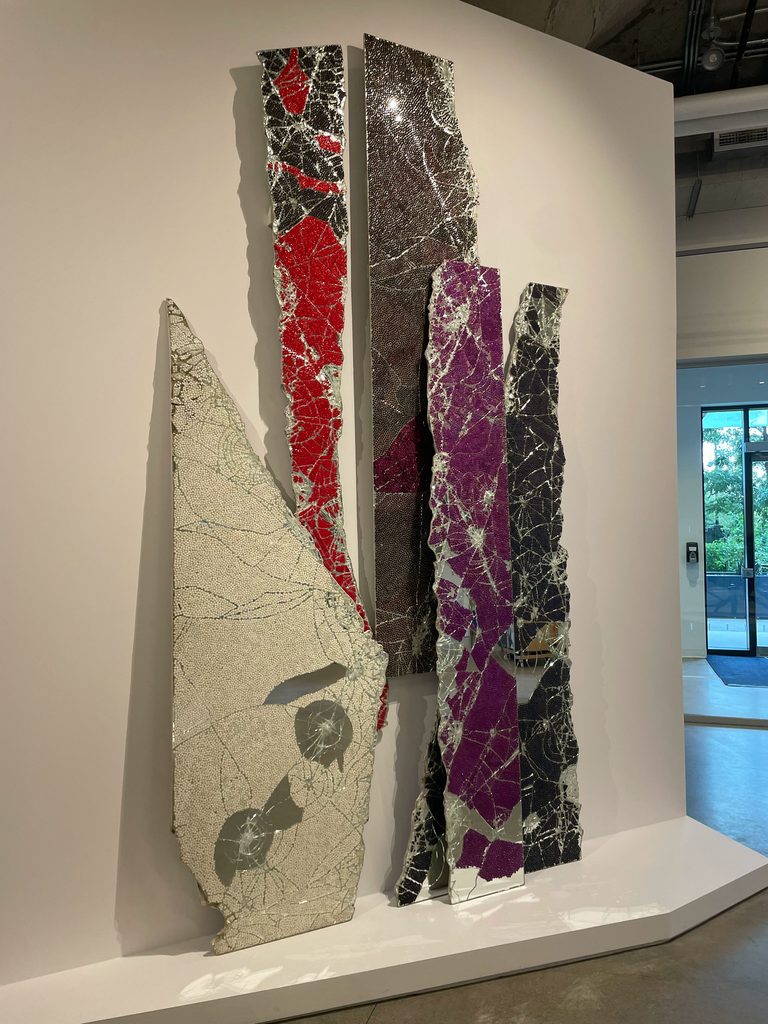
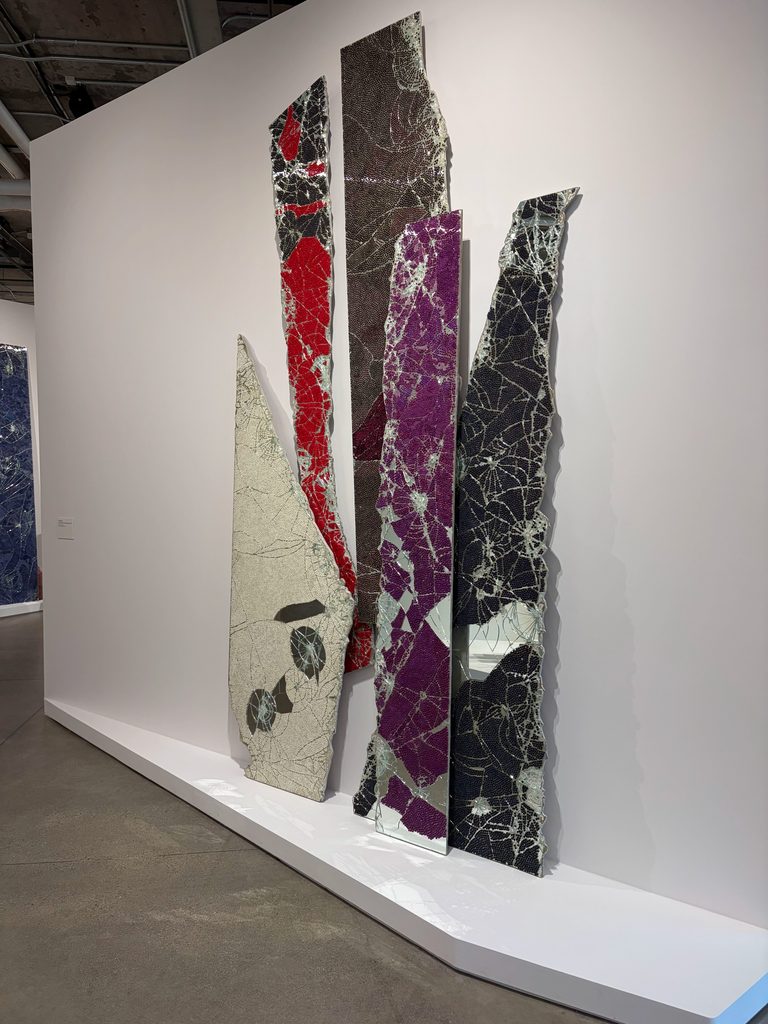
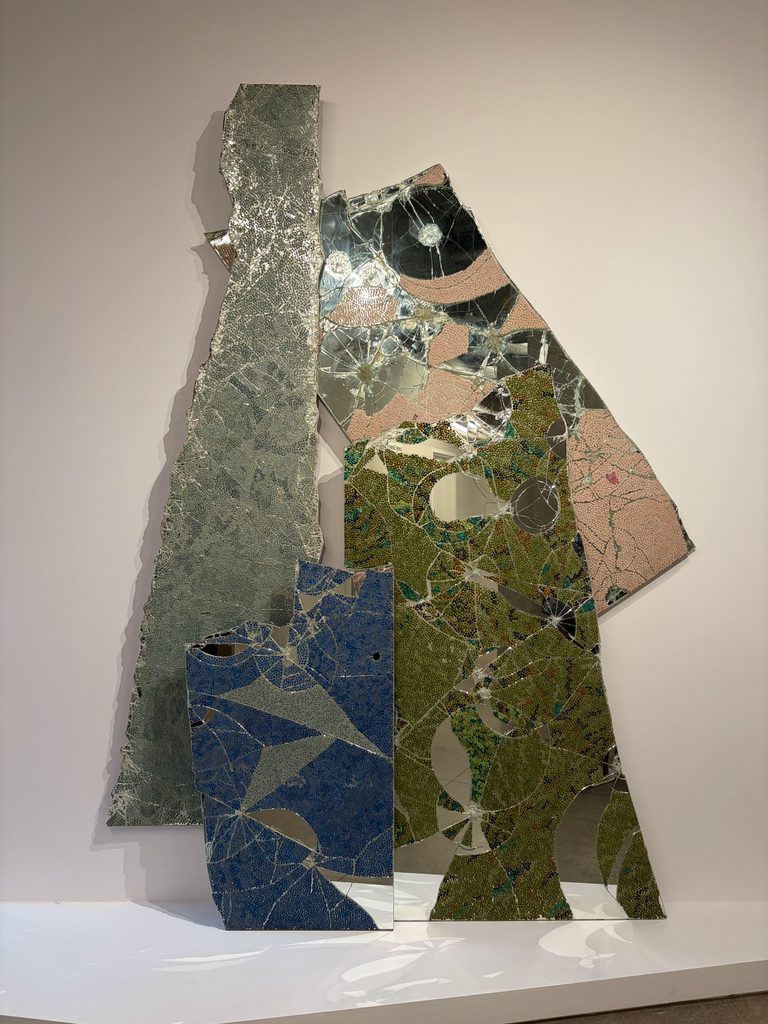
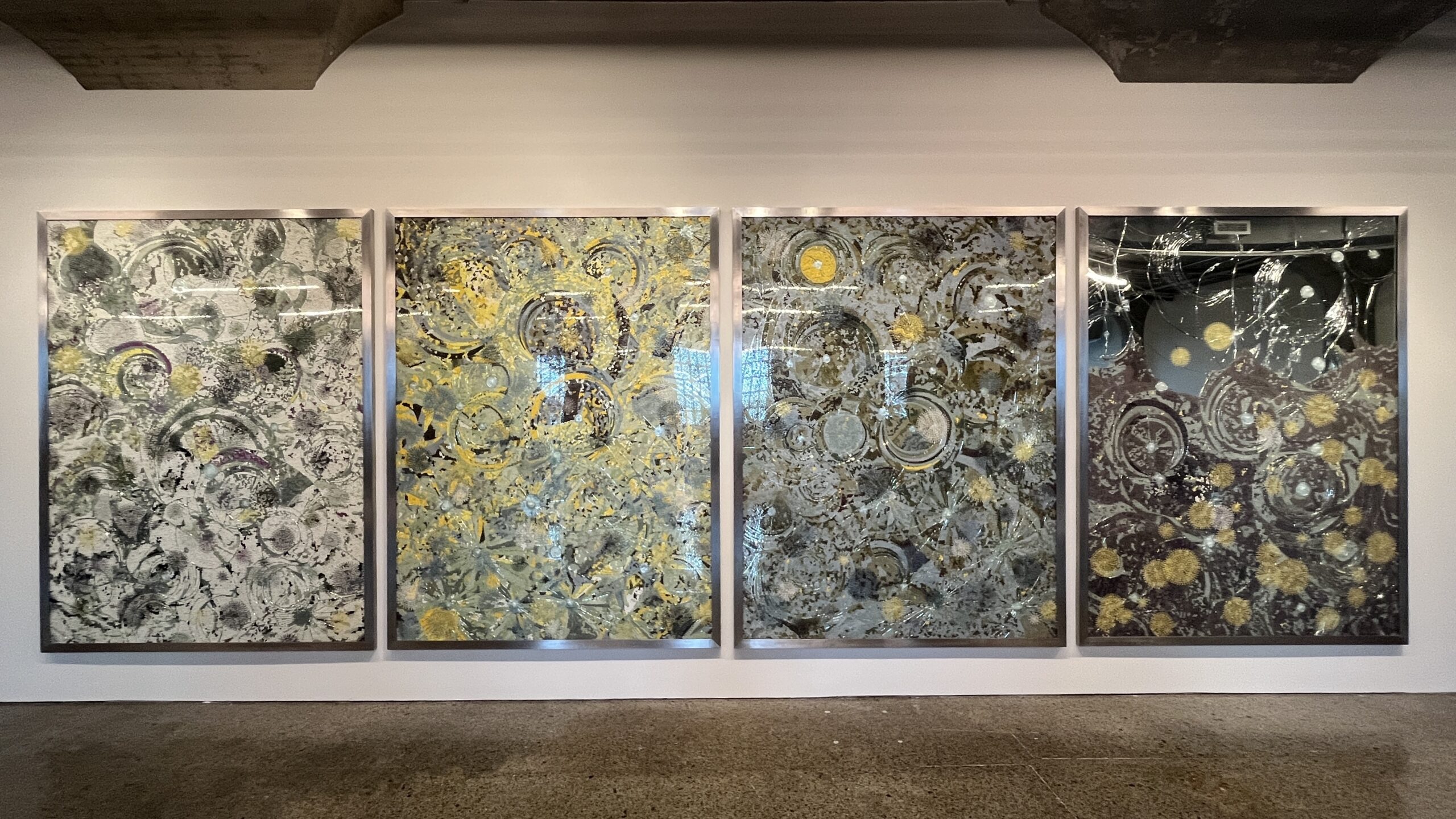
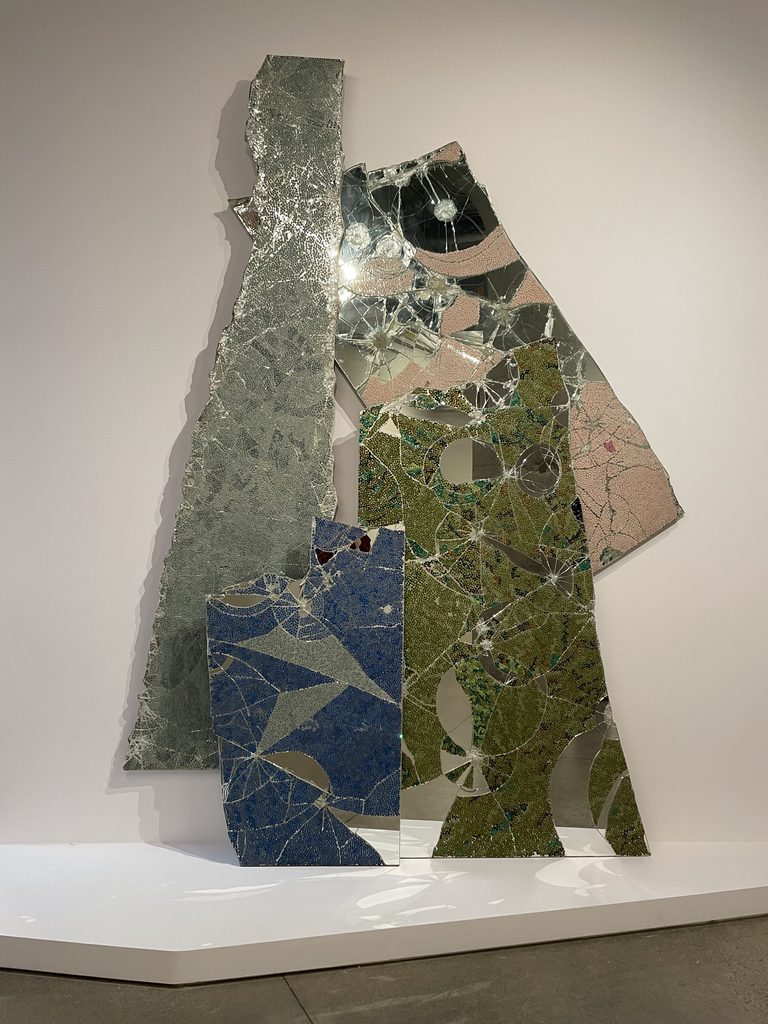
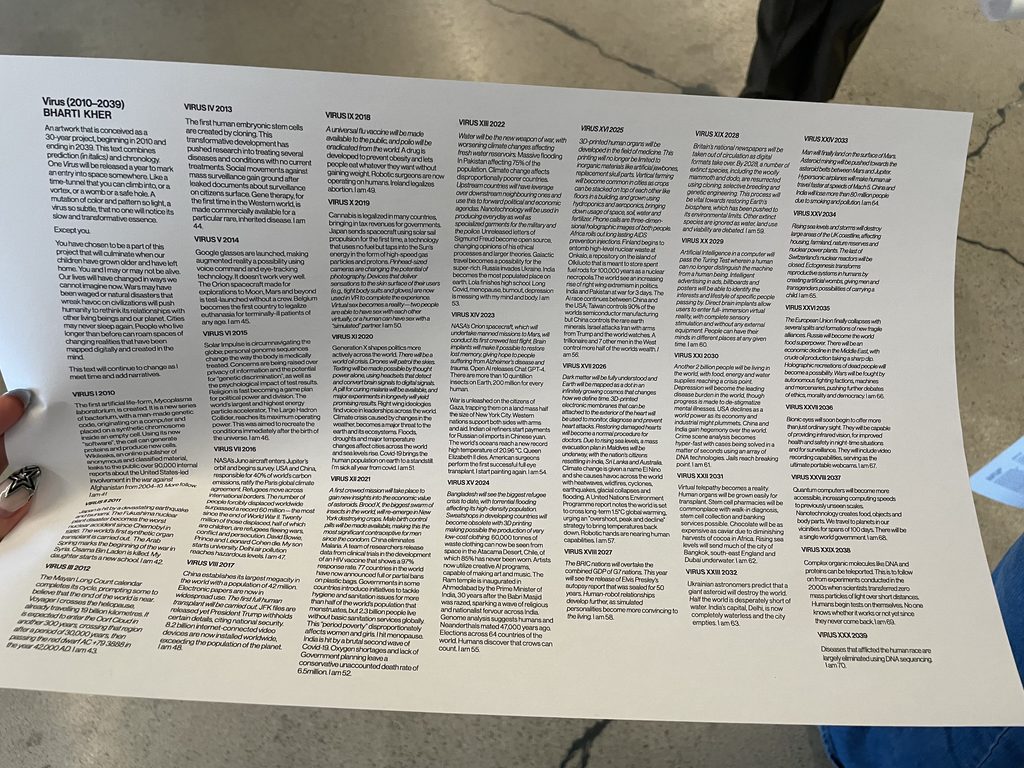
The two pieces that sparked my creative energy and are relevant to my own practices both come from the ‘Bones’ exhibition by artist Bharti Kher. The first piece is Virus (2010-2039) and the large variety of smashed mirrors covered in bindis, there were so many, all so different I was mesmerized by each.
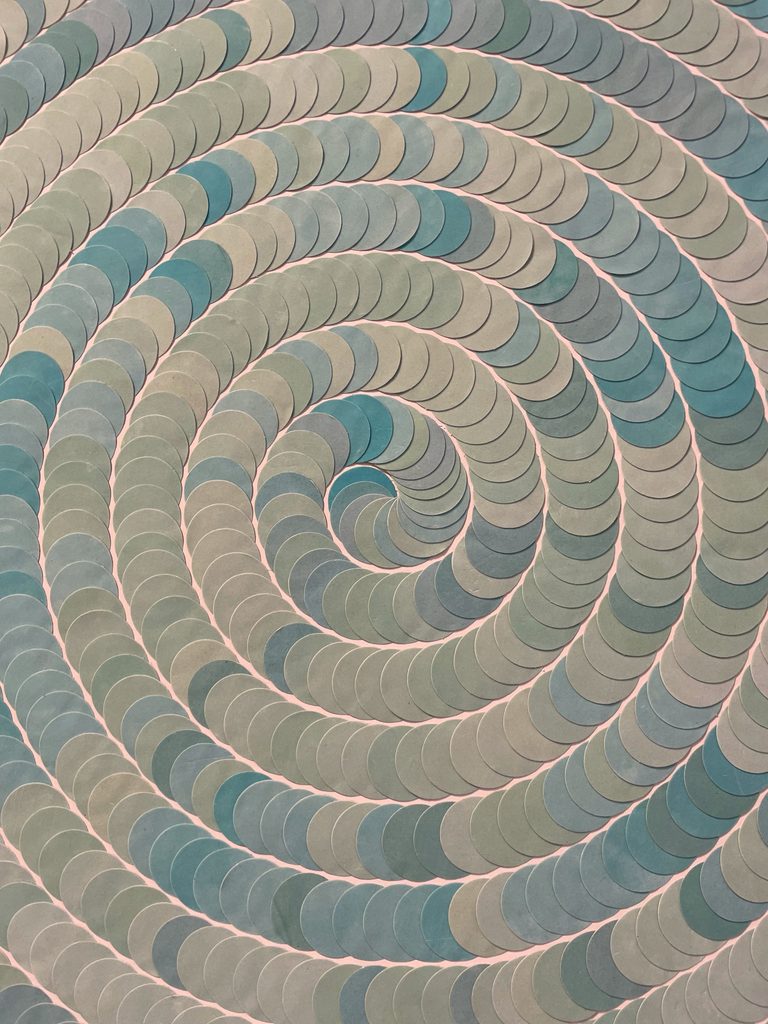
I’ll start with ‘Virus’ as it’s the first installation I spotted entering the MOCA. Immediately I was drawn to both the colours and size. Aesthetically I find it extremely pleasing to look at, feeling calming and comfortable, my eyes couldn’t help but trace the entire path. After discovering the accompanied writings the piece felt a-lot bigger and gained so much meaning. I was provoked to start thinking more about my own life, both past and future and in that way I was able to project myself onto the wall.
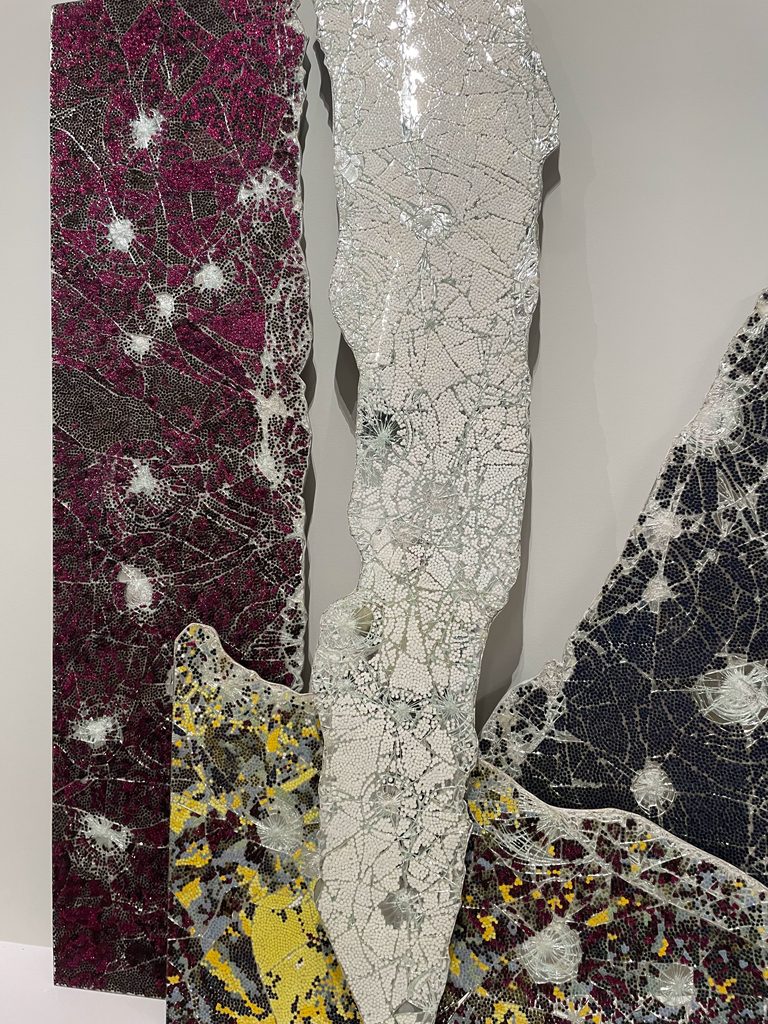
Also on the first floor of the MOCA were these absolutely eye-catching smashed mirror installations that I had such a heavy gravitation towards. Although I missed any description on these pieces, they were visually enough for me with their bright colours, the combinations, orientations and glittering effect from the lights on the mirror. I found myself searching for my reflection within the mirrors, which made me think about the meaning behind covering and breaking a mirror and the meaning behind that and I felt relation as I understand the feeling of wanting to do those actions.
The main reason I choose these two pieces and how they are relevant to my personal practices are simply there visual aesthetic appeal. My aesthetic is extremely bright, and flashy, and loud and I try to keep my work light hearted and feel good. So although I personally appreciate and love deep and thought provoking art, it’s not relevant to my personal practice.
Lastly I learned that despite not knowing the artists meaning behind a piece, I was still able to find meaning on my own, reminding me even without an explanation, an artwork still has the power to create feelings for the viewer.
Turning the Gestures of Everyday Life Into Art – The New York Times – Response
1. Describe the work discussed in the article and the unique challenges – as well as the unique gifts- that come with attempting to archive personal movements?
The article discussed the project “Motus Mori” by Katja Heinemann, a piece that involves ten dancers, public volunteers, and their donated movements, that get choreographed into multi-hour long public installations. I think a unique challenge that comes with this piece is the identity of the dancers. From what I gathered from the article this is more then a career for these dancers, this performance is their life and we are even told the copied mannerisms go beyond performing seeping into their everyday lives, This sparks ethical questions for me, how safe is this truly for the psyche of the dancers, is this interfering with their quality of life?
2.Discuss one or two examples of movements in the article – what strikes you about them?
Something that struck me while reading this article is the equal value the artist gives to all movements. Examples of these opposites from the article include the simple gesture of a scratch being equal to a religious gesture. “For Heitmann, there is no “good’ or “bad” movement, as long as its authentic” This work isn’t supposed to highlight the gestures themselves but the identity of the individual behind it.
3.Describe the habitual movements/unconscious gestures, tics etc. of 3 people you know well. How do individual body parts move, and how does the whole body interact? What about facial expressions, and emotional valence of the movement? How does body type inform the movement? What do these examples of small movements mean and imply?
Im sure I have many unconscious gestures I am unaware of but two I catch myself doing constantly are twirling my hair and Scratching picking my hands. I twirl my hair out of a need to fidget both when bored and focusing. I scratch pick my skin out of anxiety. For me these are both unconscious actions I have done my whole life.
my partner is an occasional lip biter when he is anxious, for him it appears to be a disconnect from reality for him. He ases this unconsciously without realizing.
Lastly my best friend for as long as I’ve known her has fidgeted with her jewelry. As both a conscious and unconscious action to keep her hands busy she is always twisting a ring or jingling bracelets.
Childhood Nostalgia – 1 Shot, 3 Feats
Payton Goosney, Charlotte Christie, and Mateja Bubas
Our intentions behind Childhood Nostalgia was to push the child-like act of blowing bubbles in chocolate milk to the extreme. Most of us have done this throughout our youth but will never let ourselves blow to the point of spilling the drink over the edge of the glass, whether it was fear of our mom yelling at us growing up, or having to clean up the mess ourselves now, we will live our lives without pushing that extreme. Except for Charlotte, Mateja, and Myself.
We entered filming our one shot with the intentions of being as serious as possible and having the focus and extremity on the bubbles and the mess itself. We decided to use only one camera angle to capture a strait on shot keeping it as simple as possible to align with our original editing plans for feat two. We also only did one single take due to mess, and material limitations and cost of the chocolate milk. We used a completely white background and tablecloth to create a sterile like atmosphere to emphasize the mess of the bubbles we are creating. Our other supplies included clear plastic cups and colourful straws. And with that we filmed our one shot, which took a turn from intentionally serious to naturally humorous completely changing our plan.
With the new plan of focusing on the extreme humour of blowing bubbles, we began editing what is now the original feat two (not our final edit) that I’ve attached below for your viewing pleasure. This edit had us belly laughing as we created it, however we quickly realized we had completely lost our focus and intentions which are the bubbles and the act of blowing itself. So we started from the ground up creating what is our final edit above, that was much more tame, simple, and intentional, while still highlighting the humour that so clearly co-exists.
That brings us to feat three; our animation. With this animation I knew from the beginning despite the serious plans for the first two feats I wanted this one to be very playful and tap into that childhood like nostalgia that comes from preforming child-like acts such as blowing bubbles as an adult. I knew I also wanted it to be a mixed media stop-motion animation as I have recently started experimenting with that form of media however due to time constraints, my personal situation, and material/technology limitations I had to create the stop-motion completely digitally, which gave me the pro of having access to all the material and designs in the world, however that was also the con of a loss of originality and creativity.
Overall we are very happy with how all three feats came together and all really enjoyed getting to step away from the familiarity of our personal practices and have the opportunity to create something so silly and nostalgic to help recharge that childlike energy in us.
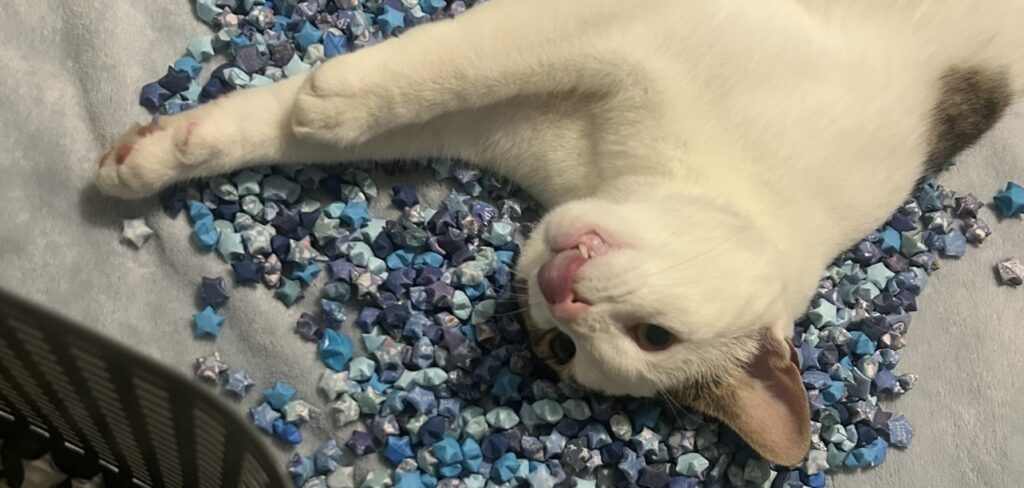
Hi, my name is Paige! I am a second-year Studio Arts major and Music minor. I chose this program because art and music are my biggest passions. To me, nothing is more exiting than being able to teach these subjects in my future. Some interesting facts about me are that I love pretty much anything to do with art(all medias) and I LOVE cats.
Hi! My name is Olivia Olena Cichon. I transferred from Sheridan College, where I studied Visual and Creative Arts for two years, and then came to Guelph after graduation to gain more experience in the arts. I chose the Bachelor of Arts in Studio Art program to continue my learning and skills.
Reflection Question:
“Why did you decide to take this program? What do you hope it helps you do or become”
When I hit grade 9, I had an art teacher who changed my perspective on my career choices; not only did she inspire me, but she also gave me the confidence to walk the path she walked. I went to Sheridan College to gain more experience in my art and then go into my bachelor’s. My hope is to one day enrol myself in teacher’s college and hope that one day I can inspire a student or two the way I was.
The Artist Is Present
Marina Abramovic
Reflection:
When watching the documentary, my emotions were spiraling from Disturbed to confused, then feeling sad. I didn’t see how sitting in a chair completely still for 3 months straight was art. Until I saw the bigger picture.
When she started on the first day, I didn’t understand, but as more and more days went on, I felt it. The piece wasn’t about her; it was about the people who sat in front of her. It was the eyes – the expression – the furrowed eyebrows – tension that many people don’t realize we hold in our faces.
From years of putting up an invisible wall, but what Marina was doing, in my perspective. She was breaking down people’s walls; you can see their rigid posture become slack and calm. Some let out tears; some were angry, etc. It was a beautiful piece, and I believe one of her most emotional ones.
What are some of your first impressions of Marina Abramovic’s performance works, based on the documentary? Use an image/example of one or two works to describe aspects you admire and aspects you might agree are problematic.
The work that stuck with me most was Rhythm 0, the piece where she stood still for six hours and let the audience do whatever they wanted to her using 72 objects laid out on a table, including a rose, a feather, a scalpel, and a loaded gun. Watching people go from gentle (placing a flower in her hand) to genuinely cruel (cutting her clothes, cutting her skin) over the course of a single evening was one of the more disturbing things I’ve sat through. What I admire about it is how honest it is. She didn’t design an experiment to prove a comfortable point about human nature; she designed one that could go badly, and let it. That’s a kind of bravery I don’t think I fully appreciated before.
The Artist is Present hits me differently quieter, less violent, but somehow just as intense. Three months of sitting in a chair, silently making eye contact with strangers, one at a time. What I love about it is that the “art” is almost nothing: a chair, a table, a gaze, and yet people wept. It made me think about how much of a performance art isn’t really about the performer doing something to an audience, but about what the audience brings into the space with them.
Assignment 1KM
Reflection/Idea:
It was hard to think of what to do for an assignment that gives so much freedom, especially when that freedom is 1KM. At first, I wanted to walk Stone Rd and map out what restaurants or stores I saw on my path, but when I walked the road, I learned that everywhere my eyes trailed, I saw bars all over the place. So I decided to draw a map and pinpoint all of the bars and count them as I went.
The 1KM stopped me at the Delta Hotel & Bar Mason on Stone Rd, which counted as the 8th bar I saw, and that’s only on Stone Rd.
It shows not only that there are so many bars on one street alone, but also that a street is significantly popular with University Students walking along that road almost every day. The bars promote drinking and getting under the influence. While studies are the main priorty its hard to get on track and lock in when your friends want to go out and drink, and it’s easily accessible.
THE MATERIALS I USED
Paper
Acrylic Markers
Black pen/Pencil
Olivia Cichon, Stroll On Stone RD. 2026
I chose to do a physical drawing of a map because when I was in Sheridan College, not only did I do something quite similar, but I loved the assignment. I wanted to represent a similar medium, but instead of painting, I used acrylic marker.
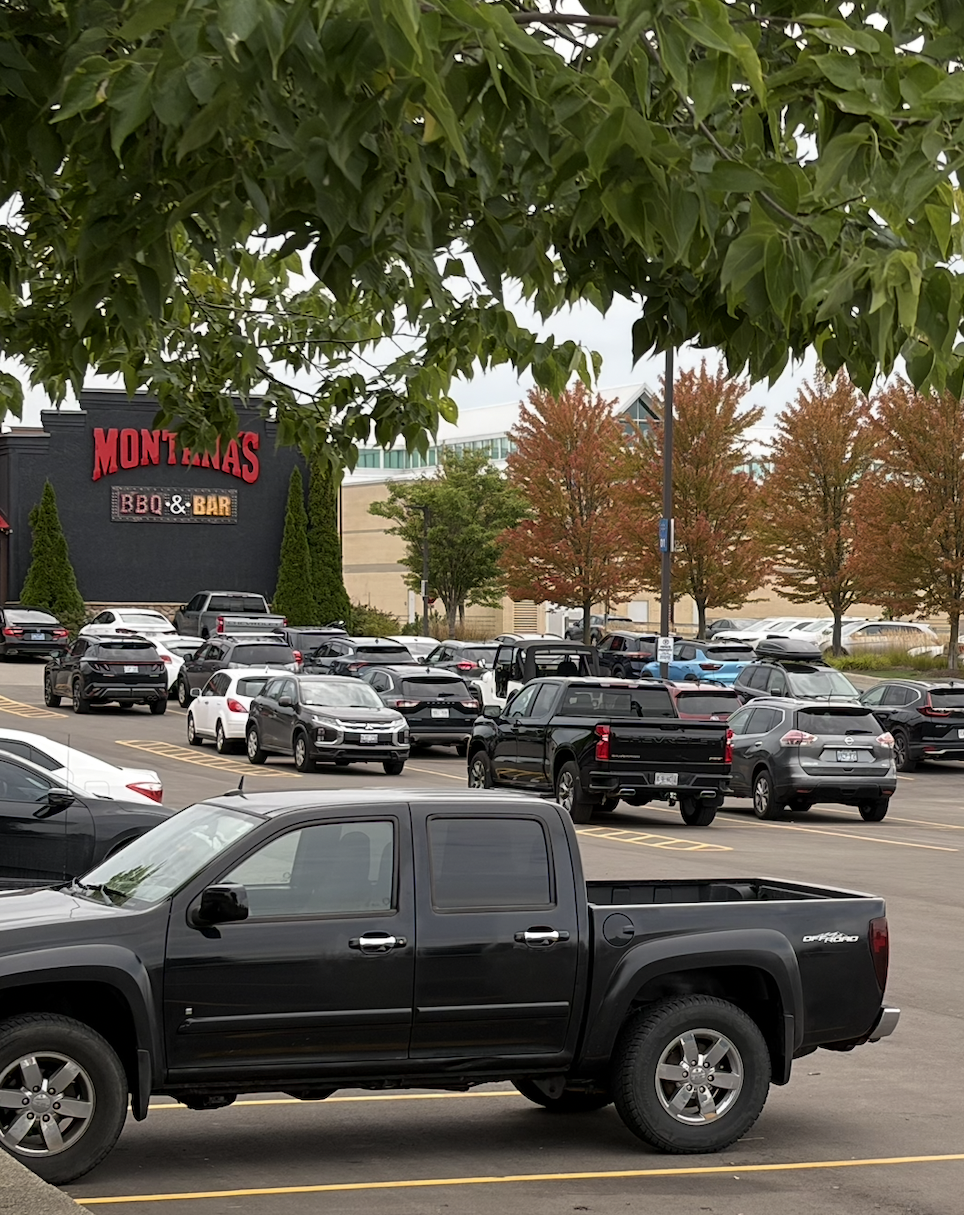
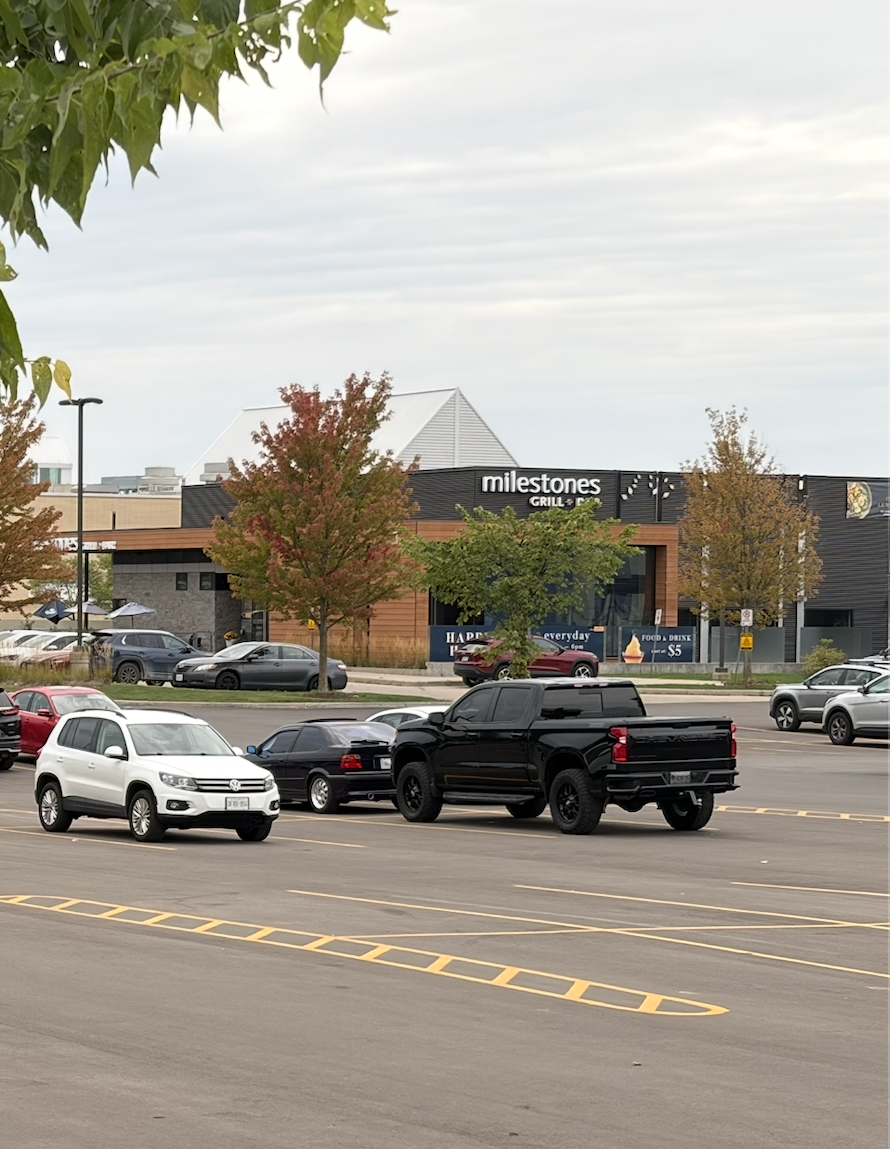
From the map, you can see all the bars so close-knit together, to the point where I was even surprised by how many there really were. I have photos of all the bars I saw; most of them I didn’t take a photo of, but I did document them on my map.
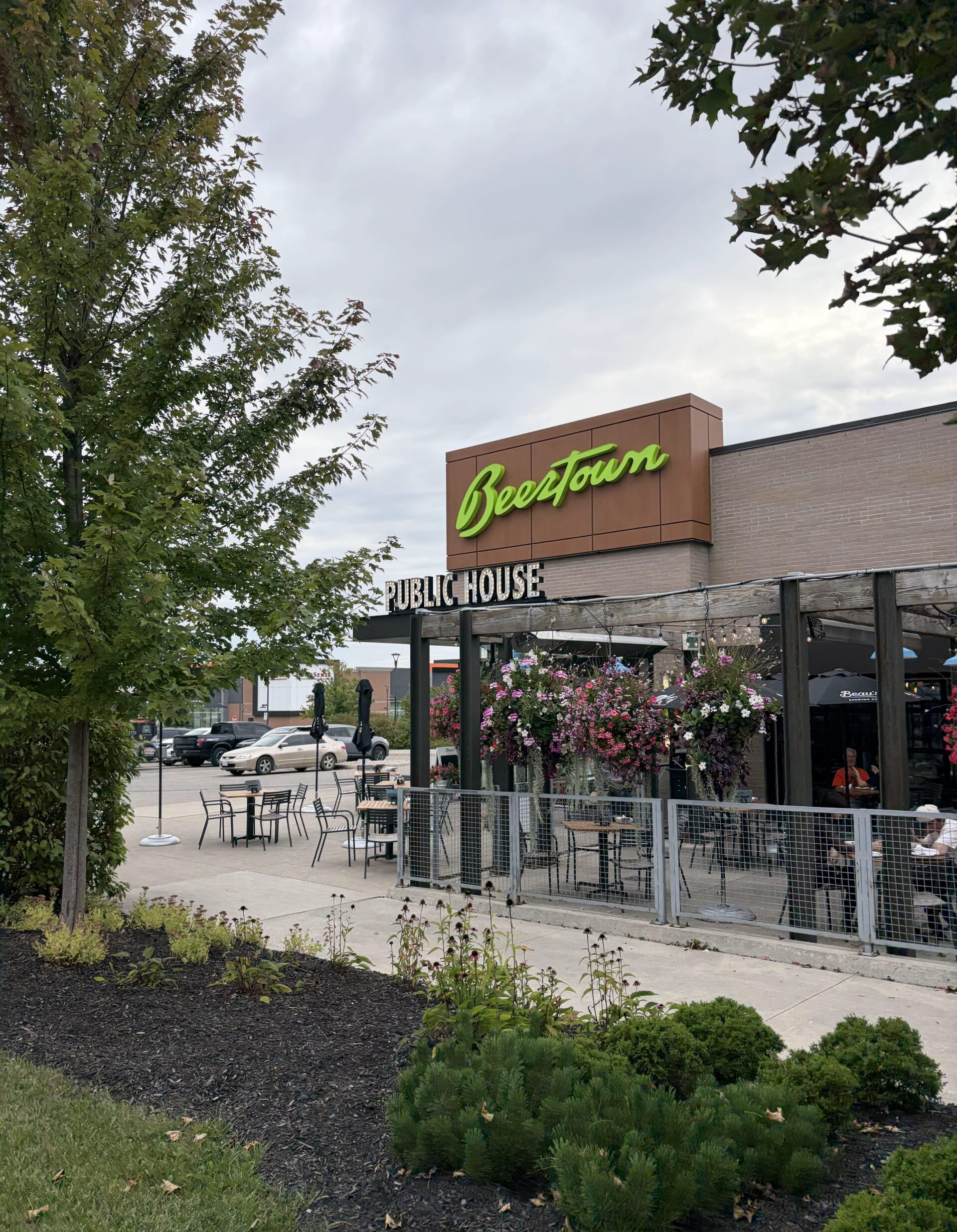
Beer Town Public House
Montana’s BBQ & Bar
Milestones Grill and Bar
In Conclusion:
All of these companies sell alcohol, and yet, you can find a bar within a 20 feet radias. That’s (6 meters). While doing this walk, I found that my mind drifted off while I was strolling down the road; I saw many students on campus at night in party outfits (ON A SCHOOL NIGHT). I have no clue how they do it, and yet they do, and we can guarantee they’re either going to bars on Stone Rd or downtown Guelph.
MOCA Field Trip
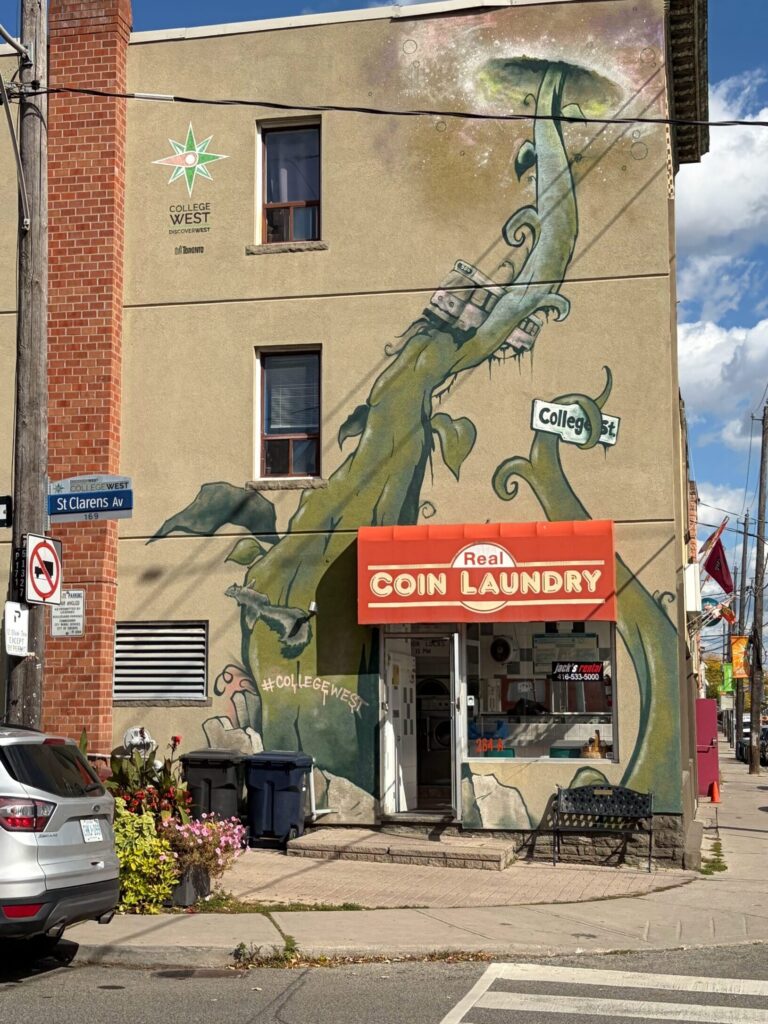
When going into this Field Trip, I went with a open mindset. I loved the walk from the station towards the MOCA muesuem, I noticed many art on the street of toronto that I found very interesting and beatiful, Which showed me how you can express art anywhere.
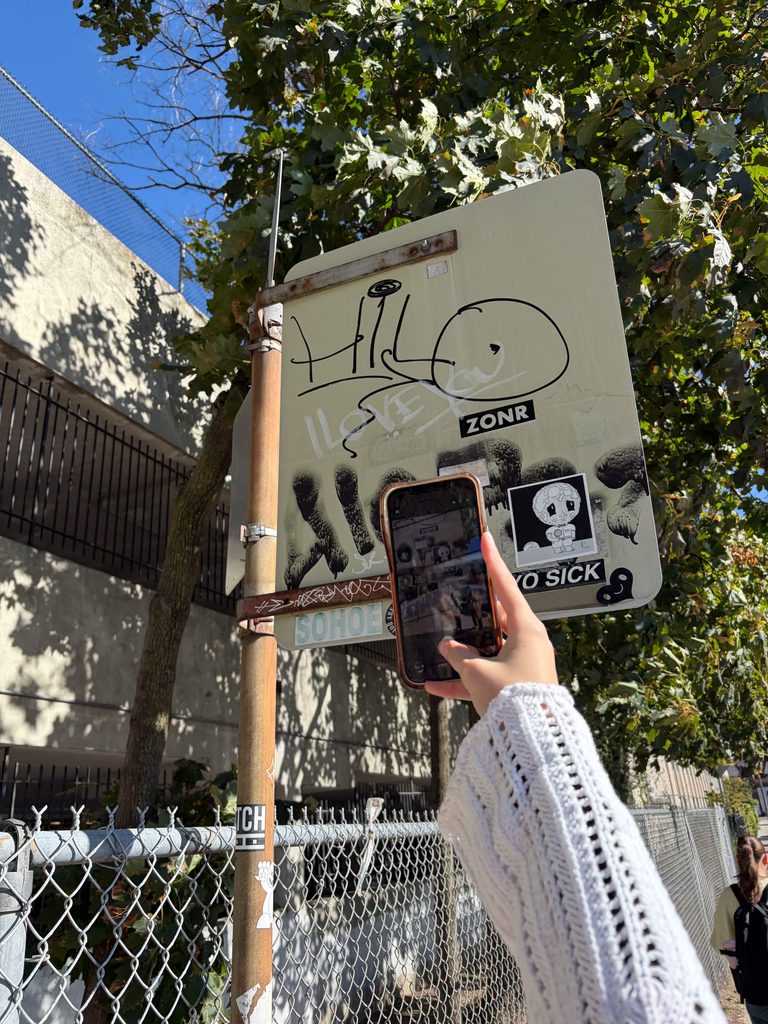
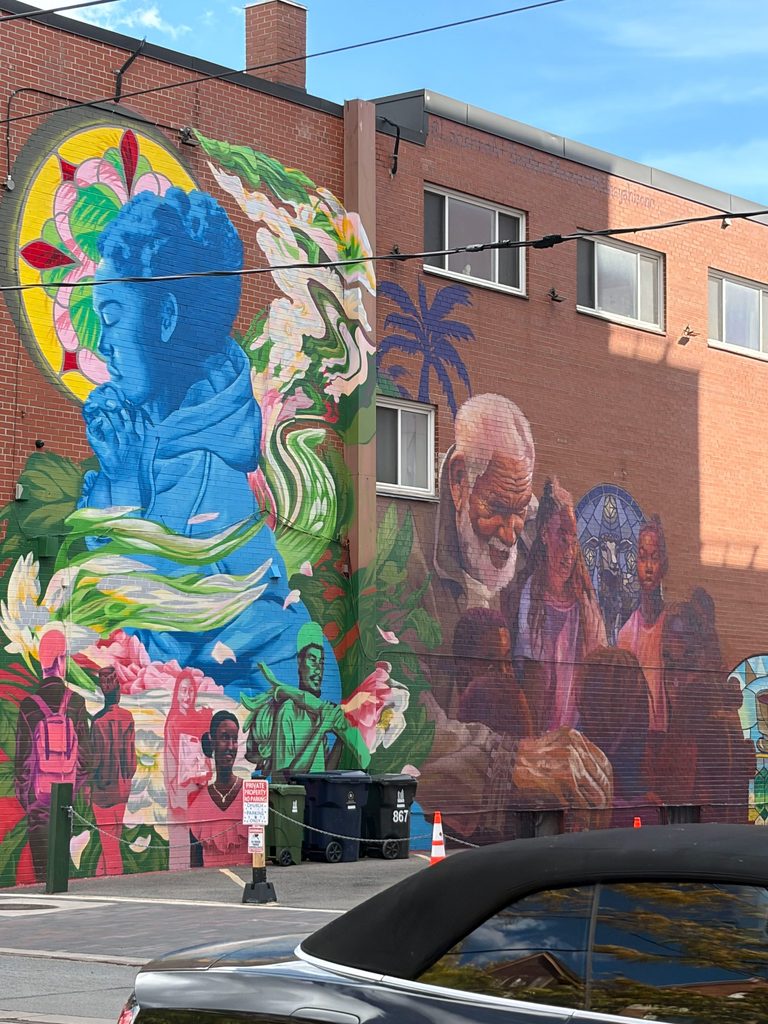
Griffeti is all over Toronto and some have a lot of meaning towards them and some are just humorous, When walking I found many artworks littering the streets that I find not only art but inspiration. It shows how people have the talent that they want to express but decide to express it through street art. When I left to walk to my friends place in Toronto, I did not stop finding artwork that I continued to take pictures of:
These artworks genuinely made me stop walking just to admire how much work and thought went into planning these pieces; especially the love of the artwork that shows through. Walking towards my friends place took me 1 hour and 15 minutes but It was worth it, I could have taken the train but decided to walk the way there and I think that was the best decision I could have made cause I got to witness this art, that someone took so much time to do and poured there heart out and it shows.
Back to the MOCA museum, when we went into the museum, I wasn’t expecting how much variety of work I was going to see. I thought of an art museum as paintings of oil, acrylic, gouache, but to see literally glass shards placed to make a cohesive sculpture on a wall made me stop in my tracks; I was fascinated, to say the least.
1st floor piece
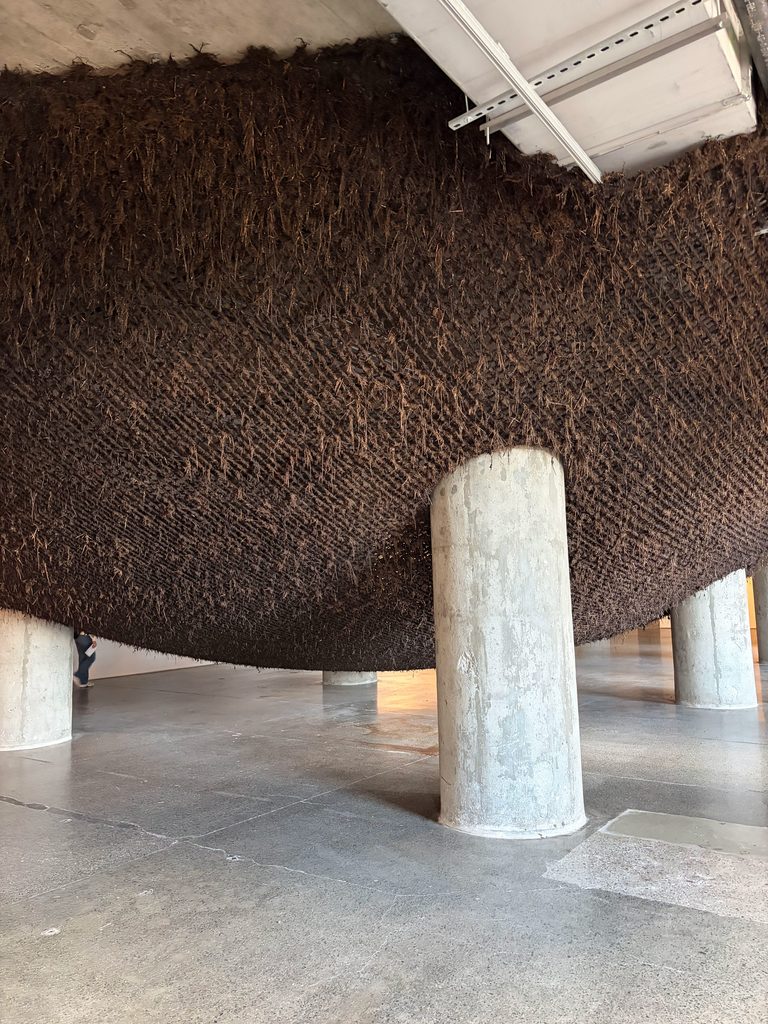
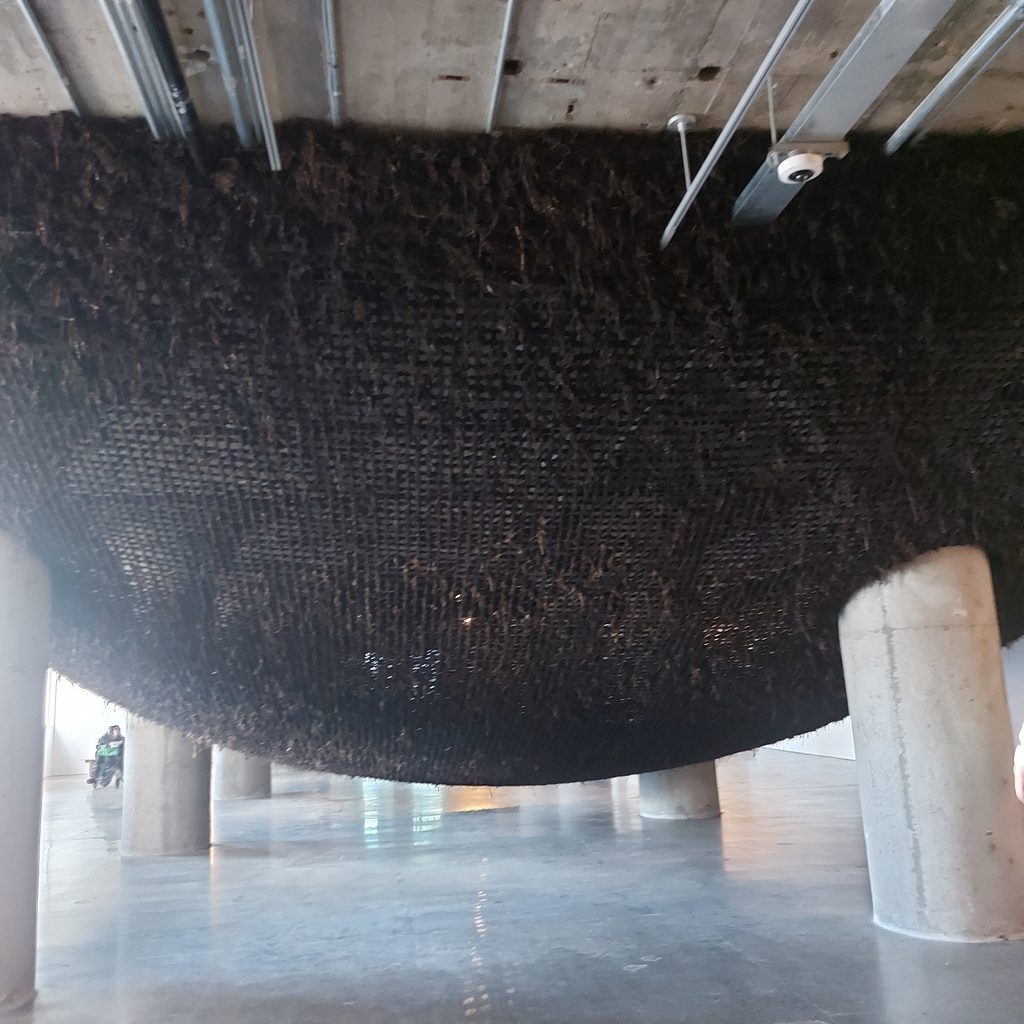
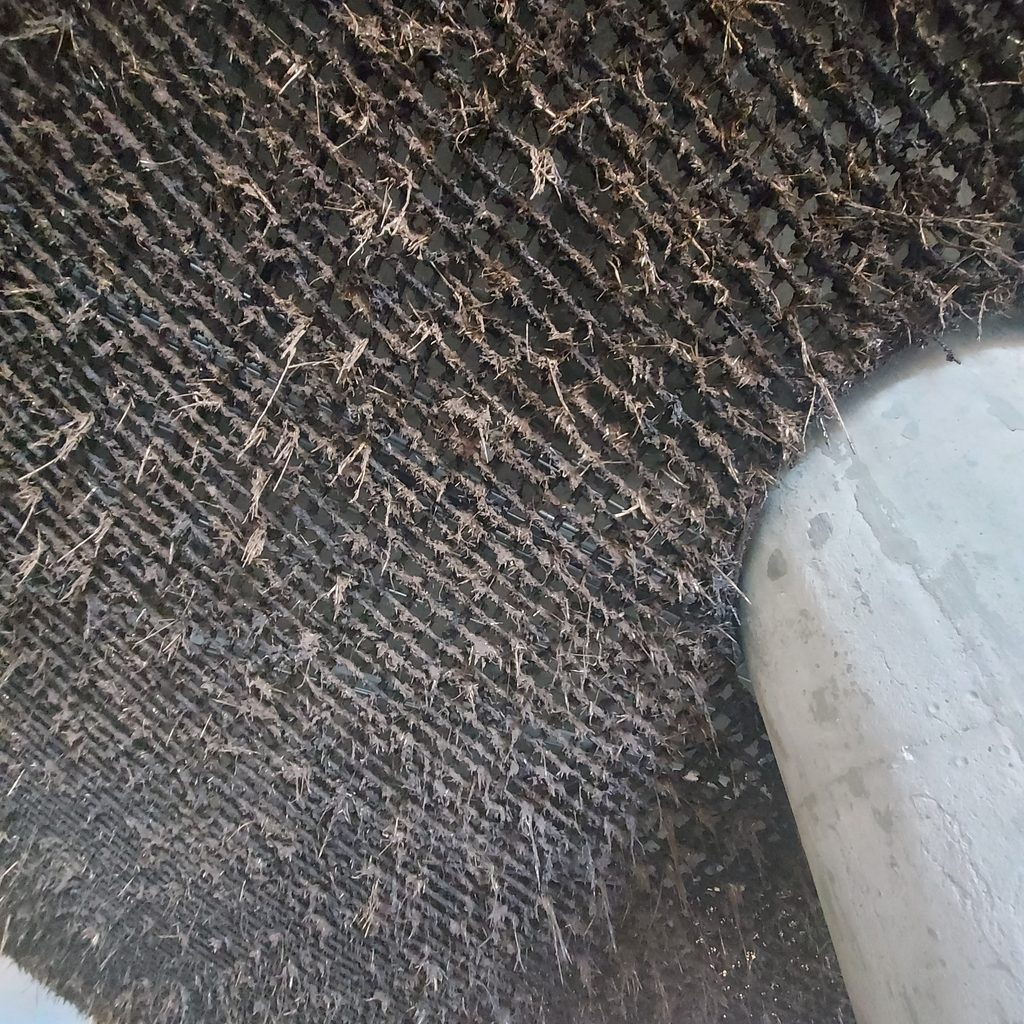
On the second floor, I wasn’t ready to walk into the room to see what I saw. My mind couldn’t comprehend how they installed this piece in the museum, especially given its size.
Delcy Morelos
“Rooted in her relationship to the land in her native Colombia. Delcy Morelo’s art is concerned with the earth’s nourishing, regenerative strength and the violence of dispossesion. This work follows the contours of a womb and is woven from long strands of sisal rope treated with local soil and corn roots harvested in Toronto. Pulling inspiration from the ingenuity of the spider, Morelos has spun and woven a sensory web that binds, catches, shelters, and nurses” (MOCA 2026)
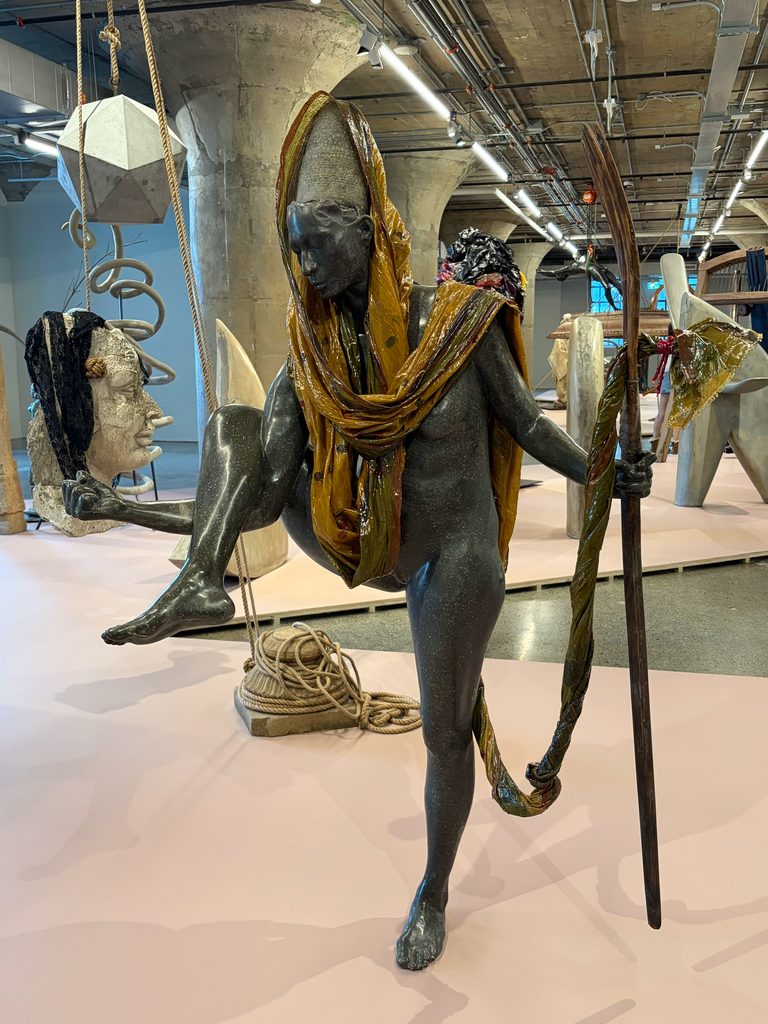
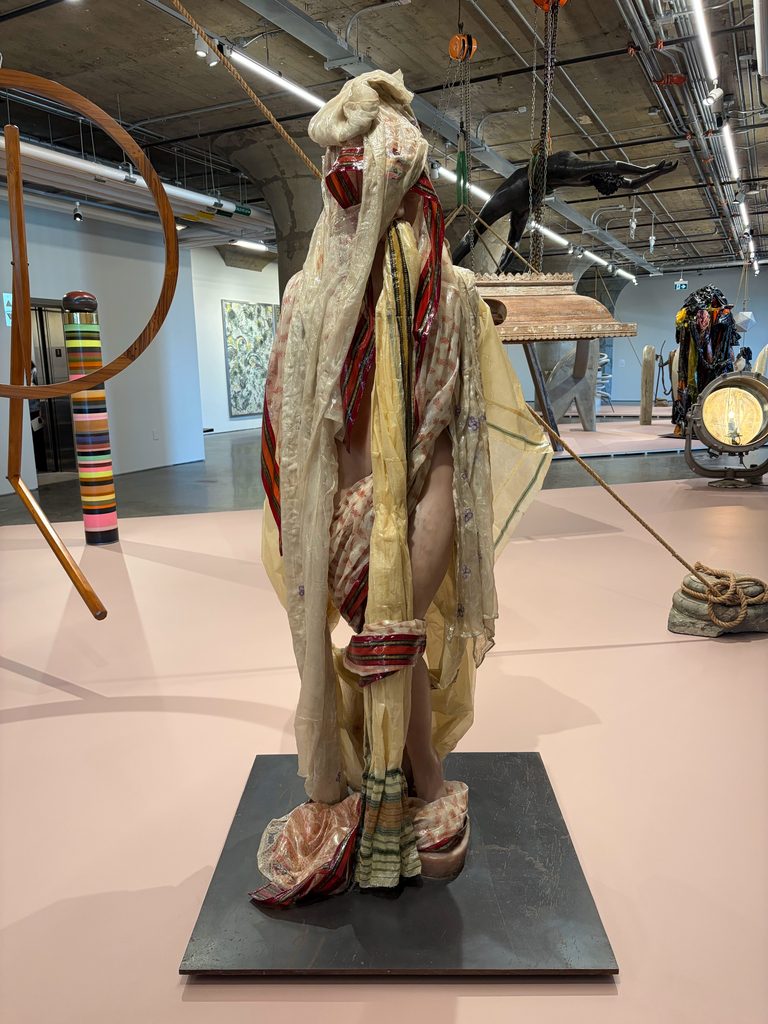
Bharti Kher
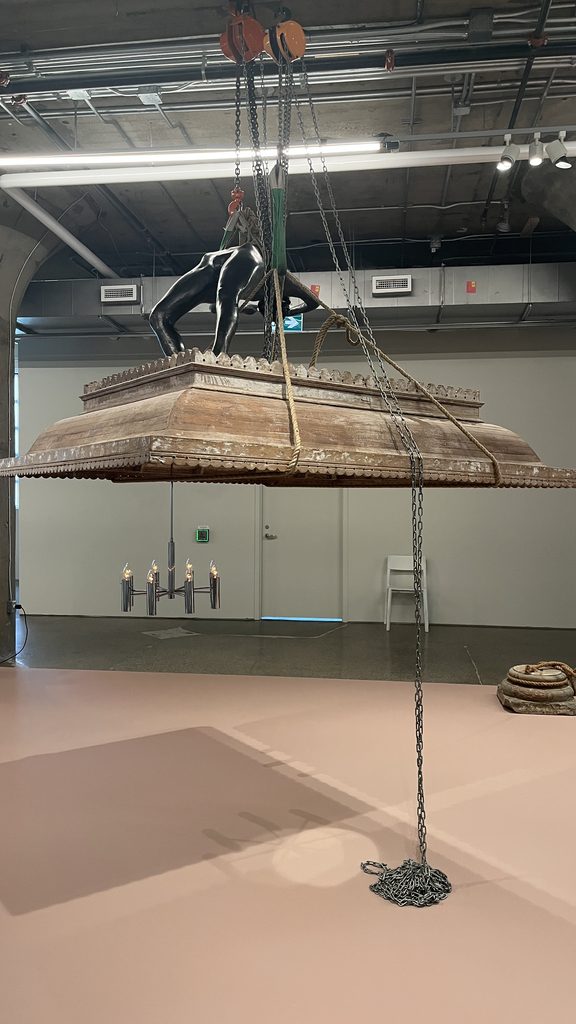
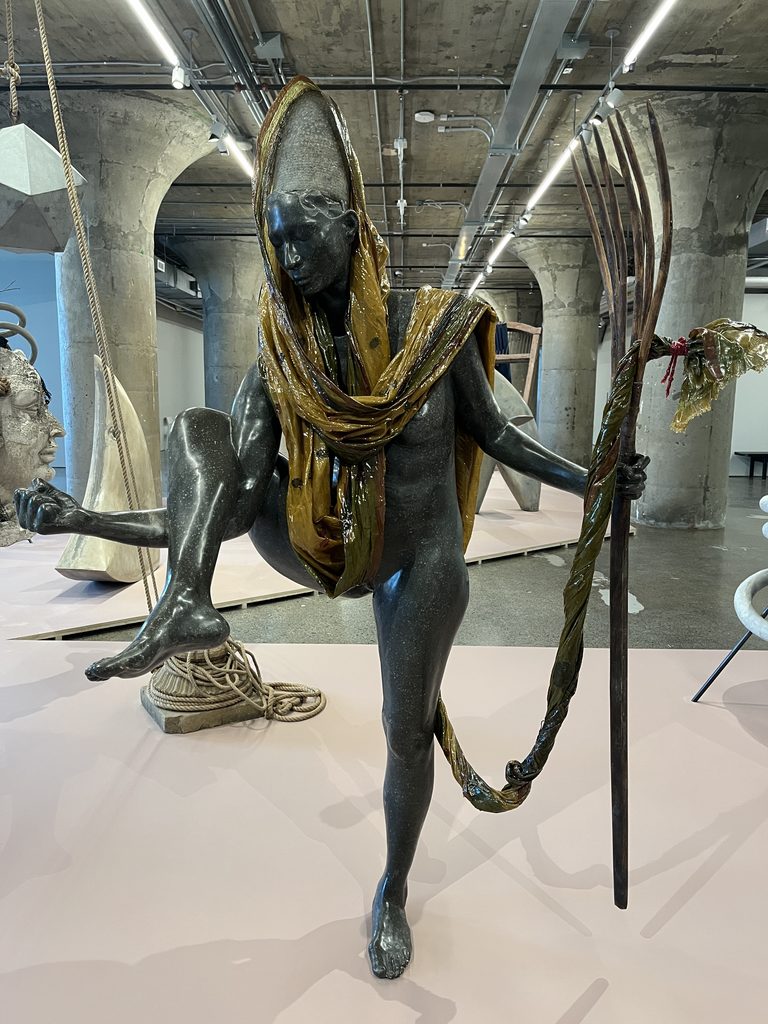
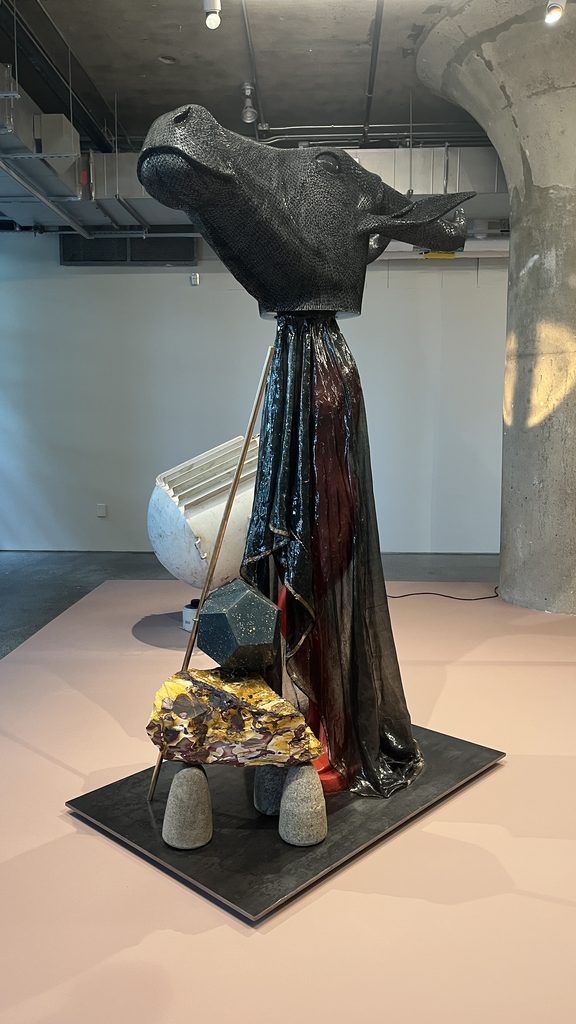
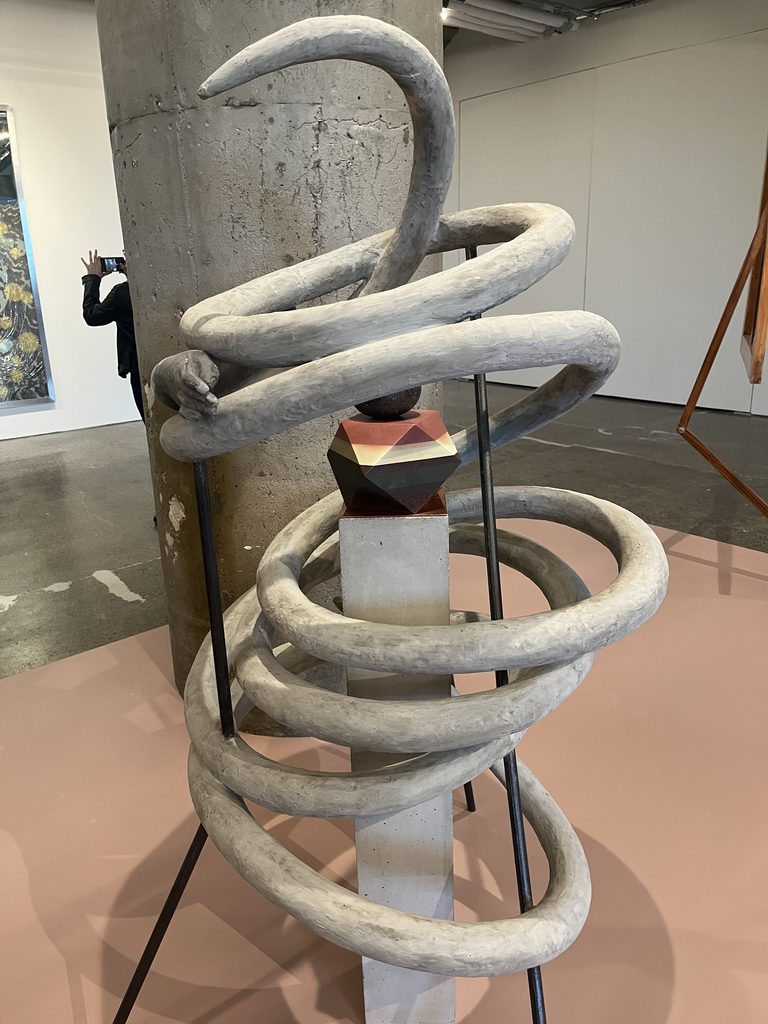
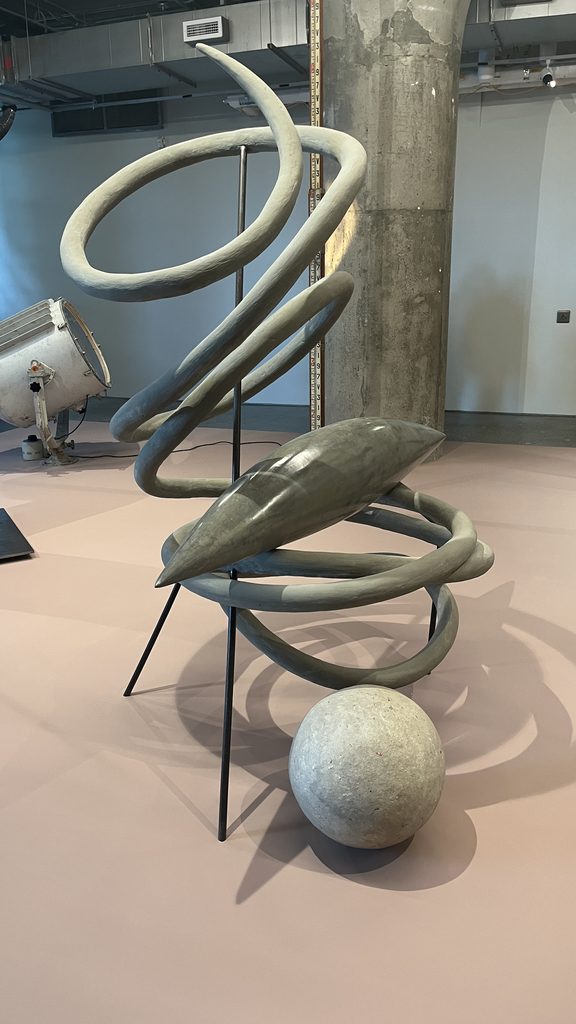
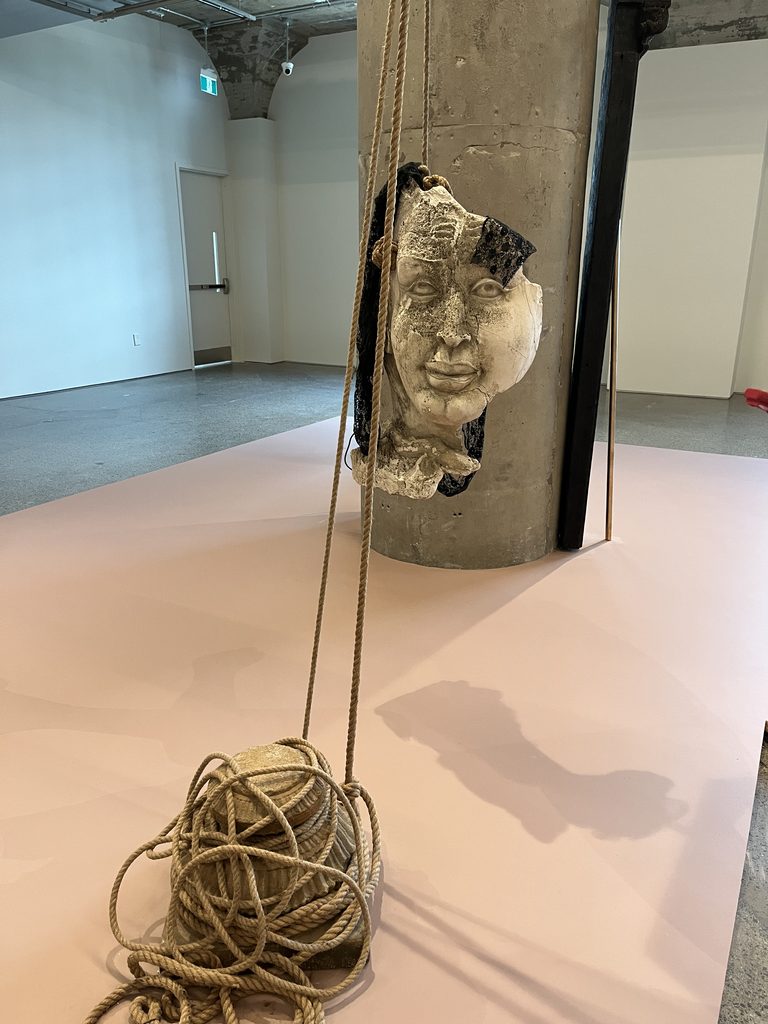
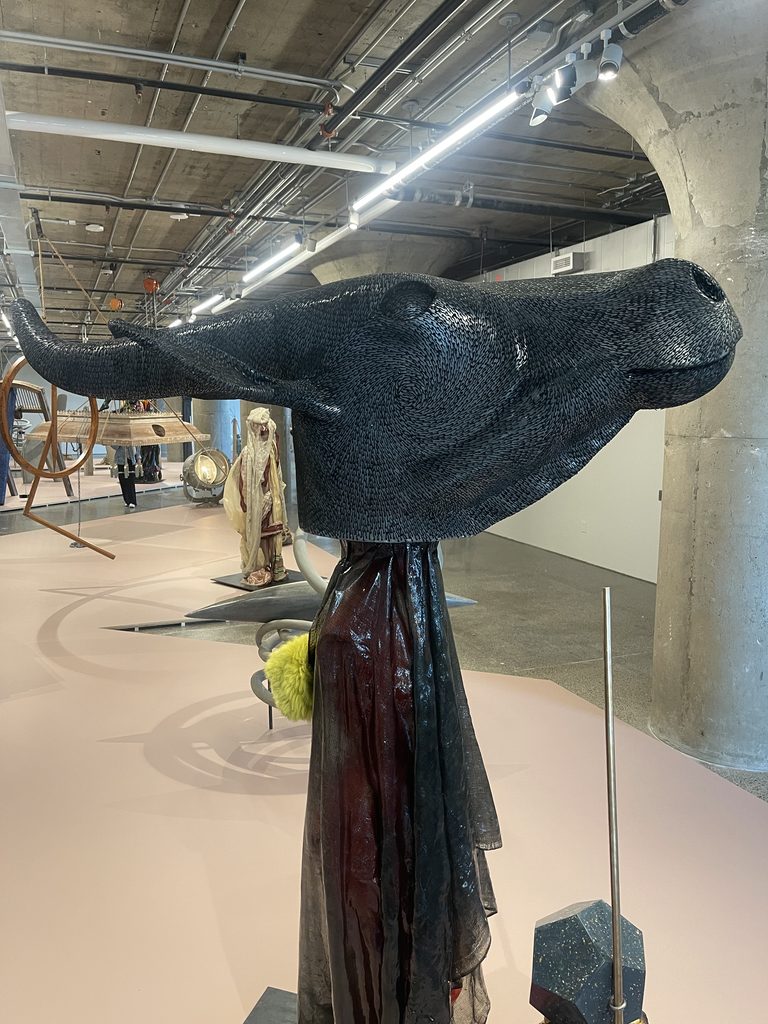
Bharti Kher is acclaimed for her masterful approach to assemblage, combining ready-made and nature materials with cast object into spellbinding artworks. Kher’s process involves breaking and remaking things. Kher’s project at MOCA, which spans two floors, objects tilt, rise, swirl, and hover, creating a universe of tension. Hybrid figures, part animal and human, part deity and earthling exist among geometric elements.
Turning the Gestures of Everyday Life Into Art (Reading)
By Zoey Poll. Photographs and Video by Melissa Schriek
This article is about Katja Heitmann, a German Choreographer based in Tilburg, the Netherlands, who has spent years collecting people’s tiny physical habits: How they walk, fidget, kiss, sleep, and stand. Volunteers “donate” their gestures, and the collection now holds the movements of more than a thousand people. The project is called Motus Mori, which means “movement that is dying out.”
My mind keeps coming back to the interview process. A dancer shadows each volunteer for an hour, chatting about everyday things like commuting or work while quietly mirroring their posture. People start out trying to sit up straighter and be their “best” selves, but the dancers coax them into relaxing, and apparently people open up fast, even sharing insecurities and trauma.
Then the dancer performs your movements back to you, slowed way down and stretched into something almost painfully deliberate. Some donors found it unsettling. One man realized he moves less elegantly than he’d pictured. Another, a spoken-word artist, said his nervous knuckle-cracking felt like his own after seeing it performed.
Heitmann says we’re trying to capture humanity in data and losing something along the way. That’s a big claim, but the project made it feel true; we record everything now, and a gesture that’s only ever lived in one person’s body is a strangely fragile thing to try to keep. The ending is what really got me. After a young woman died, her mother and boyfriend donated her movements, and her family came to performances as a way of remembering together.
Heitmann also donated some of her late father’s gestures, since all he left behind officially was tax paperwork. She said the gestures weren’t important, but neither were the tax filings, and that this was a “more human memory”.
There’s also a small, eerie detail about a dancer waking up one morning curled in a sleeping position that belonged to someone she’d interviewed a year earlier. The movements seep into the people carrying them.
Assignment 2
One Feat, Three Ways
Descripton:
For our project, my partner and I chose one of the most routine things you might do on holiday, wrapping a Christmas present, and took it a step further by wrapping a real person.
From the start, we decided the video should be silly and a little absurd, but not pointless; we wanted it to convey a message. Christmas is supposed to be about spending time with the people we love, but it’s easy to get caught up in shopping for gifts, finding the perfect wrapping paper, and making everything look flawless. In the process, I believe we lose sight of what the season is actually for.
Our approach was to wrap a person, not a box. The people in our lives are worth far more than any item we could buy in a shop; yet there’s a twist: the more paper we add, the more our ‘gift’ begins to look like a thing, and the less like a person. I find this change most interesting, since it shows the strange discrepancy between the importance we attach to material things and the importance we ought to attach to one another.
Another area we wanted to explore was the challenge itself. It is easy to wrap a box because its flat sides and sharp corners take most of the work off; a human body is the opposite, curved, flexible, and always in motion. We wanted to find out how far we could push a simple, ordinary task and what would occur when we attempted it.
In the end, what we wanted was to take something that is common knowledge, turn it into something unusual, and perhaps encourage people to reconsider what it really means to give a gift.
“More Than a Gift”
ONE SHOT
SEQUENCE
ANIMATION
Audio Studio Assignment 3
Beauty and The Beast | Evermore/The Mob Song (MIX)
Description:
Somewhere along the way, I noticed a pattern in Disney movies: so many of them have a song about a prince yearning for the heroine. Belle and the Beast. Aurora and Prince Philip. Jasmine and Aladdin. Different stories, same ache.
When I started thinking about writing something that captured that feeling, I knew I wanted to bring together two songs from Beauty and the Beast. My first pairing was “Evermore” and “How Does a Moment Last Forever.” Both are tender and a little bittersweet, about love that outlasts the moment. But the more I sat with them, the more I realized they didn’t say everything I was trying to say. I wanted to dig deeper into what I actually wanted to portray.
So I kept searching, and I landed somewhere I didn’t expect: “The Mob Song.” On the surface, it’s Gaston rallying the village to hunt down the Beast. But listen closely, and you’ll hear that it was never really about the Beast at all. Gaston wanted him gone to impress Belle and to claim her as his own. Underneath all the shouting is jealousy and obsession, a man who could never imagine letting her go.
The Beast has every reason to hold on. He’s been cursed, and Belle is his only hope of breaking the spell. If she leaves, he stays a beast forever, and with his enchanted rose wilting, he knows he’ll die. And still, he opens the door. He lets her go. That’s the heart of it for me. Gaston loves the idea of having Belle. The Beast loves Belle, enough to want her free even if it costs him everything.
There’s a saying that captures it: you don’t truly love someone until you let them go; if it’s meant to be, they will come back. And Belle does come back, not because she was trapped, but because she chose to. I think that’s why these two songs belong together in my mind. One is love as possession, and the other is love as a gift. I know which one I’d want.
Main practices: Oil painting, photography, fashion and journalism
My birthday is March 9, 2004
I started Monarch Magazine in my third year, and just launched it as a business! My goal is to grow it into a large scale media platform that offers vintage and sustainable brands the same exposure that large companies receive from mainstream fashion magazines. We are also starting to sell our own curated vintage collections 😉
Graduating June 2027
Currently commuting, but lived in Guelph for three years
Why experimental?
As a fifth year student taking this class, admittedly I’m taking it because I need to graduate. I have practically no experience doing experimental work, so while it’s not necessarily something I gravitate to, I’m taking it as a challenge to expand my horizons. I’ve been feeling a bit stagnant in my studio work and have been looking for new opportunities to experience creative breakthrough, and so I feel that this is going to be a great way to achieve that.
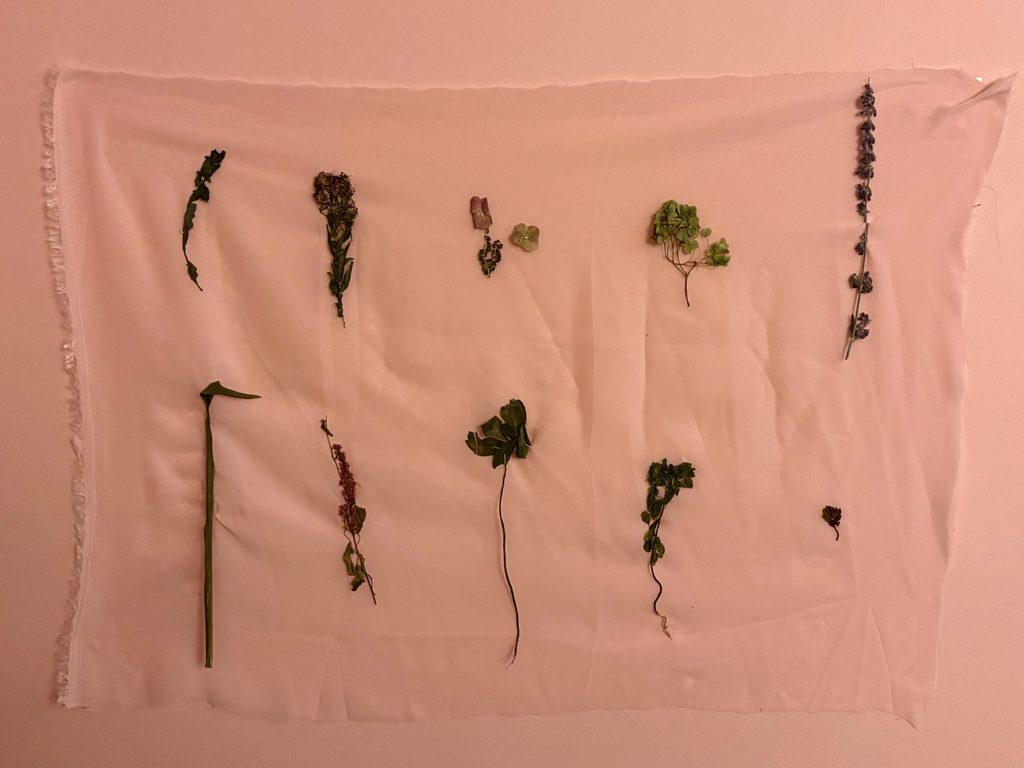
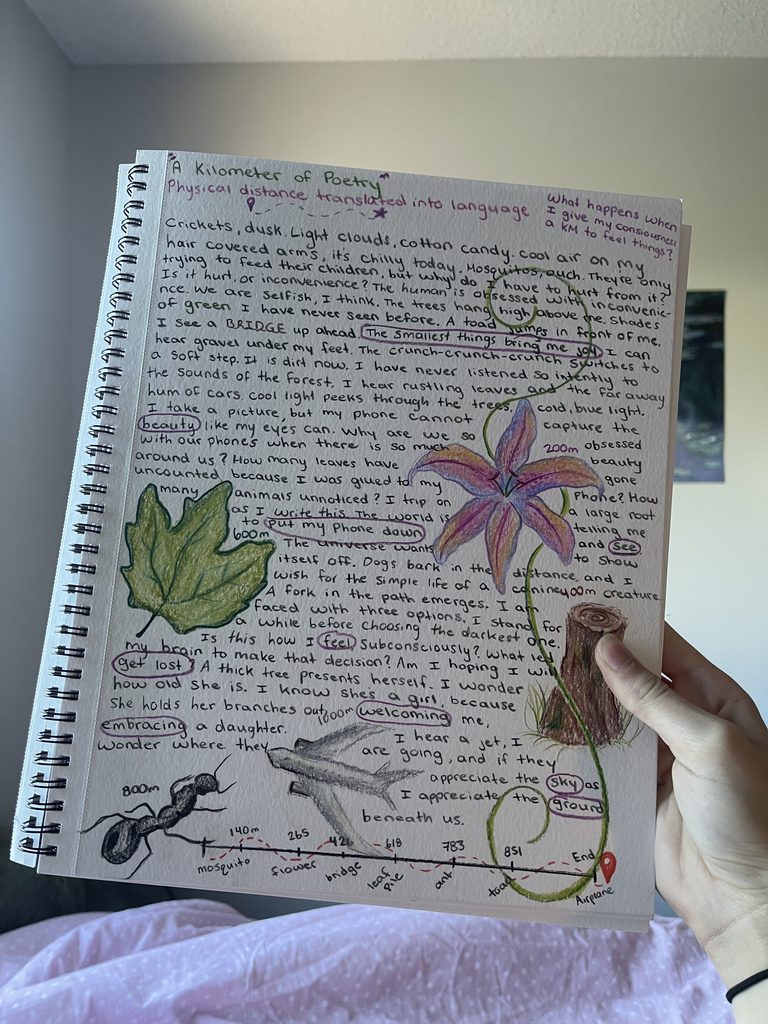
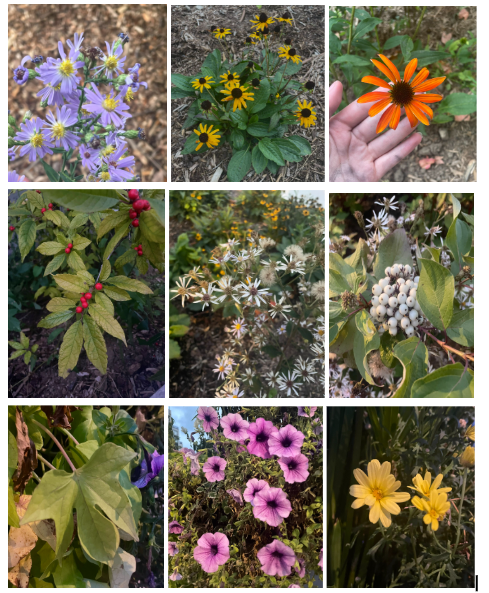
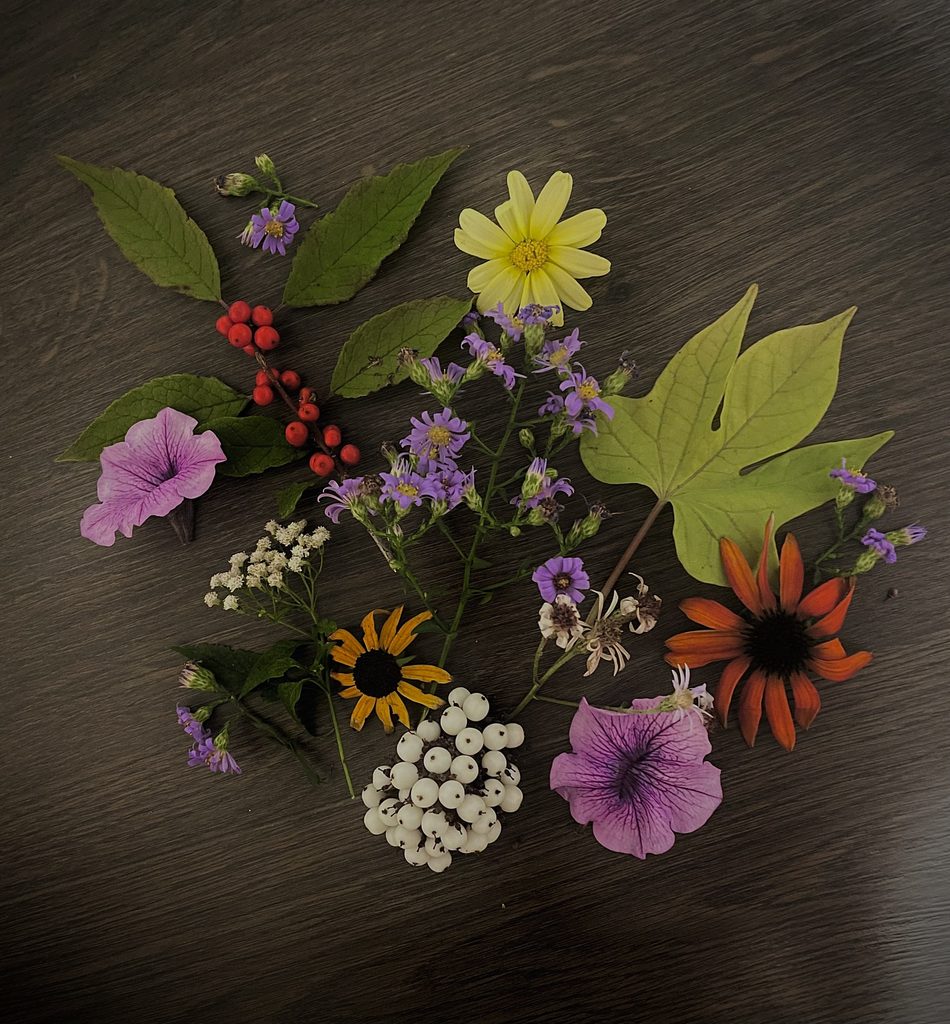
Spending time in nature feels like the default habit of maintaining a peaceful life. Most of my creative inspirations and personal breakthroughs have occurred in solidarity with plants and trees and sounds in replacement of spoken word. Florals have been a long-standing staple in my practice—out of all the manufactured beauty that we’re sold in the material world, nature possesses a sort of beauty that can’t be measured up to. I find myself using flowers as markers of time, distance, location, and experience. For this assignment I took a walk through the arboretum, and every 100 metres collected a flower or plant that helped me keep track of the journey. At the end I pressed the plants, and sewed them into a square of sheer pink chiffon material equally as delicate. Seeing these plants onto one small square of fabric helps put into perspective how small our experiences are, how fleeting the moment remains, yet their beauty remains significant to the overarching picture.
I initially had the idea for the assignment a few days before my Great Grandmother passed away. It took a while for me to realize the irony of the concept, as it gave clarity to, in very simple terms, this struggle of time passing that I didn’t realize I was at odds with. Every journey has a beginning and an end point, and the cycle continues regardless of how we feel about it. What is in our control is our perspective, and it’s important that in our (hopefully) 80 years of life, that we pay deeper and greater attention to the flowers rather than the fact that they will inevitably come to an end.
Q. 1
What are some of your first impressions of Marina Abramovic’s performance works, based on the documentary? Use an image/example of one or two works to describe aspects you admire, and aspects you might agree are problematic?
I really didn’t think I’d have much to say about Marina’s work. Over the years I’ve encountered many of her pieces, with only a small handful being remarkable enough for me to care for. Without context I was unimpressed, though the documentary has revealed that I have much more in common with Marina than I would’ve imagined. Despite our very different approaches to practicing art, I feel a certain closeness to her based on shared heritage and similarities in upbringing.
Growing up ex-Yugo, it’s often difficult to relate to people who were not raised within a similar culture. Hearing the simultaneous pain and appreciation she has for her upbringing is a staple of Balkan reminiscence, and one that feels like a read on my own life. There aren’t many famous artists from that part of the world, and so it is quite inspiring to see someone who grew up with very similar and suffocating cultural expectations, do something incredibly unorthodox.
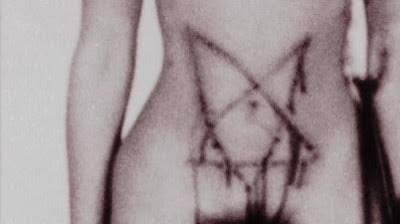
There’s one piece in particular that elicits both positive and negative emotions for me. The 1975 Thomas Lips performance where she slices the pentagram into her lower stomach and Ulay kisses the wounds I find to be equally disturbing and tender. Watching the blood pour out of her open wounds is a difficult watch for me—personally speaking, I don’t deal with gore well. The self-harm element is quite gruesome, even for performance art. It can be incredibly triggering for those who struggle with self-harm and suicidal ideation, and I don’t think it’s a matter that should be depicted in art so freely.
Regardless of the context, publicly slicing into your skin and having someone come and kiss it better is irresponsible—there are people who would see that and perceive it as romantic, something to strive for. In reality, it is quite twisted and should not be normalized as a way of achieving “raw” and “real” intimacy.
However, I do appreciate the relationship Marina forms with her audience through her works, especially The Artist is Present. It is a beautifully raw exhibition that forges a relationship between Marina and her spectators, and I cannot think of another artist capable of such a feat.
Q. 2
What have you learned about features of performance art based on Abramovic’s work? Name a few key features according to her examples. Include an image to illustrate. Consider her quote: “When you perform it is a knife and your blood, when you act it is a fake knife and ketchup.”
I watch Marina perform her art, and it is evident that the experience is raw. There is one take and no option for a redo—everything is unfolding before the eyes of the viewer to bear witness to the process of creation. While theatre maintains similar elements, the actor approaches the performance by putting on someone else’s skin, versus claiming full ownership as the person initiating the performance.
Oftentimes in theatre there is a distance between the actor and their character. It is obvious to the viewer that their behaviours and mannerisms are exaggerated, out of character, and do not entirely belong to them. While performance art is also exaggerated, the mechanisms feel intrinsic to the artist conducting them. It is a form of expression that comes from deep within, reflecting the artist’s inner world outward via its methodology.
I see this in the immediate shift in Marina’s work from her Great Wall Walk to the 2011 performance of The Life and Death of Marina Abramović. The Great Wall Walk concludes Marina’s life of extremity and performance art categorized by its physically demanding exhibitions, and in this pivotal drama she officially waves goodbye to the life she lived with Ulay for twelve years. Her theatre performances are without the physical torture and personal sacrifices that were a longtime staple in her performance art; though eventually she resumed with the vulnerable performance-art approaches, they never featured the same gore and physical hardship that her early works did.
Hi! I’m Leah and I am a second year student in Creative Arts, Health and Wellness. After school I would like to be an art therapist either in the cancer wing of a hospital or in hospice. I’m taking this course in hopes to challenge my creativity and to become more confident in thinking outside of the box, not only in art but also in my practices.
Marina Abramović: The Artist is Present
Question 1.
My first impression of Marina’s performance works was that this art is raw and vulnerable, and I wondered what inspired her art. The courage it takes to be so incredibly vulnerable to the public is truly admirable. Additionally, I admire how simple yet powerful some of her pieces are. For example, The Artist is Present where she sits in a chair in the middle of the room for 8-10 hours, allowing participators to sit with her in silence. It was so moving and fascinating to watch as something so simple could bring out such complex emotions as she said, “there was so much pain and loneliness – so many incredible things”. Leaving space for viewers to interpret art is an effortless way to give life to it because I think the mind fills in the gaps with what is familiar and by doing so creates a connection between the viewer and the piece.
Question 3.
The traditional art world assumes that an artwork is an object; something physical that you can buy, own, and display indefinitely. Performance art resists these conventions, because, though it involves something physical to look at, it is not purchasable or infinite; once the performance is over, that is it. Additionally, the artist(s) themselves are not the art, but the movement or actions in their performance and the emotions it evokes are art. Marina solves these problems by becoming the “object” herself. By sitting in silence for the duration of the show, she turns her presence into something viewers can observe, similar to how they would a sculpture. I think this compromise adds to the idea, because people are given the option to observe the performance like they would any other painting or sculpture, or they can view it from up close and by doing so they become a part of the performance and make it come alive.
Assignment 1 – A KM
An Endless Stroll – Leah Nelsons
The artwork consists of a sporadic montage of social media reel clips layered overtop of a video of a girl walking while looking at her phone in the background. There is not a definite start or end to the video as it plays in a loop; a reminder of the endless tangent we often get trapped in when scrolling on our phones.
The purpose of this artwork is to capture the numbness and dream-like state that many of us experience when we get sucked into our phones; losing our sense of time and space.
The Beginning Idea
During the brainstorming period, the first idea was to have a map of where I walked the kilometre next to a grid of screenshots that I took from all the reels I watched on my walk. Later, I thought the addition of a video of me walking while on my phone would look cool placed in the center of the two images (as shown to the right). However, as we were watching the documentary on Marina Abramović, I decided that the whole thing was far too complicated and didn’t leave enough room for interpretation.
Rough Draft - Brainstorm
By leaving it simple, my hope is if this were to be displayed in a gallery or simply outside of the classroom, viewers could have the freedom to interpret the artwork themselves rather than me spelling it out for them.
Creating the Art
As I walked the kilometre through Preservation Park, I made myself watch Instagram reels and track how long I was walking, by screen recording my phone for the duration of the walk. I did my best to keep track of how far I was walking by using my Apple Watch; in the end, I walked 1.17 km while watching 15.07 minutes worth of instagram reels (15mins 4secs).When I got back from my walk I used CapCut to trim, speed-up, and layer all of the videos.
The 1 KM Walk
As I walked through the forest, I could feel my attention getting sucked more and more into my phone and some point my mind reached a point of numbness. I took the same path back as I did on the way there, but put away my phone this time. On the walk back, I could feel my mind becoming clearer as I took in my surroundings and I realized just how much beauty and life I had missed because I was on my phone.
Walking a km was a metaphor for doomscrolling because a walk is something that can go on forever or be a short stroll. Doomscrolling is the act of scrolling social media platforms endlessly, watching mind-consuming media to the point of numbness. We need to apply the same concept to doomscrolling, in that, with enough effort we can control how long we scroll for.
Assignment 2: One Feat, Three Ways
Part 1: The One Shot
Part 2: The Sequence
Part 3: The Loop – Rotoscope Animation
Video #3 – The Loop (Rotoscope Animation) The third idea revolves around the visualization of the phrase ‘I love you.’ It is drawn differently. The heavier the emotions, the more bold and vivid the letters and colouring. The softer the phrase, the lighter and smaller the words. We focus on how the words are delivered, and how different tone can change the meaning of a sentence.
Turning the Gestures of Everyday Life Into Art – Questions
Question 1.
type
Question 2.
One example that stuck out to me was Tjan’s habit of hiding his thumbs by flattening them into his palms. Pointing out this habit made Tjan realize that he often positions himself in a way that takes up less space. I like that Tjan reflected after this project and was able to acknowledge that he does in fact tend to arrange his body so that it takes up less space. It’s refreshing that he went out of his way and bought a bright yellow jacket for himself saying, “…you can’t miss me now”. I love that he decided to change this habit and not ‘apologizing’ for taking up space anymore. It’s interesting to think just how many this work probably helped so many like Tjan to become aware of their movements and change their habits for the better.
Question 3.
One of my roommate always walks with near perfect posture and a small bounce in every step, and it intensifies depending on her mood and environment. I’ve seen her walking around campus alone before, and she just looks straight ahead focused on her destination, the small hop of her walk is smaller and portrays the image of confidence. On contrast, when she sees someone she loves (especially if it’s unexpected) she smiles brightly and the hops become more dramatic and sometimes even turning into skips. She is a warm, bubbly person, and I love how that part of her true personality still peaks through her cool, neutral mask when she walks amongst strangers.
MOCA Field Trip Assignment
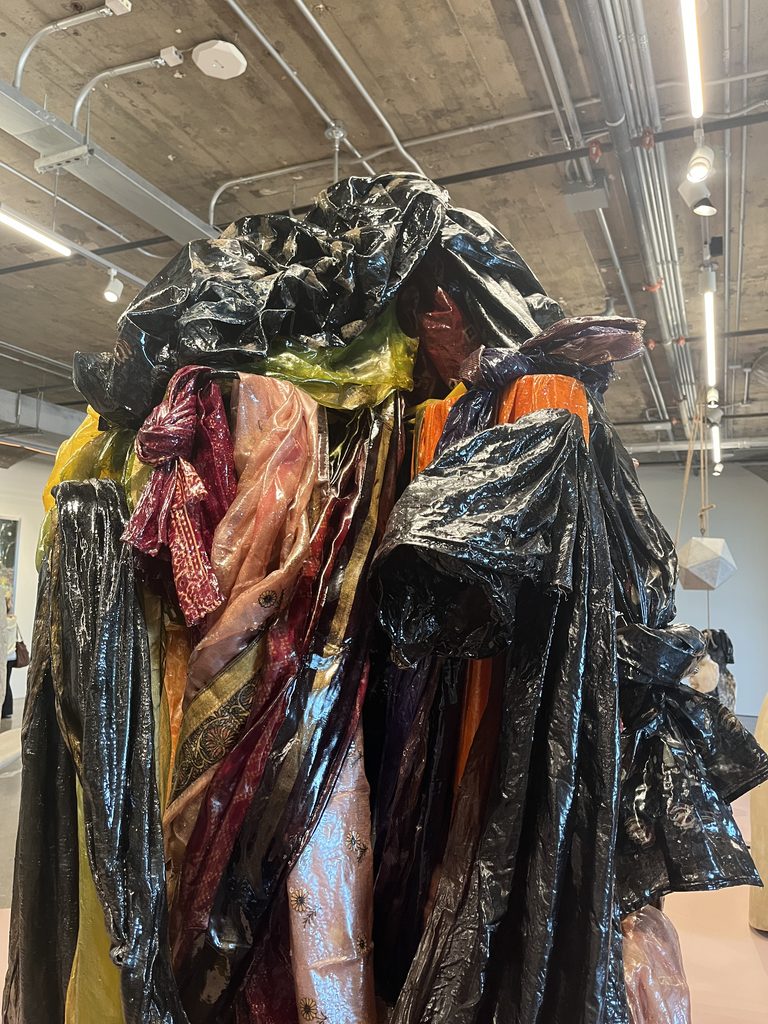
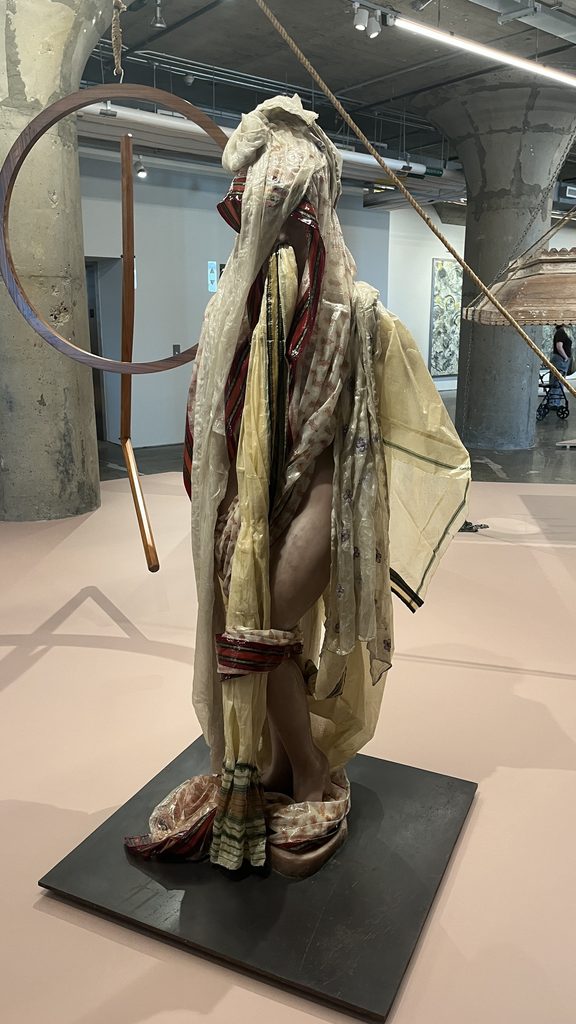
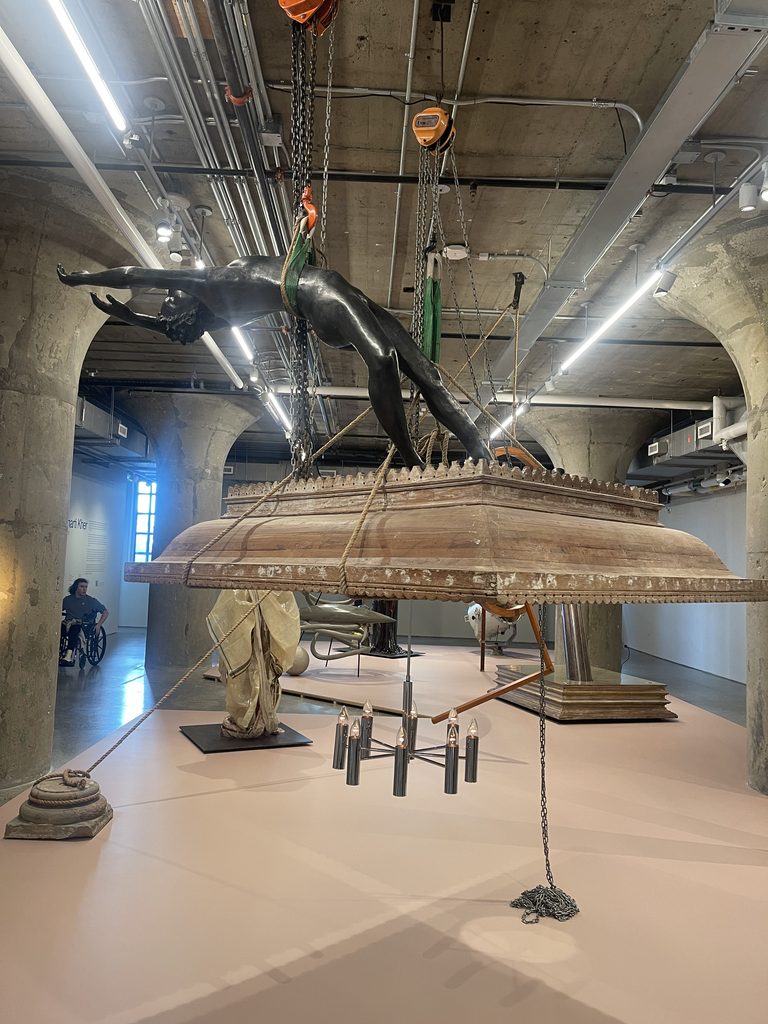
The third floor of the gallery was my favourite by far. The artist’s name is Bharti Kher and what captured my attention the most was the variety of materials and sculptures she created. Every sculpture on display was different and unique in their own way but all together there is a balance between them. Immediately when I got to the floor, I was overwhelmed by the smell of Play Dough, which through discussion with my peers, we realized was resin we were smelling not Play Dough. Bharti used resin to freeze fabric in space to create movement; those sculptures were the ones I liked the most(sculptures a. + b.).
a. Everything about this sculpture was intriguing to me. The way the human figure is suspended in air with use of the chains is beautiful. With the addition with the wooden frame and chandelier hanging underneath the figure and the chain piled on the ground; I can’t put my finger on it but something about it is so beautiful and breathtaking. I would love to know what the story is (if there is one).
b. I had very similar feelings about this sculpture as I did for sculpture a. I love the placement of the scarves over the figure. the droplets of resin dripping from the cloths was mesmerizing. I’m having a hard time putting my feelings about these sculptures into words without sounding repetitive; the best words I can find are awestruck, mesmerized, and admiration.
a.b.
I admire how she used pieces of torn-down religious buildings, like temples, and gives them a new life in her gallery. She transforms discarded rubble into pieces of art, and I think that’s a concept I might like to explore and apply to my own practice in the future.
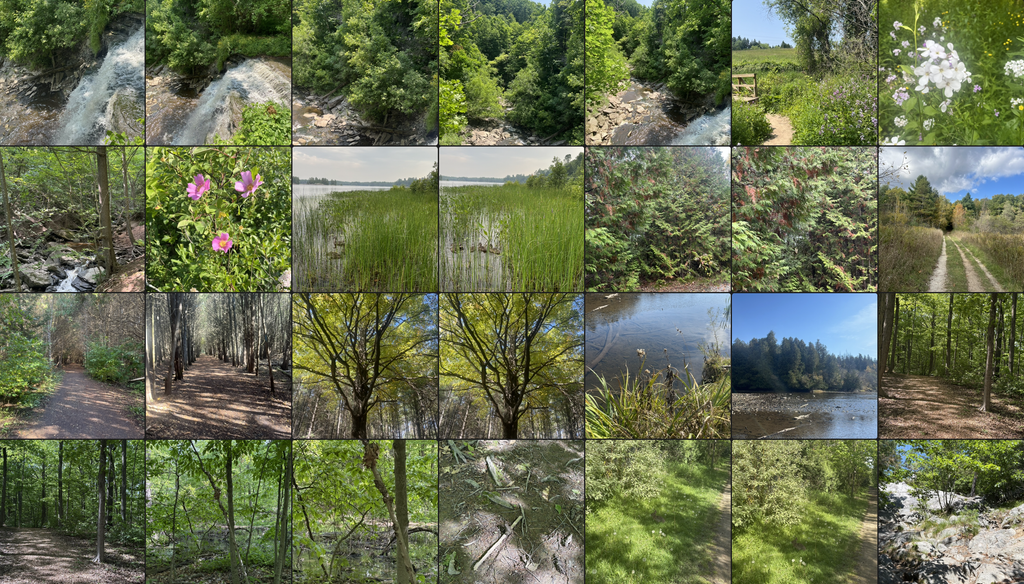
I’ve been passionate about photography for as long as I can remember. I am always the one at family events taking all the pictures and constantly holding a camera in my hand. Since photography is such a huge part of my life, I decided that for my 1-kilometre assignment, I would measure my life in photos. For part 1 of my assignment, I went on a hike with my dad and captured as many photos as I could. This walk was a 2km loop (so 1 km out and 1km back). I took 28 photos, each one showing a little part of the hike that brought me joy.
Now, don’t get me wrong, I will always appreciate taking photos on my phone, but there is something about taking pictures with my camera that makes every moment feel a little more special. Right now, the camera I love to use and take everywhere with me is my Sony ax5000. This particular camera has a 6.17 inches wide by 3.21 inches high screen. If you divide that by how many inches there are in a kilometre, you will get 6,381, and that is how many photos it will take to make a kilometre. Having only had this camera for a year and a half, I have officially taken over 8043 photos, and of those photos, I have created an album along the way of my favorites. In this album, there are so many moments of my life, from exciting to disappointing, with family or even just enjoying some alone time. But each one, to me, was worth taking a picture of. Photos are a representation of memories, moments in your life that you want to remember. Many of these pictures in my album show what makes me who I am. Often I like to scroll back through old photos just to see how far I’ve come. I consider us so lucky to live in a lifetime where we are able to capture these photos to look back on and realise that even the smallest moments can become some of the most meaningful memories.
One Feat 3 Ways
Video 1
Video 2
Video 3
What was the meaning/insperation behind our work?
For our feat, we decided to take the everyday activity of wrapping a Christmas present and push it to the extreme by wrapping an actual person instead.
We wanted our video to be funny and a little ridiculous, but we also wanted there to be a meaning behind it. Christmas is supposed to be about spending time with the people you care about, but I think sometimes we get so caught up in buying gifts, wrapping presents, and making everything look perfect that we forget what the holiday is really about.
By wrapping a person instead of a regular gift, we wanted to play around with the idea that the people in our lives are actually more valuable than any present we could buy. At the same time, as the person gets covered in wrapping paper, they slowly start to look more like an object than an actual person. I think that creates an interesting contrast between the importance we place on material things and the people themselves.
We also wanted to push the limits of something that would normally be a pretty simple task. Wrapping a box is easy because it has straight edges, but wrapping a person is completely different. We wanted to see how far we could take that ordinary action and what would happen when we actually tried to do it.
Overall, we wanted to take something familiar, make it unusual, and hopefully get people thinking a little differently about the meaning of giving gifts.
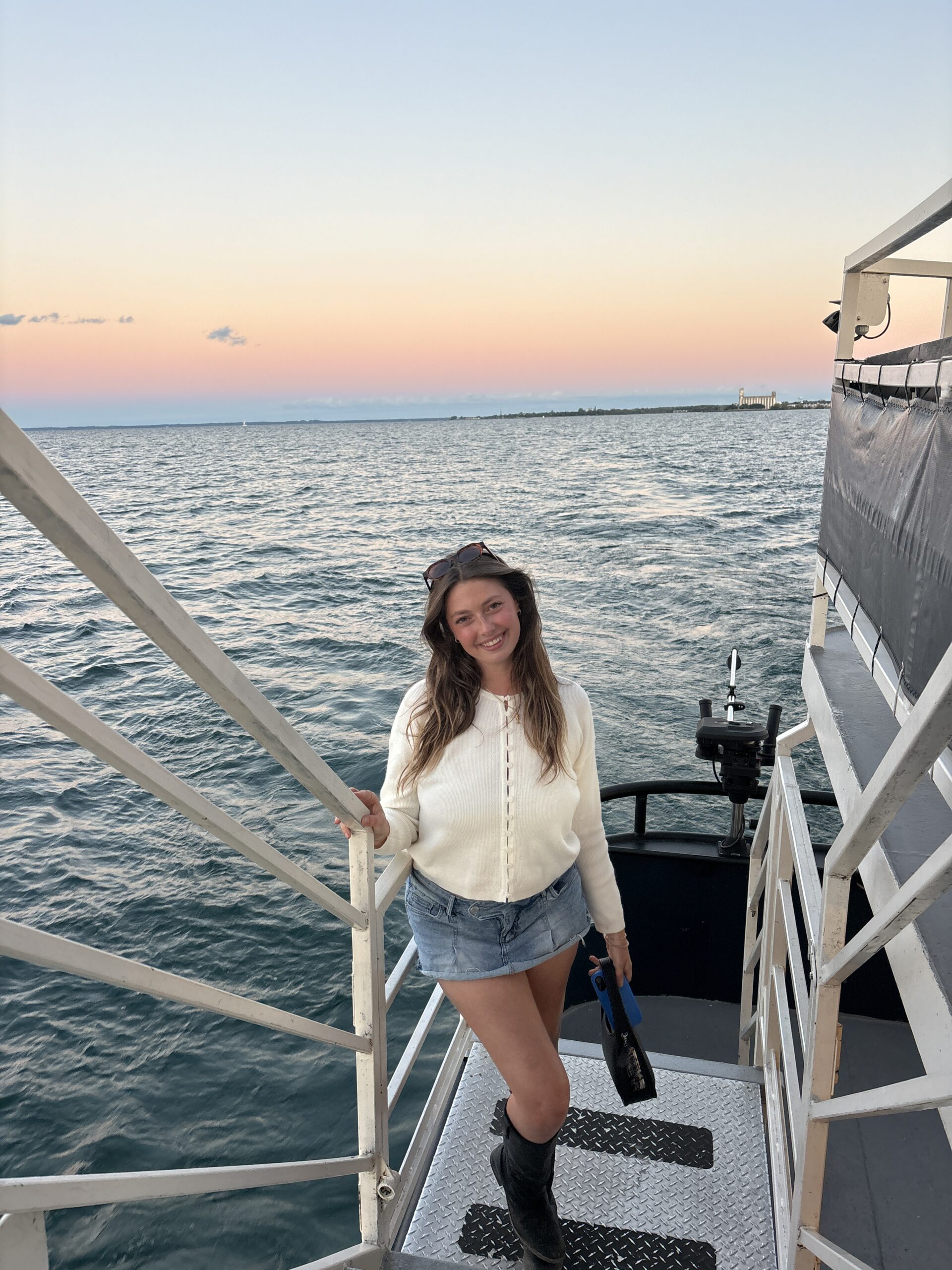
A little about me! I am in the Creative Arts, Health and Wellness program, I love the summer time, you will always find me on the water! I want to become a High school art teacher after I finish this program & a little fun fact I have a diploma in Interior Design from Fanshawe collage!
ONE KILOMETRE
At first, I thought about a kilometre as simply a measurement, but I wanted to explore it in a way that felt more personal. Since I listen to music whenever I walk, I decided to use songs as a way of measuring my kilometre. I also created a cardboard bouquet to give the project a physical form.
How I Did It
I walked exactly 1 kilometre while listening to music. I didn’t create a playlist beforehand. Instead, I let the first song I chose determine what played next. As I walked, I tracked the distance covered during each song.
The songs became different sections of the kilometre:
Cardigan – 279.7 metres
Wildest Dreams (Taylor’s Version) – 256.4 metres
All of Me – 313.5 metres
Let Her Go – 150.4 metres
Together, these songs added up to exactly 1 kilometre.
After completing the walk, I created a cardboard bouquet. Each flower represented part of the journey and became a physical reminder of the experience.
The Final Piece
For my final artwork, I created a YouTube video using an image of my cardboard bouquet and combined it with the songs from my walk. The total length of the video matches the total time it took for the songs that made up my kilometre.
Rather than showing the walk itself, I wanted the audience to experience the kilometre through sound and reflection. The bouquet acts as a visual record of the journey, while the music recreates the experience and emotions I felt during the walk.
What I Learned
What I learned is that a kilometre is not just a number or a distance on a map. It can be experienced in different ways. By measuring my kilometre through music, I started thinking about distance through time, emotion, and memory instead of just physical space.
The songs helped shape my experience of the walk, and the bouquet turned that experience into something I could see. The YouTube video brought everything together by combining the visual and audio parts of the project into one final piece.
In the end, my kilometre became a mix of sound, memory, movement, and making. Instead of simply measuring a kilometre, I transformed it into an experience that could be listened to and reflected on by other people.
This version better reflects what you actually ended up creating, rather than the original plan. It shows the evolution from the walk, to the bouquet, to the final video, which demonstrates your process and understanding of the project.
1. What are some of your first impressions of Marina Abramovic’s performance works?
My first impressions of Marina Abramovic’s artwork were that it was daring, bold, and very different from other types of art I have seen before. I felt that she was always trying to convey a deeper message to her audience rather than just creating something for people to look at. One thing I really admired was how fully she immersed herself in her work. She seemed completely committed to every performance and was willing to push herself physically and emotionally to get her message across.
Some of my favourite works were Imponderabilia, where two naked bodies stood in a doorway and visitors had to walk between them, and The Artist Is Present, where Abramovic sat across from strangers and connected with them through eye contact. I thought The Artist Is Present was especially powerful because it takes a lot of courage and strength to make yourself vulnerable in front of so many people. I also found Imponderabilia interesting because standing naked in front of that many people requires not just physical confidence but mental strength as well.
I think some of her performances could be seen as controversial. For example, some of her pieces involved self-inflicted pain, such as using a whip on herself. Viewers could see the pain she was experiencing, which can make people uncomfortable. However, I think that is also part of what makes her work powerful. The audience is not just watching art; they are experiencing those emotions alongside the artist. While some people may think her work goes too far, I believe that somebody has to push boundaries in order for art to evolve. If it wasn’t Abramovic doing it, then who would have?
2. What have you learned about features of performance art based on Abramovic’s work?
From watching the documentary, I learned that performance art is more about creating an experience than creating a physical object. The artist’s body often becomes the artwork itself, and the audience plays an important role in how the performance is experienced.
Some key features of performance art that I noticed in Abramovic’s work are vulnerability, endurance, audience participation, and authenticity. Abramovic constantly put herself in situations where she was emotionally and physically vulnerable. She also pushed herself to her limits, which showed a lot of endurance. In works like The Artist Is Present and Imponderabilia, the audience was not just observing the artwork but actually becoming part of it.
One quote that stood out to me was, “When you perform it is a knife and your blood, when you act it is a fake knife and ketchup.” To me, this means that performance art is real. The emotions, experiences, and sometimes even the pain are genuine. The artist is not pretending or acting as a character. Abramovic wants the audience to experience something authentic, and I think that is what makes her work so powerful.
3. Discuss the ways performance art resists many museum and commercial artworld conventions.
Performance art resists many traditional museum and art world conventions because it is not something that can easily be bought, sold, or collected like a painting or sculpture. A performance only exists while it is happening, which makes it difficult to preserve.
Abramovic has found ways to work around this challenge by documenting her performances through photographs, videos, documentaries, and museum exhibitions. This allows people who were not there to still learn about and experience her work.
Personally, I think these compromises add to her work rather than take away from it. Without documentaries and museum exhibitions, I probably never would have discovered Abramovic’s work in the first place. Even though watching a performance on a screen is different from experiencing it in person, I still think it helps preserve the artwork and allows more people to connect with it. I think Abramovic has done a good job balancing the temporary nature of performance art with the need to share it with future audiences.
New York Times Reflection
1. Describe the work discussed in the article and the unique challenges, as well as the unique gifts, that come with attempting to archive personal movements.
The article talks about Katja Heitmann’s project Motus Mori, which collects people’s everyday movements and habits. Instead of using videos or photos, dancers learn the movements and keep them alive by performing them. The project includes things like the way people walk, fidget, stand, sleep, or react when they’re nervous.
What I found most interesting is how hard it is to save something as personal as movement. A lot of these habits happen without people even noticing, so they can be difficult to capture. Since the dancers rely on memory, there’s also a chance that some movements could change over time. At the same time, I think that’s what makes the project special. It saves little parts of people that can’t really be captured in photos or documents. These small movements can show someone’s personality, feelings, and experiences. It made me realize that being human is about more than information and data. Even the smallest habits can tell a story about who we are.
2. Discuss one or two examples of movements in the article. What strikes you about them?
One movement that stood out to me was Mahat Arab’s habit of cracking the knuckles on his left hand when he feels anxious. This caught my attention because I think everyone has some kind of nervous habit. We usually don’t think of these habits as part of our identity, but they can actually say a lot about us. It also made me think about the little things I do without realizing it.
Another example was Chandra Merx’s habit of raising their eyebrows when rushing or lost in thought. I usually connect raised eyebrows with being surprised, so it was interesting to learn that the same movement can mean something different for someone else. It made me realize that body language can be very personal, and the same gesture can have different meanings depending on the person.
3. Describe the habitual movements, unconscious gestures, tics, etc. of 3 people you know well.
One person I know is always tapping their foot when they are concentrating. Their legs bounce under the table, and they lean forward when they’re focused on something. Their faces usually look serious while they’re working. To me, it seems like the movement helps them concentrate and keep their mind active.
Another person I know always plays with their hair when talking. They keep tucking it behind their ear without even noticing they’re doing it. They also tilt their head when listening to people. These little movements make them seem interested in the conversation and easy to talk to.
The third person often crosses their arms when they’re thinking about something. They become really still except for small changes in their posture. Their eyebrows pull together while they think. Some people might see crossed arms as a negative thing, but because I know them well, I see it as a sign that they’re carefully thinking things through.
After reading this article, I started paying more attention to the little movements people make every day. They might seem unimportant, but they can reveal a lot about someone’s personality and the way they move through the world. What I liked most about Motus Mori is that it focuses on things people usually overlook and shows that even small gestures can be meaningful.
Field Trip Blog Post
Location: Art Gallery of Guelph (AGG)
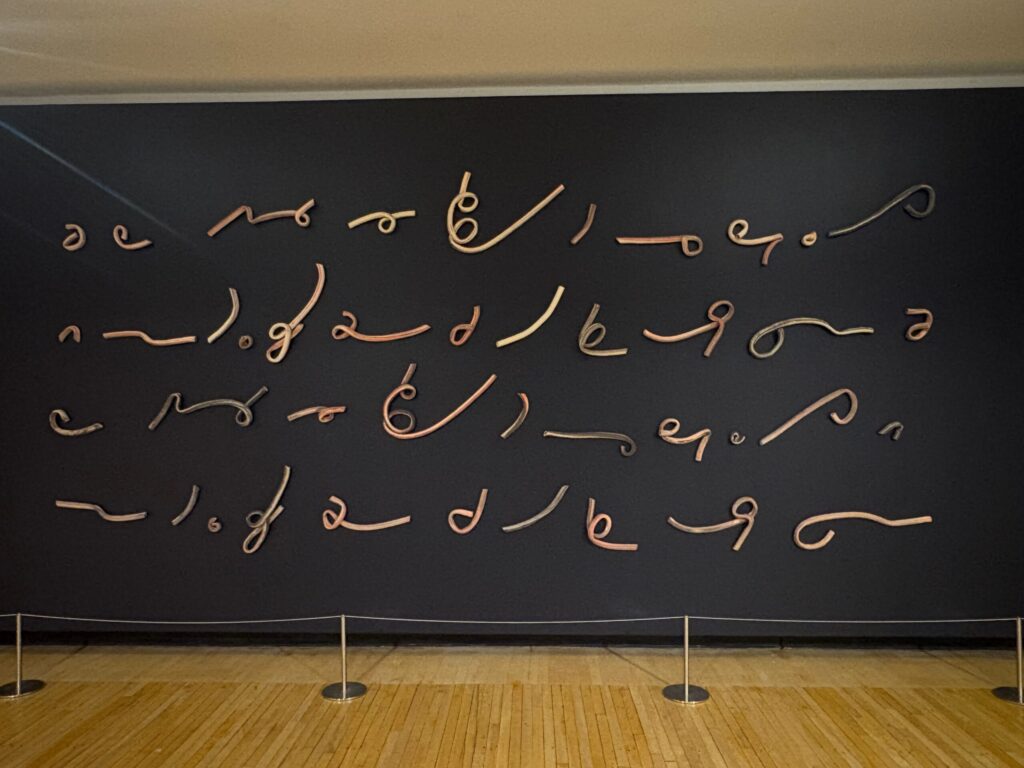
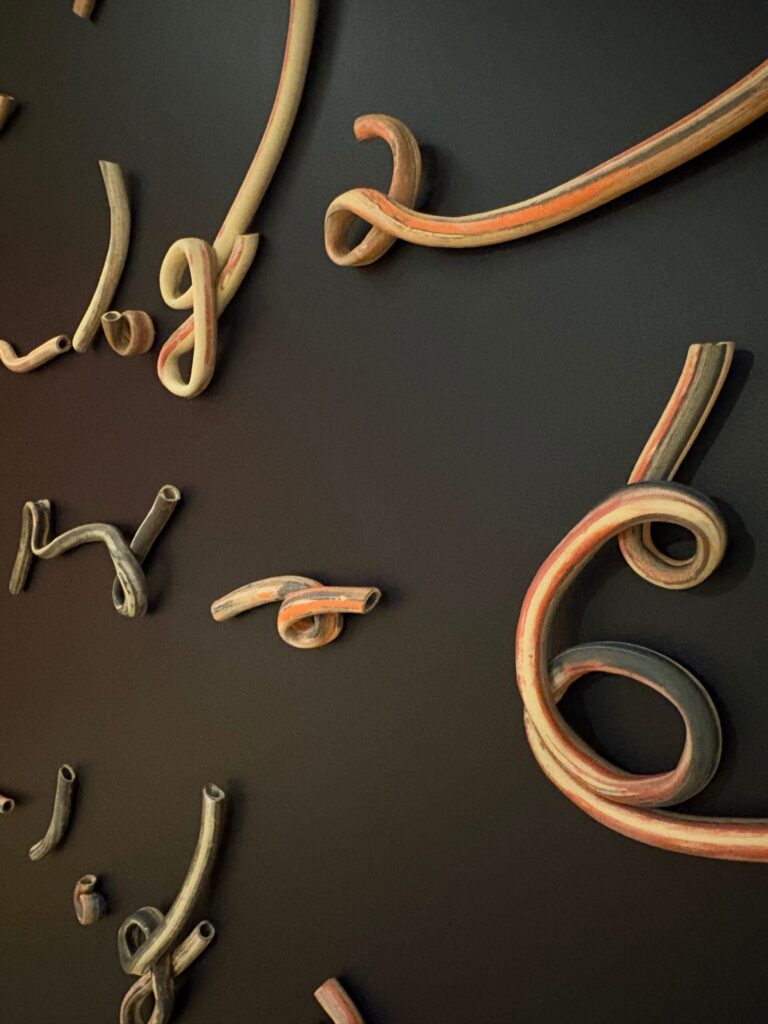
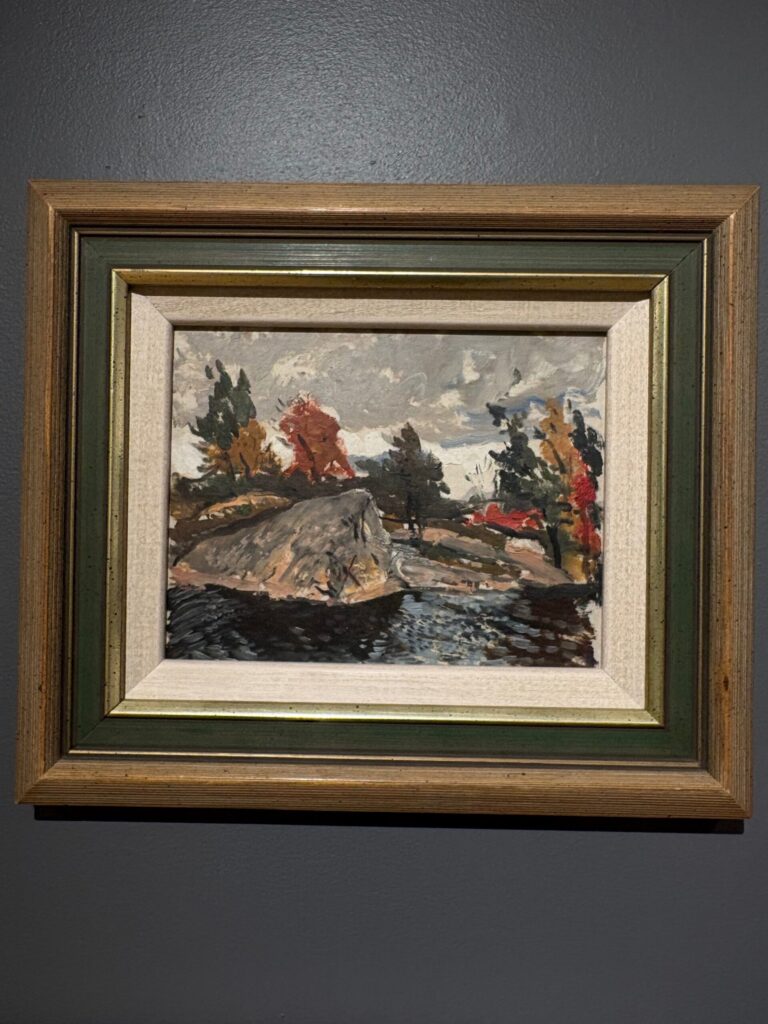
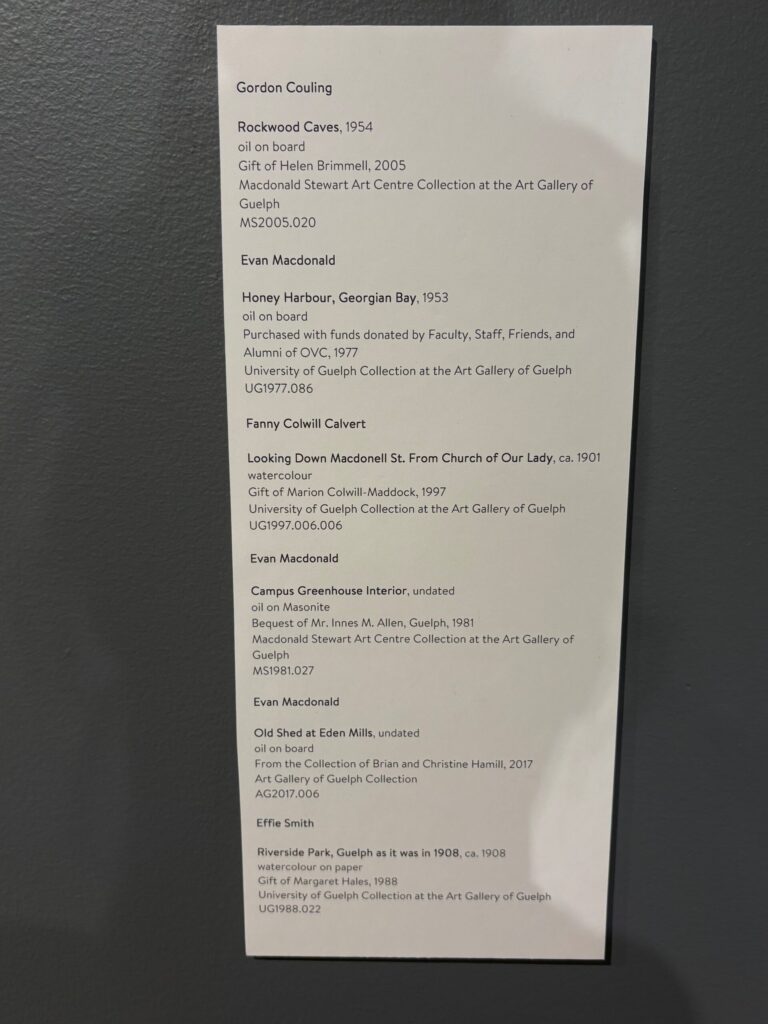
For this field trip, I visited the Art Gallery of Guelph (AGG), located beside the University of Guelph campus. While exploring the gallery, two artworks stood out to me: Nadia Myre’s Nothing by Accident (2024) and Evan MacDonald’s Honey Harbour, Georgian Bay (1953). Although these works are very different, both created meaningful experiences and encouraged me to reflect on history, memory, and personal connection to place.
Artwork 1: Nothing by Accident (2024) by Nadia Myre
The first artwork that caught my attention was Nothing by Accident. What initially drew me to the piece was the incredible amount of detail and the unusual way it was displayed across the wall. At first, I did not know what the installation was made of, which made me even more curious. The ceramic forms stretched across the dark wall like a language or code, and I found the placement of each piece especially interesting. Every shape seemed carefully positioned, creating a sense of movement and rhythm throughout the installation.
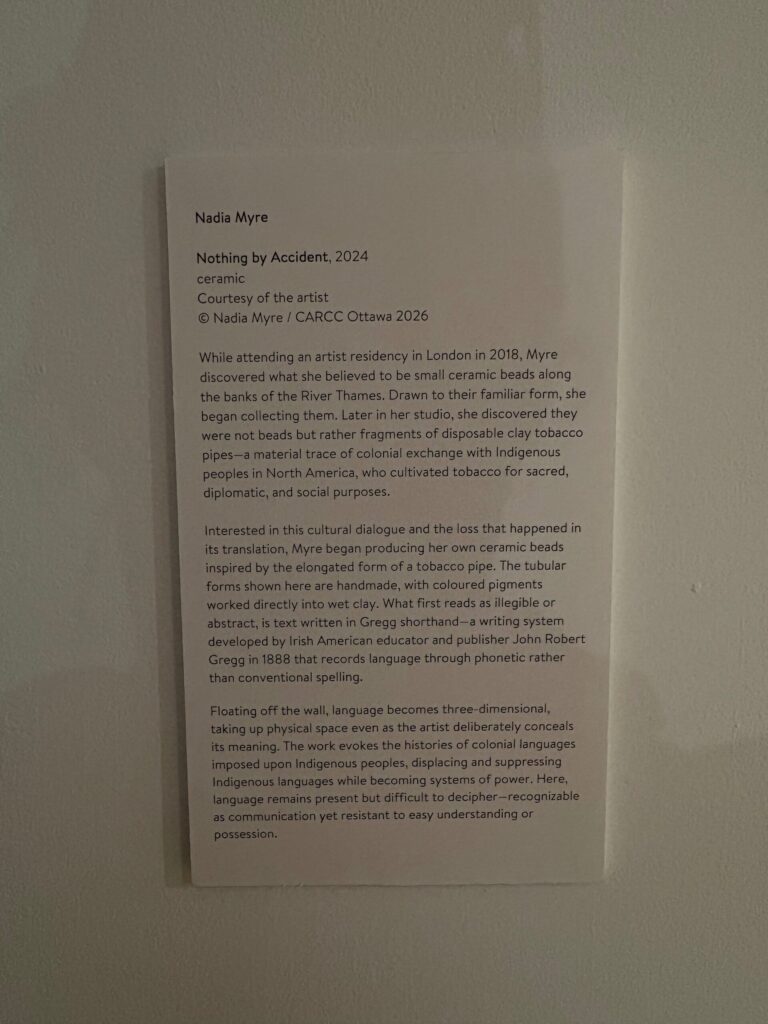
As I stood looking at the artwork, I kept wondering what the artist was thinking about while creating it. I thought about where the inspiration came from and what each individual form might represent. After reading about the artwork, I learned that it explores language, colonial history, and Indigenous experiences. Understanding the meaning behind the work made me appreciate it even more.
What I noticed most was that the artwork looked like writing, even though I could not read it. This made me think about how language can connect people while also creating barriers to understanding. I learned that art does not always need to be immediately understood to be meaningful. Sometimes the experience of questioning and reflecting is what makes the artwork powerful.
This work is relevant to my own interests because I am interested in how art can communicate ideas and emotions. I enjoy art that encourages viewers to think deeply and create their own interpretations. Nothing by Accident showed me how materials, placement, and form can tell a story without relying on traditional images or words.
Artwork 2: Honey Harbour, Georgian Bay (1953) by Evan MacDonald
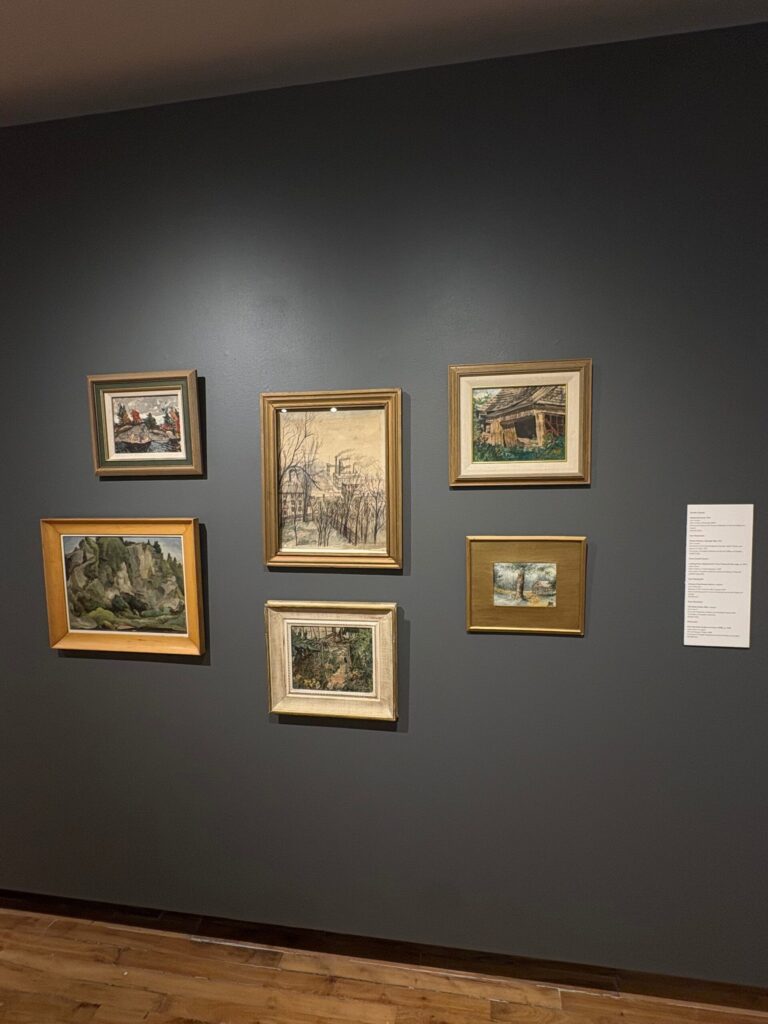
The second artwork that caught my eye was Honey Harbour, Georgian Bay. I discovered this painting near the end of my visit on the second floor, where several landscape paintings were displayed together. As soon as I saw it, something about it felt familiar.
The painting immediately reminded me of Honey Harbour, a place I have visited many times while spending summers with friends and family friends at their cottages. Looking at the painting brought back memories of being out on the water, sitting in a small fishing boat with my lure dragging behind me. I remembered the feeling of the wind in my hair and spending long summer days enjoying nature.
What stood out to me most was the rocky shoreline. The rocks, trees, and water looked very similar to what I remember seeing during my visits. The moment I looked at the painting, I felt a strong sense of comfort and familiarity because it represented a place I had personally experienced. It was almost like looking at a photograph from one of my favourite memories.
This artwork is relevant to my own interests because it demonstrates how art can preserve places and memories. It reminded me that landscapes are more than just scenery. They hold personal experiences, emotions, and stories. Even though the painting was created many years ago, it still connected with my experiences today.
From this artwork, I learned that art can create powerful emotional connections. A simple landscape painting was able to transport me back to meaningful moments spent with people I care about. It reminded me how strongly places can become connected to memories.
Reflection
My visit to the Art Gallery of Guelph was a valuable experience because both artworks encouraged me to think in different ways. Nothing by Accident challenged me to think about language, history, and communication, while Honey Harbour, Georgian Bay connected me to personal memories and experiences.
The biggest takeaway from this gallery visit was that art can have different meanings for different people. Some artworks teach us about history and culture, while others help us reconnect with important memories and places. Both pieces left a lasting impression on me and showed me how art can inspire curiosity, reflection, and emotional connection. Through this experience, I gained a greater appreciation for how artists communicate ideas and how viewers bring their own experiences and interpretations to a work of art.
One Feat 3 Ways
Reflection
For this project, our concept was The Sound of Movement. Our feat focused on the connection between music and movement. We invited participants to walk into the frame, put on a pair of headphones, and dance or move freely to music that only they could hear. When the music stopped, they would walk out of the frame and the next participant would enter. An important part of our concept was that the audience could not hear the music. Instead, viewers only heard the sounds created by the body and movement, such as footsteps, clothing shifting, and other subtle noises. This encouraged the audience to focus on the gestures and movements of each participant rather than the music itself. I wanted viewers to imagine what song each person might be listening to based on the way they moved. The project explored how movement alone can communicate personality, rhythm, and energy.
Creating the project in three different formats helped me understand how the same idea can be transformed through different approaches to video art. The one-shot video focused on performance, framing, and allowing the action to unfold naturally without editing. For our sequence video, we wanted to build on the feedback we received during our critique. We were encouraged to use more editing techniques, so we experimented with a variety of tools in DaVinci Resolve. We used split screens, mirrored effects, trimming, picture-in-picture phone frames, and additional footage that was not included in the one-shot version. We wanted the final edit to feel fun, energetic, and visually engaging. The sequence reminded me of a Just Dance video or a dance music video because of its fast pace, colourful edits, and moments of comedic relief. For the rotoscope animation, Xavain drew the dancing character approximately 95 times, and we turned the drawings into a stop-motion animation. We also used cropped photographs of each participant and arranged them into a colourful pop-art grid inspired by Andy Warhol. I learned that repetition and looping can make an ordinary gesture feel much more interesting and expressive.
One of the biggest challenges we faced was during filming. Our first recording was filmed vertically and used a different performer, which did not fit the assignment requirements, so we had to reshoot the project. Although this was frustrating at first, it ultimately improved our final result. We found two new participants, improved our lighting, adjusted our focus, and received help with our camera setup. We were also able to film using two different cameras, which gave us more options when editing. Looking back, I think one of our greatest strengths was our willingness to experiment and respond to feedback. If I were to do the project again, I would spend more time planning camera angles before filming and continue exploring more advanced editing techniques. Overall, this project changed the way I think about video art. I learned that even a simple action can become meaningful when it is repeated, edited creatively, and viewed through different formats. It showed me how sound, movement, performance, and looping can completely change the way an audience experiences a gesture.
A third year student enrolled in the Creative Arts, Health, and Wellness program. I transferred from Fanshawe College’s Fine Arts program. My goal is to become an Art Therapist who specializes in trauma and spirituality.
ARTWORK THEMES: living with disabilities, healing, transformation, spirituality MEDIUMS: digital illustration + animation, gestural abstraction painting, abstract wooden sculpting and musical instrument making (HARPS)–which is an endangered crafting skill!!! https://heritagecrafts.org.uk/categories-of-risk/ INTERESTS: Nature, history, baking, games (Stardew Valley, Baldur’s Gate 3, Mario Kart)
____________________________________________
KILOMETRE ASSIGNMENT
Julie Cracknell, Acid’s Crackle, 2026, digital animation, 1920p x 1080p
YouTube link is below if the embedded media is not working. Sadly, it’s a lower quality compared to the source material.
ARTS & SCIENCE
My animation conveys 1 kilometre with the combination of the visual of a lightning strike and the delayed audio of the thunder.
The sound of the thunder plays at 2 seconds and 27 frames after the flash of light on the screen, showing the amount of time it would take for the sound of the thunder to travel one kilometre from its point of origin to the listener.
The reason frames are relevant is because I was using Adobe Premiere Pro to edit, and time code is written in the format of Hours:Minutes:Seconds:Frames; the flash happened at 00:00:02:00 and the sound plays at 00:00:04:27. Since my video is in 30 fps, 27 frames is equal to 0.9 seconds. (30 x 0.9= 27)
IDEA
When brainstorming for ideas I glanced into my closet at wooden harp that I made last year (see below). Then I asked myself, “How fast does sound travel?” After exploring ideas of playing my harp live, I also asked myself; do I preform live or do I film; or do I want to visually show the idea to people in a different way? Then the idea of a lightning animation came to mind.
Julie Cracknell, Soothing Sugarwind, 2025, maple wood + metal harp string kit
MEDIA
Being there was no thunderstorms currently in our area to record, I had to come up with an idea of how to convey my concept. Animation felt like the best way to do this with the time and materials I had available.
I didn’t want to use a royalty free video of a lightning strike because it lacked my artist fingerprint. There needed to be something visual that said something about me. (I LOVE TREES ♥) So, I created a flat layered image that was inspired by Japanese wood block printing.
TROUBLESHOOTING It was my intention to create this whole project with the program Clip Studio Paint Pro. It’s similar to Photoshop, but is geared more towards illustration, comic book design, and animation. After I had created the background image, I was ready to animate the lightning strike, or so I thought. The animation timeline was not allowing me to extend the video’s duration. It was stuck on frame 24! If I cannot create more keyframes, I cannot draw animation still images.
After a frustrating amount of time, I finally found the answer online. There are three versions of the program: Debut, Pro, EX. I had Pro. EX was the version that allowed you to animate longer than 24 frames. Which equals to one second if your video settings are 24 frames per second. Not enough time for the lightning animation and sound delay considering the math I did above.
After consulting my wife, she recommended that I use Premier Pro to animate it. I was so disappointed and angry with myself that I could not animate it the way I originally wanted to. My wife reminded me that I had to take it easy on my mind and body this week. Listening to her sage advice I locked in and was successfully able to finish my project!
____________________________________________
Marina Abramović The Artist is Present
1. What are some of your first impressions of Marina Abramovic’s performance works, based on the documentary? Use an image/example of one or two works to describe aspects you admire, and aspects you might agree are problematic?
When I was first exposed to Marina’s work her performance art didn’t connect with me at all. Like with all art mediums, not everyone is attracted your art style or is able to understand your message. Her performances evoked emotions of unease, sadness, and a little confusion. Generally, that’s not the type of art I enjoy or look for.
Marina Abramović and Ulay, Imponderabilia, 1977/2010
Yes, I understand that for Imponderabilia that was the point. Allowing people squeeze between Marina and Ulay’s nude bodies puts people in an uncomfortable situation physically, mentally, and emotionally. It was a simple yet powerful performance from both of them. I respected the bravery and appreciated the ingenuity. However, it wasn’t the type of art that resonates with me.
Her past works may seem problematic because often the visuals are so striking that people get caught up in that and are unable to process anything else. The public sees nudity and assumes the artist doesn’t have the same morals or ethics are they do. Thus, their message is not worth listening to. It’s a little sad, because there is a lot you can discuss about her work. Such as her choice of medium (herself), the setting, intended message versus received, and the objectification of the female body.
After watching The Artist is Present a few times, I asked myself, “How would I feel if my past partner did that during my performance?” My emotional reaction was similar to Marina’s—well I assume a little—looking at her subtle facial expressions. The surprise, joy, grief, gratitude, and pain. All the memories flooding back at once would be overwhelming.
Marina Abramović, The Artist is Present, 2009 Marina Abramović, red dress, two chairs and table (Ulay sitting on the right)
2. Discuss the ways performance art resists many museum and commercial artworld conventions. How does Abramovic solve/negotiate some of these challenges, and do you find these compromises add to, or undermine the ideas at play in her work?
Marina’s is able to resist traditional museum and commercial artworld conventions because her work does not have a lasting physical presence. Her performance with her body is the work in the moment it is presented. It cannot be easily bought, auctioned, or revisited like a collectable on display at a museum.
She negotiates these challenges by having herself be filmed, photographed, and documented. Thus, allowing her performance to have a longer stage presence. This gives her work an opportunity to be viewed by a larger audience. Plans like these help document the spontaneity of the moment that would otherwise have no evidence of existing.
I think there is a little play with her work with how its main attraction is to be seen in person for a limited time, while also being documented. Her art seems to resist control by the very institutions she often performs in. It causes the viewer to stop, think, and question trained thought patterns, and I enjoy that.
____________________________________________
Assignment 2: One Feat, Three Ways Video Project
Video 1: The One-Shot
Video 2: The Sequence
Video 3: Rotoscope Animation Loop
Assignment Overview
The objective of this project was to create three videos exploring a movement-based feat: one long shot, two sequences, and three rotoscope loops. The assignment required me to experiment with filming, composition, lighting, video editing, and animation while working within the limitations of my available equipment, space, and resources.
As a mature art student with the long-term goal of becoming an art therapist, I approached this assignment as an opportunity to explore movement as a form of visual expression. However, the process proved more challenging than I anticipated. Although I encountered several technical and practical obstacles, I gained experience in problem-solving, adapting my original concept, and exploring different approaches to digital animation.
Media and Equipment
Technical equipment:
Canon SLR camera
Tripod and microSD card
Portable lighting kit and natural sunlight
iPad
Windows PC and monitor
Adobe Premiere Pro
Props and materials:
Table
Mason jar and lid
Tap water and ice
President’s Choice instant espresso coffee
Performer: Scarlet Flowers
Location: My living room – filming space.
Filming Process & Development
The project involved three filming sessions. My initial concept explored repetitive rocking as a form of self-soothing. I wanted to capture a movement that could communicate discomfort and the instinct to seek comfort through physical repetition. Unfortunately, the resulting footage did not convey the idea as good as I had hoped.
We attempted the concept again during a second filming session, but the results remained the same: lacking. I questioned whether the difficulty came from my direction, the performer’s unfamiliarity with the movement, or the concept itself. As the deadline approached, the repeated attempts became increasingly stressful, and I realized that I needed to reconsider my idea.
During the third session, I collaborated with Scarlet to develop an alternative concept. My initial idea was to film her whisking heavy cream into whipped cream. Having previously worked as a professional baker and cake decorator, I was drawn to the repetitive physical movement and the visual transformation of the ingredients. However, we recognized that our limited supply of cream would restrict the number of takes we could afford to make.
Scarlet then suggested filming the way she makes instant coffee at home by shaking the ingredients in a Mason jar. Since we had sufficient instant coffee to accommodate multiple takes, we agreed to this alternative and began filming. I appreciated her contribution, as it allowed us to move forward with a practical solution that suited our limited resources.
The coffee-making process provided several distinct movements and materials to explore, including the addition of water, ice, and coffee powder, followed by shaking the jar. These actions offered opportunities to capture movement through live-action footage and animation.
Editing, Sequencing, and Animation
During post-production, I explored different ways of combining footage and animation to create visual interest. For the second video, I incorporated stop-motion animation using coffee grounds alongside shots taken from my long-shot video. My intention was to combine the recorded movement with a more tactile, experimental element created from the coffee grounds.
However, I was uncertain whether I had structured this second video correctly according to the assignment requirements. I understood that I needed to create sequences, but I was unsure whether combining stop-motion animation with footage from the long shot was the intended approach. Although I made a creative effort to integrate the different elements, I cannot say with complete confidence that the final sequence met the assignment’s expectations.
The rotoscope loop component was the most enjoyable part of the project. I found digital animation on the iPad considerably faster than working on paper, and I enjoyed experimenting with the process. I also added sound effects to imitate the ice, water, and coffee powder moving inside the jar. These sounds helped emphasize the physical qualities of the movement and added another sensory dimension to the animation.
Technical Challenges and Troubleshooting
Space and composition: My living room was small, which restricted my ability to position the camera and frame the performer as effectively as I would have liked. Because Scarlet is tall and the ceiling has a bulkhead beneath an air vent, I could not tilt the camera down very far without including too much of the floor. Also, I had limited control over the negative space above her head. With more room, I would have preferred a composition with greater breathing room and a more balanced frame.
Lighting and colour correction: The portable lighting kit contained only two lights, making it difficult to achieve even illumination across the background. The left side appeared cooler in colour temperature than the right side. I used the available lighting and natural sunlight as best I could, but the uneven illumination remained visible in the footage.
During post-production, I tried to correct the colour temperature and shadows in Adobe Premiere Pro. However, I was met by difficulties masking specific areas of the background independently. When I tried to create additional masks, the adjustments affected the settings of existing masks. I was also unable to isolate the shadow of a kitchen cupboard visible on the right side of the background as well as I had intended. I chose to focus on balancing the overall colour temperature on the left side of the frame rather than continuing to try corrections that I couldn’t correctly fix.
File transfer and software limitations: Transferring footage between my Windows PC and the iPad was another unexpected challenge. I initially tried downloading applications that would allow me to transfer files between the two devices, but these attempts were unfruitful. Eventually, I uploaded the MP4 video to Dropbox and downloaded it through a browser on the iPad. Although this solution worked, the process was less straightforward than I had had in mind.
Costuming and continuity: An unexpected incident occurred during an early practice take when Scarlet accidentally spilled water from the Mason jar onto her shirt. Because this was a practice run, the instant coffee had not yet been added, so the footage could not be used. Although her expression during the incident was amusing, the water stains remained visible on her shirt during the subsequent filming.
____________________________________________
Blog Post 2
Zoey Poll, “Turning the Gestures of Everyday Life Into Art,” The New York Times, November 21, 2022.
Questions
1. Describe the work discussed in the article and the unique challenges – as well as the unique gifts- that come with attempting to archive personal movements?
2.Discuss one or two examples of movements in the article – what strikes you about them?
3. Describe the habitual movements/unconscious gestures, tics etc. of 3 people you know well. How do individual body parts move, and how does the whole body interact? What about facial expressions, and emotional valence of the movement? How does body type inform the
movement? What do these examples of small movements mean and imply?
Answers
1. Katja Heitmann’s Motus Mori, meaning movement that is dying out, is an ongoing dance project that collects and preserves the small, often overlooked movements that make everyone special. It could be habits such as cracking knuckles, raising those bushy eyebrows, fidgeting, walking, sleeping, and changing the bodies stance. Since 2019, Heitmann has collected the movements of more than one thousand people!
One challenges in this work is change. People may self-correct their behaviour when they know they are being observed, presenting a socially accepted and idealised version of themselves instead of just being themselves. The dancers must build trust with people to learn their genuine movements. The most beautiful part of this project is that it treats ordinary movements as meaningful expressions of individuality. A minor habit can reveal someone’s personality, insecurities, emotions, and experiences in life.
I find the idea of a living archive very sweet and moving because it preserves something that written records cannot fully capture: the physical presence of a person. A person’s gestures may seem unimportant while they are alive, but after they are gone, these small details can become precious reminders of their individuality. The project also makes me question how much of our identity is expressed through our bodies without our conscious awareness—especially for people with disabilities.
2. Example 1: Mahat Arab cracks the knuckles of his left hand when he feels anxious, while driving or talking on the phone. This repetitive movement is an example of how emotions can become physical habits. I too fidget while stressed and driving. A lot of people fidget/repeat various movements when they feel nervous, and often others and themselves don’t even notice it. It also reminds me of stimming for people who are overstimulated and need comfort. Yet, for Arab, his habit is distinctive enough to become part of his identity.
The project also changes how he understands his own body. Seeing his movement reproduced by a dancer gives him a new understanding and ownership of it. Rather than viewing his knuckle cracking as a nervous habit, he recognises it as something unique to himself. I find this interesting because it shows how our unconscious gestures can reveal emotional states that we might not outwardly express. The movement becomes a record of anxiety, but it is also a characteristic that could be accepted rather than hidden and shamed.
Example 2: Ranti Tjan discovered that he tended to shift his body to occupy less space. One detail that surprised him was his habit of hiding his thumbs by flattening them against his palms.
Tjan was unaware of a movement that reflected a broader pattern in how he presented himself physically. His posture spoke to a tendency to make himself less noticeable, even though he held a respectable position. Tjan’s movements suggest that the body can communicate aspects of self-confidence and social behaviour that we may not consciously recognise. A small movement of the hands can be part of a much larger pattern of how someone occupies space and presents.
3. I tend to pick up on subtle behaviours more so than the average person. I consider it an evolved survival trait from my childhood, due to not being a consistent safe and secure environment. However, it has transformed since then to also assist me with my endeavors of becoming an art therapist. It may assist me to gain a better understanding a person from their physicality, rather than from their words alone.
Example 1: Scarlet, my wife, tends to have a droopy energy to her sometimes. It can be seen in her eyes, upper torso, and how she completes her work. When she’s having life challenges it becomes much more noticeable, with how lethargic her body language becomes. It’s as if her vitality has left her. On the plus side, when that happens, I’m always there to step in and support her when I notice it.
Example 2: Pia, my friend, has a unique energy that makes me consider them an Earthbender with the way their body’s stance holds firm, how they carry themselves in an anxious conversation: it’s as if they are a tiny solid rock. Round, strong, unmoving, grounded to the Earth. For the untrained eye, there is a fire there as well that drives this spirit forward. Example, they enjoy dancing.
Example 3: Myself. I too have a grounded energy to my presence. Not solely based on my weight, but my body language as well: slow, intentional, strong, and stable. When it comes to the mind though, it translates in other types of subtle and not so subtle movements. I bite my nails when I feel anxious or bored, I touch my face to sooth and brace myself, and if I smell any strong perfume/cologne that I am sensitive to you’ll immediately see my facial muscles tense up.
____________________________________________
FIELD TRIP
Create a FIELD TRIP blog post illustrating, describing and responding to two art works. How are these works relevant to your own research interests and practice? What did you notice, learn, or take away from the experience of the works in the gallery?
Location: Woodstock Art Gallery, Woodstock, Ontario
Artwork 1: Peanuts featuring “Good ol’ Charlie Brown”
Artist: Charles M. Schulz Date: n.d.
Seeing the original Peanuts comic layouts upstairs was exciting! Being someone who has drawn comics in the past and has always been a fan of the series it was a fun surprise to see. One of the first things I noticed was how much larger the original page layouts were compared to the comics we see in books.
The white-out corrections and editors’ notes about spelling and grammar was fun to see. It was nice that even a famous comic artist went through revisions before publication. Art doesn’t have to be perfect from the beginning. There is a process behind the final product.
This reminded me of my own experience drawing comics. In 2017 I was inspired by Peanuts and Steven Universe and drew the image below. Seeing Schulz’s original work made me want to draw comics again. I also enjoyed seeing how his drawing style evolved from the 1950s into the 1960s while maintaining its recognizable look.
The gallery’s interactive art stations, where visitors could trace Peanuts characters using light tables, were another highlight. Overall, this experience reminded me to embrace experimentation and revision in my own practice and inspired me to enjoy comics again.
Artwork 2: Beams
Artist: Lou Palmer (Canadian, 1929–2019) Date: 1977 Medium: Watercolour on paper
Downstairs, in the permanent collection, Lou Palmer’s Beams immediately caught my attention. I am always drawn to landscape paintings, particularly those featuring nature, plants, and foliage. Palmer’s mastery of watercolour amazed me. The precise perspective, balance of warm and cool tones, and photorealistic details were amazing.
As someone who enjoys working with wood in my sculptural practice, I was drawn to the old wooden timbers. They made me wonder about the building’s history. Was it a barn, a mill, or an old factory? The painting captures a moment in time that makes you think about the past, present, and future all at once.
Seeing this work reinforced my appreciation for watercolour and its ability to capture the fine details of architecture and nature. From an artist’s perspective, it was clear that Palmer was a master of his craft. The painting also reminded me to consider the textures, histories, and stories that materials can communicate in my own work.
Summary
Both artworks offered different perspectives on my artistic practice. The Peanuts collection reminded me of the importance of process, experimentation, and developing a personal style. While Palmer’s Beams highlighted the beauty of craftsmanship, material, and careful observation.
This visit inspired me to maybe get back into comic-making and reconnecting with natural materials. Also, it reminded me that inspiration can come from the smallest details, whether it is an editor’s note on an original comic or the weathered texture of an old timber.
Hi everyone! I’m a (nearly) 21 year old second year student from California studying Studio Art with a minor in SXGN. I use she/he pronouns, and am mixed race, queer, trans, disabled, and neurodivergent. I love illustrating and breaking rules with art, and try to implement as many of my alternative and queer ideas into my art. My goal in life is to be a character designer for video games.
Hi, I am a second-year student majoring in Studio Art and Psychology. I am taking this course because I hope to become an Art Therapist after my master’s degree and want to experiment with more media while strengthening my skills in video editing and performance art.
1 Km Project
Two Paths
Grace Gaebel
Two Pathsis a mix of physical and virtual recordings of my journeys through campus on two separate days, capturing my heart rate, emotions, pace, and the time it takes me to travel 1 km across campus. I tracked this information through my watch, fitness app (VeryFit) and documented myself through video as well as through photos. The purpose of capturing this experience on two separate days is to show a contrast in my emotions, weather conditions, technological tracking, and the time it takes me to trek across campus, and to see how my emotions reflect my steps. In a gallery setting, this would be displayed as a wall installation—a large grid of visual maps and biometric graphs paired with audio recordings or printed large-scale personal representations (drawings) of my path through an emotional lens.
Critique
1. Did I measure a precise kilometre and can I prove it?
Yes. I measured and tracked the exact 1 km distance across campus using my watch, which recorded my precise step count, timing, and route. The complete path is digitally documented through the VeryFit app tracking log.
2. Is my idea creative or thought-provoking?
Yes. After completing each walk and viewing the route on the VeryFit app, I recreated my own emotional visual representation of the path. The creativity comes from directly contrasting the cold, technological capture of my trek against my internal, subjective emotional experience of it.
3. Do my materials/media match my concept?
Yes. I intentionally combined virtual and physical media to connect technology and human emotion. Using my watch, phone, and app provided the hard digital data, while drawing out the lines on paper created a physical representation of my inner state.
4. Can I present it clearly in under 5 minutes?
Yes. I organized my documentation into a clear, visual video format incorporating images of my data, drawings, and routes, allowing me to present the entire project smoothly in under 5 minutes.
5. Can I reflect on what I learned and how this kilometre makes us think differently?
Yes. I learned that physical distance is nuanced and open to interpretation depending on how it’s measured. By mixing physical drawings with technological tracking, the project shows that 1,000 metres is not just a number. The KM represents my emotions—like stress, anxiety, or feeling relaxed—that directly changed my physical pace, heart rate, and even whether I chose a direct or winding path across campus. It makes us think differently about the monotonous actions of walking through campus and actually gives you the chance to slow down and think about your every step instead of the busyness of life, as well as practice mindfulness. A kilometre changes based on whether it is being recorded by an app or actually felt by the person walking it, proving that technological tracking only tells half the story.
Marina Abramovic
The Artist is Present
Q. 1
When watching the documentary, my first impression was definitely a mix of shock and admiration at how far Marina Abramović pushes her body for art. To be honest, I found the nudity and self-harm pretty startling, and at times it felt like too much for performance art—crossing a line into unnecessary physical risk. On the other hand, I really admire her piece The Artist Is Present. Sitting across from strangers and holding motionless eye contact for three months straight takes unbelievable mental discipline, concentration, and passion. However, it’s also problematic because of the extreme physical toll it takes on her body. Trapped in one spot for hours without moving, dealing with intense physical discomfort and no bathroom breaks in front of an audience, it makes viewers question the unethical side of her piece.
Another work I found really interesting was The Lovers, where she and Ulay walked from opposite ends of the Great Wall of China. What was originally planned as a romantic reunion and marriage turned into a bittersweet 90-day walk that ended up being a funeral for their relationship. The piece faced many major problems, including taking eight years of legal battles with the Chinese government just to get permission, along with enduring harsh physical terrain. Instead of a happy reunion, through the harsh terrain it ended up being a very sad goodbye, which shows that legal troubles and physical exhaustion can completely change the original intentions of the performance.
Q. 3
Her performance art resists traditional museums because you can’t buy, sell, or hang a temporary live action on a wall when the artwork is literally a person’s body in the moment. Marina Abramović gets around this by hiring 30 young artists to re-perform her iconic past works and selling photo and video documentation. I think having those young performers re-enact her pieces is a great compromise—it lets her almost relive her art through them and gives a new audience the chance to experience it live. Even though re-performing these raw pieces in a clean museum can feel a bit staged since she herself is not re-enacting it, these compromises ultimately add to her work, because without documentation and re-enactments, performance art would just fade away and be forgotten.
One Feat, Three Ways
Breaking Point: Video 1
Breaking Point: Video 2
Breaking Point: Animation
One Feat, Three Ways Critique
Title: The Breaking Point
What was the main idea or inspiration behind the work?
Our inspiration was to take an everyday action of a person catching an object. Our idea was to demonstrate that, through the action of catching objects, we often bite off more than we can chew. In our videos, the objects are often dropped, representing the physical action of taking on more than we can, to the point in which we need to surrender and drop the objects to easily capture more without getting overwhelmed.
What were you trying to communicate or explore?
In this work, we are trying to communicate a feeling of being overwhelmed and faced with task after task, in this case, objects. When the objects are missed or dropped, it represents the times we struggle and are completely overwhelmed. In our videos, when we show multiple objects in our hands, we are also representing that we actually can handle a lot, but there is almost always a breaking point.
Why did you choose this subject or idea?
We chose this subject because it felt interesting to explore the action of trying to catch and hold onto items as much as we could before having to drop some to take on more.
What do you want viewers to think, feel, or question?
We want our viewers to feel the overwhelm and relate to it. We also wanted it to give an effect of absurdity with the random objects we were throwing while keeping straight faces.
Did your original idea change throughout the process?
Slightly. At the start, I thought it would be more about catching and passing objects, but I feel like it evolved into a deeper approach of capturing and trying to hold onto as many things as we possibly could.
What techniques or methods did you use?
We used different camera angles like wide shots, close-ups, full-body shots, and three-quarter view shots. We also used a reversing technique in our editing process to demonstrate the process of the object coming back into our hands only to be let go again.
What challenges did you encounter while making the work?
We really struggled at a point with figuring out which camera angles would be most effective, how specifically we wanted to edit our videos, and which ideas we should dismiss. We also had an extremely hard time agreeing on the right title that fit our videos and action.
How did you solve problems or experiment with different approaches?
We eventually came to an agreement on what angles and editing choices would be most effective by rewatching the footage together as we were editing.
Space: How does the work occupy or interact with its surroundings?
Since the objects are being thrown to the person—with the person throwing also present in the video—the object flies at the person through an in-frame entrance, and the performer is usually centered or off to the side.
Scale: How does the size affect the viewer’s experience?
Presented at a close, intimate perspective, the scale makes the viewer feel a direct sense of physical proximity. Because the framing focuses tightly on the body and hands, the impending drops and fumbles feel immediate and personal.
What do you think worked particularly well?
After rewatching our videos, I feel like the camera angles worked pretty well, along with the reverse effect of the objects coming back into my hands.
What part of the artwork are you most satisfied with?
I really like the camera angles and the use of absurd objects.
What was the most challenging part?
Narrowing down our creative choices and figuring out the right angles and editing approach amidst the struggles of production.
What would you change or improve if you did it again?
If we did it again, we might use more meaningful props—though it was difficult to find meaningful props that were not small and fragile. It would also be interesting to test different Foley sound effects for the falling objects or even try entirely different actions.
NYC Dance
In the article “Turning the Gestures of Everyday Life Into Art,” Zoey Poll details choreographer Katja Heitmann’s performance project Motus Mori (“movement that is dying out”). In this project, a team of trained dancers acts as a living archive, seeking to collect and preserve thousands of gestures anywhere from kissing and sleeping to unconscious fidgets. Additionally, some challenges they face are the toll it takes on the dancers, as rigorous training and holding a precise memory of those actions cause physical wear and tear on their muscles. Another challenge is that the donors want a perfect, slow-motion version of themselves and the memory rather than an imperfect version of their physical habits. In contrast, the unique gift it presents is preserving human intimacy in dance rather than in videos or pictures, making it deeply emotional to the individual. It also provides comfort in grief and loss to reminisce on the memories and mannerisms of their loved ones.
Two examples of movements in the article that stand out are the sentimental hairline kiss and the everyday habits of Katja Heitmann’s late father. What strikes me about the hairline kiss is how such a small, tender action between two people can be preserved and turned into art. On the other hand, the gestures of Heitmann’s father—like scratching his scalp or pulling in his stomach when passing a studio mirror—show how small habits become deeply emotional after someone passes away. Since he only left behind official government tax filings, having dancers preserve his movements created a much more human memory of him. What strikes me about both examples is how these simple, everyday actions carry so much personal meaning and hold a deeper emotional connection than pictures or written records ever could.
Person 1 (Myself): Every night when I get ready for bed, I do a full-body shake, almost like a sudden shiver that has happened consistently since I was a kid. The movement starts at the top of my head and travels all the way down my frame to my feet, making my whole body tremble in a rigorous motion for a few seconds. My slighter frame makes the movement look sharp and sudden, as my shoulders tense up and my face briefly tightens as the shiver passes through. The emotional valence feels like an automatic physical reset right before sleeping. Looking at this habit, it makes me wonder why my body has kept this nightly ritual for so long and what subconscious purpose it serves.
Person 2 (My Dad): My dad consciously picks and scratches his ears, moving his finger in a jagged circular motion around all the grooves and edges of his outer ear. His larger frame and bigger hands make the movement look deliberate and grounded as his arm stays bent close to his head. His face usually relaxes, showing an expression of comfort and deep satisfaction once the itch or nervous urge is satisfied. The emotional valence is a sense of soothing relief, even though it is an unhealthy habit that can cause sores or ear infections. What is most interesting and funny about this small movement is that I’ve caught myself doing the same thing, implying how we can subconsciously inherit unique physical mannerisms and habits from the people who raised us.
Person 3 (My Mom): My mom often rests her hand on her face, holding her thumb under her chin while placing her index finger horizontally across her philtrum. Her whole upper body stills as her hand anchors against her jaw, making her smaller frame look composed and focused. Her facial expression usually becomes still and contemplative, giving off an emotional valence of deep thought, focus, or quiet reflection. What makes this habit humorous is that resting her index finger over her upper lip makes it look like she has a little mustache. This small gesture implies a moment of internal focus, showing how people physically anchor themselves when processing thoughts or taking a pause in everyday conversation.
Art
Field Trip
Delcy Morelos
Omblingo
Visiting MOCA Toronto and experiencing Delcy Morelos’s massive installation Ombligo in person was striking because of its sheer scale. The work completely commands the room, and walking all around it allowed me to take in its incredible detail and wonderful, earthy scent. Just seeing it up close gave me a strong sense of wonder and a deep appreciation for the amount of time and physical labour it must have taken to build something of that magnitude.
This installation connects deeply to my own studio research and performance practice, particularly in how it handles physical presence, duration, and sensory interaction. In my current performance projects, I am exploring the concept of pushing an action to its maximum potential—such as capturing random objects and recording every single instance of them from multiple viewpoints. Interacting with Ombligofelt very similar to that studio process because it proved that art doesn’t have to be static, flat, or small to carry meaning. Instead, I learned that a piece can be dynamic, multisensory, and interactive, and that experiencing a work with all your senses gives you a much deeper understanding than just looking at something from a distance.
Rouzbeh Akhbari
Of Wool and Diesel
When I visited the exhibition at Mercer Union, Rouzbeh Akhbari’s multi-media installation Of Wool and Diesel was really engaging because all the different elements came together. I liked how the handheld postcards you could take, the video projection, and the handcrafted wool rugs on the floor worked together to fill the space and fit the overall scene. For me, the atmosphere and environment of the pieces matter just as much as the artworks themselves, and this installation did a great job of making the whole room feel cohesive.
This approach relates strongly to my own research interests and studio practice, especially around video work, installation design, and environmental presentation. I absolutely loved the videography, particularly the specific scenes where the camera was attached right to the side of a boat with water spraying against it, the top-down views of sheep eating from a trough, and the 3D video animations. Studying how Akhbari builds a complete spatial and visual experience taught me a lot about how video art doesn’t just exist on a screen, but can be deeply integrated into the physical space and mood of a room to shape how a viewer takes it all in.
For this audio project, Echoes of Silence, my primary inspiration came from Joel Sartore’s Photo Ark, translating his mission of documenting endangered species before it’s too late into an auditory medium. Sourcing recordings from Xeno-canto, I wanted these bird calls and wing flaps to act as fragile pieces of evidence—reminding us of what we are at risk of losing forever.
I chose to let the audio gradually fade into complete, heavy silence. I applied my piece to Pauline Oliveros’ principles of deep listening; I wanted listeners to physically feel the suffocating weight of emptiness when the sounds disappear, as well as the overwhelming presence when all their calls and songs combine together, highlighting that once these species are gone, they cannot be brought back.
In a physical gallery setting, I envision a multi-room installation. Visitors would first encounter isolated listening booths dedicated to individual birds before moving into a separate, highly resonant room where the full piece echoes and pans all around them. This spatial design forces the audience to slow down, confront the absence, and truly listen to the gravity of extinction.
Reflection Questions: Pauline Oliveros
In a chaotic, labour-intensive society where everyone is often self-centred, many people choose to listen only passively because they believe their time shouldn’t be wasted. What Pauline Oliveros wants us to do instead is actively and deeply listen: to pause, take in our surroundings, reflect, and escape from the busy world. By approaching sound as a form of play and research, deep listening changes our understanding of connection, communication, and creativity.
Deep listening changes our understanding of connection and creativity by the way we are able to interact with sound in a space and feel every part of it. Whether it’s deep rumbling vibrations we can feel in our chest or ambient surrounding noise coming from all directions. It shows that creativity is endless in terms of what you can do and express with sound in space.
Hi, I’m Elinoy. I’m in my third year of the Bachelor of Creative Arts, Health and Wellness program, but in my fourth year of university since I switched programs. I am taking this course to push myself out of my artistic comfort zone. My end goal is to be a therapist with the ability to do art therapy!
Hello! I am a third-year Studio Art major with a focus in sculpture and printmaking. I am very passionate about creating, making social connections, and learning new and uncomfortable things (which is why I love this program so much!!).
Reflection: Why did you decide to take this program? What do you hope it helps you do or become?
I chose to study Studio Art because of the connection I feel not only to art itself but to the community that surrounds it. The type of introspective, independent, free thinkers that all types of art attract make it such a valuable community to learn from.
I transferred from YorkU to GuelphU for the 2024 Fall semester because it was too expensive living in the city, and I never actually checked this class off the list.
HOWEVER…
This does not mean I’m not excited for this class. I’m very intrigued by the different projects and artists we’ve talked about so far, and I’m excited to expand my thinking about art and what is considered art.
Hi! My name is Oscar and I am a second year Studio Art major. I loooove photography and collage the most, but I am always excited to experiment with new mediums! My favourite author is Jeanette Winterson, and I am currently reading her book Written on the Body. My other hobbies/interests include: writing, tarot, embroidery and sewing, tea, movies (my current favourites are Carol and Frances Ha), antiquing, journaling, and cooking!
Hi! My name is Alyssa and I am in Creative Arts, Health, and Wellness. I hope to become an art therapist and work with young children. I love all things art, but with a special adoration for watercolors. I love painting animals, especially birds, and you can always find me working in my sketchbook. I am always listening to music while I paint, with some of my favourite artists being Phoebe Bridgers, Noah Kahan, Hozier, and Clairo. When I’m not painting, you can find me baking or reading. I’m a huge fan of poetry, and I’m currently super into Mary Oliver poems! Here is me and some of my artwork! 🙂
The Artist is Present – Marina Abramovic
What are some of your first impressions of Marina’s performance works? Use an image/example of one or two works to describe aspects you admire, and aspects you might agree are problematic? My first impression of Marina Abramovic’s work is that is intensely personal. It was honestly uncomfortable to watch, and there were many moments where I wished to look away but I couldn’t. It was captivating in a way that made my skin crawl; I needed to know more, but why? Marina’s performance art is nothing like traditional art. Marina uses her body as part of the artwork. I love how she is able to engage the audience in her pieces, and she makes them present in her artwork. In the piece The Artist is Present, Marina makes intense eye contact with each person who sits across from her. I learned that a lot of the people became very emotional, as siting across from Marina evoked a lot of emotions. It gave them an opportunity to reflect. One aspect I find interesting about this performance is how Marina treats every single person with the same respect and utmost attention. Marina mentioned that the experience becomes less about herself, and more about the viewer. One aspect I find problematic is how Marina deliberately put herself in danger in some of her early works, and gave the audience permission to threaten and hurt her. In Rhythm 0, Marina allowed the viewers to use object on her body, demonstrating the speed at which people can become violent ‘when they are given the permission to do so.’ This is a really powerful idea to expose the morbidity of human nature, but it is also very disturbing because it relies on real physical danger.
Discuss the ways performance art resists many museum and commercial art world conventions. How does Abramovic solve/negotiate some of these challenges, and do you find these compromises add to, or undermine the ideas at play in her work?‘ Performance art resists many traditional museum and commercial art world conventions, as it is extremely difficult to treat it as something that can be displayed, owned, or contained. It is not creating a physical piece that can remain in a museum or gallery, but rather a fluid and everchanging piece that exists through the artist, audience, space, and time. Marina’s work relies heavily on the relationship between the audience and the artist. Marina negotiates this by bringing her performances into museums, but still focuses on making the relationship with the audience the main focus. Using the example of ‘The Artist is Present’ performance, people had to sit across from Marina and spend time with her. Even though the performance existed within a museum, it still is not something that can be captured. We have evidence of it happening due to pictures and videos, but we can never truly recreate the experience of being there in the flesh.
A KM Assignment
My project is titled “A Kilometer of Poetry.” It works to translate a physical distance into an experience. It is essentially the process and creation of what happens when I let my thoughts flow and give my subconscious my full attention. I walked exactly one KM in the forest by my house, documenting my precise journey on google maps. I documented my thoughts, observations, sounds, feelings, and questions.
As I walked, I wrote out every single thought that entered my brain. I also stopped every 200 meters to complete a quick sketch, also allowing my brain to pick whatever came to mind.
My walk was a total of 16 minutes and 43 seconds, making sure to account for the time spent sketching. I let my sketches last no longer than a minute and a half, allowing myself to stray from perfection and embrace a style that encapsulated the beauty and unpredictability of any given moment.
My poem started off quite simple, consisting mostly of really simple observations. I was describing what I could see and hear. Then i got bit by a mosquito, which led to more complex thoughts. “they are just trying to feed their children, but why do I have to hurt from it?” Then I got thinking about how humans often associate inconvenience with something negative. The bite didn’t hurt, but rather, caused a minor inconvenience to my life. i wrote “the human is obsessed with inconvenience, we are the most selfish of creatures”. Something as small as getting bit by a mosquito led to a thought about human behavior. This became a pattern throughout my walk; I would notice something and that would lead me somewhere else mentally.
A really important part of the kilometer for me is when i was typing I wrote “how many leaves have gone uncounted because I was glued to my screen? How many animals unnoticed?” I tripped on a root after I wrote that, so I wrote “the world is asking me to put my phone down and see.” The environment around me wasn’t just something I was observing, but rather becoming a part of. My free verse poem ended up being an entire page, a reflection of the distance I walked through words. As a small reflection after the kilometer was finished, I went through the poem and circled some words that stuck out to me, creating another poem within a poem.
One Feat, Three Ways Assignment
Video #1 – The One Shot Our one-shot video explores the act of one of our group members, Leah, repeatedly saying the phrase ‘I love you’ in an uninterrupted take. The camera records Leah continuously, and the audience is able to observe how the phrase changed through tone, facial expressions, body language, and repetition. The words remain the same. Three simple syllables; I love you. The emotional meaning lies in how the performance shifts from silly to sincere. At first, Leah smiles uncomfortably, as saying something so vulnerable in front of us seems so lighthearted. As the video progresses, we see that Leah’s facial expressions become more intimate. The viewer is encouraged to question who she may be thinking about. What kind of scenario could she be imagining? By presenting the performance in a single, uncut take, we allow these subtle and emotional changes to unfold in real time, creating a sense of vulnerability and intimacy that could be lost through editing.
Video #2 – The Sequence Our sequence video explores the repetition of the phrase “I love you” through the overlapping performances of all three group members; Julia, Leah, and myself. Each member was given roughly a minute and a half to repeatedly say “I love you.” Then, through editing, we layered the recordings over one another while reducing their opacity. As the videos overlap, my group becomes visually connected, creating moments where our movements and expressions align, while at other times, they fall out of sync. The layering transforms a simple expression of love into a shared experience, blurring the line between individual voices and identities. Three separate individuals, all with our own experiences of love. In our video, we are reduced only to a body saying three words. What do they mean to us? How have they changed our lives? I know for a fact I can only answer these questions for myself, and I think that speaks volumes in our project. I will perhaps not ever know what Julia and Leah were thinking while saying those words. We were all thinking of an entirely different scenario with different people, likely in different timelines. Although our bodies occupy the same visual space, our thoughts remain separate. This reminds that, even though we share the same words, we can never fully know the experiences and emotions they hold for someone else.
Video #3 – The Loop (Rotoscope Animation) The third idea revolves around the visualization of the phrase ‘I love you.’ The phrase is represented by different uses of colourful drawings around our faces. Each of us have our own unique visual details, using different colours and placements to create our own interpretations of the phrase. The video combines portraiture with simple hand drawn elements, transforming a simple expression into something visual and deeply personal to each of us. By adding these drawings over our footage, we explore how love can be communicated through more than spoken words.
Turning the Gestures of Everyday Life Into Art – Katja Heitmann
1. Describe the work discussed in the articles and the unique challenges – as well as the unique gifts – that come with attempting to archive a personal movements? Katja Heitmann’s Motus Mori is a dance project that preserves people’s everyday movements, habits, and mannerisms. Volunteers share gestures they make unconsciously, which can include things such as cracking knuckles, fidgeting with their hands, or moving their hands in a certain way. A team of dancers learn these movements through observation, as well as muscle memory. They then recreate them during live performances. A unique challenge of this project is how difficult the movements are to preserve; they are constantly changing and cannot be captured through photos or written records. The dancers are constantly and repeatedly practicing the gestures in order to keep them alive. This project also brings a unique gift in the sense that it preserves a deeply personal part of someone’s identity that may otherwise be forgotten. These movements can reveal a lot about someone, including their emotions, insecurities, and even secrets that the individual may not even recognize themselves. I think its really cool that the project creates such a human way of remembering people, especially those who have passed, by preserving tiny details of what made them unique.
2. Discuss one or two examples of movements in the article – what strikes you about them? One example that stuck out to me when Mahat Arab’s habit of cracking the knuckles on his left hand whenever he feels anxious, such as when driving or talking to someone on the phone. I think it’s really interesting how a small, simple gesture can be a reflection of someone’s emotional state. He initially described the movements as ‘anxiety hands,’ but having them recreated through dance, he was able to feel a sense of ownership over the habit. This example stuck out to me because I pull my hair when I’m anxious, and I related a lot to his unconscious movements. Becoming aware of these unconscious movements can change the way we understand ourselves. Another example that stuck out to me was the dancer who found herself sleeping in a fetal position, when she normally slept with her limbs stretched out. The movement, she realized, belonged to a woman she had interviewed the previous year. This is really fascinating because it shows how deeply the dancers came to absorb the physical habits of others. It also demonstrates how personal movement’s can live on in other bodies. I often find myself unconsciously picking up tics/gestures of those I spend a lot of time with, creating a sense of connection between two differing individuals. This example reminded me that our identity can be expressed through our bodies in ways that we sometimes don’t even notice.
3. Describe the habitual movements/unconscious gestures, tics, etc., of three people you know well. One habitual movement I have noticed in my dad is that he taps his fingers against the steering wheel to the beat of the song that is playing. He seems to do it without realizing, especially when he is impatient at a red light. I find it interesting how this small movement appears repeatedly, no matter the duration of the car ride or the destination, and almost becomes a part of how I recognize him. The second person is one of my best friends from back home. She always touches her necklace when she is nervous, without interrupting the conversation. This movement seems more automatic, and she may not even realize how often she does it. I think it is interesting how our bodies and hands stay busy even when our attention is focused on something else. Finally, my little sister bounces her leg while sitting or watching a movie. This movement can continue for several minutes without her noticing. It is interesting to think about how a repetitive gesture can become so familiar that it feels like a natural part of someone’s presence and identity. These small habits may seem insignificant to the untrained eye, but they can make each person’s way of moving and living much more distinctive. In all three of these examples, facial expression remains the same, while the emotional valence of them all reflect slightly negative, nervous tendencies. Relating it to Heitmann’s article, these movements demonstrate how everyday gestures can reveal aspects of our experiences and individuality, even when we don’t consciously attach meaning or emotion to them.
Field Trip to MOCA!! 🙂
The first art piece that stood out to me was the short film, Of Wool and Diesel by Rouzbeh Akhbari, that we watched at Mercer Union. This film was visually stunning, and I think that’s why it stuck with me. If I’m being completely honest, I didn’t fully understand the movie. The different languages and fast-paced information made it tricky to keep up with. There were three acts to the short film, each of which I made short jot-notes on in my notes app. The prologue featured a woman singing in a different language, with yellow subtitles translating the beautiful song. A line that stood out to me was “A fixed light asks for nothing, a pulsing light calls out a response.” After the prologue, it transitioned into the first act, called The Crossing, a silent montage of sheep, boats, and the crossing of the Gulf. The next act was The Letters, where a narrator spoke over a montage of hundreds of hand-written letters. The third and final act was The Risk, an underwater shot transforming into a wrecked ship on a beach. This act stood out to me the most. I remember the narrator saying something about how the village people were completely unphased by the blood strewn on the beach. “Perhaps they were used to it,” the narrator read. I really loved this film because there wasn’t a lot of talking, which made each sentence so much heavier. A line that caught my attention was “Some die with a bullet, others die waiting; Some die from bombs thrown from a plane, others from an aching heart.” Really fantastic film and I’m so glad I got to take some souvenirs with me 🙂
The second art piece that stood out to me was the installation on the third floor of MOCA. Each piece evoked so many questions that will forever be unanswered. I remember saying to one of my friends that I wish there had of been an explanation to the pieces, to which she replied “maybe the whole point is that there isn’t.” These works are by Bharti Kher, an artist whose process involves breaking and remaking things. The works on the third floor are described as ‘part animal and human, part deity and earthling. […] They boldly suggest the ways geometry can organize not only space, but also systems of belief and human experience.” I really loved the two pieces I have attached below. The first one looked to me like someone falling from a great height, an industrial chain keeping them from falling to their imminent death. I also enjoyed formulating thoughts about the bull that appeared to have the stylized, elegant legs of a woman. A very thought-provoking installation that left me with more questions than answers.
Nature, Interrupted – Audio Assignment
For this assignment, I used a combination of found audios and self-recorded audios to capture thirty seconds of peace and tranquility that is quickly overthrown by the harsh sounds of industrialization. I wanted this piece to have an overwhelming and heavily stimulating transition that allows the listener to feel as if nature is being engulfed by unnatural and fabricated sounds of the city. I wanted the transition to to evoke feelings of tension, anger, and the overloading of sense as the listener is transported from a calm nature scene into the chaos of a busy city. This piece was inspired by the nostalgia and yearning I have for the sounds of my childhood, where I could always hear the familiar songs of birds, running streams, and a symphony of crickets. As I grew up, I lost the ability to hear such sounds. I wondered if I had just stopped listening. I realized while trying to collect audio for the first half of the piece, I hadn’t stopped listening; the nature had slowly been disappearing, slowly been transforming into a dystopia of highways, pollution, and endless noise. Being outside wasn’t a symphony of peace anymore, but rather a cacophony of overconsumption. During the last few seconds of the piece, there is a singular mourning dove coo right after the loudness of the city abruptly stops. This is to create more defined juxtaposition between the two states, and to remind the viewers how beautiful a simple sound could be in the midst of our ever changing modern world.
Pauline Oliveros Documentary
Reflect on your own experiences of listening – to sound, to others, to your environment, or to yourself. How does Oliveros’ ideas of deep listening challenge the way you typically give attention? In what ways might listening through your whole body, or approaching sounds as a form of play and research, change your understanding of connection, communication, or creativity?
Hi everyone! My name is Amelia and I’m a second year student in the Creative Arts, Health and Wellness program (BCAHW). I specialize in visual arts, specifically drawing and painting, but I am always willing to try new exercises and media.
~Get to Know Me~
I decided to join this program because art has always been a passion of mine, whether its the act of creating or learning about it through history. My goal is to eventually step into the field of art therapy as a way to help people in ways that aren’t necessarily “conventional”, while strengthening creative minds.
Some fun facts about me… I’m a plant mom. I’ve worked at a greenhouse for a few years now, and have a huge (and ever growing) collection. I also enjoy music of pretty much any genre, drinking tea, spending time outside, hanging out with friends, and reading.
Flower Watch: Kilometer
My Process
When I think of a km, I mainly focus on the journey rather than the measurement itself. I believe that it’s all about living through observation and experience rather than focusing solely on the destination. The media that I selected was photography of nature, which was taken randomly on my journey. I focused on what drew my attention from the task of “travelling”, and what sparked creative insight for me. My final arrangement is detached from one another, meaning that it can be altered at whatever point seems right.
My initial plan was too open ended. For starters, I was going to select different landmarks within a kilometer distance and draw them as representation. However, pre-selecting them made too much of a “set plan” and defeated the exploration that comes in this experience. I also felt that the drawing would have been too permanent and personalized. It would have been my own style with no way to alter it, and there would be no freedom in shaping the pre-made landmarks. After some thought and discussion, I changed the media to photography and didn’t go in with any sort of plan.
Gallery Proposition
I believe my work could be displayed in a gallery as a photographic series, as well as an interactive. Having information posted around each of the items (the collection above) would give the audience insight of what was specifically grabbed and where. For the interactive portion I would have preserved pieces of my gatherings and have them accessible to the audience to make their own pieces/collages. Applying these factors would strengthen my idea of detachment and change within creativity.
Post-Presentation / Self-Critique
My kilometer reshaped measurement for me because I don’t just see it as a number or distance. I’ve learned that measurement is made through observation and appreciation of the small things that go unnoticed, and how mindfulness can help me see these things. Choosing to document flowers and leaves forced me to be present in everything. It allowed my mind and focus to wander freely. Measurement in this sense is a starting point, while everything else was free. None of my documentations were pre-planned and weren’t taken at exact checkpoints.
For my own grade, I would mark myself an 8/10. While my presentation could have been more tied together, I do feel that my process was hitting the mark. I had a personal connection in my work yet found a way to convey it so that others could have their own connections. I didn’t tell others how to feel, but instead let them have a gateway into imagination. One thing that I could have improved on is my proof of a kilometer. While my collections were made within this measurement, I should have made the connection clearer.
Gestures of Art – An Essay
Question 1
In this essay, Katja Heitmann conducted an experiment of sorts, which she called Motus Mori, where she observed and mimicked everyday gestures while keeping the authenticity and individuality alive. She had volunteers do certain gestures of their choosing, from small facial tics, to bigger gestures like hugging one another and moving around. After a series of demonstrations, she documented her versions and findings into an archive of bodies. The struggle with this project is that no two bodies are the same, no gestures are perfect, and no one can perfectly replicate individuality. While she was able to recreate these movements to a certain degree, there were some small quirks which were only expressed through the volunteers.
Question 2
What I found intriguing about some of the gestures discussed is how minor and unconscious they were. One of the volunteers talked about how he caught himself hiding his thumbs periodically by flattening them into the palms of his hands. Small tics like these make me more aware of what I’m doing. Another person absentmindedly fixed posture while in the interview with Katja, something that I also do when my awareness is heightened. Overall I just like how these small gestures automatically made me focus on myself.
Question 3
One that automatically comes to mind is something my mom does, which is pick at the skin around her nails. It’s something she does to fidget when her mind is very active, which I always notice but she never does. Sometimes she does it while driving, other times it’s when she’s having regular conversation, or even when she’s watching television. Something so minor for her can hint at how she’s feeling mentally, providing a non-verbal signal for everyone else
Another example is something I do, which is bouncing my leg or tapping my nails together. I’ve caught myself doing it many times over the past few years, which can come when I’m stressed or simply bored/daydreaming. If I’m listening to music these gestures can follow the beat of the song. I find it interesting that these movements can be triggered by a variety of things, both positive and negative.
I’ve noticed this over the past 2 years, but one of my closer friends will let out little hums. This isn’t a physical movement, but it’s just something that she has yet to notice. Sometimes it’s when she wakes up, or when she’s having her coffee, and sometimes she will do it randomly
Shuffled : 3-Part Stack
One-Shot
The Sequence
Animation
Animation credit – Hailey Pudnick
MOCA Review
The main art display that stood out to me is part of Bharti Kher’s Bones collection. I absolutely loved these pieces, using glass and shattered mirrors to create these crystal-like structures. Using materials outside of the traditional medium isn’t always easy to do, but using that talent to reference the rarities of the natural world is far beyond what most expect. As someone who is still learning to branch from common forms of art, such as drawing and painting, these pieces inspire me to utilize what’s around me, and to find value and beauty in the mundane.
This piece is from Bharti Kher, a brain dump of future inspired theories regarding society, technology, and medicine. Virus references many concerns while being open and voiced with some levels of intrigue, even though the topics aren’t necessarily beneficial for everyone. Conspiracy theories have been prevalent for a long time, and I always enjoy listening/reading about them, often pulling me into a deep rabbit hole in the internet. The fact that something all about controversy can be turned into such a fun and interactive piece was surprising to me. It’s interesting how a simple brain dump can connect to so many people and spark such deep reflection, inspiring the audience to make their own theories about the years ahead as well.
Silent Sensitivity: Audio Assignment
Silent Sensitivity is a personal project using a mix of homemade and found audio clips. It consists of a series of heartbeats and breathing, with sounds of light sorrow and muted chatter in the background during scenes of higher tension/buildup. This piece is meant to portray the physical reactions to stress, anxiety, and some of those “deeper” emotions that everyone dislikes to confront and/or acknowledge. It portrays what it means to suffer in silence: the fast heartbeat, uneven breaths, all while your mind is fuzzy and racing with all of that pent up emotion.
My initial plan before discussion was to focus on the stressors themselves, to create a piece about the idea of time and having too many tasks at hand. However, using audio surrounding clocks can seem a bit cliche. Instead I took that Idea and transformed it into a more personal piece, focusing on the human experience rather than the tasks/activities at hand. Making this piece and swapping my idea forced me out of my comfort zone and to really dial in on my own body and headspace during those darker moments.
Self-Critique
I faced a number of setbacks while creating this piece, both in the recording and editing stages. Capturing quiet breaths while trying to block out any background noise was a challenge and required me to boost the audio majorly with assistance from tech/sound profs. Some of the sounds didn’t even show up, such as the heartbeat. For that I ended up focusing on how the beats were throughout the day and re-created the sounds tapping my wrist. While the sound itself isn’t an actual heartbeat, the rhythm reflects my own. It was difficult to decide how I was going to express what was going on in my head. I decided to use the idea of dissociation by adding a slight ringing/fuzzy background noise. When it came to editing I had some slight issues simply surrounding navigation. Overall, I do believe my piece conveyed what I was aiming for since I was able to find ways to express those reactions.