Responses
Marina Abramovic, “The Artist is Present”
What have you learned about features of performance art based on Abramovic’s work? Name a few key features according to her examples. Include an image to illustrate. Consider her quote “When you perform it is a knife and your blood, when you act it is a fake knife and ketchup.”
Performance art strives to invoke the most emotion from the viewers, typically by including the audience in the art piece itself. It’s meant to reveal human nature through curiosity, a lot of Marina’s work I feel is rooted in the question: how far will someone take it when they feel the freedom of not having to perform a certain way? Marina sets the stage for the audience to interact, she controls the stakes/risk of the performance by the provision of certain materials but ultimately leaves it up to the audience to see how far they are willing to commit to the performance. Will they pass through the nude artists and squish against their bodies? Will they touch the nude artists inappropriately? Will they harm her or nurture her?

She also provides the insight that “Artist have to be warrior” when it comes to any art, but particularly performance art. It takes everything from an artist to perform in front of an audience, because it is real, “it is a knife and your blood”, it takes courage and training to prepare the body and mind for a performance. Especially to the extent that Marina went to, and how involved the interaction between her and the audience was, as she described the “most important is what state of mind you have to be doing what you’re doing”.
Discuss the ways performance art resists many museum and commercial artworld conventions. How does Abramovic solve/negotiate some of these challenges, and do you find these compromises add to, or undermine the ideas at play in her work?
Performance art is free of the standard assumptions and structures that shape majority of static art within museum and commercial artworld conventions. This allows the artist the freedom to manipulate not only the setting around them but include the audience in the art piece in a way that paintings and videos never could. It can’t be hung in a gallery, but it can be more intensely experienced compared physically, emotionally, and spiritually.
Performance art is tricky in the sense that it can’t be monetized as easily as say, a painting. There’s not really a physical “thing” you can take home with you to prove the experience you witnessed/felt. Marina overcame this in her MoMA exhibition by choosing a few select photos of her previous performance art and creating limited prints. Personally, I believe her performance art is incredibly powerful and is really good at invoking emotion, curiosity and reflection, and that she created a very strong name and association for herself before trying to monetize her work through art prints is what made it so successful. She wrote in her manifesto “An artist should not be an idol” but I think she made herself one through her charismatic qualities and that in turn fed back into her striking success.
Turning the Gestures of Everyday Life Into Art
1. Describe the work discussed in the article and the unique challenges – as well as the unique gifts – that come with attempting to archive personal movements?
The article talks about a project that had people ‘donate’ their movements (tics, habitual movements, etc.) to this gallery and the performers would try their best to copy/mimic the movements and perform them during the duration of the gallery. This allowed families to process grief of loved ones who may have passed by allowing themselves to see the little movements that reminded the family of their loved ones memories. For the performers, it was physically taxing, they would perform all day perfecting the habits of strangers until their body shook, the reminder that they are also human. But it also brought them happiness, when they found themselves performing the habits of the people they learned from years ago, reminding themselves of that person’s story.
2. Discuss one or two examples of movements in the article – what strikes you about them?
I liked the one movement where it was two performers side hugging and they would breathe in and hold their breath, and then breathe out and then hold their breathe. I think this one was really cool because you could see the breakdown in their movements, which muscles were being used, their positioning, etc. But you could also see the space that was created depending on where they were at in their breathing. The intimacy of the hug seemed to retract when the performers let all of the air out of their lungs and held for a couple seconds, creating that space of distance.
3. Describe the habitual movements/unconscious gestures, tics etc. of 3 people you know well. How do individual body parts move, and how does the whole body interact? What about facial expressions, and emotional valence of the movement? How does body type inform the movement? What do these examples of small movements mean and imply?
I have a friend who tics her head to the side when she is met with a noise that bothers her. It is sudden and fast, sometimes she isn’t even aware she is doing it. Her eyes squeeze shut as her head tilts, in less than a second she is back to normal.
My dad lets out a big heavy sigh when he is unhappy with something, if you ask him about it he tells you he doesn’t do it, that he was just breathing. He doesn’t look you in the eyes when he does it, I think it’s how he processes the information that was just told to him. He frowns a little bit, but anyone who doesn’t know him would just assume that’s his neutral face.
I have an aunt who slams her hand down and throws her head back when she laughs after a couple drinks. Her laugh is big and loud and infectious, when she laughs, you laugh. You may not experience the same movements she does when laughing but you’ll definitely feel the same emotions which I think is really cool. Her eyes prick with tears if it’s really funny and sometimes her face goes red if she can’t stop. She has smile lines on her face from how many times she’s laughed like this.
How are these works relevant to your own research interests and practice?
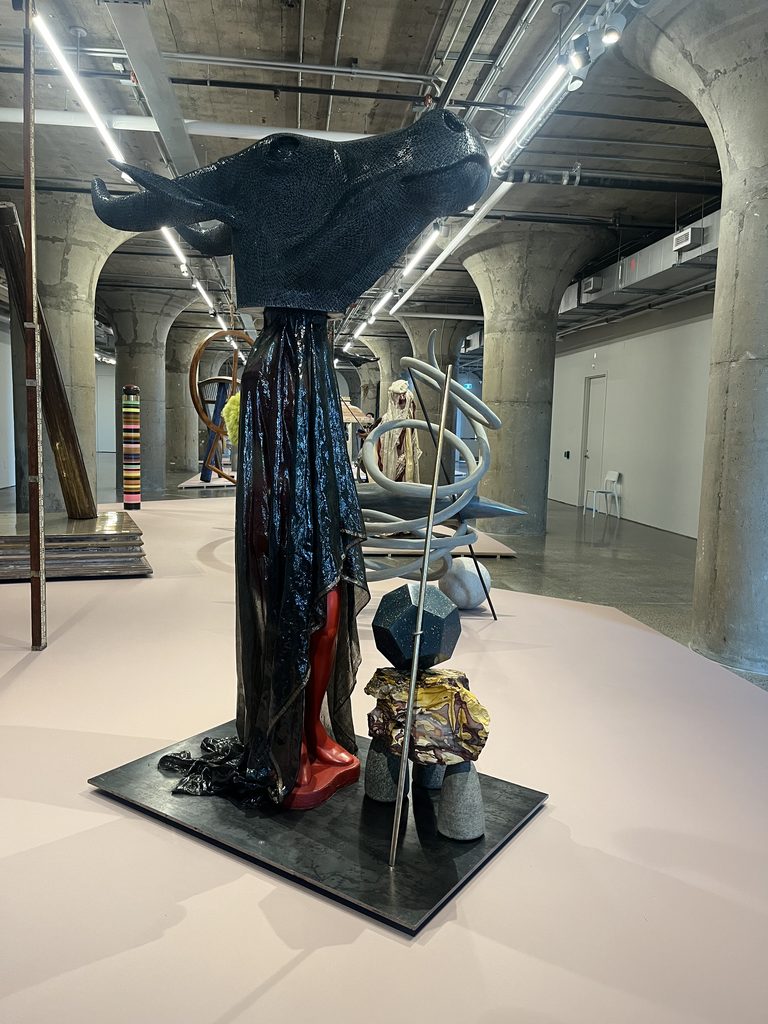
A lot of Bharti Kher’s work resonated with me as we are both interested in similar topics when it comes to art: how the female body is represented and what it means personally, and the inclusion of mythological or folklore elements. A piece of hers that particularly stood out to me was The Prophet, which depicts a female body draped in sashes and fabric with a bull-like head. At the feet of the humanoid figure is a pile of organic and non-organic rocks supporting a staff.
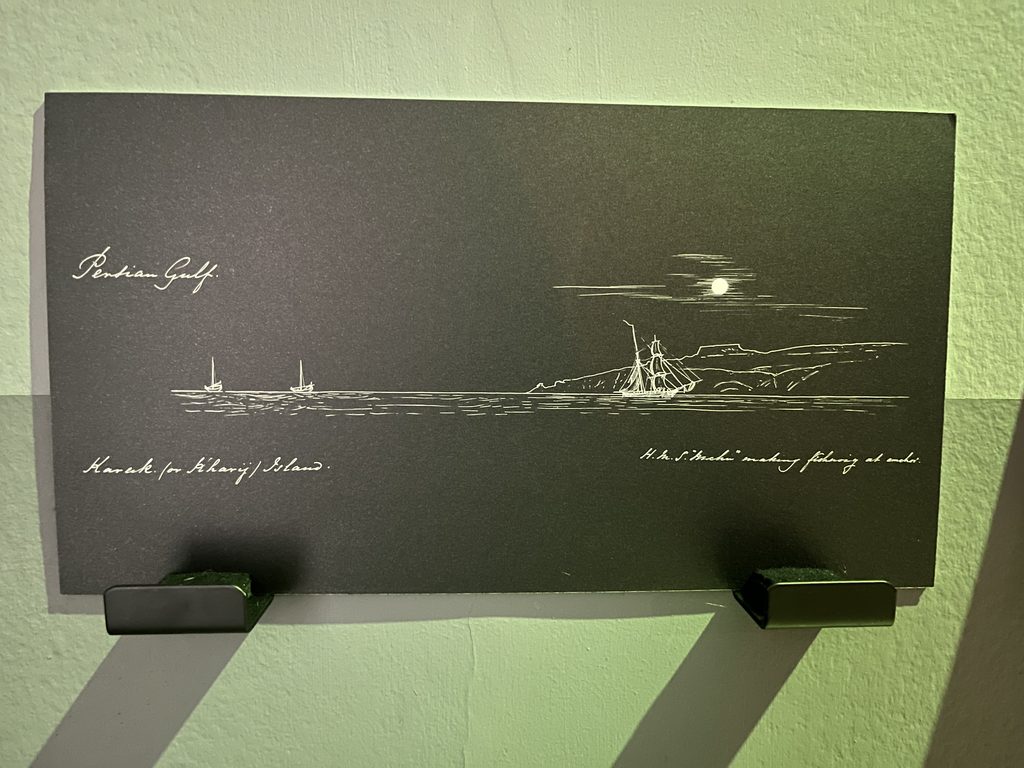
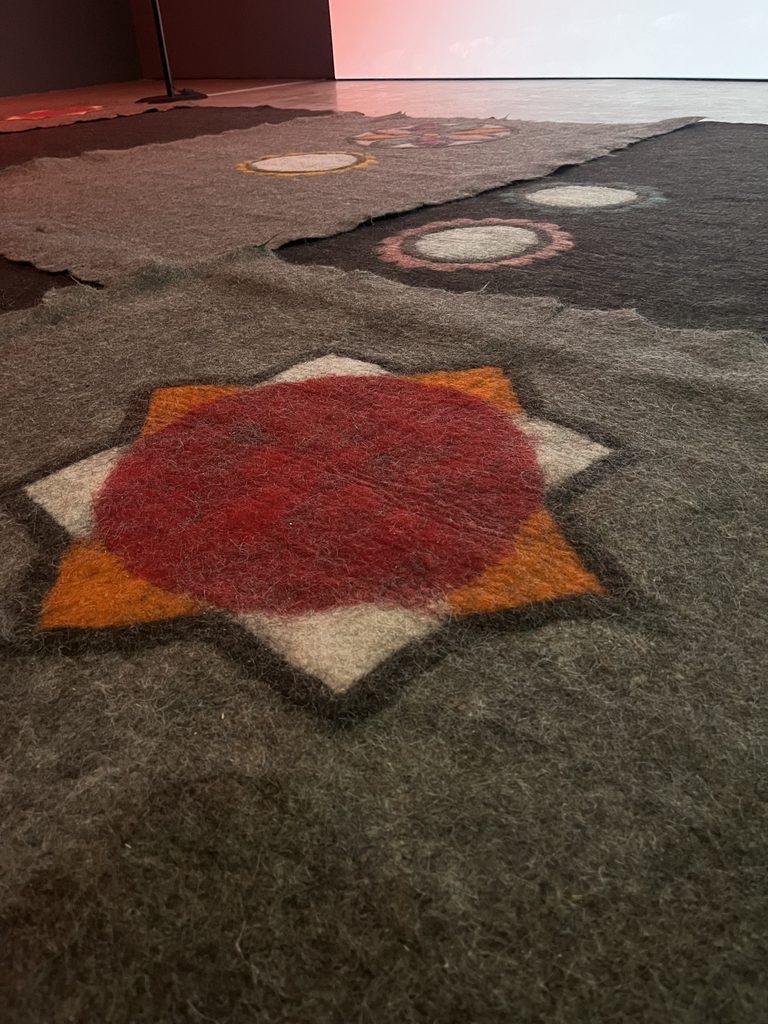
When at the Mercer Union gallery we watched the short film art project Of Wool and Diesel by Rouzbeh Akhbari which was about the waterway from the Persian Gulf to the Indian Ocean and the people and animals who ‘slip through it daily’. I particularly liked the first act where they had an audio recording of a letter that was written by the wife of an Iranian sailor. I think storytelling is such a crucial part of art that can sometimes be forgotten for sake of clean aesthetics. I really liked that they had an interactive element being the wool carpet to sit on while watching the film, it really tied together the importance of sheep trade and crossings as the fibers dug through my pants and pricked at my skin.
What did you notice, learn, or take away from the experience of the works in the gallery?
For both art pieces, I really enjoyed being able to see the beliefs and materials of other cultures present in their artwork. It’s becoming more available to experience the art of other cultures but not to the extent that I would like yet. Especially after being in a few art history courses and focusing topics that have been widely Westernized it’s refreshing to learn about the other places around the world and how they operate through art.
How does Oliveros’s idea of deep listening challenge (listening without hearing) the way you typically give attention?
It causes me to not only focus on the little details but also to consider and reflect on what I am not immediately noticing; the vibrations of the bass along with the music, the attention of the person performing and what they notice or feel. How does the room and space the audio is occupying react to it, is there echoes, does it echo in some spots and fall flat in others?
In what ways might listening through your whole body, or approaching sound as a form of play and research, change your understanding of connection, communication, or creativity?
It makes me consider other perspectives, sound is something that is near-universally experienced. There’s a saying that goes, “a picture is worth a thousand words” and in a way, I think that applies to sound as well. Everyone has experienced sounds of traffic, animals, general chattering, every sound is just a slight variation of each other depending on where you’re from: rural area = not as much traffic as a city, a region that doesn’t speak English = the general chatter will sound different, animal noises will be different yet specific to the regions they come from. I think sound can be a very powerful tool to form connections that by-pass barriers, and mixed with research, it provides us a way to communicate with our non-human beings as well.
Leave a Reply
You must be logged in to post a comment.